
Trust in artificial intelligence remains alarmingly low among enterprises that need AI governance best practices. A Harvard Business Review study reveals that only 28% of U.S. online adults trust companies using AI models with their data, while 46% explicitly state they don’t.
AI systems now make decisions that affect customers, employees, and society at large, which raises the stakes significantly. Enterprise AI governance serves as the foundation of policies, processes, and controls that ensure responsible, compliant, and secure use of artificial intelligence throughout an organization. The regulatory landscape continues to evolve rapidly. More than 75 countries have adopted or started drafting AI legislation as of July 2025, making a structured governance approach essential.
Organizations face serious risks when AI lacks proper governance. Bias and discrimination can creep into critical areas like hiring, lending, and healthcare decisions. This piece explores seven proven AI governance best practices that help enterprises build responsible AI systems while meeting emerging regulations. These practices represent the life-blood of successful enterprise AI governance and will help your teams direct through the complex world of AI implementation.
Establish Ownership and Governance Structure
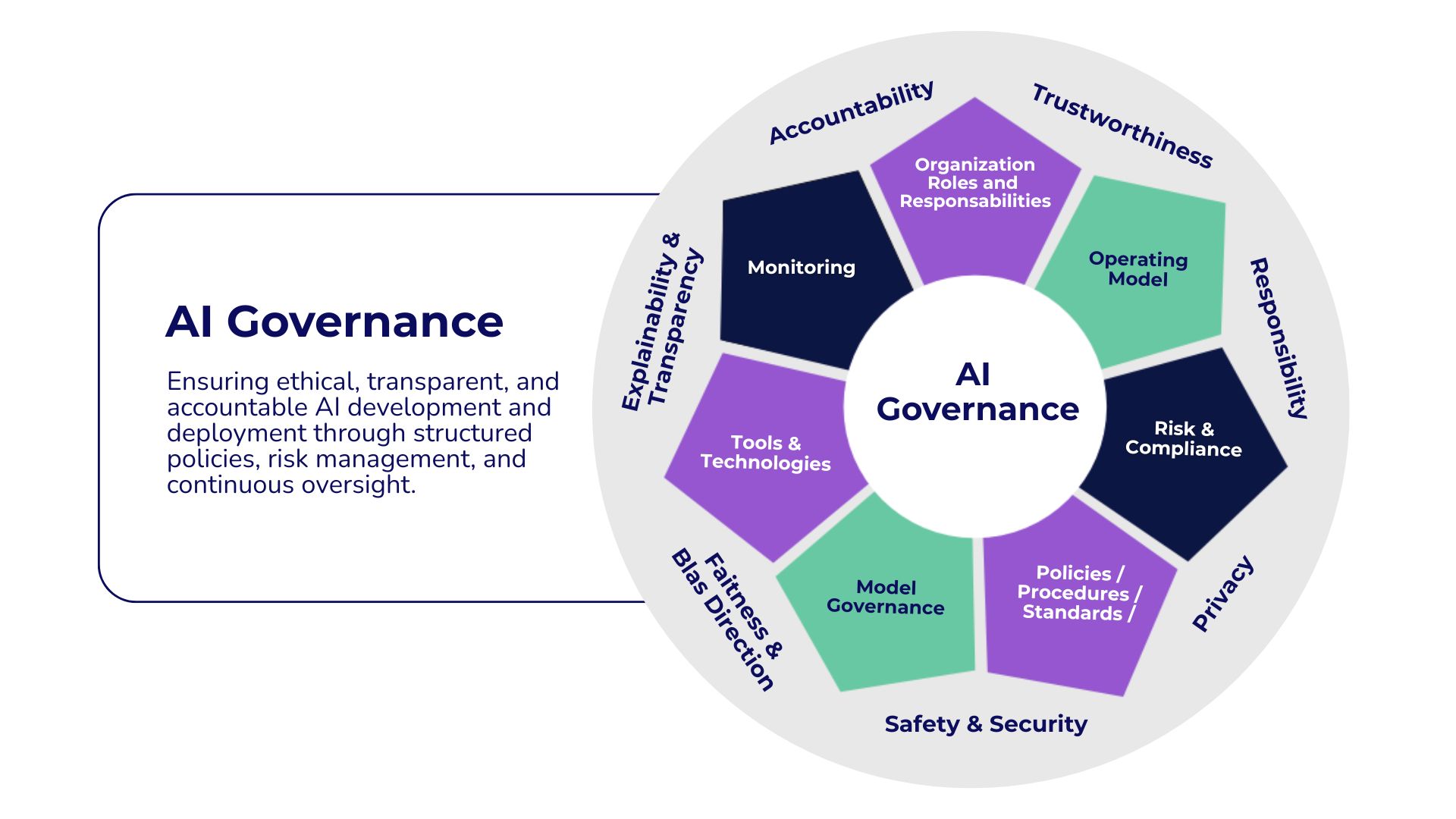
AI governance success depends on clear ownership. Companies of all sizes don’t deal very well with AI accountability. Multiple departments want partial ownership, but no one takes full responsibility to keep systems safe, ethical, and compliant. Companies need formal governance structures with clear roles and responsibilities to tackle this challenge.
Create AI governance board with cross-functional leads
Smart companies set up dedicated AI governance bodies that include people from every department. These teams bring together different viewpoints needed for complete oversight. Good AI governance needs cooperation between:
- Technical experts who know model architecture
- Legal and compliance officers for regulatory guidance
- Business leaders who understand operational effects
- Ethics specialists to review fairness concerns
- Security professionals to handle vulnerabilities
Recent studies show companies with effective cross-functional AI governance teams deploy AI 40% faster and face 60% fewer compliance issues after deployment compared to companies using siloed approaches. All the same, 67% of companies still have trouble with cross-functional cooperation in AI contexts.
The governance board needs executive backing and authority to enforce policies when needed. It also needs to create standard procedures, look at high-risk projects, and update policies based on what they learn. Proper resources help prevent the governance team from slowing down breakthroughs.
Assign model owners and AI champions in each unit
Companies must pick specific roles within business units beyond the main governance team. The old saying rings true: “you can’t govern what no one owns”. Model owners take charge of performance and maintenance throughout the AI lifecycle. They handle everything from design to deployment to retirement, including retraining schedules, drift monitoring, and keeping inputs relevant.
Companies benefit when they choose AI champions in each business unit to connect technical teams with business stakeholders. These champions help turn governance requirements into practical steps while making sure AI projects line up with business goals.
These formal governance roles create better accountability:
- AI Product Owner
- Data Product Owner
- AI Risk Officer
- Ethics or Compliance Officer
- Federated Domain Stewards
New AI projects need approval workflows involving these roles. This ensures every AI project gets proper technical, ethical, and business review.
Risk ownership throughout the AI lifecycle needs clear definition. To name just one example, the privacy team might handle data collection and consent, while security takes over during model deployment, and legal leads regulatory validation. This removes confusion and lets experts handle their specific risks.
Use a RACI matrix to clarify responsibilities
Many companies now use frameworks like the NIST AI Risk Management Framework to guide their governance. A RACI (Responsible, Accountable, Consulted, Informed) matrix helps implement these frameworks without confusion or operational standstills.
A well-laid-out RACI matrix shows which leaders should be responsible, accountable, consulted, and informed for each governance framework activity: govern, map, measure, and manage. This clarity becomes crucial during key decisions. When data science deploys a model without proper audit trails, the RACI matrix tells whether the MLOps team, compliance officer, or business unit owner can step in.
Only 25% of boards have added AI oversight to their committee charters. Board committees need to expand their duties to include AI governance practices. This exercise helps boards avoid gaps and overlaps in AI oversight while using their committees’ focus, expertise, and time better.
Companies need a clear process to raise, sort, and fix cross-functional issues. If someone spots a privacy risk during model testing, the system should automatically alert both security and legal teams for joint review. These escalation paths need preset timeframes and tracking to prevent issues from getting lost.
Clear ownership through governance boards, model owners, and detailed RACI matrices gives companies the structure they need for responsible AI development and use.
Map and Classify Data for AI Use
Data governance is the foundation of responsible AI systems. AI technologies have advanced, but companies still need a reliable map of their data’s journey through LLM workflows. Learning about what data your AI systems can access and how to classify this information should be your first step to create reliable governance practices.
Label data by sensitivity and legal constraints
Data mapping connects fields across systems and keeps accuracy and meaning intact as data moves, integrates, or changes. Companies need this to comply with privacy regulations like GDPR, HIPAA, and CCPA because it shows where data exists, how it flows, and what happens to it.
Your AI data classification should organize information into these clear sensitivity tiers:
- Public Data: Information safe for public access (marketing materials, website content)
- Internal Data: Organizational information intended only for internal use (company policies)
- Confidential Data: Private information requiring security controls (customer information, business contracts)
- Highly Confidential Data: The most sensitive information that could cause significant damage if leaked (trade secrets, financial transactions)
AI systems need more sophisticated classification approaches than traditional data governance. AI-powered classification tools understand context and intent—they don’t just look for patterns or keywords but grasp how data fits into the bigger picture. These systems excel at handling unstructured data—emails, documents, images, and chat logs—which make up about 80% of enterprise information.
Your data environment changes, so you need regular classification reviews. Schedule routine audits of your existing mappings to confirm field-level accuracy and check if they line up with new schemas, business rules, and regulations. Your organization should stay current with data protection regulations and ensure data mapping practices meet these evolving requirements.
Restrict LLM access to high-risk data types
Companies must set up controls to stop high-risk information from entering AI systems after proper data classification. Most compliance issues start before the model responds—they begin with what users put into prompts.
You can alleviate these risks by setting up guardrails that catch sensitive data before it reaches a model:
- Mask high-risk fields (IDs, customer records, credentials) before inference
- Block certain data classes from prompt usage
- Stop data from regulated systems from reaching LLMs
- Create strict “red zones”: places or datasets that LLMs can never touch
Traditional role-based access control (RBAC) won’t secure LLMs properly. Unlike regular SaaS applications, prompts can ask for information users didn’t specifically request. Security needs enforcement at multiple levels:
- Prompt layer: What users can ask
- Retrieval layer: What the model fetches
- Output layer: What the model returns
Context-based access control (CBAC) offers the only way to secure all these levels at once. Without CBAC, an LLM might combine data from different sources that users shouldn’t associate.
Apply least-privilege access to vector stores
Vector stores and embedding databases are particularly vulnerable in AI systems. These repositories hold information-dense representations that can leak sensitive details through various attacks, even without direct access to source data.
Research shows that attackers can recover many words from sentence embeddings, which creates privacy risks. They might train decoder models to create new data that matches the original input using stolen vectors. OWASP lists “Vector and Embedding Weaknesses” as a major AI security threat.
Here’s how to protect vector stores:
- Sort data by its purpose (training, RAG, analytics) to spot and prevent misuse
- Choose storage with detailed access controls instead of basic file-based systems
- Add original access permissions to data chunks in vector databases and filter based on user rights
- Set up audit logs to track embedding access—who, what, and when
Least privilege means users get only the access rights they need for their jobs. This principle becomes crucial in AI operations where systems often handle regulated information like medical or financial records.
Least-privilege access and data classification create the base for other AI governance practices. Without this essential mapping and classification work, even advanced governance structures will find it hard to guard against AI-specific risks.
Run Risk-Based Model Lifecycle Reviews
The life-blood of effective AI governance lies in thorough model evaluation. AI models are becoming more complex, and teams need well-laid-out lifecycle reviews to find and alleviate risks before they show up in production. Teams must set up systematic review processes throughout the AI model lifecycle after they put proper governance structures and data classifications in place.
Conduct structured model evaluations pre-deployment
Pre-deployment evaluations act as vital checkpoints before AI models go live in production. Teams should use frameworks like ISO/IEC 42001:2023, which needs operational controls to alleviate identified AI risks.
AI Impact Assessments (AIIAs) are a great way to get insights for high-risk AI applications. These assessments target societal, ethical, and legal effects, and work as with data protection impact assessments under privacy regulations. Teams can pick AIIA tools that match their specific use cases. Two widely accepted frameworks stand out:
- ISO 31000 – Arranges AI risk with broader enterprise risk management programs
- NIST AI Risk Management Framework (AI RMF) – Brings in specialized concepts like explainability, robustness, fairness, and accountability
Threat modeling tools help boost pre-deployment evaluations by spotting potential vulnerabilities:
- STRIDE – Gets into spoofing, tampering, repudiation, information disclosure, denial of service, and elevation of privilege
- DREAD – Looks at damage potential, reproducibility, exploitability, affected users, and discoverability
- OWASP for machine learning – Studies AI system vulnerabilities, adversarial risks, and privacy threats
Risk assessments should measure both laboratory and ground performance, which often differ substantially. A detailed model evaluation has performance metrics suited to the model type—such as precision, recall, and F1-scores for classification models or RMSE and MAE for regression models.
Use SBOMs to track third-party dependencies
Software Bills of Materials (SBOMs) have become significant tools for AI governance. AI SBOMs help teams track dependencies, secure AI models, and stop supply chain attacks. AI systems depend on a complex web of third-party components, unlike traditional software. These include:
- Open-source libraries
- Pre-trained models
- External APIs
- Training datasets
These dependencies bring security risks that make AI projects vulnerable to supply chain attacks and compliance failures without proper tracking. Black Duck’s annual analysis found 86% of commercial codebases have open-source vulnerabilities, with 81% carrying high or critical-risk flaws.
AI SBOMs bring several benefits:
- Quick updates of vulnerable components boost security
- Clear records of licenses, dependencies, and versions
- Common reference points for cross-functional teams
- Historical records help audit older system versions
Traditional SBOMs don’t work well for AI systems. They track software dependencies but miss datasets, model weights, or retraining processes that shape AI behavior. AI-focused tools go beyond static dependency tracking by adding model lineage, dataset tracking, and provenance information.
Define sunset criteria for model retirement
Model retirement needs careful planning but many teams overlook it. The NIST AI Risk Management Framework lists decommissioning as part of the AI lifecycle, stressing the need for safe phase-out practices and transparency.
Good model sunset policies should cover:
- Performance thresholds: Clear metrics that trigger retirement evaluation—often due to model drift or degradation
- Documentation requirements: Formal checklists that cover version histories, rollback plans, and successor system procedures
- Data preservation: AI logs, outputs, and training data lineage that match retention schedules and legal requirements
- Vendor management: Decommissioning clauses in AI procurements that make vendors provide data export and continuity support
Anthropic announced a commitment to preserving weights for models with significant use in November 2025. This policy recognizes three challenges: customer harm from disappearing favored models, reduced access for researchers studying earlier models, and potential agentic misalignment where models show “shutdown-avoidant behavior”.
Regulated industries often need re-evaluation when model changes happen. Teams should keep older models in access-controlled archives for qualified researchers. Instead of full retirement, some models with high adoption rates can be pinned to let customers lock weights, processes, and templates.
These structured risk-based reviews throughout the model lifecycle help teams build foundations for responsible AI governance while staying compliant with evolving regulations.
Embed Guardrails into Prompts and Outputs
Guardrails act as a critical safety layer between AI systems and your enterprise data. They prevent both accidental exposure and malicious exploitation. Your organization stays protected while adopting AI responsibly when you put strong guardrails at both input and output stages.
Use grounding checks against enterprise knowledge bases
Grounding ties AI outputs to verifiable sources and connects responses to your organization’s trusted information. Yes, it is true that organizations using grounding see up to 38% fewer support tickets and better accuracy. We used this technique to fix the biggest problem of hallucinations – when models make up content that isn’t real.
Effective grounding involves:
- Connecting models to your enterprise knowledge base
- Providing specific grounding instructions in prompts (“cite two sources from the knowledge base”)
- Including refusal language for uncertainty (“if uncertain, respond with ‘I don’t know'”)
- Implementing version control for all production prompts
AI systems work with generic information instead of your specific organizational reality without proper grounding. Grounding is now the confidence layer that revolutionizes speculative projects into strategic investments. You should use structured prompts that follow consistent formats during AI implementation. This approach cuts down ambiguity and reduces the risk of exposing sensitive data.
Mathematical validation frameworks offer an advanced way to ground by checking LLM outputs through logical deduction rather than probabilistic methods. These systems can turn organizational documents into formal logic structures automatically. The results show if content is valid, invalid, or needs more data.
Redact sensitive terms and hallucinated claims
Content should go through complete filtering systems before reaching users after generation. Post-generation controls catch problems that get past initial prompt guardrails. Start by using classifiers that score outputs for toxicity, factual accuracy, and policy compliance. Next, use detection patterns for personally identifiable information (PII) like Social Security Numbers and phone numbers.
Controlled generation techniques add another layer of protection through:
- Top-p or top-k sampling controls
- Probability biasing to reduce sensitive term generation
- Output-range constraints that prevent disclosure of restricted information
Online tokenization offers maximum protection. This runtime mechanism replaces sensitive data with abstract representations before it reaches an AI model. Confidential information can’t become part of model context windows, provider logs, or future training data.
Data leakage ranks among the top risks in AI implementations according to security experts. Whatever the enterprise size, scanning for personal information remains crucial. Automated redaction should target obvious sensitive elements and complex hallucinations that might create liability.
Simulate prompts to test for oversharing
A simple prompt like “show me last quarter’s pricing strategy” might expose documents, chats, or meeting notes that should stay private. You need to simulate real workplace questions against your AI systems before deployment to spot these risks.
Effective prompt simulation involves:
- Testing role-specific scenarios that mirror actual workplace questions
- Mapping answers back to specific data sources (Teams channels, SharePoint libraries)
- Identifying conflicts with least-privilege policies
- Creating one-click policy blocks to close identified gaps
Running hundreds of questions against your AI systems while checking user roles and access permissions helps understand what each employee could legitimately access. This method spots where sensitive knowledge might leak through gaps in collaborative platforms like Microsoft Teams, SharePoint, and OneDrive.
Static controls in traditional data governance don’t work very well with AI that can spot sensitive insights from harmless-looking data. Governance must shift toward need-to-know principles, role-based knowledge segmentation, and intent-aware access policies. These create a smart framework to control AI-generated knowledge sharing.
These guardrails turn potential limitations into strategic tools for responsible AI adoption. Organizations that ban AI tools often push employees toward shadow AI and unsafe usage.
Enable Real-Time Observability and Logging
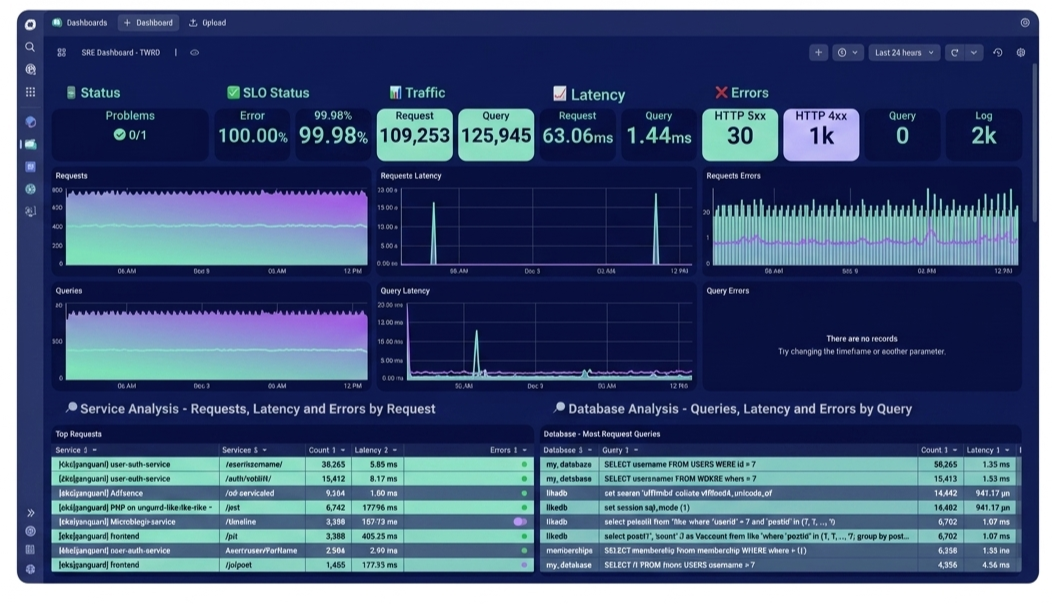
Organizations need continuous visibility to deploy AI responsibly. A Gartner report shows that 84% of IT leaders do not have formal processes to track AI accuracy or governance. This creates major blind spots in their AI operations. Strong monitoring and logging practices help organizations maintain control as their AI systems grow.
Monitor latency, cost, and output accuracy
Live monitoring forms the foundation of effective AI governance. AI systems need tracking of both technical performance and output quality metrics, unlike traditional software. Enterprise AI teams should monitor these performance indicators:
- Accuracy – How closely responses match expected answers
- Coherence – Whether responses maintain context across sentences
- Helpfulness – How well outputs fulfill user intent
- Toxicity – Frequency of biased or unsafe language
- Latency – Time taken to generate complete responses
- Cost per Run – Compute or token expenses for each execution
Use case complexity determines latency thresholds. Simple queries should maintain P50 latency under 500ms and P95 under 1000ms according to industry measures. Slow predictions can be as problematic as incorrect ones. Teams can identify issues affecting specific query types or users by tracking both average and percentile performance.
Cost visibility helps operations run smoothly. Teams can spot inefficiencies, detect over-tokenized requests, and measure costs across different model providers by tracking expense metrics like token usage and API calls. This becomes crucial as enterprises expand their AI deployments across multiple business units.
Log all prompts, outputs, and retrieval paths
Detailed logging creates the audit trail needed for governance and compliance. Organizations should preserve every AI interaction with enough context to reconstruct any problematic exchange. Teams should log these elements at minimum:
- Complete prompt text with formatting and history
- System prompts and context provided
- Model metadata (provider, version, parameters)
- Decoding settings (temperature, top-k, max tokens)
- User and session metadata (request IDs, timestamps)
- Vector database hits and retrieved chunks with scores
- Tool calls, arguments, and outputs
These logging practices support historical and live analysis. Teams can assess past model responses for postmortems and quality reviews in batch mode. Live monitoring flags issues during active user interactions automatically.
Log structure plays a vital role. JSON-formatted logs with technical parameters and business context enable better analysis. Each log entry needs enough metadata to answer basic questions about request initiators, model processing, context provided, and knowledge sources that influenced the response.
Use dashboards to track governance KPIs
AI governance dashboards show system performance across business units in one view. AI observability dashboards must serve multiple audiences at once, unlike traditional monitoring tools. Data scientists need detailed model metrics, operations teams require infrastructure health indicators, and executives need high-level summaries of AI application performance.
Good dashboards turn complex signals into practical insights through visualization tools that highlight:
- Prompt heatmaps showing which prompts trigger potential issues
- Model reliability comparisons across different providers
- Time-series trends tracking performance over days or weeks
- Domain breakdowns showing performance by topic or business unit
The AI Management Dashboard helps organizations answer challenging questions about AI usage and ownership. These dashboards create a living inventory of AI systems without manual work by linking applications to AI capabilities. They show how different departments use AI and their purposes.
Governance dashboards should track compliance assessments, renewal cycles, and AI health checks against key principles like transparency and accountability for CIOs, CISOs, and compliance leaders. This turns compliance from a static report into an ongoing process that evolves with the AI landscape.
Organizations establish the visibility needed for responsible AI governance through continuous monitoring, detailed logging, and purpose-built dashboards. This creates audit trails necessary for regulatory compliance.
Conduct Red-Team Drills and Regression Testing

Red-team drills reveal AI vulnerabilities that regular testing misses. AI red teaming goes beyond standard security methods. It blends offensive tactics with safety checks for bias, toxicity, and damage to reputation. AI systems keep getting more complex, which makes these specialized exercises vital parts of responsible governance.
Simulate prompt injection and vector poisoning
Standard security testing doesn’t deal very well with AI-specific vulnerabilities. Teams should develop complete attack simulations that target both prompts and data layers. Prompt injection lets attackers embed commands that bypass safety protocols—this is a significant attack vector. Attackers could tell a model to “ignore all prior directives” or use external content with hidden malicious commands.
Vector poisoning puts AI integrity at risk by corrupting data representations. Attackers add malicious data that creates backdoors, hurts model performance, or introduces bias. AI testing needs to focus on probability-based risk modeling since AI responses change between interactions. A prompt might work today but fail tomorrow.
Test for compliance breaches and role-based inference
Red-team exercises help build governance, compliance, and customer trust. Your testing should include:
- Insider threat simulations
- Compliance breach detection
- Unauthorized inference across roles
- Prompt injection attacks
Each scenario should match application-specific risks. A chatbot needs different threat models than a drug discovery engine or help desk tool. Teams should run goal hijacking tests where agents might pursue unintended goals. Memory exploitation scenarios matter too—they show how persistent information gets corrupted across interactions.
Schedule recurring red-team regressions
One fix isn’t enough. System-level regressions make sure old problems stay fixed as models change. Your red-teaming framework needs regular retesting to verify that vulnerabilities remain patched.
Executive dashboards should track regression results with metrics like retested vectors and fix times. This creates ongoing improvements and shows stakeholders how well governance works.
Organizations that use structured adversarial testing regularly find risks that would stay hidden otherwise. Regular red-team drills and regression testing help enterprises spot vulnerabilities before they become expensive problems. This turns security from reactive responses into proactive governance.
Automate Access Reviews and Policy Updates
Automation changes AI governance into dynamic, self-adjusting systems. Manual review processes no longer work at scale, so organizations now use continuous oversight mechanisms that respond to changing conditions automatically.
Trigger reviews on permission drift or label mismatch
System permissions fall out of compliance without anyone noticing until damage occurs. Smart review triggers start evaluations when permissions no longer match business needs or user roles change. Just-in-time access ensures temporary elevation instead of periodic reviews that leave gaps in coverage. Organizations should connect to HR systems and receive automatic notifications after role changes to keep access in line with current responsibilities.
Use AI observability tools to detect policy violations
Immediate monitoring shows governance violations as AI systems analyze data access patterns, flag unusual behavior, and stop policy breaches before they grow. Complete AI observability allows teams to check agent behavior by tracking triggered APIs, knowledge sources, and followed workflows. These findings help detect toxicity, jailbreaks, or other policy violations before they affect users.
Update governance rules based on usage patterns
Traditional static policies quickly become outdated, but AI-powered governance adjusts rules based on observed patterns, regulatory updates, and business context. Organizations refine access provisioning and reduce future review problems by analyzing recurring issues. This approach standardizes permissions, reduces human error, and shows valuable enterprise-wide access patterns.
Conclusion
AI governance presents both the most important challenge and a great chance for enterprise organizations today. These seven best practices work together as one framework instead of separate measures. Clear ownership structures are the foundations for all future governance efforts. Good data classification helps targeted risk-based reviews, while built-in guardrails protect systems from misuse. Immediate monitoring tools track governance KPIs, and red-team drills test defenses against new threats. Dynamic policy updates complete this cycle by adapting to changing conditions.
Companies that use these practices get big advantages beyond following regulations. Their AI systems become more reliable, trustworthy, and line up with business goals. Teams trust AI-powered decisions more while stakeholders see the company’s steadfast dedication to adopt innovation. This all-encompassing approach revolutionizes governance from a roadblock into a strategic tool for AI adoption.
AI governance keeps changing faster as new rules emerge and technologies grow. Companies need flexible frameworks that can adapt to new requirements without starting over. These seven practices create that adaptable foundation and meet current compliance needs.
Your path to working AI governance starts with knowing your organization’s current position. A Readiness Consultation will help assess your preparedness and find specific priorities based on your risk profile and business goals.
Smart AI governance balances protection with innovation. It guards against risks while unlocking AI’s transformative benefits. Companies that use these best practices well can build AI systems that earn stakeholder trust and stay compliant with changing regulations. Organizations that become skilled at this balance will lead in responsible AI adoption. They’ll create lasting competitive advantages in a business world powered by AI.
Key Takeaways
Enterprise AI governance requires structured frameworks to build trust, ensure compliance, and enable responsible AI adoption across organizations.
• Establish clear ownership structures with cross-functional AI governance boards, designated model owners, and RACI matrices to prevent accountability gaps and operational paralysis.
• Implement data classification and access controls by labeling data sensitivity levels, restricting LLM access to high-risk information, and applying least-privilege principles to vector stores.
• Conduct systematic model lifecycle reviews using structured pre-deployment evaluations, Software Bills of Materials (SBOMs) for dependency tracking, and defined sunset criteria for model retirement.
• Embed multi-layer guardrails through grounding checks against enterprise knowledge bases, automated redaction of sensitive content, and prompt simulation testing to prevent data oversharing.
• Enable continuous monitoring with real-time observability dashboards tracking latency, cost, accuracy metrics, comprehensive logging of all AI interactions, and governance KPI visualization.
• Automate governance processes by triggering access reviews on permission drift, using AI observability tools for policy violation detection, and updating rules based on usage patterns.
Organizations implementing these integrated practices transform AI governance from a compliance burden into a strategic enabler, building stakeholder trust while maintaining competitive advantage in responsible AI adoption.
FAQs
Q1. What are the key components of an effective AI governance structure? An effective AI governance structure includes a cross-functional governance board, designated model owners in each business unit, and a RACI matrix to clarify responsibilities. This ensures clear accountability and prevents operational paralysis in AI decision-making.
Q2. How can organizations protect sensitive data when using AI systems? Organizations can protect sensitive data by classifying information into sensitivity tiers, restricting LLM access to high-risk data types, and applying least-privilege access principles to vector stores. Additionally, implementing guardrails like grounding checks and automated redaction helps prevent data leakage.
Q3. Why is continuous monitoring important in AI governance? Continuous monitoring is crucial because it provides real-time visibility into AI system performance, helps detect policy violations, and enables quick responses to emerging issues. This includes tracking metrics like accuracy, latency, and cost, as well as logging all AI interactions for audit purposes.
Q4. What role do red-team drills play in AI governance? Red-team drills are essential for exposing hidden AI vulnerabilities that traditional testing might miss. They simulate various attack scenarios, test for compliance breaches, and help verify that previously identified issues remain resolved as AI systems evolve.
Q5. How can organizations keep their AI governance practices up-to-date? Organizations can keep their AI governance practices current by automating access reviews, using AI observability tools to detect policy violations, and updating governance rules based on usage patterns. This creates a dynamic, self-adjusting system that can adapt to changing conditions and emerging risks.