Line of Sight for AI Governance and AI Risk Management
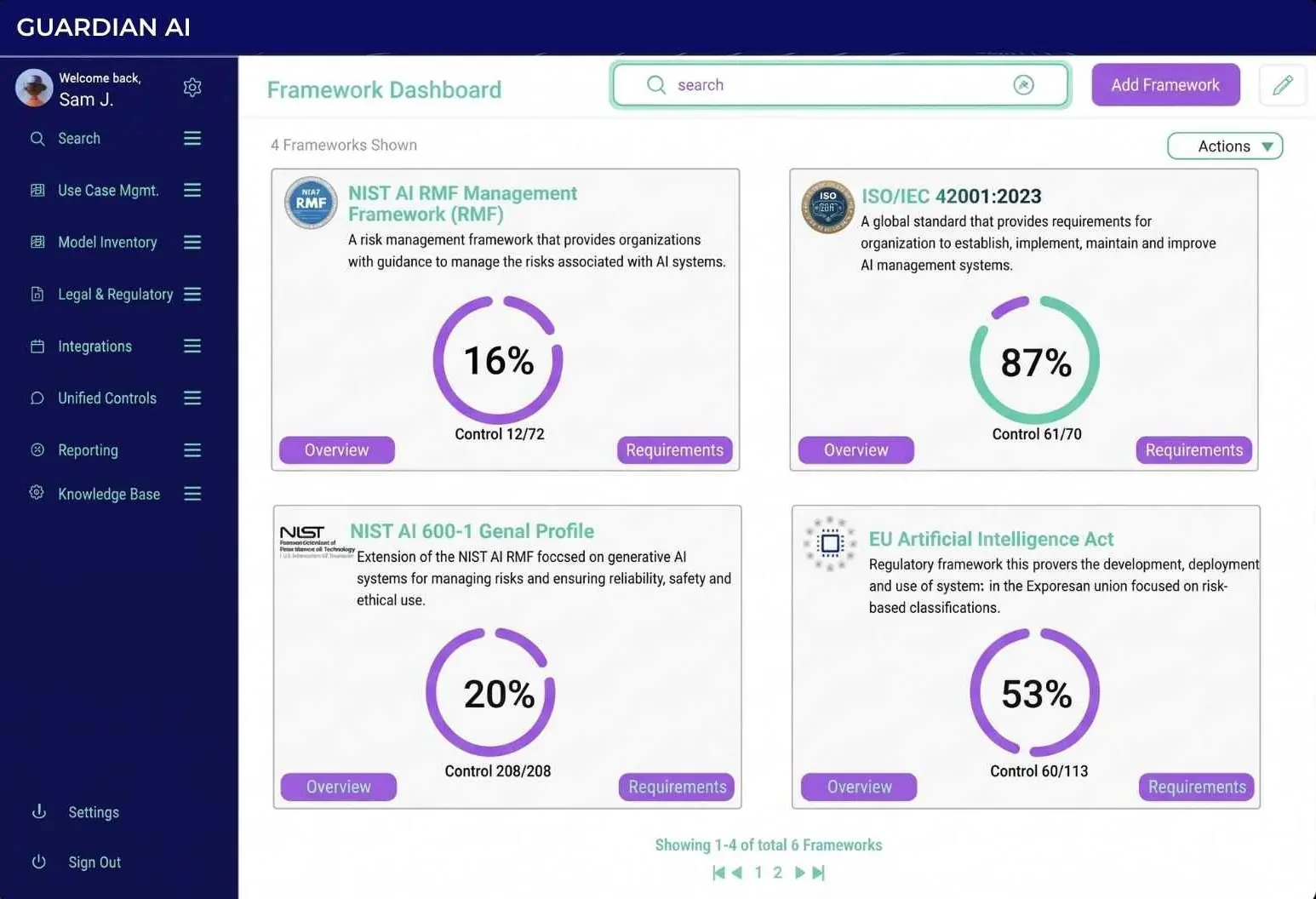
AI governance fails at the inventory. Organizations discover generative features embedded in procured tools that nobody catalogued, models retrained without a record, and use cases approved by someone who has since left. AI Guardian is Elevate’s platform for AI model use case management and model inventory, aligned to ISO/IEC 42001, the NIST AI Risk Management Framework and the NIST Generative AI Profile. It gives the register, the classification and the workflow a system rather than a spreadsheet, and Elevate’s advisory work supplies the governance decisions the register records.
PRODUCTS · AI GUARDIAN
Where the platform fits
The register is the artifact regulators and buyers ask for first
Every AI governance obligation starts with knowing what AI the organization runs. The EU AI Act classification, an ISO 42001 scope statement, a NIST AI RMF Map function and an enterprise security questionnaire all draw on the same inventory. Maintaining it in a document guarantees it ages.
Platform and advisory do different jobs
AI Guardian holds the register, the classification, the assessments and the workflow. Elevate’s advisory work decides what belongs in it: which use cases are in scope, how they classify, what controls apply and what evidence proves they operate. A platform records governance decisions; it does not make them.

Certification still runs through an accredited body
ISO/IEC 42006:
2025 governs the bodies that certify AI management systems. A platform supports readiness and evidence; the certificate comes from an accredited certification body, and verifying that accreditation is part of the readiness work.
WHY GOVERNANCE NEEDS A SYSTEM
Spreadsheets do not survive change
AI models improve operational efficiency, decision-making and innovation. Without governance they create bias, privacy exposure and regulatory non-compliance, and the common failure is not a missing policy but a register that stopped matching reality.
The recurring problems are specific: tracking the lifecycle of models through retraining and decommissioning, managing use cases with different compliance obligations, keeping pace with frameworks that change on their own schedule, and handling ethical concerns in a way that produces a record.
WHAT THE PLATFORM DOES
Three Capability Areas
AI Guardian holds the register, the classification, the assessments and the workflow. Elevate’s advisory work decides what belongs in it: which use cases are in scope, how they classify, what controls apply and what evidence proves they operate. A platform records governance decisions; it does not make them.
Centralized repository
USE CASE MANAGEMENT
Store and track AI use cases across the organization, giving a single source of truth for all deployments rather than a version per department.
Aligned to NIST AI RMF
RISK CATEGORIZATION
Classify use cases by risk level, low, moderate or high, against NIST AI RMF risk categories, so the classification is defensible rather than assigned by feel.
Impact assessments
RECORDED AGAINST THE USE CASE
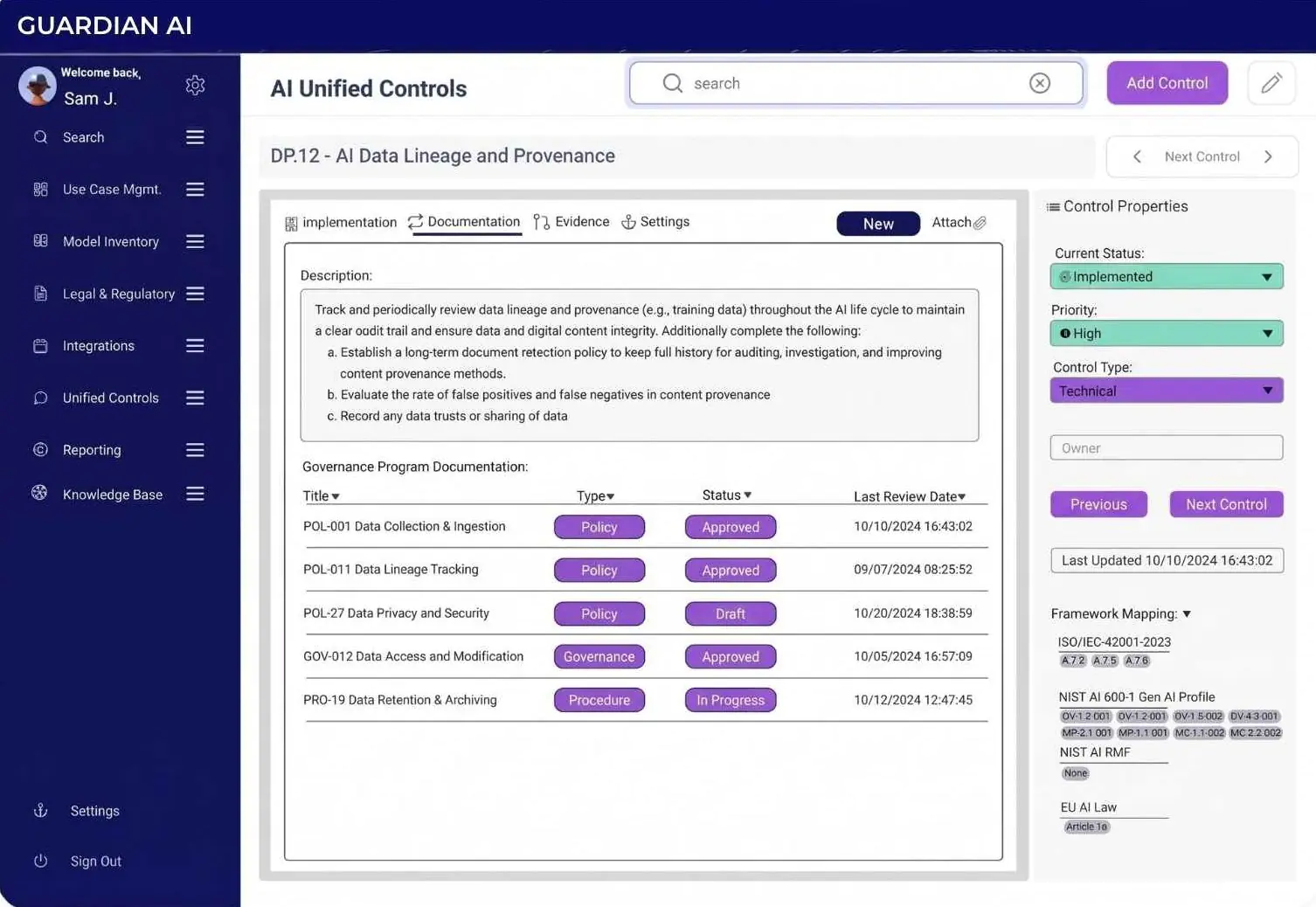
Perform risk and model impact assessments and record them in the platform against the use case, surfacing which models need additional security or data protection attention.
Workflow integration
APPROVALS AND DOCUMENTATION
Built-in workflows for approval and documentation, tailored to AI model use cases, so a new deployment cannot enter production without a record of who approved it.
Dynamic model inventory
PURPOSE, VERSIONING, DATASETS
An up-to-date inventory covering model purpose, versioning, training datasets and performance metrics.
Compliance tags and version control
TRACEABILITY ACROSS THE LIFECYCLE
Tags aligned to ISO 42001, NIST AI RMF and other frameworks, with tracking of updates, retraining and decommissioning so the lifecycle stays transparent.
PLATFORM PLUS ADVISORY
How Elevate delivers it
Elevate’s consulting supports the organization across the AI lifecycle: gap analyses, control evaluation and assessment of AI-related processes. With AI Guardian as the underlying register, that work produces a maintained position rather than a point-in-time report.
ISO/IEC 42001
Guidelines for AI system lifecycle management, including governance structures, risk assessments and incident response planning, with the register supporting the AI inventory an AIMS scope depends on.
NIST AI Risk Management Framework
The four core functions, Govern, Map, Measure and Manage, with the Map function supported directly by the inventory and the classification work.
NIST Generative AI Profile
Guidance for the risks specific to generative AI, including hallucination, bias and misuse, applied to the use cases where generative features are in play.
Governance framework development
Clear accountability structures and assigned roles for AI oversight, with governance policies and charters that build responsibility by design into every stage of AI operations.
Gap analysis and control evaluation
Advisory assessment of AI-related processes, with findings recorded against the use cases in the register rather than delivered as a separate report that ages.
Awareness and culture
Visibility into AI and machine learning usage across the organization, which is what turns a governance policy into observed practice.
ENGAGEMENT PHASES
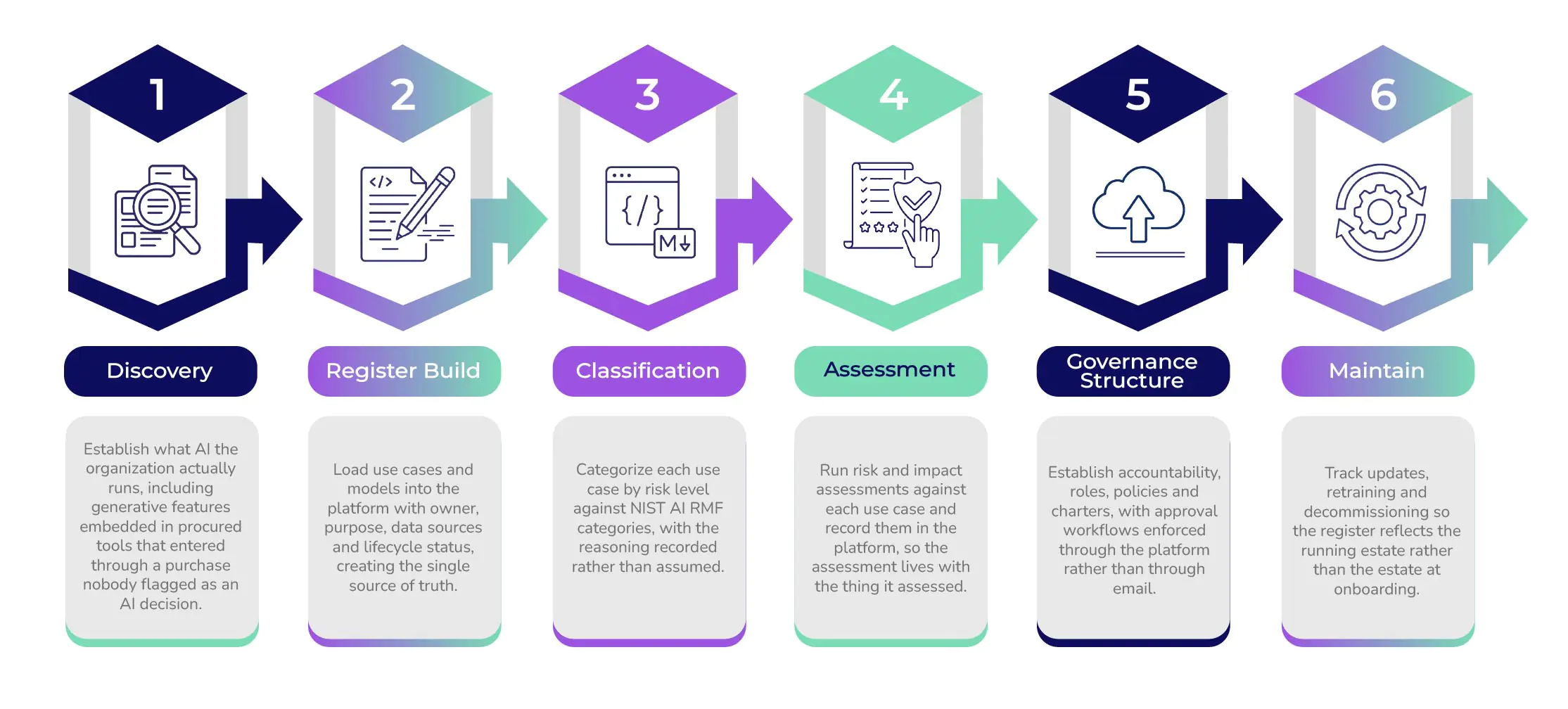
How the Work Runs
PLATFORM PLUS ADVISORY
How Elevate delivers it
Elevate’s consulting supports the organization across the AI lifecycle: gap analyses, control evaluation and assessment of AI-related processes. With AI Guardian as the underlying register, that work produces a maintained position rather than a point-in-time report.
WHO THIS IS FOR
Roles Elevate works with on this Standard
+ Chief Legal and Compliance Officers
+ CISOs and security leads
+ AI and data science leads
+ Risk and GRC officers
+ CTOs and heads of engineering
+ Internal Audit
GET STARTED
Ready to see AI Guardian?
Elevate combines the platform that holds your AI register with the advisory work that makes it defensible, so the answer to what AI do you run and who owns it takes minutes rather than weeks.
FAQ
Common Questions
🡪 Is AI Guardian a platform or a service?
Both, delivered together. AI Guardian is the platform holding the AI use case register, model inventory, classifications, assessments and workflows. Elevate’s advisory work decides what goes in it and what the results mean. The platform records governance decisions; it does not make them, and a register maintained without the governance work behind it is an inventory rather than a programme.
🡪 Which frameworks does it align to?
ISO/IEC 42001, the NIST AI Risk Management Framework and the NIST Generative AI Profile, with compliance tags applied against each so traceability holds across the model lifecycle. Additional framework mappings are available.
🡪 Does the platform produce an ISO 42001 certificate?
No. Certification is issued by an accredited certification body following a two-stage audit. ISO/IEC 42006:2025 governs the accreditation of those bodies. AI Guardian supports readiness by maintaining the inventory, assessments and evidence an AIMS requires, which is the part organizations most often cannot produce on request.
🡪 How does it handle models we bought rather than built?
The same way, and that is usually where the value shows up. Procured AI and generative features embedded in SaaS tools are the category organizations most consistently fail to catalogue, because they arrived through a procurement decision nobody flagged as an AI decision. The register treats built, bought and embedded identically.
🡪 What happens when a model is retrained?
Version control tracks updates, retraining and decommissioning activities against the model record. That history is what makes a claim about model behaviour defensible, because an assessment of a model version that no longer runs is evidence of nothing.
🡪 Can we use the platform without Elevate's advisory work?
The platform can hold a register on its own. Whether that is useful depends on whether the organization already has the governance capability to classify use cases defensibly, run impact assessments and decide what controls apply. Most organizations adopting a register for the first time do not, which is why the two are delivered together.