Companies that handle customer data or process transactions on behalf of their clients often need a SOC report, and many discover they need help getting there. SOC 2 consulting exists to bridge the gap between where an organization’s controls are today and what an auditor will expect, whether the goal is a SOC 1 report focused on financial reporting controls, a SOC 2 report focused on security, or both. Choosing the right consulting firm matters, because the wrong partner can leave a company with a binder of policies that does not survive the audit. This guide explains what a SOC 1 and SOC 2 consulting firm actually does, how to evaluate one, and the red flags worth avoiding before signing. For organizations weighing both reports, Elevate’s SOC 2 consulting support is built around readiness and remediation rather than checklists.
SOC 1 vs SOC 2: A Quick Distinction
The two reports answer different questions, and knowing which you need shapes the engagement. A SOC 1 report addresses controls relevant to a client’s internal control over financial reporting, which matters most when an organization’s services could affect its customers’ financial statements, such as payroll or payment processing. A SOC 2 report addresses controls over security, and optionally availability, processing integrity, confidentiality, and privacy, which matters when customers care how their data is protected. Some organizations need only one, while others, particularly fintech and financial-services providers, need both. A capable consulting partner helps determine the right combination before any work begins.
What a SOC 1 and SOC 2 Consulting Firm Does
A consulting firm handles the preparation that comes before the audit. Understanding the scope of that work helps set the right expectations and budget.
Readiness and Gap Remediation
The core of the engagement is a readiness assessment followed by hands-on remediation. The firm evaluates current controls against the relevant criteria, identifies gaps, and then works to close them. The strongest partners do not stop at a list of findings; they help implement the fixes until the gaps are sufficiently closed to pass the audit.
Scoping and Control Design
Getting the scope right is one of the most consequential parts of any SOC engagement. A consulting firm helps define the system boundary, identify which controls apply, and design controls that are both effective and sustainable. Good scoping prevents the two common failures of including too much, which wastes effort, or too little, which produces an inaccurate report.
Evidence and Continuous Compliance
Because most audit findings come from missing or non-defensible evidence rather than missing controls, a strong partner builds evidence collection into the program and supports it over time. SOC reports are not a one-time event, and a consulting firm that offers ongoing support helps keep controls effective between audit cycles so each renewal is smoother than the last.
How to Choose a SOC 1 and SOC 2 Consulting Partner
The differences between firms become clear once you know what to look for.
Look for Cross-Framework Depth
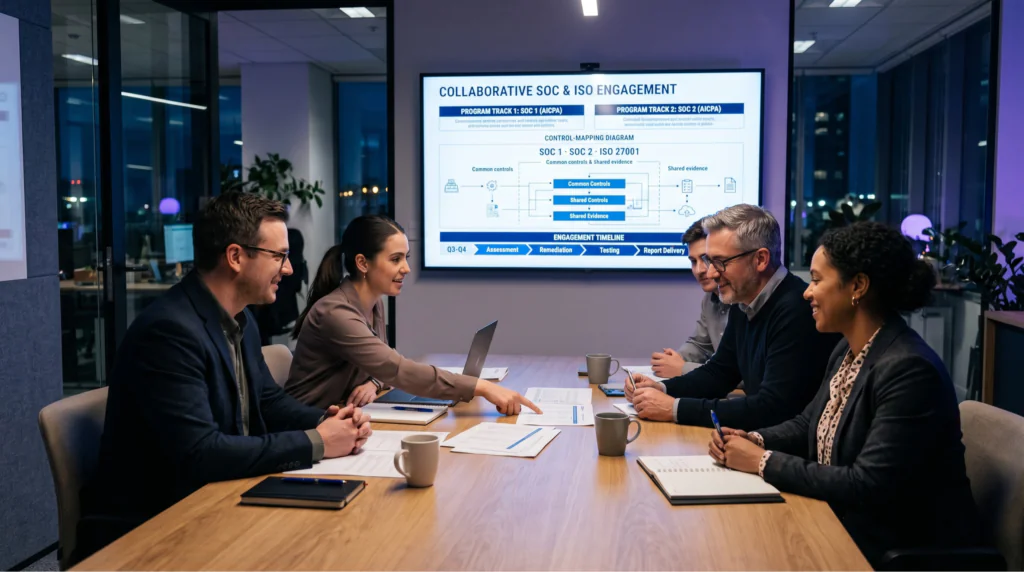
Many organizations pursue SOC alongside other frameworks such as ISO 27001. A firm with cross-framework depth can map controls so evidence is reused across SOC 1, SOC 2, ISO 27001, and others, which reduces duplicate work and cost. If a company expects to add frameworks over time, this experience pays off quickly.
Readiness Plus Remediation, Not Just Advice
Advice alone rarely gets a company audit-ready. Look for a firm that will work side by side through remediation, strengthen documentation, and organize evidence, not one that delivers a report and leaves the hard part to an overstretched internal team. Hands-on execution is what separates a partner from a vendor.
Independence Done Right
A consulting firm cannot issue the SOC report for its own client, because the report must come from an independent licensed CPA firm. The right partner is transparent about this separation, prepares the organization for the CPA firm’s audit, and coordinates cleanly with the auditor. Be cautious of any provider that blurs the line between preparing for an audit and performing it. Book a Readiness Call with Elevate’s SOC specialists to scope a SOC 1, SOC 2, or combined program around where your team is today.
Red Flags to Avoid
A few warning signs reliably predict a difficult engagement. Be wary of a firm that sells a checklist with no remediation support, that cannot clearly explain the difference between readiness and the audit, that promises a full Type II report in an unrealistic timeframe, or that lacks references in your industry. The best partners are direct about what the work requires and honest about what cannot be rushed.
Conclusion
SOC 1 and SOC 2 consulting is about closing the distance between current controls and audit expectations, with a partner that does the hands-on work rather than handing over a list of gaps. Decide which report or combination you need, choose a firm with cross-framework depth and real remediation capability, and make sure it understands that a CPA firm issues the report while the consultant prepares you for it. Book a Readiness Call with Elevate to build a SOC program that holds up under audit and scales as your compliance needs grow.
Key Takeaways
SOC 1 and SOC 2 answer different questions, and the right consulting partner prepares an organization for the audit with hands-on remediation rather than advice alone.
- SOC 1 and SOC 2 serve different needs – SOC 1 addresses controls relevant to clients’ financial reporting, while SOC 2 addresses security and related criteria, and some organizations need both.
- Consulting is the work before the audit – A consulting firm delivers readiness, gap remediation, scoping, and evidence preparation, then coordinates with the CPA firm that performs the audit.
- Cross-framework depth saves money – A partner that maps controls across SOC 1, SOC 2, ISO 27001, and others lets an organization reuse evidence and avoid duplicate work.
- Choose remediation, not just advice – The strongest partners work side by side to close gaps and organize evidence rather than handing over a list of findings.
- Independence is non-negotiable – Only an independent licensed CPA firm can issue the SOC report, so a credible consultant prepares you for the audit and is transparent about that separation.
The organizations that get the most value treat a SOC consulting partner as an execution ally, not a report generator, and choose one that can grow with their compliance program.
FAQs
Q1. What does a SOC 2 consulting firm do? A SOC 2 consulting firm prepares an organization for its SOC audit. That includes scoping the system, assessing controls against the relevant criteria, remediating gaps, organizing evidence, and supporting continuous compliance. The firm does not issue the report itself, since that must come from an independent CPA firm.
Q2. What is the difference between SOC 1 and SOC 2? A SOC 1 report covers controls relevant to a client’s internal control over financial reporting, which matters for services that can affect customers’ financial statements. A SOC 2 report covers controls over security, and optionally availability, processing integrity, confidentiality, and privacy, which matters when customers care how their data is protected.
Q3. Can one firm handle both SOC 1 and SOC 2? Yes. A consulting firm with experience across both can help an organization determine which reports it needs, scope a combined program, and reuse evidence where the underlying controls overlap. This is common for fintech and financial-services providers that need both reports.
Q4. Does a consulting firm issue the SOC report? No. The SOC report must be issued by an independent licensed CPA firm. A consulting firm performs the readiness and remediation work that prepares the organization for the audit and coordinates with the CPA firm, but it cannot attest to its own client’s controls.
Q5. How do I choose a SOC 1 and SOC 2 consulting partner? Look for cross-framework depth, hands-on remediation rather than advice alone, a clear focus on defensible evidence, and transparency about the separation between preparation and the audit. Be cautious of checklist-only services, unrealistic timeline promises, and a lack of references in your industry.