
CYBER SECURITY COMPLIANCE · FedRAMP REV 5
FedRAMP Rev5 Completion and Transition Planning
Finishing Well, Reducing Rework and Meeting the CR26 Deadlines
A Rev5 certification is not a finished state any more. Under CR26 it is a sequence of obligations with dates attached, and the nearest one arrives on 7 December 2026 when the VDR and VER vulnerability rules become mandatory. If your organization already started the Rev5 path, Elevate Consult helps you complete it with stronger evidence, better submission discipline and a practical transition strategy toward a 20x-ready model. If you are starting from zero, Elevate recommends evaluating 20x first.
2026 UPDATE
The obligations a Rev5 provider is now on
7 December 2026: VDR and VER mandatory
Vulnerability detection and response rules apply to all certifications, pulled forward from June 2027 to align with CISA Binding Operational Directive 26-04. Legacy monthly scanning no longer suffices on its own. The grace period ends 7 March 2027 and non-compliant certifications are revoked after it.
11 June 2027: the door closes for new entrants
FedRAMP stops accepting applications for new Rev5 Certifications. Existing certifications remain active until at least 31 December 2028 unless FedRAMP is otherwise directed.
The System Security Plan is now a legacy artifact
Implementation detail belongs in the Security Decision Record. Some agencies, notably within the Department of War, still require an SSP, so it does not disappear from every engagement, but the package structure changed underneath it.
1 January 2027: CR26 mandatory
Current Rev5 certifications must have adopted the rules by this date. The baseline rebuild requirement applies at the first independent assessment after it, which means the next assessment is not a repeat of the last one.
Machine-readable packages are a requirement, not a proposal
Under CR26, Rev5 providers must produce machine-readable certification packages and reduce dependence on static narrative documentation, with JSON schemas replacing the template set. Treat machine-readable readiness as a near-term engineering priority rather than a documentation task.
WHAT FedRAMP REV5 IS NOW
Still active, no longer static
FedRAMP Rev5 is the traditional certification framework most providers already operating in the established model know. It is rooted in the NIST SP 800-53 Rev 5 control structure and has historically depended on extensive documentation, formal assessment activity and ongoing monitoring.
That model remains active and FedRAMP has been explicit that migration to 20x will never be forced. What changed is that Rev5 now carries CR26 obligations of its own, and an end date for new entrants.
NO LONGER A ONE-PATH DECISION
Four things beyond documentation completeness
A strong Rev5 programme is no longer defined by package size. It is defined by whether the package reconciles to the running system, whether evidence holds up across change, and whether the operating model can evolve without being rebuilt.
A package that reconciles
Security Decision Record and attachments
The SDR, attachments and assessment artifacts need to reconcile cleanly and reflect the real system rather than an outdated documentation layer. Drift between architecture and package content is the most common source of submission churn.
Machine-readable readiness
A near-term engineering priority
CR26 requires structured certification data and interoperability, with hard deadlines. This is engineering work rather than documentation work, and scoping it as the latter is why programmes miss it.
Transition awareness
Build for the next phase
Even when completing Rev5, build so the compliance operating model does not have to be redesigned later. Package debt accrued now is paid at transition.
Evidence discipline
Ownership and versioning
An evidence model that reduces version inconsistency, unclear ownership and submission churn. Screenshot-heavy collection does not survive the change velocity of a modern cloud environment.
VDR and VER capability
7 December 2026
Vulnerability detection and response beyond legacy monthly scanning, aligned to the CISA KEV catalog. The nearest deadline and the one most likely to be under-scoped.
Path clarity
Rev5 or 20x, not both
Providers must make a clear type decision and the lanes are not reciprocal. The Program path allows sponsorless certification on both types for Classes A through C.
OUR RECOMMENDATION
Different answers depending on where you are
The right move depends entirely on whether the Rev5 work has already started, and the two answers are genuinely different rather than variations on the same advice.
Rev5 completion support
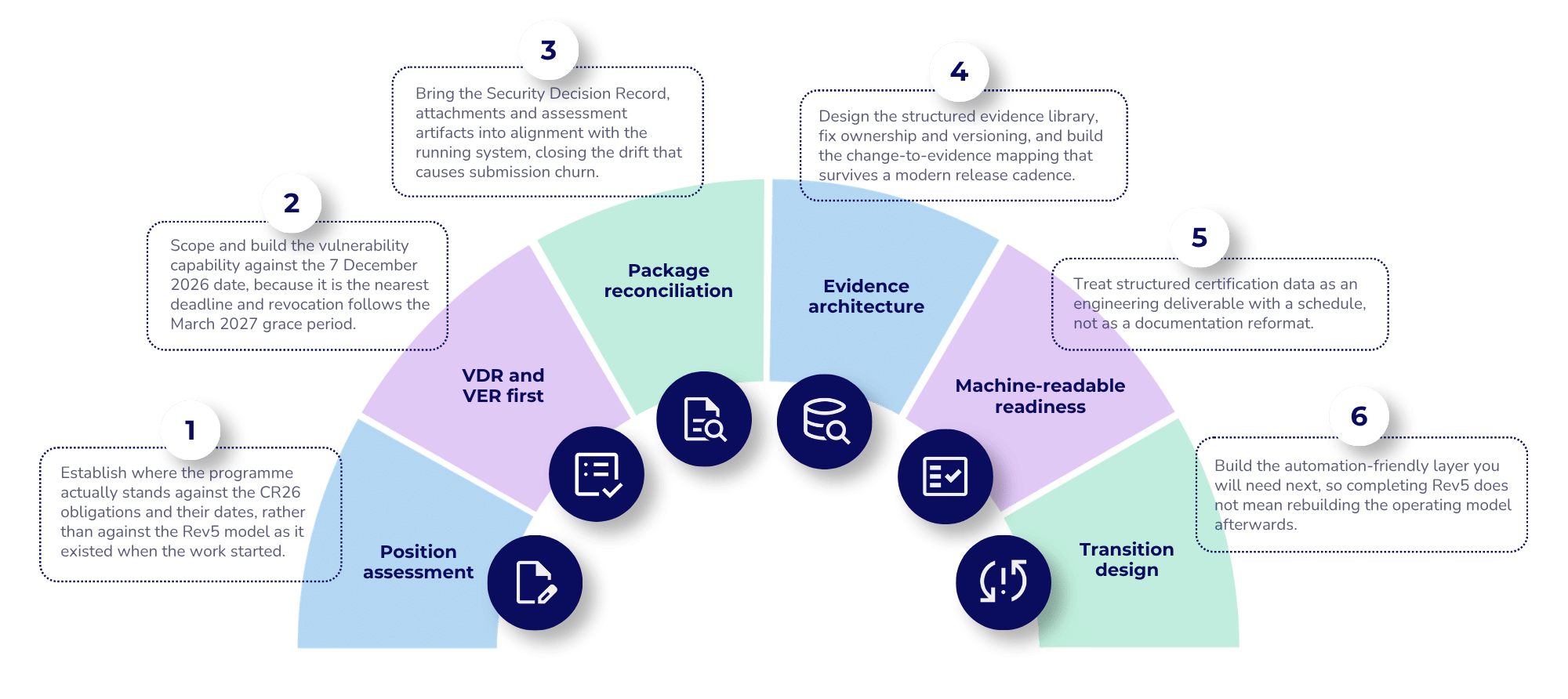
Readiness gap analysis, documentation hardening, control-to-evidence alignment and submission-quality reviews.
Evidence and package modernization
Structured evidence library design, machine-readable readiness planning, package consistency checks and change-to-evidence mapping.
Transition strategy toward 20x
Identify what can remain, identify what must evolve, and design the next operating model without losing current Rev5 progress.
VDR and VER readiness
Build the vulnerability detection and response capability the December 2026 deadline requires, aligned to the CISA KEV catalog, ahead of the March 2027 grace period ending.
Security Decision Record development
SDR and package development under the CR26 structure, with the SSP handled where an agency still requires one.
Independent assessment preparation
Evidence collection and package quality review ahead of engaging a FedRAMP-recognized independent assessor. Elevate prepares; it does not assess.
ENGAGEMENT PHASES
How the work runs
WHO THIS IS FOR
Roles Elevate works with on this standard
GET STARTED
Already started Rev5?
Elevate Consult helps you complete the process, strengthen evidence quality and prepare for transition, with the December 2026 vulnerability deadline scoped first. If you are still deciding which path to start, Elevate can help you assess whether 20x is the better first move.
FAQ
Common Questions
🡪 Is Rev5 still active?
Yes. Rev5 remains active for existing programmes and FedRAMP has said migration to 20x will never be forced. Existing certifications remain active until at least 31 December 2028 unless FedRAMP is otherwise directed. But FedRAMP stops accepting applications for new Rev5 Certifications on 11 June 2027, so the window for new entrants is closing.
🡪 What is the nearest deadline for a Rev5 provider?
7 December 2026, when the VDR and VER vulnerability rules become mandatory for all certifications. The date was pulled forward from June 2027 to align with CISA Binding Operational Directive 26-04. The grace period ends 7 March 2027 and certifications not compliant after it are revoked with public notice.
🡪 Is Rev5 becoming machine-readable too?
Yes. Under CR26, Rev5 providers must produce machine-readable certification packages with structured interoperability, and JSON schemas replaced the template set. This is a requirement rather than a proposal, and it is engineering work rather than a documentation reformat.
🡪 What happened to the System Security Plan?
It became a legacy artifact under CR26. Implementation detail belongs in the Security Decision Record. Some agencies, notably within the Department of War, still require an SSP, so it has not disappeared from every engagement, but the package structure around it changed.
🡪 If we already started Rev5, should we continue?
Usually yes. The practical recommendation is to complete the current process while building the transition layer you will need next, and to do it ahead of the machine-readable package deadlines rather than after them. Throwing away work already done is rarely the right answer.
🡪 Should new entrants start with Rev5?
Not by default. Starting from scratch, the stronger strategic recommendation is to evaluate 20x first and decide whether an automation-first compliance architecture gives the better long-term position. The 11 June 2027 cutoff for new Rev5 applications makes the default weaker still. This is a strategic recommendation grounded in the direction FedRAMP has publicly signalled, not a FedRAMP mandate.