CYBER SECURITY COMPLIANCE · CMMC MOCK ASSESSMENT
CMMC Mock Assessment
The Only External Test Before Your Senior Official Signs
With Level 2 certification assessments suspended, there is no C3PAO between a contractor’s claim and its contract. The self-assessment is the assertion of record, the annual affirmation carries False Claims Act exposure, and the person signing it usually has no independent basis to verify what they are attesting to. A mock assessment is now the only external test of that claim before the signature. Elevate Consult evaluates scope, documentation, evidence and team preparedness objective by objective, so gaps surface on your timeline rather than in an inquiry.
2026 UPDATE
Why this matters more under self-assessment
The independent check disappeared
Phase 2 was suspended on 13 July 2026 and the September class deviation carried it into acquisition regulation. Only Level 1 (Self) and Level 2 (Self) designations are currently permitted. The assessor who would have tested the environment, the evidence and the staff is no longer part of the process.
Self-assessments overstate without intending to
The common mechanism is not fraud. It is an assessment conducted at the requirement level rather than at the assessment objective level, by someone who understands the intent of a control but has not verified its operation, then signed by an officer with no way to test the number.
The affirmation still carries legal weight
A current NIST SP 800-171 self-assessment posted in SPRS with an annual senior official affirmation remains a condition of eligibility. A false or overstated affirmation carries False Claims Act exposure along with potential termination, suspension and debarment. The Department of Justice announced cybersecurity settlements during the review window.
A mock assessment is the substitute for the missing check
It tests the same things a C3PAO would have: whether the boundary is defensible, whether evidence supports each objective, whether control owners can explain what they operate. The difference is that the findings land on your timeline instead of in a contracting officer’s file.
WHAT A MOCK ASSESSMENT IS
A structured pre-assessment, not a certification
A mock assessment is a structured exercise designed to reflect how an environment, its documentation and its evidence would hold up under review. It is not a formal certification assessment and it does not produce a certification result.
It reviews requirements objective by objective, prepares staff for assessor-style conversations, and leaves the organization with a practical remediation path. Under the current regime it serves a second purpose: giving the affirming senior official an independent basis for the signature.
WHAT WE REVIEW
Beyond a surface gap check
The review covers the areas that create the most friction in a formal engagement and the most exposure in a self-assessment: scope decisions, documentation quality, objective-level support, and whether the team can explain and defend what has been implemented.
Scope and boundary
Assumptions tested
Assessment scope and system boundary assumptions, including whether the boundary as documented matches the boundary as operated.
System Security Plan
Quality and completeness
SSP consistency and completeness against the environment, because a plan describing an intended state rather than the running one is the most common structural finding.
Control implementation
By objective
Implementation reviewed at the assessment objective level rather than the requirement level, which is where self-assessments most often overstate without intending to.
CUI and FCI
Asset identification
Where CUI and Federal Contract Information actually live, and which assets fall in scope as a result. Scope errors propagate into every downstream finding.
Evidence
Completeness and traceability
Whether evidence exists, is current, is organized and actually supports the objective it is cited against. Most findings come from evidence rather than from missing controls.
Interview readiness
Control owners
Whether the people who operate the controls can explain them. Documentation that describes a control accurately does not help when the administrator cannot describe how it runs.
WHEN TO RUN ONE
When the cost of being wrong exceeds the cost of checking
The trigger used to be an upcoming C3PAO engagement. Now it is the affirmation date, which arrives annually regardless of what the certification programme is doing.
Program coordination
Organize owners, timelines, dependencies and decisions so the work does not stall between teams. This is the single largest cause of delay and it is not a technical problem.
Enclave strategy and planning
Evaluate whether an enclave fits, define the boundary, and plan the deployment as part of the broader programme rather than as a separate infrastructure project.
Readiness findings report
A clear view of what appears ready, what appears partially ready and what needs additional work, stated at the objective level.
Affirmation support
The basis on which the affirming senior official can point to evidence behind each claim rather than relying on assurance from below.
Priority remediation roadmap
A risk-based path that focuses the team on what matters most rather than attempting everything at once.
Documentation and evidence improvement list
Focused recommendations for the SSP, policies, diagrams, inventories, procedures and supporting artifacts.
Connected support
Where the mock assessment reveals broader execution or maintenance needs, Elevate can support remediation and ongoing readiness through End-to-End Managed Services and Compliance as a Service.
Interview readiness feedback
How prepared internal stakeholders appear for assessor-style questioning, and where additional preparation is needed.
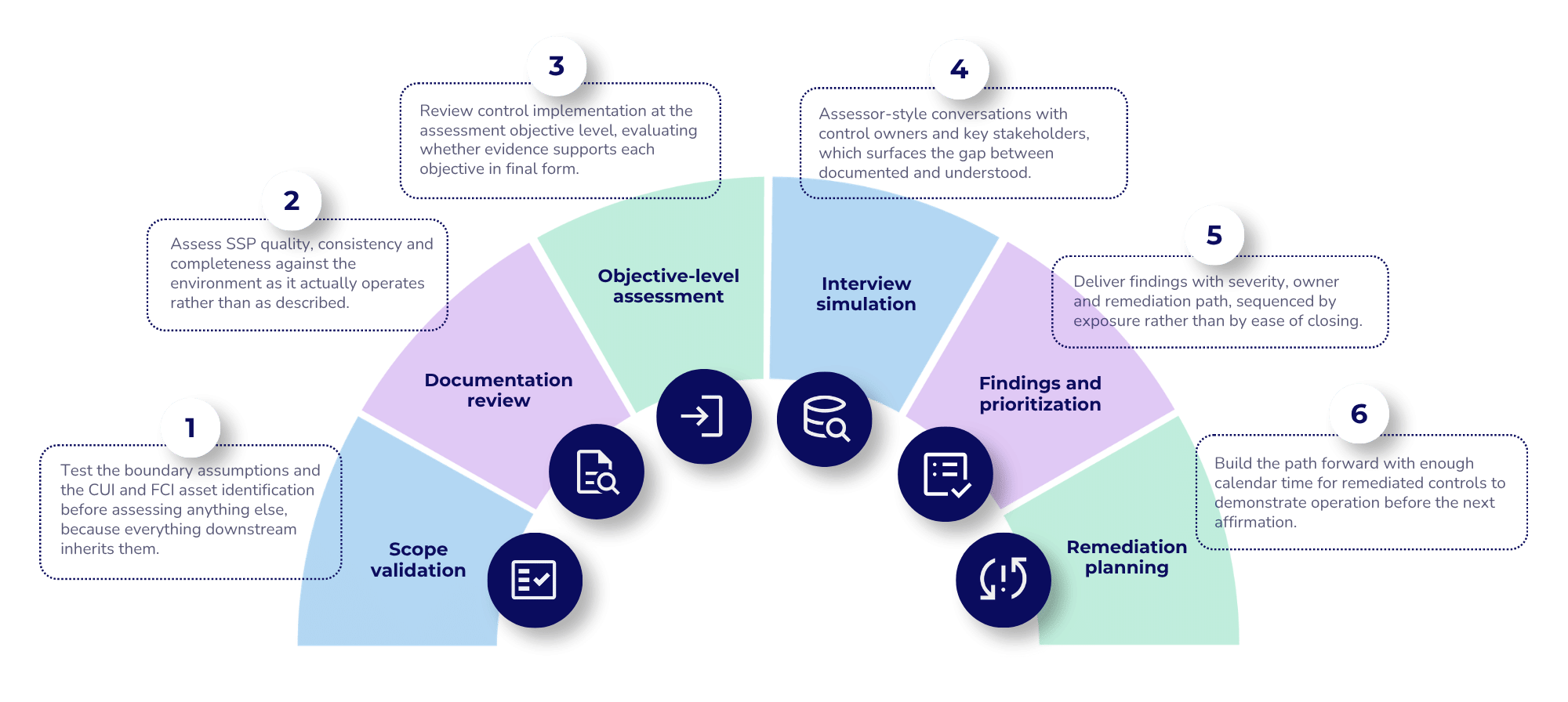
ENGAGEMENT PHASES
How the work runs
WHO THIS IS FOR
Roles Elevate works with on this standard
GET STARTED
Ready to find the gaps before someone else does?
Elevate Consult tests scope, documentation, evidence and team readiness objective by objective, so the affirming official signs against evidence rather than against assurance, and remediation happens on your timeline.
FAQ
Common Questions
🡪 Why run a mock assessment if certification is suspended?
Because the affirmation is not suspended. A current self-assessment posted in SPRS with an annual senior official affirmation remains a condition of eligibility, and a false or overstated affirmation carries False Claims Act exposure. With no C3PAO in the process, a mock assessment is the only external test of the claim before the signature.
🡪 Is a mock assessment the same as a formal CMMC assessment?
No. It is not an official certification assessment and does not produce a certification result. It is a readiness exercise that simulates the process, exposes gaps and helps the team prepare. It also gives the affirming official an independent basis for a signature that currently has none.
🡪 Will we receive a score?
You receive a structured view of readiness and identified gaps at the objective level, not an official certification decision. Where a SPRS score is in play, the review establishes whether the posted score is supportable, which is the question that actually carries risk.
🡪 What do you review?
Scope and boundary assumptions, CUI and FCI asset identification, SSP quality and completeness, evidence completeness and traceability, control implementation reviewed by assessment objective, and interview readiness for control owners. The objective-level review is where self-assessments most often turn out to have overstated.
🡪 When should we schedule one?
Before an annual affirmation, after major remediation work, when evidence defensibility is uncertain, when scope decisions still feel unclear, after significant architecture, staffing or provider changes, or before an internal decision on formal assessment if and when certification returns.
🡪 Can Elevate help after the mock assessment?
Yes. Where the exercise uncovers broader issues, Elevate supports remediation planning, documentation improvement, readiness coordination and ongoing support through End-to-End Managed Services and Compliance as a Service.