

CYBER SECURITY COMPLIANCE · GSA CUI
GSA CUI Compliance Readiness
IT Security Readiness for Protecting CUI in Nonfederal Systems
On 5 January 2026, GSA issued Revision 1 of its IT Security Procedural Guide for protecting Controlled Unclassified Information in nonfederal systems, with no phase-in period and no advance notice. It is the first major CUI protection mandate to extend beyond the Department of War ecosystem, it is built on NIST SP 800-171 Revision 3 rather than Revision 2, and prior CMMC or FedRAMP work does not satisfy it. Elevate Consult guides contractors through all five phases of the guide, from scoping through continuous monitoring.
2026 UPDATE
What this framework means in practice
A new compliance standard for thousands of GSA contractors
CIO-IT Security-21-112, Revision 1 establishes how contractors whose systems process, store or transmit CUI must secure that data. It applies to anyone holding a GSA contract that touches CUI, including Multiple Award Schedule holders and GWAC vehicle participants. It applies where CUI resides in a contractor system not operated on behalf of the federal government, and therefore not already subject to FISMA or FedRAMP.
Built on NIST SP 800-171 Revision 3
GSA is among the first federal agencies to require Revision 3 for contractor CUI environments, supplemented by select enhanced requirements from NIST SP 800-172 and privacy controls from NIST SP 800-53 Revision 5. The Department of War deliberately held CMMC at Revision 2 because Revision 3 arrived mid-programme. GSA made the opposite choice, and that difference is why documentation does not transfer cleanly.
Effective immediately, at contracting officer discretion
GSA published the guide without a press release, without notice, and without the comment period that accompanies rulemaking. Contracting officers can incorporate the requirements into new solicitations and existing contract modifications immediately. There is no formal phase-in period, which means contractors who have not started are already behind rather than early.
Independent assessment, no self-attestation
Assessment must be completed by a FedRAMP-accredited 3PAO or an assessment organization approved by the GSA Office of the Chief Information Security Officer. Self-assessment is not permitted. The approved assessor pool is limited and scheduling pressure is already real.
KEY DIFFERENCE FROM CMMC
Stricter than what the Department of War currently requires
Both frameworks draw from the same NIST foundation, but they are separate programmes with different baselines and different evidence expectations. A System Security Plan written for CMMC cannot be relabelled for GSA: the requirement identifiers differ between Revision 2 and Revision 3, some requirements were merged in the restructure, and Revision 3 introduces organizationally defined parameters that need explicit assignment in the GSA System Security and Privacy Plan.
Existing CMMC or FedRAMP work is a foundation rather than a substitute. The structural overlap is real and worth reusing, but tailoring and gap-filling come before any of it meets GSA authorization standards.
Showstopper requirements
Nine controls GSA will not approve without
Appendix C of Revision 1 was refocused to list only the showstopper requirements: controls that preclude system authorization if they are not fully implemented. Partial implementation is not acceptable for these nine, and no compensating control or risk acceptance path applies to them.
Everything else can be addressed through a POA&M with realistic remediation timelines, which makes the showstopper list the first thing to assess rather than the last.
Access control
Appendix C
Foundational access control implementation across the CUI environment.
Configuration management
Appendix C
Baseline configuration and change control across in-scope systems.
Boundary protection
Appendix C
Defined and enforced boundary between the CUI environment and everything else.
FIPS-validated encryption
Appendix C
Encryption using FIPS-validated cryptographic modules, not merely strong encryption.
One-hour incident reporting capability
Appendix C
Technical alerting and procedures capable of reporting within one hour of identification.
Phishing-resistant MFA
Appendix C
Multifactor authentication resistant to phishing, not any MFA implementation.
Vulnerability monitoring
Appendix C
Continuous vulnerability identification with timely remediation of serious findings.
Administrative access controls
Appendix C
Privileged access restriction, separation and monitoring.
End-of-life technology removal
Appendix C
Prohibition on unsupported and obsolete software and systems in scope.
Our process
Five-phase readiness aligned to the procedural guide
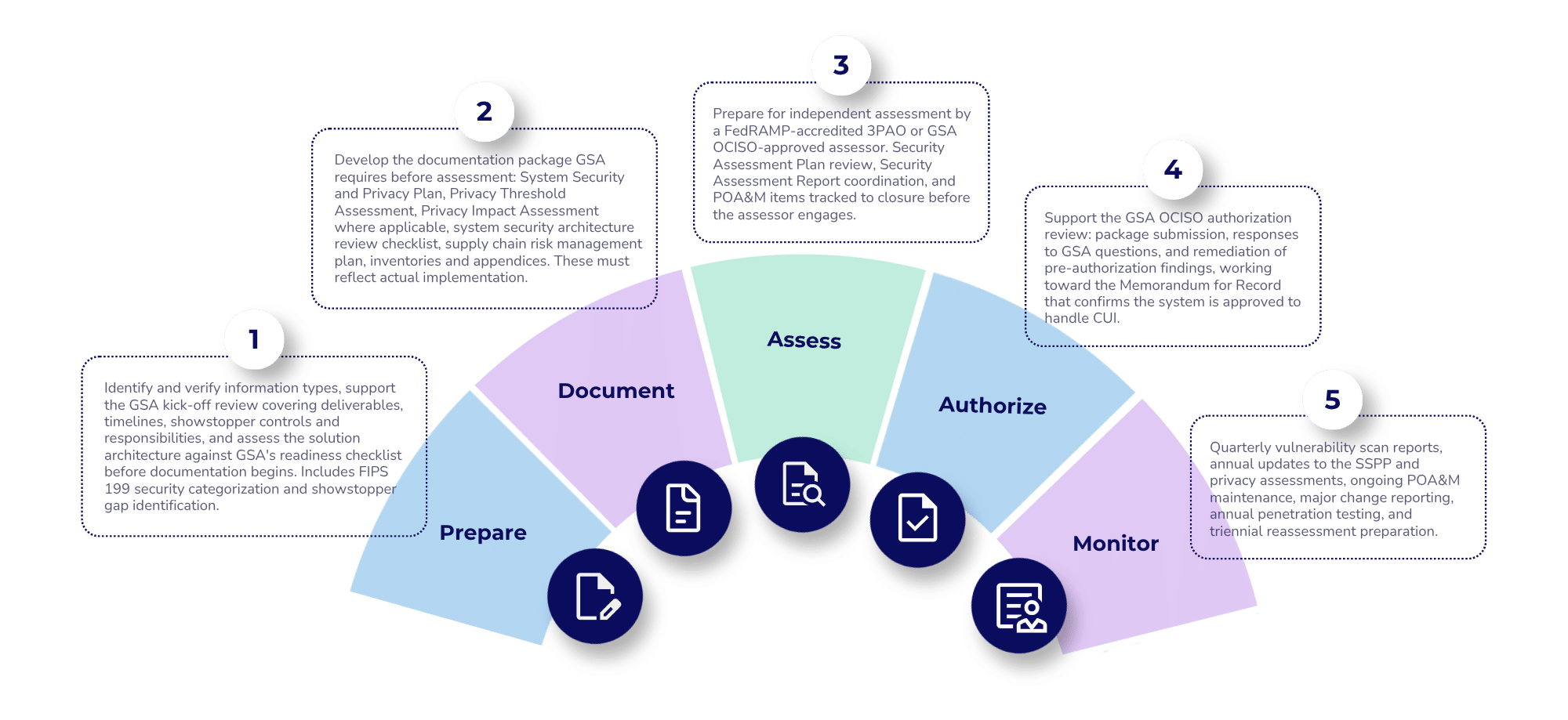
Elevate Consult supports clients through every phase of the GSA CUI authorization lifecycle, following the five-phase structure established in CIO-IT Security-21-112, Revision 1.
System Security and Privacy Plan
Complete, implementation-specific documentation of your security posture, written to GSA standards rather than repurposed from CMMC or FedRAMP templates.
Assessment-ready POA&M
A realistic, trackable remediation plan with timelines and control-level gap documentation acceptable to GSA OCISO.
Security Assessment Report coordination
End-to-end support through the SAR process with your FedRAMP 3PAO or GSA-approved independent assessor.
Privacy assessments
Privacy Threshold Assessment and Privacy Impact Assessment where applicable, maintained on the annual cycle.
Quarterly and annual monitoring deliverables
Vulnerability scan reports, updated privacy assessments and POA&M maintenance that keep the authorization current.
Triennial reassessment preparation
Readiness for the reassessment required every three years or after major system change.
ENGAGEMENT PHASES
How the work runs
WHO THIS IS FOR
Roles Elevate works with on this standard
GET STARTED
Ready to begin your GSA CUI authorization?
Elevate Consult supports federal contractors through every phase of the GSA IT Security Procedural Guide, from initial scoping and SSPP documentation through independent assessment, authorization and continuous monitoring.
FAQ
Common Questions
Does our CMMC Level 2 certification satisfy GSA's CUI requirements?
No. Both frameworks draw from NIST SP 800-171, but GSA requires Revision 3 while CMMC assesses against Revision 2. Revision 3 restructured, consolidated and in some cases removed Revision 2 requirements, so the identifiers differ and some requirements were merged. GSA also has its own documentation requirements and its own assessment process. Existing CMMC or FedRAMP documentation is a usable foundation, but it needs tailoring and gap-filling before it meets GSA standards.
When do these requirements take effect for our contracts?
They are already in effect. GSA published the guide on 5 January 2026 with no phase-in period. Contracting officers have discretion to incorporate the requirements into new solicitations and existing contract modifications immediately, and the publication was not accompanied by a press release or agency communication.
Who can perform the independent assessment?
A FedRAMP-accredited Third Party Assessment Organization or an assessment organization approved by the GSA Office of the Chief Information Security Officer. Self-assessment is not permitted. The approved assessor pool is limited, so securing a schedule slot early is a practical necessity rather than good practice.
What happens if our system does not meet all controls before assessment?
GSA permits authorization where some controls are not fully implemented, provided the nine showstopper requirements are satisfied and all remaining gaps are documented in a POA&M with realistic remediation timelines. GSA expects measurable progress against those timelines, and the POA&M is subject to annual review.
Do these requirements flow down to subcontractors?
The guide does not specify explicit flow-down language, but prime contractors remain responsible for overall compliance. Consistent with the approach under DFARS 252.204-7012, contractors should pass CUI security obligations through all tiers of the performance chain where subcontractors access or handle CUI.
What is the one-hour incident reporting requirement?
GSA requires contractors to report any cybersecurity incident involving CUI within one hour of identification, even where the full scope is not yet known, including the number of systems, records, users and information impacted. That is substantially faster than the 72-hour window under DFARS, and it requires incident response procedures and technical alerting to be configured before authorization rather than after.