AI GOVERNANCE · AIUC-1
AI Governance and AI Risk Management
Inventory, Classification, Controls and the Evidence That Proves They Operate
AI governance is measured by what an organization can produce when someone asks, not by what its policy asserts. Buyers, regulators, auditors and boards are all asking now, and for AI agents the question has changed: not only how the system was governed, but whether it behaves safely under attack. Elevate builds the inventory, classification, controls and evidence that answer all of them from one program.
WHAT CHANGED
What changed in the AI regulatory landscape
EU AI Act high-risk obligations moved to December 2027
Regulation (EU) 2026/1744, the Digital Omnibus on AI, entered into force on July 27, 2026 and deferred standalone Annex III high-risk obligations to December 2, 2027 and Annex I embedded systems to August 2, 2028. What did not move: the Article 5 prohibitions and AI literacy obligation since February 2025, the general-purpose AI model rules since August 2025, and the Article 50 transparency obligations since August 2026.
Colorado repealed its AI law before it took effect
SB 24-205, the template most US programs planned against, was repealed by SB 26-189 in May 2026 and replaced by the Automated Decision-Making Technology Act effective January 1, 2027. The duty of care, mandatory impact assessments and the rebuttable presumption for NIST AI RMF alignment are all gone. Roadmaps still carrying a Colorado high-risk workstream are aimed at duties that no longer exist. The replacement law carries four narrower ones from January 1, 2027: notice when a consumer interacts with AI, disclosure within 30 days of an adverse outcome, correction of inaccurate data, and meaningful human review.
Texas TRAIGA is now the main US safe harbor
Effective January 1, 2026, TRAIGA provides an affirmative defense for organizations that comply with the NIST AI Risk Management Framework. Following Colorado’s repeal, that is the most significant statutory protection of its kind in the United States.
California’s ADMT regulations are in force
The CPPA regulations took effect January 1, 2026, with automated decision-making technology compliance required for existing uses by January 1, 2027. The final rules deliberately removed all references to AI: the trigger is whether the technology fully or substantially replaces human decision-making in a significant decision, so a rules engine can be in scope and a model can be outside it.
ISO 42001 certification now depends on accreditatio
ISO/IEC 42006:2025 governs the bodies that audit and certify AI management systems, and the European co-operation for Accreditation made it mandatory for accrediting them in November 2025. A certificate from a body without that accreditation will not satisfy the buyers most organizations certify to reach.
AI agents now have their own certification
AIUC-1 certifies AI agents by combining an audit of organizational controls with adversarial testing of the agent itself, repeated each quarter. UiPath became the first enterprise automation platform to certify on March 9, 2026, and procurement teams can now require it before an agent is deployed. It complements ISO 42001 rather than replacing it. AIUC-1 readiness →
Financial services got a sector framework
The Cyber Risk Institute published the Financial Services AI Risk Management Framework in February 2026 with the Treasury and the Financial Services Sector Coordinating Council. CRI Profile v2.2 includes a mapping to it, so institutions fold AI risk into an existing control set.
WHAT WE DO
Governance that produces artifacts
AI governance work divides into four things an organization can be asked for. What AI do you run and who owns it. How did you decide this system was acceptable. What evidence shows the controls operated. And, for AI agents, does it behave safely when someone tries to push it past its limits.
Programs that produce a policy and a committee answer none of those, and the fourth cannot be answered by documentation at all. It takes adversarial testing, which is what AIUC-1 certifies. Elevate builds the inventory, the classification logic, the controls and the records, tests agent behavior through its penetration testing practice, and maps the work across whichever frameworks apply so it is done once.
AI GOVERNANCE
Visibility and accountability across the estate
The first problem is almost always inventory. Organizations discover generative features embedded in procured tools that nobody cataloged as an AI decision, because they arrived through a procurement rather than a build.
EU AI Act
Binding law, risk-tiered
Prohibitions, AI literacy, GPAI rules and Article 50 transparency apply now. Annex III high-risk from December 2, 2027, Annex I from August 2, 2028. Penalties under Article 99 reach EUR 35 million or 7% for prohibited practices, with high-risk non-compliance in the 3% tier.
NIST AI RMF
Voluntary, with statutory weight
Four functions: Govern, Map, Measure, Manage. Voluntary and non-binding, but it carries an affirmative defense under Texas TRAIGA and is referenced across state legislation.
ISO/IEC 42001
Accredited AI management system certification
Accredited certification of an AI management system. Verify the certification body holds accreditation covering ISO 42001 on the accreditation body’s own register, because ISO/IEC 42006:2025 now governs that.
AIUC-1
Agent certification, adversarially tested
Independent certification of AI agent security, safety and reliability across six domains, combining a controls audit with technical testing of the agent under attack. The standard is revised quarterly and certified agents are retested each quarter
NYC Local Law 144
Bias audit, independently conducted
Employers using automated employment decision tools for NYC hiring or promotion need an annual independent bias audit, a public results summary and candidate notice at least ten business days before use. Penalties run 500 to 1,500 dollars per day.
CCPA ADMT regulations
In force, phased
California regulations effective January 1, 2026, with ADMT compliance for existing uses required by January 1, 2027. Covers significant decisions including employment, healthcare, financial services, education and housing.
FS AI RMF
Financial sector
Published February 2026 by the Cyber Risk Institute. Scales control obligations to a documented AI adoption stage across four levels, and maps to CRI Profile diagnostic statements.
AI RISK MANAGEMENT
Risk to the organization, and impact on people
Elevate advises on how to meet the audit requirements for the privacy and security portion. Elevate never holds system access or privileges, which preserves independence from the process, while bringing the architecture knowledge that produces a platform capable of passing CMS review.
AI and model inventory
A working inventory of AI systems covering built, procured and embedded, each with intended use, foreseeable misuse, risk classification and a named owner. Structured to stay current rather than age into a snapshot. Elevate’s AI Guardian platform supports use case and inventory management where a client wants the register to live in a system rather than a document.
AI impact assessment
Assessment of effects on individuals, groups and society, with a documented methodology applied consistently on a defined cadence. This is the requirement organizations arriving from information security most consistently underestimate.
Policy, roles and governance
AI policy, decision rights, escalation paths and the mechanism through which staff raise concerns, integrated into existing governance rather than built alongside it.
AIUC-1 readiness
For organizations building or deploying AI agents: agent inventory, a controls gap assessment across the six domains, and adversarial pre-testing by Elevate’s penetration testing practice before the certification testing runs. Existing ISO 42001 evidence carries over through the published crosswalks. AIUC-1 readiness →
EU AI Act readiness
Classification, high-risk controls under Articles 8 to 15, Article 50 transparency, AI literacy and GPAI provider due diligence.
Model validation and verification audits
Assessment of model performance, data quality and integrity against defined benchmarks for accuracy, robustness and accountability.
Risk classification and framework mapping
Documented classification logic per use case, mapped across the frameworks that apply so a single assessment answers the EU AI Act, the NIST AI RMF, ISO 42001 and the sector framework where one exists.
AI risk assessment
Analysis of exposure to the organization: model performance, bias, robustness, drift, third-party opacity and misuse, with the thresholds that trigger action rather than reporting.
ISO 42001 readiness
Certification readiness including scope definition, gap analysis, AIMS build, internal audit and management review, plus verification that a prospective certification body is actually accredited for the standard.
NIST AI RMF program
The four functions built as operating controls with owners, cadence and records, which is what the Texas affirmative defense rests on.
AI governance training
Role-based training for the people who actually operate and oversee AI, which is also what the EU AI Act literacy obligation requires evidence of.
ENGAGEMENT PHASES
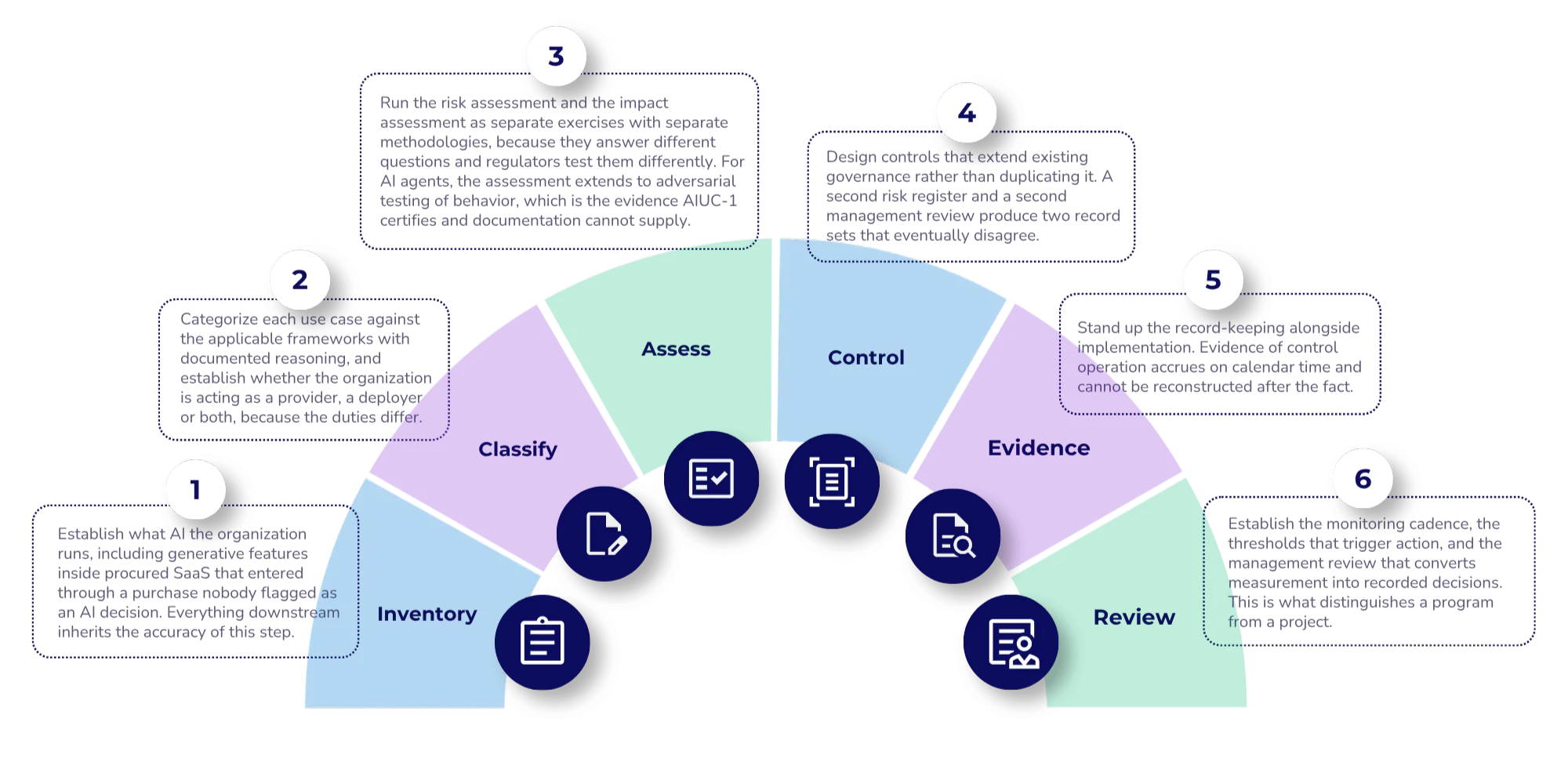
How the work runs
THE FIRST CALL
What the AI governance call produces
Thirty minutes, no cost, and you leave with four things rather than a proposal to read later.
Which frameworks actually apply to you
Across the EU AI Act, the state laws, ISO 42001, AIUC-1 and your sector framework, which ones reach your organization, and which ones your roadmap is still carrying that no longer do.
A first read on your inventory gap
The AI that arrived through procurement rather than a build, including agents embedded in platforms nobody cataloged as agents. Everything downstream inherits the accuracy of this step.
Where your existing evidence already reaches
What ISO 27001, SOC 2 or your privacy program already covers, so the governance work extends what you run instead of building beside it.
A realistic sequence
What has to exist first, what can run in parallel, and when certification, whether ISO 42001, AIUC-1 or both, makes sense to book.
Who you meet. The call is run by Elevate’s AI governance practice, led by Angela Polania, who holds CISA, CISM and CRISC and is an ISO 42001 Lead Auditor. You do not have to track the regulatory changes yourself. We track them.
+18
500+
100%
500+
WHO THIS IS FOR
Roles Elevate works with on this standard
GET STARTED
Ready to build AI governance that produces evidence?
Whether the driver is a customer security review, a statutory exposure, an enterprise buyer asking for AIUC-1, or a board asking where the organization stands, Elevate builds the inventory, the classification logic, the controls and the records, and tests the agents, from one program rather than several.
FAQ
Common Questions
When do EU AI Act obligations actually apply?
Prohibited practices and the AI literacy obligation since February 2, 2025. General-purpose AI model obligations and governance rules since August 2, 2025. Article 50 transparency obligations since August 2, 2026. Annex III high-risk obligations from December 2, 2027 and Annex I embedded systems from August 2, 2028, following the deferral in Regulation (EU) 2026/1744. Only the high-risk obligations moved.
Does NIST AI RMF alignment provide legal protection?
In Texas, yes: TRAIGA provides an affirmative defense for organizations that comply with the framework. Elsewhere it functions as documented evidence of reasonable care rather than as protection. Colorado previously offered a rebuttable presumption for alignment, but that provision disappeared when SB 24-205 was repealed in May 2026.
Is ISO 42001 worth certifying against?
It is the only accredited certification for an AI management system, and it increasingly appears in enterprise AI procurement. The caution is on the certificate rather than the standard: ISO/IEC 42006:2025 now governs the bodies that certify, and a certificate from a body without accreditation covering ISO 42001 will not satisfy the buyers most organizations are certifying to reach. Verify accreditation on the accreditation body’s own register.
What triggers NYC Local Law 144?
Using an automated employment decision tool to substantially assist or replace discretionary decision-making for hiring or promotion where the candidate or job is in New York City, including remote roles associated with an NYC office. The employer needs an independent bias audit conducted within the prior year, a public summary of the results, and candidate notice at least ten business days before use. A December 2025 New York State Comptroller audit found enforcement had been weak and recommended a proactive posture, which DCWP accepted, so a stricter phase is expected.
Does an AI system automatically fall under California's ADMT rules?
No, and the final regulations removed all references to AI specifically to prevent that assumption. The test is whether the technology fully or substantially replaces human decision-making in a significant decision such as employment, healthcare, financial services, education or housing. A deterministic rules engine can be in scope and a model used only to inform a human decision can be outside it.
Do we need ISO 42001, AIUC-1, or both?
It depends on what you are being asked to prove. ISO 42001 certifies that the organization governs AI: policy, roles, risk processes and management review. AIUC-1 certifies that specific AI agents behave safely and securely when tested, including under adversarial conditions. An organization that builds or sells agents to enterprise buyers increasingly needs both, and the usual sequence is ISO 42001 first, because the management system supplies part of the AIUC-1 evidence. An organization that uses AI but does not deploy agents usually needs only the first.
Can the firm that builds our AI governance program also audit it?
Not the same firm for the same client. Elevate offers both advisory and audit work, and keeps them separate by client rather than by engagement. NYC Local Law 144 requires the bias audit to be conducted by an independent auditor, and a firm that designed the controls cannot provide that independence for the organization it advised. The separation is established when the engagement is scoped, and it is what makes the audit report credible to the regulator or buyer reading it.
Do you have a platform or is this all advisory?
Both. The advisory work covers inventory, classification, controls and evidence. AI Guardian is Elevate’s platform supporting AI model use case management and model inventory, for clients that want the register and its workflows to live in a system rather than in documents. The platform supports the program; it does not replace the governance decisions the program exists to make.