
PRIVACY COMPLIANCE · CCPA
CCPA Compliance for California Consumer Data
Gap Assessment, Consumer Rights Operations and ADMT Readiness
The CCPA that most organizations built their program against no longer exists. The CPRA amended it, created a dedicated enforcement agency, and expanded consumer rights from four to six. The CPPA then finalized regulations on automated decision-making technology, cybersecurity audits and risk assessments that took effect on 1 January 2026, with ADMT compliance phased into 2027. Elevate Consult assesses where a program stands against the current statute and regulations, not the 2020 version, and builds the consumer rights operations and evidence that survive an enforcement inquiry.
2026 UPDATE
What changed and what most programs are missing
There are six consumer rights, not four
The CPRA added the right to correct inaccurate personal information and the right to limit the use and disclosure of sensitive personal information. Together with the rights to know, delete, opt out of sale or sharing, and non-discrimination, that is six. Programs still built around the original four are missing two operational workflows, not two paragraphs in a notice.
The revenue threshold is inflation-adjusted
The statutory figure was 25 million dollars, but it adjusts. The applicable figure for the current period is 26,625,000 dollars. Organizations that assessed themselves as out of scope against a fixed 25 million should re-check, and the other two thresholds remain: buying, receiving, selling or sharing the personal information of 100,000 or more California residents, households or devices, or deriving 50 percent or more of annual revenue from selling or sharing personal data.
California has a dedicated privacy enforcement agency
The CPRA created the California Privacy Protection Agency, which can audit for compliance, investigate, levy administrative fines and write regulations. It is the only dedicated state privacy enforcement agency in the United States. The Attorney General retains separate civil enforcement authority and has continued to announce settlements, so there are two enforcement paths rather than one.
ADMT regulations are now in force
The CPPA Board adopted regulations on automated decision-making technology, cybersecurity audits and risk assessments on 24 July 2025. The Office of Administrative Law approved them on 22 September 2025 and the general regulations took effect on 1 January 2026. ADMT compliance for existing uses is required by 1 January 2027, which makes 2026 the planning year rather than the deadline.
Sensitive personal information now includes neural data
The regulations updated the definition of sensitive data. Organizations processing biometric or neurological signals should re-run their data classification rather than assume the prior categories still cover them.
AUTOMATED DECISION-MAKING
What the ADMT regulations actually require
ADMT is defined as technology that processes personal information and uses computation to fully or substantially replace human decision-making. The final regulations deliberately removed all references to AI to avoid ambiguity, so the trigger is the decision mechanism rather than the technology label. A rules engine can be in scope and a model can be out of it.
The obligations attach to significant decisions concerning a consumer: denial of healthcare, financial services, employment, education or housing. Businesses must provide pre-use notice, allow consumers to request access to information about the ADMT including its logic and outcomes, and allow an opt-out. There is a notable exception: the opt-out is not required where the business provides a method to appeal the decision to a qualified human reviewer with authority to overturn it.
Risk assessments are required for processing that presents significant risk, including using ADMT for a significant decision, using personal information as training data for an ADMT, and using automated processing to infer or extrapolate sensitive information.
WHO MUST COMPLY
Thresholds, and the sectors the regulations clarified
The CCPA applies to for-profit organizations doing business in California that meet at least one threshold. Nonprofits and government agencies are generally exempt, but exemptions that organizations relied on have narrowed.
Right to know
Civil Code 1798.110 and 1798.115
Request disclosure of the personal information a business has collected, sold or shared about the consumer.
Right to delete
Civil Code 1798.105
Request deletion of personal information the business collected from the consumer, subject to defined exceptions.
Right to correct
Civil Code 1798.106
Request correction of inaccurate personal information. Added by the CPRA and frequently missing from older programs.
Right to opt out of sale or sharing
CCPA as amended
Direct a business to stop selling or sharing personal information, including cross-context behavioral advertising. Businesses must now confirm to the consumer that the request was processed.
Right to limit use of sensitive PI
Civil Code 1798.121
Limit the use and disclosure of sensitive personal information to defined purposes. Added by the CPRA.
Right to non-discrimination
CCPA as amended
No denial of goods or services, differential pricing or reduced service quality for exercising a right.
OUR APPROACH
Assessment, remediation and operations
Elevate Consult works from the current statute and regulations rather than from the original act, because the gap between them is where most programs now sit.
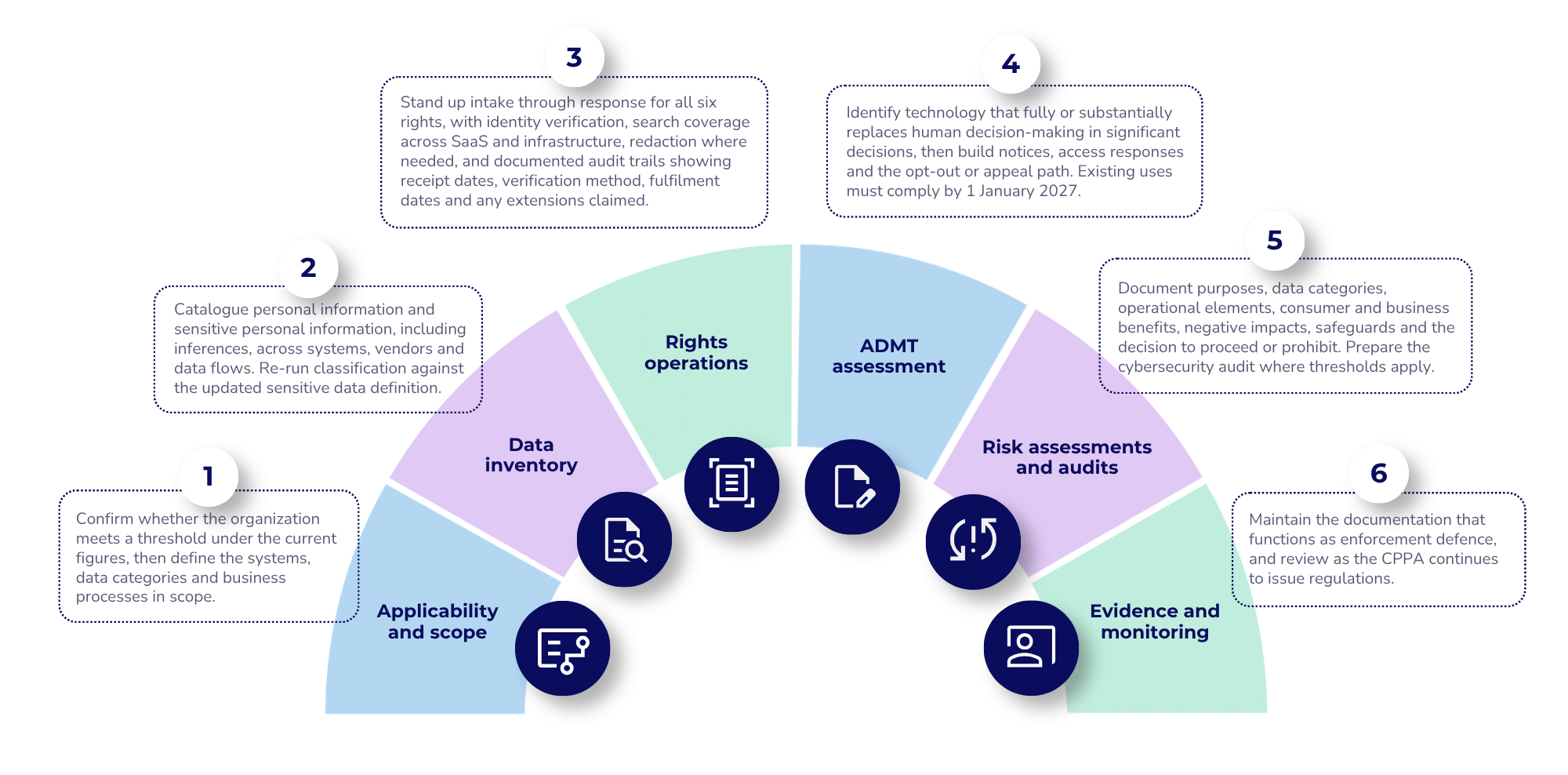
Scope and threshold assessment
Determine applicability against the current inflation-adjusted revenue threshold and the consumer volume and revenue-share tests, including for organizations that previously assessed themselves as out of scope.
Consumer rights operations
Design and implement workflows for all six rights: intake, identity verification, search across systems, review, response and audit trail, with the confirmation step the regulations now require on opt-outs.
Risk assessments and cybersecurity audits
Structure the risk assessments the regulations require and prepare for the annual independent cybersecurity audit with executive certification where thresholds apply.
Data inventory and classification
Catalogue personal information and sensitive personal information across systems and vendors, against the current definition of sensitive data.
ADMT readiness
Identify in-scope automated decision-making, build pre-use notices, access response procedures, and either the opt-out mechanism or the qualified human reviewer appeal path.
Third-party and contract review
Service provider, contractor and third-party agreements with the terms the statute requires, plus ongoing vendor monitoring.
ENGAGEMENT PHASES
How the work runs
WHO THIS IS FOR
Roles Elevate works with on this standard
GET STARTED
Ready to reassess against the current CCPA?
Whether the driver is the ADMT deadline in 2027, a threshold that moved, or a program written before the CPRA, Elevate Consult maps the gap between what your program covers and what the statute and regulations now require.
FAQ
Common Questions
How many rights does the CCPA give consumers?
Six, as amended by the CPRA: know, delete, correct, opt out of sale or sharing, limit the use and disclosure of sensitive personal information, and non-discrimination. The rights to correct and to limit sensitive personal information were added by the CPRA, and programs built against the original act commonly lack workflows for both.
What is the current revenue threshold?
The statutory figure of 25 million dollars is inflation-adjusted, and the applicable figure for the current period is 26,625,000 dollars in the preceding calendar year. The other two thresholds are unchanged: handling the personal information of 100,000 or more California residents, households or devices, or deriving 50 percent or more of annual revenue from selling or sharing personal information. Meeting any one threshold brings an organization into scope.
What are the ADMT regulations and when do they apply?
The CPPA adopted regulations on automated decision-making technology on 24 July 2025, approved by the Office of Administrative Law on 22 September 2025, with the general regulations effective 1 January 2026. ADMT is technology that processes personal information and uses computation to fully or substantially replace human decision-making. Businesses using ADMT for significant decisions must comply for existing uses by 1 January 2027.
Does an AI system automatically fall under the ADMT rules?
No, and the final regulations removed all references to AI specifically to avoid that assumption. The test is whether the technology fully or substantially replaces human decision-making, defined as using the output to make a decision without human involvement. A deterministic rules engine can be in scope and a model used only to inform a human decision can be outside it.
Who enforces the CCPA?
Two bodies. The California Privacy Protection Agency brings administrative enforcement actions and issues administrative fines. The Attorney General brings civil actions for penalties and injunctive relief in court. The CPPA is the only dedicated state privacy enforcement agency in the United States, and it also holds rulemaking authority, which it has used actively.
How does the CCPA compare to the GDPR?
Both address transparency, consumer rights and accountability, but they differ in structure. The GDPR requires a lawful basis for every processing activity, while the CCPA operates on an opt-out model for sale and sharing with opt-in consent required in specific cases. Scope, definitions of personal and sensitive data, and enforcement mechanics all differ. Organizations subject to both should harmonize controls and evidence rather than running two programs.