QUALITY MANAGEMENT · ISO 9001
ISO 9001 Quality Management System
Readiness, Remediation and 2026 Transition Support
ISO 9001 is the most widely held management system certificate in the world, and it is in the middle of its first full revision since 2015. ISO 9001:2026 is projected for publication in the second half of 2026, and the 2024 climate amendment has been in force since February 2024 regardless. Elevate Consult runs ISO 9001 readiness by extracting the business activity requirements behind each clause, so an organization sees how much of the standard its existing processes already satisfy before it starts building anything new.
2026 UPDATE
What changed and what is coming
The 2022 edition restructured Annex A from 114 controls in fourteen domains into 93 controls across four themes, with eleven controls new to the edition.
The 2024 climate amendment is already in force
ISO 9001:2015/Amd 1:2024, published in February 2024, added a requirement to Clauses 4.1 and 4.2: organizations must determine whether climate change is a relevant issue for the quality management system and consider the expectations of interested parties on it. It was immediately effective. Certified organizations that have not documented that determination have an open gap today, not at the next revision.
Leadership expectations expand
The draft strengthens Clause 5.1.1 so that top management is expected to promote and demonstrate a quality culture and ethical behavior, with new guidance on how that gets demonstrated. The climate amendment is formally integrated rather than sitting as a separate document.
ISO 9001:2026 is in the final stages
The Draft International Standard completed its voting period in late 2025 and publication is projected for the second half of 2026. The revision evolves rather than rewrites: the core requirements in Clauses 4 to 10 carry forward with targeted clarifications, and most additions sit in the expanded Annex A guidance rather than in normative requirements.
Transition will run two to three years
The International Accreditation Forum is expected to publish mandatory transition documents around publication. Organizations that addressed the 2024 amendment are already positioned for most of what the revision carries forward.
WHAT IT IS
A procurement condition as much as a quality program
For software and cloud providers in particular, ISO 9001 certification answers a consistency and reliability question that enterprise buyers now ask alongside the security ones. It demonstrates that delivery quality is managed by a system rather than by individual effort.
Elevate approaches the standard from an information technology and process improvement position rather than a manufacturing one, which is the difference that matters when the product is a service.
OUR APPROACH
Start from the processes that already exist
Most organizations completing an Elevate ISO 9001 readiness assessment find they were closer to the requirements than they expected. The approach begins by leveraging existing process documentation and understanding business objectives and quality risks, then examines support channels covering resources, infrastructure, capabilities and constraints, and then operations.
Each process is mapped to one or more business objectives and carries at least one key performance indicator measuring the quality of that process. Monitoring, measurement and analysis are built into every process across the first, second and third lines of defense. The assessment closes with a continuous improvement program report.
Context of the organization
Clause 4
Internal and external issues including climate change relevance, interested parties, QMS scope, and the processes and their interactions.
Leadership
Clause 5
Commitment, quality policy, roles and authorities. The 2026 revision adds explicit expectations around quality culture and ethical behavior.
Planning
Clause 6
Actions to address risks and opportunities, quality objectives and planning to achieve them, planning of changes.
Support and operation
Clauses 7 and 8
Resources, competence, awareness, documented information, then operational planning, design, production and service provision and post-delivery activity.
Performance evaluation
Clause 9
Monitoring, measurement, analysis and evaluation, customer satisfaction, internal audit and management review.
Improvement
Clause 10
Nonconformity and corrective action, and continual improvement driven by evaluation data rather than by intent.
OUR PROCESS
Plan, Do, Check, Act mapped to the clause structure
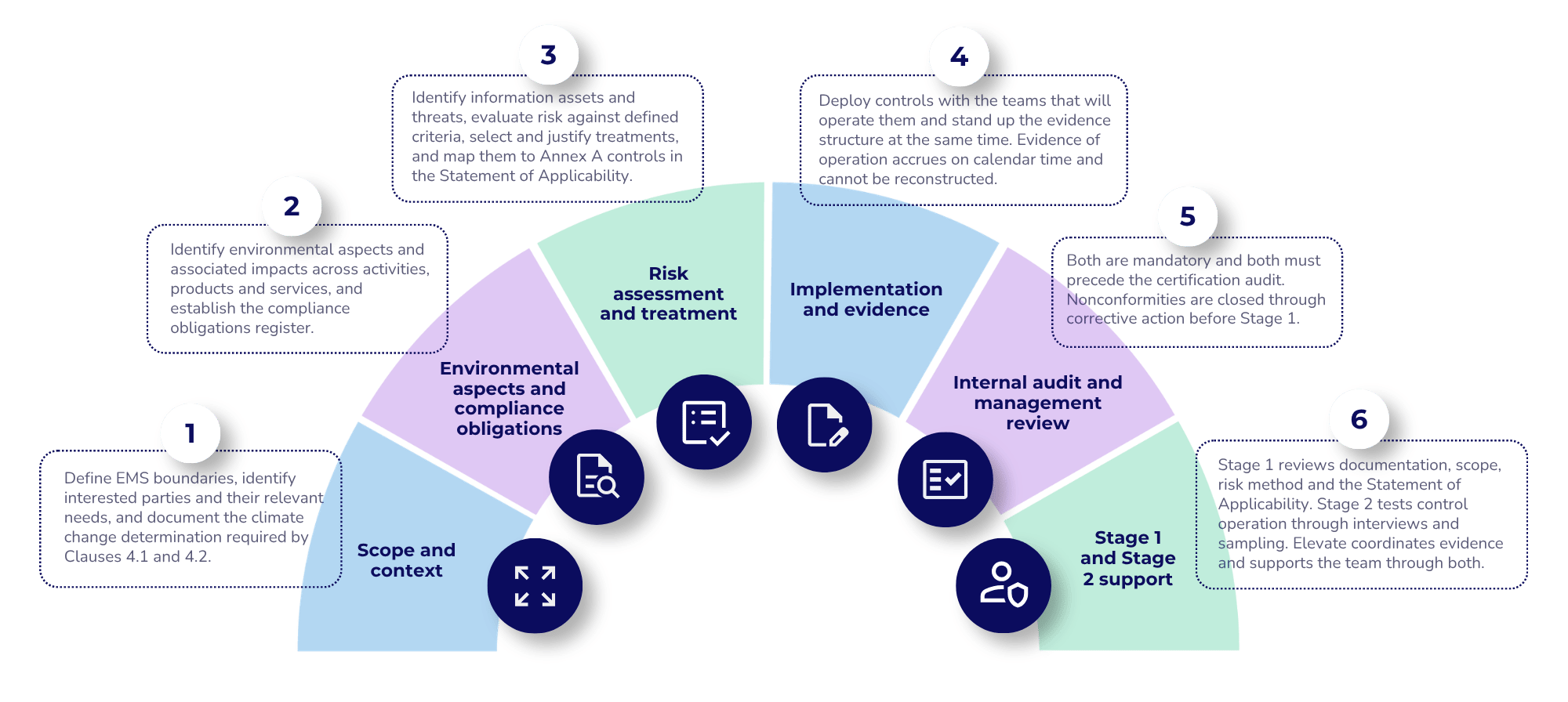
The engagement follows the PDCA cycle that the standard itself is built on, mapped to the key clauses so an organization can see exactly which requirement each activity satisfies.
Identify business objectives and context
Establish the context of the organization and the objectives every process will map back to.
Gap assessment
Assess current practice against the clause requirements, identifying where existing process documentation already satisfies the standard.
QMS training and risk assessment
Train the teams that will operate the system, and run the quality management risk assessment.
Continuous improvement program report
Recommendations for ongoing enhancement as processes evolve against customer demand and business risk.
Determine scope statement
Define QMS boundaries, applicability and justification for any exclusion.
Quality management system manual
Develop the QMS manual, implementation roadmap and implementation plan.
Internal audit and corrective action
Conduct the QMS internal audit, issue the corrective action plan and maintain it through closure.
ENGAGEMENT PHASES
How the work runs
WHO THIS IS FOR
Roles Elevate works with on this standard
GET STARTED
Ready to assess your QMS against the standard?
Whether the driver is a first certification, a customer requirement, or preparation for the 2026 revision, Elevate Consult maps your existing processes to the clause requirements and shows where the real gaps are before you build anything new.
FAQ
Common Questions
🡪 Is ISO 9001:2026 published yet?
The Draft International Standard completed voting in late 2025 and publication is projected for the second half of 2026. Until it publishes, ISO 9001:2015 with Amendment 1:2024 remains the certifiable edition. Organizations should confirm current publication status with their certification body before planning a transition audit.
🡪 What does the 2024 climate amendment require?
Amendment 1:2024 added a requirement to Clauses 4.1 and 4.2 that organizations determine whether climate change is a relevant issue for the quality management system and consider the expectations of interested parties on it. It took effect immediately on publication in February 2024 and applies to every certified organization regardless of the 2026 revision.
🡪 How much work is the 2026 transition?
Less than the 2013 to 2022 transition on ISO 27001 was. The core requirements in Clauses 4 to 10 carry forward with targeted clarifications, and most additions sit in the expanded Annex A guidance, which is informative rather than normative. The substantive new expectations concern quality culture and ethical behavior under Clause 5.1.1.
🡪 Can ISO 9001 be integrated with ISO 27001 or ISO 14001?
Yes, and that is the point of the harmonized structure. Clauses 4 to 10 share numbering, core text and common terms across management system standards, so context, leadership, planning, internal audit and management review can run once rather than three times. ISO 14001 published its 2026 edition in April 2026, so organizations carrying both may be able to coordinate transitions within one audit cycle.
🡪 Is ISO 9001 relevant to software and services?
Yes. The standard is written to apply equally to manufacturing and services, and the 2026 revision does not add sector-specific requirements. For SaaS and cloud providers the certificate answers a consistency and reliability question that buyers increasingly ask alongside security certifications.
🡪 How long does ISO 9001 certification take?
It depends on scope, existing process maturity and resourcing. Organizations with documented processes and defined objectives often find they are closer than expected, because the standard asks for structure around work that is already happening. The gating constraints are internal audit and management review, which must occur before the certification audit.