Cybersecurity and Compliance for Higher Education
GLBA Safeguards, AI Governance and NIST CSF Without Disrupting Operations
Institutions handling Title IV federal student aid are financial institutions under GLBA, which means the FTC Safeguards Rule applies with all of its obligations including the testing cadence most campuses have never run. At the same time AI arrived across academics, research and administration faster than any governance framework, and ransomware continues to treat universities as high-value, loosely segmented targets. Elevate Consult builds a programme that passes review without disrupting enrollment or aid operations.
UPDATE
What institutions have to demonstrate
GLBA applies because of Title IV
The Department of Education expects institutions handling federal student aid to meet Safeguards Rule requirements, maintain a written information security programme and manage third-party servicers. The obligation arrives through the aid programme rather than through banking regulation, which is why it is frequently owned by the wrong office internally.
Certain obligations scale with consumer count
Institutions maintaining information on fewer than 5,000 consumers are exempt from some requirements including the written risk assessment, the continuous monitoring or testing obligation, the written incident response plan and the annual report to the governing body. Above that threshold, all of them apply.
The vendor assessment standard is HECVAT
The Higher Education Community Vendor Assessment Toolkit, stewarded by EDUCAUSE, is the sector's standard vendor security questionnaire and now includes AI-specific considerations alongside security ones.
The testing cadence is the most-missed requirement
Covered institutions must conduct annual penetration testing and semi-annual vulnerability assessments, or implement continuous monitoring achieving comparable outcomes. This is the concrete, dated obligation where the gap between a written programme and actual practice becomes visible.
AI arrived across every constituency at once
Academics, research, administration and student services each adopted AI on different timelines with different tools and different risk profiles. A single institutional AI policy that ignores those differences does not survive contact with faculty governance.
WHO WE HELP
Institutions and the organizations serving them
Colleges, universities, community colleges and higher education servicers processing Title IV federal student aid and other student financial services.
Also third-party servicers, research institutes, affiliated foundations handling student information, and vendors operating in complex multi-campus environments.
GLBA SAFEGUARDS IN HIGHER EDUCATION
What a review actually tests
The requirements are the same as for any covered financial institution. What differs is the operating environment: decentralized IT, faculty governance, a research enterprise with its own systems, and an aid office that cannot pause during a remediation project.
A designated individual overseeing and enforcing the information security programme, reporting regularly to the board or senior leadership where the consumer threshold applies.
Qualified Individual
A written risk assessment, and safeguards designed against the risks it identifies: access control, encryption, multi-factor authentication, secure development, logging, vulnerability management, disposal, change management and training.
Risk assessment and safeguards
Annual penetration testing and semi-annual vulnerability assessments, or continuous monitoring achieving comparable outcomes. The obligation most consistently missed.
Testing and monitoring
A third-party servicer inventory, contractual security requirements, due diligence and periodic review. HECVAT is the sector standard for the assessment itself.
Servicer oversight
Policy and roles across academics, research and administration, model inventory, impact assessments, third-party AI review and monitoring.
AI governance
A baseline across the six functions including Govern, which is the function most campus programmes have the least documented evidence for.
NIST CSF 2.0
HOW ELEVATE HELPS | SERVICES FOR HIGHER EDUCATION
Audit-ready, not paperwork-heavy
Elevate builds programmes designed for how institutions actually operate, with evidence collection that does not depend on central IT having authority it does not have.

GLBA risk assessment and written programme
End-to-end review, gap remediation and a written information security programme aligned to what a Department of Education review tests.

Third-party servicer oversight
Servicer register, risk ranking, contract language and security addenda, and periodic review aligned to GLBA expectations using HECVAT where appropriate.

AI governance programme
Policy suite covering acceptable use by constituency, model inventory, AI impact assessments, transparency and consent, third-party AI review and monitoring workflows, aligned to ISO 42001 principles and NIST AI RMF practice.

NIST CSF maturity assessment
Current state measurement across the six functions, prioritized gaps and a roadmap with budget and milestones.

Penetration testing and vulnerability assessment
The annual and semi-annual cadence the Safeguards Rule requires, scoped across the systems that actually hold student financial information.

Incident response readiness
Notification decision trees, tabletop exercises and templates for leadership and stakeholders, tested before an incident rather than during one.

Data mapping and privacy operations
Records of processing, data flows and rights handling across students, staff and alumni, including the state privacy obligations institutions increasingly face.

Training and change management
Role-based training for financial aid, registrar, IT and security, research and procurement, because the risks differ materially between them.
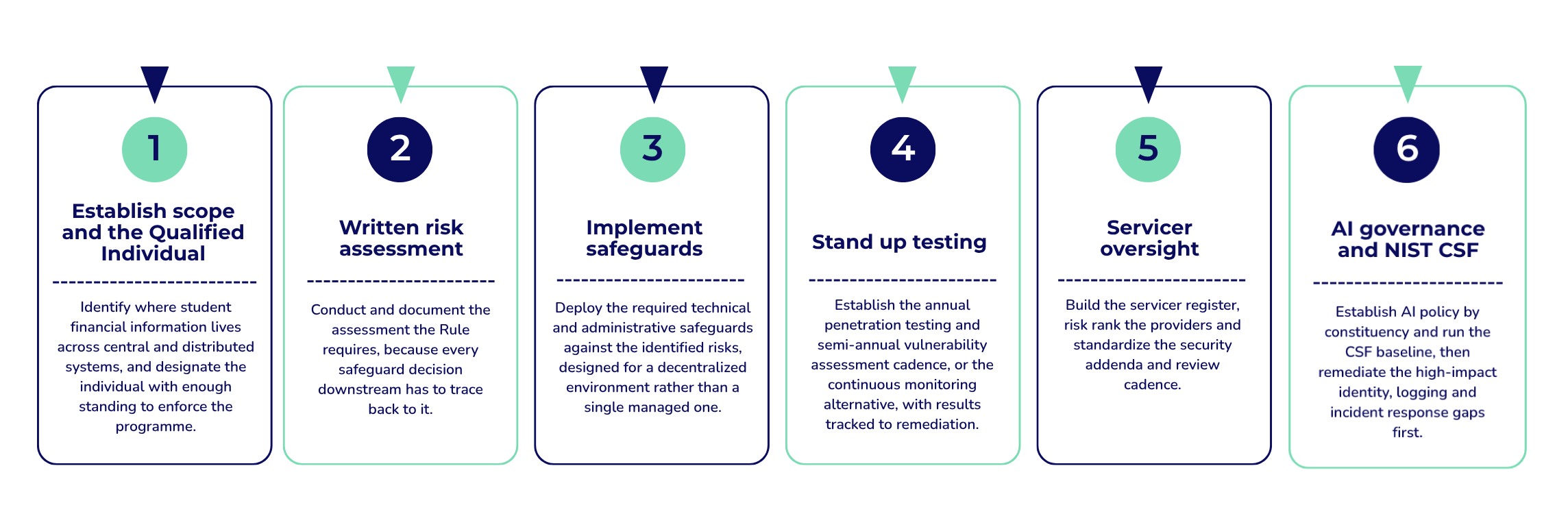
ENGAGEMENT PHASES
How the work runs
WHO THIS IS FOR
Roles Elevate works with on this standard
CIOs and CISOs
Financial aid directors
Compliance and risk officers
Research administration
Procurement and vendor management
GET STARTED
Ready to pass reviews and reduce risk?
Elevate Consult operationalizes GLBA including the testing cadence most programmes lack, stands up AI governance that works across constituencies, and raises NIST CSF maturity with audit-ready evidence and minimal disruption to aid operations.
FAQ
Common Questions
🡪 Why does GLBA apply to a university?
Because institutions handling Title IV federal student aid meet the definition of a financial institution for Safeguards Rule purposes. The Department of Education expects those institutions to maintain a written information security programme, oversee third-party servicers and implement and document safeguards. The obligation arrives through the aid programme rather than through banking regulation.
🡪 Do we need a Qualified Individual?
Yes. The Safeguards Rule requires a designated individual to oversee, implement and enforce the information security programme. Where the institution maintains information on 5,000 or more consumers, that individual must also report regularly to the board or a senior officer, which means the role needs enough institutional standing for the report to carry weight.
🡪 What is the testing requirement?
Annual penetration testing and semi-annual vulnerability assessments, or continuous monitoring achieving comparable outcomes. Institutions maintaining information on fewer than 5,000 consumers are exempt from this along with several other requirements. Above that threshold it applies in full, and it is the obligation most consistently absent when a programme is reviewed.
🡪 How does AI governance apply to a university?
Across more constituencies than most organizations. Academics, research, administration and student services adopted AI on different timelines with different tools and different risk profiles, covering admissions, advising, research, HR and security. A programme needs policy differentiated by constituency, a model inventory, risk and impact assessments, third-party AI review and monitoring, because a single policy written for administrative use will not survive faculty governance.
🡪 How do we manage third-party servicers?
Build a servicer register, risk rank the providers, standardize security addenda in contracts, and run periodic reviews aligned to GLBA expectations. HECVAT, the Higher Education Community Vendor Assessment Toolkit stewarded by EDUCAUSE, is the sector standard for the assessment itself and now includes AI considerations alongside security ones.
🡪 What is a practical first step for NIST CSF?
A baseline assessment across the six functions, then remediation of the highest-impact gaps, which on most campuses are identity and multi-factor coverage, logging and detection, and incident response readiness. Set a ninety day plan against those rather than attempting the whole framework at once.