
The world’s first international standard for AI Management Systems (AIMS), ISO 42001, made its debut in December 2023. This new framework comes at the perfect time as AI regulations change faster and become more complex.
B2B founders might find responsible AI management challenging. However, ISO/IEC 42001:2023 gives them a well-laid-out approach to govern, develop, and deploy AI responsibly for use cases and industries with different risk levels. Top management must take an active role and be accountable for the AI Management System. Startups will find this standard particularly useful as a practical framework to manage AI risks.
This piece shows how B2B businesses can gain a competitive edge through ISO 42001 certification. You’ll learn about the standard’s requirements and how to build an AI Management System from scratch that works. The framework balances flexibility for breakthroughs with the consistency needed for accountability. We’ll give you practical steps to implement it right away.
Why ISO 42001 is a Game-Changer for B2B Startups
“ISO42001 is a next-generation standard, offering organizations a framework to manage the risks, opportunities and ethical responsibilities of AI technologies.” — Mimecast, Cybersecurity Company
B2B buying has undergone a major change as technology evolves. Digital tools now play a crucial role, with 94% of B2B buyers using them in their purchase experience. The market has fundamentally moved beyond common online channels. Buyers now deliberately use sophisticated technology to make specific buying decisions and outcomes.
The rise of AI regulations and buyer expectations
Trust in AI companies has fallen from 50% in 2019 to 35% in 2024. This creates challenges for B2B businesses that use AI-assisted content to build relationships. Buyer expectations have reached new heights. By 2028, AI will make at least 15% of day-to-day business decisions for rule-based tasks, up from 0% in 2024.
The regulatory landscape is changing faster to address these shifts. The EU AI Act has been partially effective since February 2025, and new regulations are emerging worldwide. Companies now face mounting pressure to show responsible AI governance. Many organizations have noticed this trend—76% plan to comply with AI frameworks like ISO 42001.
Customers, partners, and investors expect AI systems to be fair, reliable, and secure. An industry expert points out, “if you’re already following best practices, it won’t be burdensome. If not, you’d better have a strong reason why because soon it’ll be the default expectation”.
How ISO/IEC 42001:2023 supports responsible AI growth
ISO 42001 sets the standard for an AI Management System (AIMS). This structured framework helps organizations manage their AI systems responsibly. The standard outlines requirements for ethical AI deployment that emphasize transparency, security, and accountability.
B2B startups gain several key benefits from the standard:
-
Risk management: The framework helps identify and reduce AI risks early, keeping systems efficient and cost-effective
-
Regulatory alignment: It prepares businesses to comply with evolving regulations like the EU AI Act
-
Operational efficiency: ISO 42001 boosts efficiency through improved data quality and oversight
The standard requires a ‘Plan-Do-Check-Act’ methodology that promotes continuous improvement and ethical AI principles. Organizations must have leadership support and enough resources to operate effectively. AI governance needs to be part of every process in AI development and maintenance.
Early adoption as a trust signal in B2B sales
Companies that adopt ISO 42001 early position themselves ahead of mandatory compliance requirements. Microsoft and Google have earned ISO 42001 certification, indicating they might require certification from companies wanting to compete for their contracts.
Early adopters stand out when many companies still struggle with AI system governance. A London-based predictive analytics startup shows this advantage. They implemented ISO 42001-aligned controls and passed due diligence from a global financial client, securing a six-figure pilot within three months.
Certification provides measurable ROI through quicker enterprise onboarding, lower legal exposure, and better operational resilience. B2B startups can use this powerful trust signal to speed up their sales cycles.
ISO 42001 certification means more than checking boxes—it shows maturity that can give startups an edge over competitors. Your organization can earn prospect and investor confidence by showing transparent and ethical AI risk management. This creates a foundation for responsible growth.
ISO 42001 goes beyond compliance. It turns AI governance into a strategic advantage in an increasingly AI-driven B2B marketplace.
Designing an AI Management System (AIMS) from Scratch
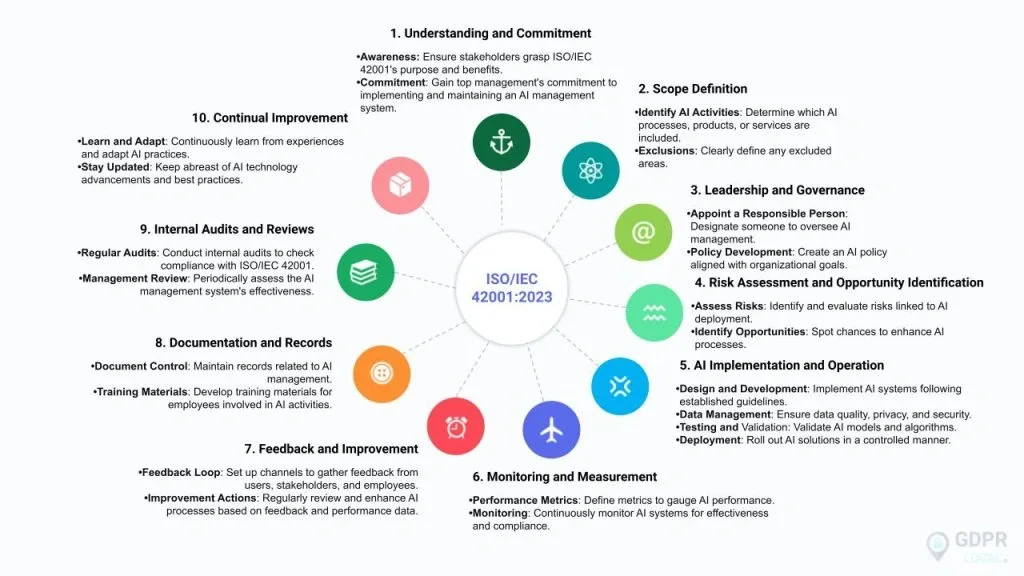
Image Source: Northwest AI Consulting
Building a strong Artificial Intelligence Management System (AIMS) needs a step-by-step approach that starts with knowing your organization’s AI ecosystem. A well-implemented AIMS serves as the foundation of responsible AI governance and makes shared compliance and innovation possible.
Understanding your AI context and stakeholders
A successful AIMS starts with a detailed stakeholder analysis. Research shows that identifying stakeholders plays a significant role in AI projects. AI systems can negatively affect individuals, society, and the environment without proper management. Project managers must identify both active and passive stakeholders early.
Passive stakeholders need special attention. These people and groups feel the effects of AI systems but can’t influence the project. End-users, communities affected by AI decisions, and regulatory bodies fall into this category. Here’s how to identify these stakeholders:
-
Apply stakeholder salience models with harm and urgency attributes
-
Let representatives of passive stakeholders take part throughout development
-
Think about ethical implications across the entire AI lifecycle
Your AIMS framework should document stakeholder expectations and requirements. This approach creates accountability and gives everyone’s viewpoint proper weight in designing AI governance structures.
Defining the scope of your AIMS
ISO/IEC 42001 asks organizations to set clear boundaries for their AIMS. Your scope definition should reflect your organization’s situation, stakeholder needs, and AI activities.
Start by identifying your AI roles—you might be an AI provider, producer, user, or a mix of these. Each role has its own responsibilities under the standard. Next, pick which AI systems belong in your scope by looking at:
-
Departments or teams developing or using AI
-
Physical and virtual locations of AI work
-
Internal and external factors that shape your AI operations
Keep your scope statement clear and brief, and explain any exclusions. Implementation experts say many organizations make their scope too narrow. This leads to “audits that lack credibility, certifications that carry less assurance, and management systems that disconnect from systems that actually present risk”.
Creating an AI policy that matches business goals
Your AI policy acts as the life-blood of your AIMS by turning business objectives into governance principles. Implementation guidance suggests creating clear connections between AI initiatives and organizational goals.
You need a full picture of your organization’s strategic direction before writing your policy. Look at your current business objectives and see how AI can help achieve them. A good AI policy will:
-
Define AI governance roles and responsibilities
-
Establish ethical guidelines and principles
-
Outline risk assessment methodologies
-
Document data governance practices
-
Detail monitoring and evaluation processes
Organizations with mature AIMS often create an AI Risk Council or add AIMS duties to existing governance committees. This setup creates leadership accountability—something ISO 42001 Clause 5 specifically requires by putting top management at the heart of successful implementation.
Setting up an AIMS might seem overwhelming at first. The Plan-Do-Check-Act method in ISO 42001 lets you improve gradually. You can start with basic elements and improve your AIMS as your AI governance grows stronger.
Building Organization-Level ISO 42001 Controls
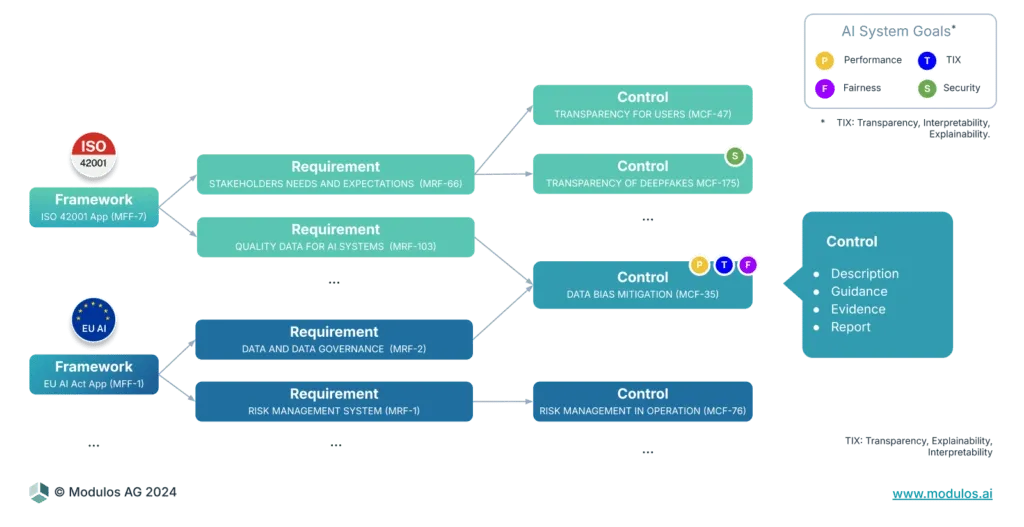
Image Source: Modulos AI
Your AI governance structure needs robust organizational controls to implement ISO 42001 successfully. These controls will give you proper accountability, competence, and full risk management across your AI operations.
Establishing leadership accountability and roles
Strong leadership commitment kicks off an effective ISO 42001 implementation. The standard needs top management to actively support your AIMS throughout the certification lifecycle. Leaders must do more than just approve – they should champion AI initiatives, push for continuous improvement, and check how well the AIMS works.
We focused on setting up clear AI governance structures where specific teams take charge of oversight. This includes:
-
Executive-level accountability enforced through formal committee charters
-
Cross-functional steering groups with real decision rights
-
Defined escalation pathways to address compliance issues
You should think about creating a cross-functional AI accountability committee that reports to your board. This helps review model ethics and compliance before deployment. As one expert notes, “AI without accountability doesn’t just create ethical risk—it distorts financial value”.
Teams must have clear roles in AI safety, security, development, data quality management, and governance. This split makes sure experts handle every part of AI system management.
Training teams on AI ethics and governance
After setting up roles, your team needs the right knowledge. ISO 42001 asks organizations to spot specific skills needed for AIMS activities and provide proper training.
Start by checking what your teams know about AI development, deployment, and oversight. Then create targeted training programs that cover:
-
Basic principles of AI ethics and governance
-
Ways to make responsible AI decisions
-
Methods to spot and fix bias in algorithms
-
Legal and regulatory frameworks for AI
Whatever industry you’re in, training should happen regularly. Many companies fail because they only give generic, one-time AI training that leaves staff unprepared for real-life challenges. The better approach uses focused training backed by clear messages.
To help staff work better, create easy-to-access materials like infographics and quick guides that turn your AI policy into a useful tool. This helps everyone understand the rules and what they need to do.
Documenting AI risk assessments and impact evaluations
ISO 42001 stands out by asking for complete AI risk assessments and impact evaluations. This goes beyond normal risk management to tackle AI’s unique challenges.
Organizations must set up operational controls (Clause 8.2) after finding and checking AI risks (Clause 6.1). They also need to watch both the controls and AI systems constantly (Clauses 9 and 10).
AI Impact Assessments (AIIAs) play a key role, especially for high-risk cases. These assessments look at effects on:
-
Fairness, accountability, and transparency
-
Privacy, security, and human rights
-
Financial and health consequences
AIIAs focus on social, ethical, and legal effects more than standard risk checks. They answer key questions about whether AI use makes sense ethically and won’t cause discrimination or violate rights.
Your records must show the AI systems’ purpose, stakeholder mapping, possible effects, and ways to reduce risks. These documents should be open to internal and external parties based on your strategic plans.
B2B founders can build an effective ISO 42001 program by combining these controls – leadership accountability, team training, and solid documentation. This balances state-of-the-art solutions with responsible governance.
Managing AI Systems with Annex A Controls
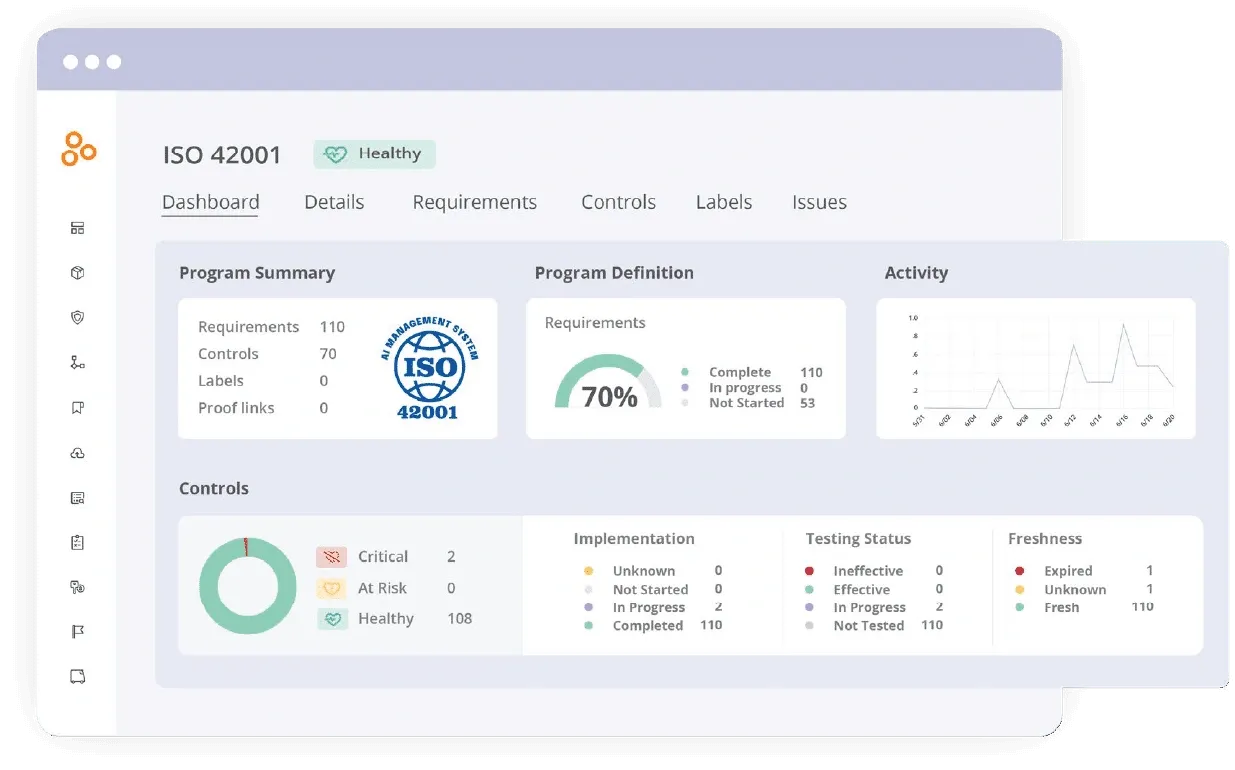
Image Source: Hyperproof
Annex A of ISO 42001 provides specific controls to manage AI systems after you set up your organizational framework. These controls are the foundations of your AIMS implementation and offer practical guidance for day-to-day AI governance.
Inventorying all AI systems in use
ISO 42001 compliance starts with creating a complete inventory of all AI systems in your organization. Annex A requires you to maintain records of technical, data, and human resources connected to AI operations. Your inventory should include everything from datasets and models to decision systems and third-party integrations.
You need an AI System and Tooling Inventory that lists models, training datasets, data feeds, inference engines, and deployment environments. This inventory serves as a central registry that documents your AI assets, their locations, and control mechanisms.
Your inventory management process should include defined ownership, version control, change logs, and regular audits. Annex A.4.2 states that organizations must “maintain an inventory of AI system components, including hardware, software, datasets, third-party libraries, and human resources”. This detailed tracking helps you spot potential risks, apply appropriate controls, and comply with governance regulations.
Documenting training data, testing, and usage
Documentation is the life-blood of ISO 42001 compliance. Annex A.6 covers the entire AI system lifecycle documentation, from requirements to maintenance. Your training data documentation should include:
-
Data acquisition methods, including sources, subject characteristics, and potential biases
-
Data rights and provenance information (creation, updates, sharing)
-
Data quality assessments, including impact of bias
-
Preparation and transformation methods used
Quality testing documentation directly shapes your AI systems’ performance. Document AI research notes that “the quality and amount of your data determines the quality of the training, uptraining, and evaluation”. Rigorous documentation protocols during testing phases help you identify risks and performance issues early.
Monitoring AI performance and compliance
The final critical component of ISO 42001 Annex A controls is ongoing monitoring. Your monitoring framework should specify what you track (accuracy, fairness, drift, resource usage) and how often. A combination of automated monitoring tools and human review provides complete oversight.
Clear change management procedures are essential for updating AI systems through model retraining, data pipeline alterations, or logic modifications. The standard requires you to “assess risks before making changes and ensure updates do not violate regulatory requirements”.
Active metadata management supports compliance monitoring by collecting dynamic, contextual information about your AI systems. Unlike static traditional metadata, active metadata scans systems continuously, detects patterns, and generates insights for immediate compliance monitoring.
Record all monitoring results and corrective actions. This documentation creates an audit trail that shows your steadfast dedication to responsible AI governance—crucial evidence during formal ISO 42001 certification audits.
B2B founders can build a governance framework that welcomes breakthroughs while upholding ethical standards and regulatory compliance throughout the AI lifecycle by implementing these Annex A controls systematically.
Preparing for ISO 42001 Certification
Your next big step after setting up your AI governance framework is getting ready for ISO 42001 certification. This step-by-step process needs a full picture, proper documentation, and teamwork with qualified auditors.
Gap analysis and documentation checklist
A detailed gap analysis helps you assess your current AI practices against ISO 42001 requirements. This vital check gives you a clear view of what needs improvement and sets your starting point for implementation. Here’s how to get a good gap analysis:
-
Define the scope by determining which AI systems and processes to include
-
Assemble a cross-functional team familiar with ISO 42001 clauses and controls
-
Document existing AI-related practices and policies
-
Compare your current state against each ISO 42001 requirement step by step
Good documentation matters throughout this process. ISO 42001 needs many records, including an AIMS manual, scope statements, risk assessments, and AI policy documentation. These documents guide your operations and show stakeholders how mature your governance is.
Internal audit and corrective actions
A internal audit should happen before formal certification to check ISO 42001 compliance and spot any issues. Your internal audit should:
-
Use qualified internal auditors who aren’t part of the implementation team
-
Follow a well-laid-out audit plan covering all ISO 42001 requirements
-
Record findings, including potential problems and ways to improve
-
Fix issues by addressing their mechanisms, not just surface problems
Audit plans, monitoring records, internal audit reports, and gap closure reports need proper documentation. These audits help your organization prepare for certification by finding issues before external review.
Working with accredited auditors for certification
ISO 42001 certification happens in two audit stages through accredited certification bodies. The first stage looks at your readiness by reviewing documentation, checking scope, policies, and risk management methods. The second stage checks how well your AIMS works by looking at your policies, controls, and processes in action.
Picking the right auditor matters just as much as being prepared. Choose certification bodies that recognized national accreditation bodies have approved. This ensures they’re competent and unbiased. Find auditors who know your industry and understand AI – they’ll give you more than just a compliance check.
A successful certification gets you an ISO 42001 certificate that lasts three years. You’ll need yearly check-ups to make sure you stay compliant and keep improving.
Integrating ISO 42001 with Other Standards and Tools
Organizations find great value when they blend their AI governance with existing management systems, beyond just implementing ISO 42001 alone. This integrated way improves compliance and deepens overall governance.
ISO 27001 and ISO 27701 integration opportunities
ISO 42001, ISO 27001, and ISO 27701 share a natural compatibility in their structure. These standards share similar clauses that cover context, leadership, planning, support, operation, performance evaluation, and continual improvement. Organizations can build unified frameworks that handle multiple compliance areas at once because of this arrangement.
Companies with ISO 27001 certification can add AI governance to their information security management system (ISMS). This approach lets them reuse:
-
Central policies and management review processes
-
Unified risk assessment methods (with domain-specific tagging)
-
United audit frameworks and improvement tracking
Each standard has its own focus areas. ISO 42001 looks at AI ethics and transparency, ISO 27001 deals with information security, and ISO 27701 tackles privacy requirements. Good integration respects these differences while cutting out duplicate processes.
Using platforms like ISMS.online for compliance
Digital platforms make multi-standard compliance much simpler. ISMS.online supports over 100 standards and regulations in one place. These platforms help organizations to:
Create central document management with cross-standard evidence tagging. Build unified dashboards that monitor compliance across standards. Make compliance tasks automatic, like documentation reviews and approval processes.
Organizations see big gains in efficiency. Teams can tag every document, log, training record, and report for all relevant standards and clauses. This method turns manual, error-prone processes into simplified workflows.
Balancing agility with structured governance
Organizations don’t need to sacrifice innovation for compliance, despite complete requirements. The best integration balances structured governance with flexible operations.
Teams should keep specialized documentation for each standard while uniting core processes. A company might have one steering committee that oversees information security, privacy, and AI governance, with specialized working groups handling specific areas.
ISO 42001’s Annex D offers guidance about integration with other management systems. It recognizes that coordinated implementation should improve organizational flexibility rather than limit it.
Conclusion
ISO 42001 serves as a key framework for B2B founders in today’s faster-evolving AI world. This state-of-the-art standard bridges the gap between innovation and responsible governance. B2B founders now have a well-laid-out approach to manage AI risks while staying competitive.
This piece shows how ISO 42001 certification turns AI governance from a regulatory burden into a strategic asset. The framework gives clear guidelines to establish leadership accountability and train teams on AI ethics. It also provides detailed risk assessments. You’ll find practical controls to inventory AI systems, document training data, and track ongoing compliance.
B2B founders who adopt ISO 42001 early gain an edge in today’s regulated market. Smart organizations don’t wait for mandatory compliance requirements. They use this standard to build trust with customers, partners, and investors who want fair, reliable, and secure AI systems.
Getting certified might look challenging at first. A step-by-step approach makes this trip manageable through gap analysis, documentation, internal audits, and work with accredited certification bodies. Organizations that already have ISO 27001 certification can find many ways to integrate both standards.
Note that ISO 42001 compliance doesn’t hold back innovation. The standard creates guardrails that welcome responsible AI development and minimize risks. Its Plan-Do-Check-Act method helps organizations improve continuously as technologies and regulatory expectations change.
AI will without doubt keep altering the map of B2B business. Companies with resilient governance frameworks will thrive while others struggle with increasing oversight. ISO 42001 goes beyond compliance – it forms the foundations of sustainable growth in an AI-driven future.
Key Takeaways
ISO 42001 represents the world’s first international standard for AI Management Systems, providing B2B founders with a structured framework to transform AI governance from regulatory burden into competitive advantage.
• Early adoption creates trust signals: ISO 42001 certification positions startups ahead of mandatory compliance, with major tech companies now requiring it from vendors • Leadership accountability is mandatory: Top management must be actively involved in AI governance, establishing clear roles and cross-functional oversight committees • Comprehensive documentation drives success: Maintain detailed inventories of AI systems, training data, and risk assessments to demonstrate responsible governance • Integration amplifies efficiency: Combine ISO 42001 with existing standards like ISO 27001 to create unified compliance frameworks without sacrificing innovation • Structured approach enables scalability: Use the Plan-Do-Check-Act methodology to build AI governance that grows with your business while maintaining ethical standards
The standard addresses the critical trust gap in AI—where buyer confidence dropped from 50% to 35% between 2019-2024—by providing measurable frameworks for responsible AI development. Organizations implementing ISO 42001 report faster enterprise onboarding, reduced legal exposure, and enhanced operational resilience, making it essential for B2B success in an increasingly AI-regulated marketplace.
FAQs
Q1. What is ISO 42001 and why is it important for B2B companies? ISO 42001 is the world’s first international standard for AI Management Systems. It’s important for B2B companies because it provides a structured framework for responsible AI governance, helping businesses manage risks, comply with regulations, and build trust with customers and partners in an increasingly AI-driven marketplace.
Q2. How can implementing ISO 42001 benefit B2B startups? Implementing ISO 42001 can benefit B2B startups by positioning them ahead of mandatory compliance requirements, accelerating sales cycles, reducing legal exposure, and enhancing operational resilience. It also serves as a powerful trust signal that can give startups an edge over competitors in enterprise sales.
Q3. What are the key components of an AI Management System (AIMS) under ISO 42001? Key components of an AIMS under ISO 42001 include stakeholder analysis, scope definition, AI policy creation, leadership accountability, team training on AI ethics, comprehensive risk assessments, and thorough documentation of AI systems and processes.
Q4. How does ISO 42001 integrate with other standards like ISO 27001? ISO 42001 shares a similar structure with standards like ISO 27001, allowing for integrated implementation. Organizations can extend existing management systems to encompass AI governance, reusing central policies, risk assessment methodologies, and audit frameworks while addressing the unique focus areas of each standard.
Q5. What steps are involved in preparing for ISO 42001 certification? Preparing for ISO 42001 certification involves conducting a gap analysis, creating comprehensive documentation, performing internal audits, implementing corrective actions, and working with accredited certification bodies. The process typically includes a two-stage audit, resulting in a certificate valid for three years with annual surveillance audits.