CYBER SECURITY COMPLIANCE · CMMC Managed Services
CMMC End-to-End Managed Services
Hands-On Execution, Scope Reduction and Enclave Deployment
With third-party certification suspended, the contractor’s own Level 2 self-assessment is the assertion of record and the affirming senior official carries the False Claims Act exposure alone. That makes scope the decision that matters most. An enterprise-wide boundary produces a self-assessment nobody can honestly evidence; a tightly scoped enclave produces one that holds up. Elevate Consult coordinates scope, documentation, evidence, remediation and readiness alongside your team, and deploys a CMMC enclave where reducing the boundary is the right answer.
2026 UPDATE
What the Phase 2 suspension changed, and what it did not
Third-party certification is suspended and the suspension is now regulation
The Department of War suspended CMMC Phase 2 on 13 July 2026, and Revision 3 of class deviation 2026-O0025, signed 3 September 2026, directs contracting officers to remove third-party assessment requirements from solicitations and contracts. Only CMMC Level 1 (Self) and Level 2 (Self) may currently be designated, with no waivers.
That raises the value of scope discipline rather than lowering it
Under a certification model, an assessor tests the boundary and the evidence. Under self-assessment, nobody does until something goes wrong. A narrow, defensible boundary is the difference between an affirmation an officer can sign with confidence and one they are signing on trust.
That raises the value of scope discipline rather than lowering it
Under a certification model, an assessor tests the boundary and the evidence. Under self-assessment, nobody does until something goes wrong. A narrow, defensible boundary is the difference between an affirmation an officer can sign with confidence and one they are signing on trust.
Contracts do not update themselves
Third-party requirements come out of awarded contracts at the next option exercise or scheduled administrative modification. Until the modification is signed, the clause still binds. Confirm removal in the contract file in writing rather than assuming it happened.
Every underlying obligation survived
DFARS 252.204-7012 is unchanged. The 110 requirements in NIST SP 800-171 Revision 2 are unchanged. The SPRS score and the annual senior official affirmation remain conditions of eligibility. 32 CFR Part 170 is still codified. What disappeared was the independent party who would have tested the claim.
Enforcement did not pause
The Department of Justice announced cybersecurity False Claims Act settlements during the review window. A contractor that overstates a self-assessment score carries that exposure without an assessor’s findings to show the claim was independently tested.
WHY PROGRAMMES STALL
Not because nobody knows what to do
CMMC programmes rarely stall on knowledge. They stall because nobody is moving documentation, remediation and evidence forward at the same time, and because ownership is unclear across security, IT and compliance.
Enterprise-wide Level 2 readiness has typically taken twelve to eighteen months. The work is real: scoping CUI flows, retooling environments, rewriting policies, deploying controls, organizing evidence. Most contractors do not have eighteen months, and some do not have nine.
TWO WAYS TO COMPRESS THE TIMELINE
One operational, one structural
The operational answer is to stop running CMMC as a side project and put a coordinated team on the work. The structural answer is to stop trying to cover the entire company and scope to an enclave instead. Most clients use both.
MNS Microsoft Enclave
Microsoft 365 GCC or GCC High on Azure
Use your existing company-approved devices. Best for teams already running Microsoft 365 that want to keep familiar Outlook, Teams and SharePoint workflows. Quick setup. Verified by DIBCAC.
Included in both
MNS cannot then assess you
MNS is an authorized C3PAO as well as the provider that builds the enclave. If you deploy through this partnership, MNS cannot serve as your assessment organization. That is the correct outcome rather than a limitation: the separation between the party that builds a control environment and the party that judges it is what makes any assessment result worth presenting.
Scope growth
On your terms
Start contract-specific and expand toward enterprise-wide if the CUI footprint grows, rather than committing to the larger boundary before the business requires it.
SecureCMMC Google Enclave
Google Workspace, FedRAMP High-rated
Purpose-built Chromebooks that wipe when the lid closes. Best for teams that want lower licensing cost, faster subcontractor onboarding and a minimal device footprint. Quicker setup. Verified by DIBCAC and used by C3PAOs.
Ownership model
You keep the keys
The enclave belongs to your business. You hold the tenant keys, the policies and the logs. Elevate helps set it up and can help operate it, and if you take it in a different direction the enclave goes with you.
The lease model to avoid
Why ownership matters
Many lower-cost providers lease the enclave back to the client and hold the keys to the tenant, the policies and the logs. The initial price looks attractive, but switching providers later means buying a new enclave and, in many cases, redoing the assessment work already completed.
THE CMMC ENCLAVE
A boundary you can actually defend
An enclave is a tightly scoped, isolated environment where Controlled Unclassified Information lives, is processed and is accessed. Instead of assessing every laptop, server and user in the organization, the assessment covers the enclave. Scope shrinks, cost shrinks, timeline shrinks, and the contracts you can pursue stay the same.
Elevate does not build enclaves. They are deployed through a partnership with MNS, a managed services provider with more than twenty years supporting federal contractors, whose security controls you inherit. MNS is also an authorized C3PAO, which means that if you deploy an enclave through this partnership, MNS cannot act as your assessment organization. Elevate states that upfront rather than leaving a contractor to discover it when they go to select an assessor.Ç
Under the current self-assessment regime the argument changes emphasis. The enclave is no longer primarily about reaching a certificate faster. It is about producing a self-assessment and an affirmation that an officer can sign, and that would survive a False Claims Act inquiry, because the boundary is small enough to evidence honestly.
Program coordination
Organize owners, timelines, dependencies and decisions so the work does not stall between teams. This is the single largest cause of delay and it is not a technical problem.
Enclave strategy and planning
Evaluate whether an enclave fits, define the boundary, and plan the deployment as part of the broader programme rather than as a separate infrastructure project.
Remediation coordination
Translate findings into prioritized action plans and work with technical stakeholders to keep remediation moving toward closure rather than toward the next status meeting.
Affirmation readiness
Prepare the evidence behind the SPRS score and the annual senior official affirmation, so the person signing can point to the artifact behind each claim.
Scope and boundary support
Define what is in scope, what is out, and where shared responsibility needs to be documented. Under self-assessment this determines whether the affirmation is defensible.
Environment and operations support
Align readiness across cloud, on-premises, hybrid and enclave-based environments so technical decisions support the boundary rather than complicating it.
Documentation and evidence management
System Security Plan refinement, Plan of Action and Milestones management where applicable, policy alignment, and evidence organized so it can be defended and maintained.
Ongoing readiness operations
Establish the operating rhythm that keeps compliance from slipping after the initial push, including the annual affirmation cycle.
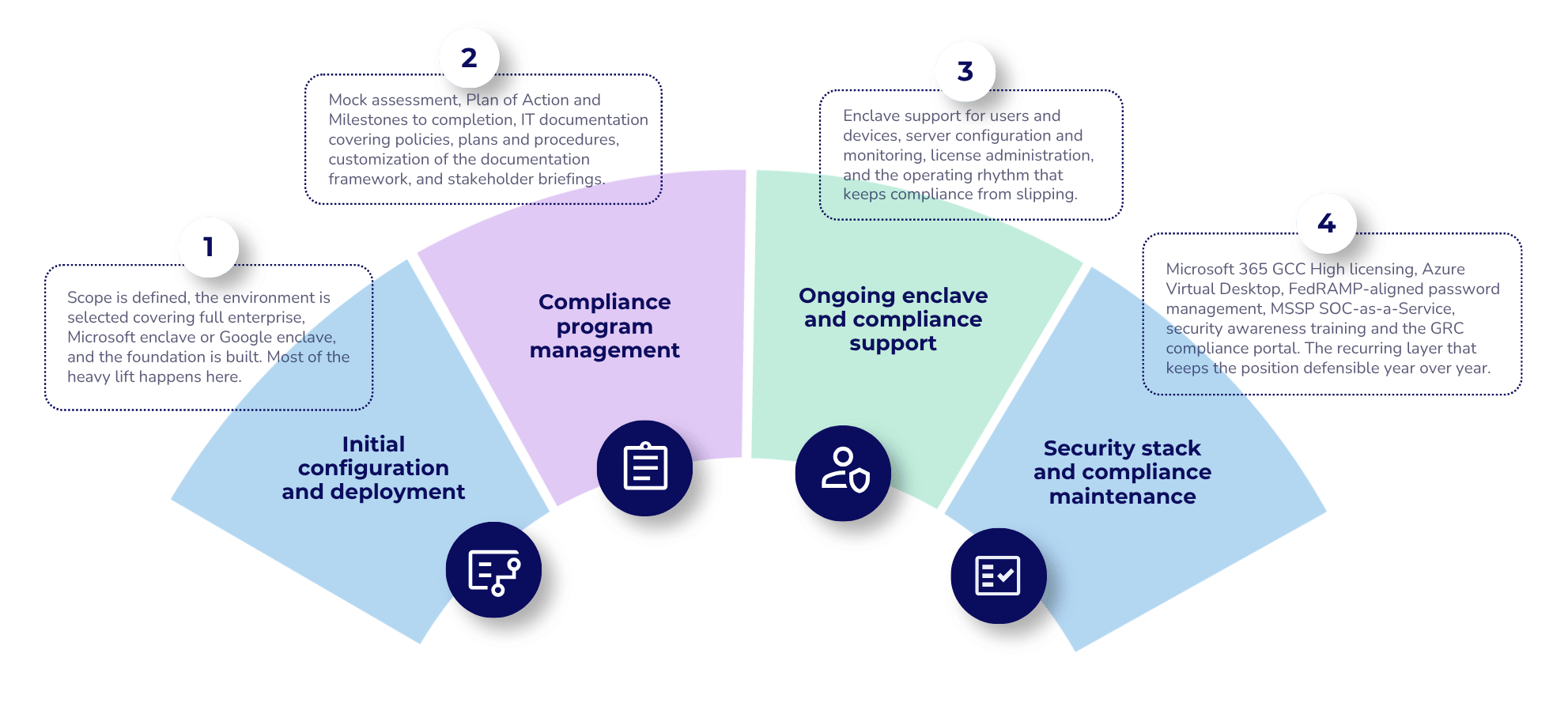
ENGAGEMENT PHASES
How the work runs
WHO THIS IS FOR
Roles Elevate works with on this standard
GET STARTED
Ready to see what your path would look like?
Elevate Consult coordinates the work across readiness, remediation, documentation and affirmation, and deploys an owned enclave where reducing the boundary is what makes the self-assessment defensible. Pricing is scoped to your environment, user count and the path you choose.
FAQ
Common Questions
🡪 Is CMMC cancelled? Should we stop?
No, and no. Phase 2 is suspended, not repealed. The programme rule remains codified at 32 CFR Part 170, DFARS 252.204-7012 is unchanged, and the 110 requirements in NIST SP 800-171 Revision 2 still apply. Pausing certification-specific spend where no customer requires it is defensible. Pausing control implementation is not, because those controls are mandated independently of CMMC.
🡪 If certification is suspended, why scope an enclave?
Because the argument changed emphasis rather than disappearing. Under certification, an assessor tested the boundary. Under self-assessment, the contractor’s own affirmation is the assertion of record and nobody tests it until something goes wrong. A narrow boundary produces a self-assessment that can be honestly evidenced and an affirmation an officer can sign with confidence. An enterprise-wide boundary usually does not.
🡪 How long does an enclave take versus enterprise-wide?
An enclave compresses readiness to a fraction of the twelve to eighteen months enterprise-wide work has typically required. The exact timeline depends on user count, environment complexity and existing documentation maturity. The compression is structural: only the scoped environment where CUI lives is in scope, rather than every system in the business.
🡪 If MNS builds our enclave, can they also assess us?
No, and that is deliberate. MNS is an authorized C3PAO as well as the provider that deploys the enclave. Where MNS has built or operates an organization’s environment, it cannot serve as that organization’s assessment organization. The constraint follows from the same separation principle that governs the whole scheme: C3PAO accreditation rests on ISO/IEC 17020 Type A requirements for a third-party inspection body, and a body cannot impartially judge an environment it helped build. Elevate raises this at scoping so the assessor decision is made with the information rather than around it.
🡪 Do we own the enclave or are we locked in?
You own it. You keep the tenant keys, the policies and the logs. This is deliberate. Many lower-cost providers lease the enclave back, which means switching later requires buying a new one and repeating work already done. Enclaves deployed through Elevate work the opposite way: the enclave belongs to your business and goes with you.
🡪 Microsoft GCC High or Google Workspace?
Microsoft if the team already runs Microsoft 365 and wants to keep existing devices and Outlook, Teams and SharePoint workflows. Google if the priority is lower licensing cost, faster subcontractor onboarding and a minimal device footprint using purpose-built Chromebooks. Both are FedRAMP-aligned and verified by DIBCAC.
🡪 Does managed service mean we outsource responsibility?
No. The organization still owns compliance outcomes, and under self-assessment that is more consequential than before, because the affirmation is signed by your senior official rather than validated by an assessor. Managed support moves the work forward; internal ownership, decision-making and accountability remain with the contractor.
🡪 How is this different from a mock assessment?
A mock assessment is a focused pre-assessment exercise that tests readiness at a point in time. End-to-End Managed Services is a broader engagement that runs the work across planning, remediation, documentation and ongoing readiness. Many clients use the mock assessment as a checkpoint inside the managed engagement rather than instead of it.