
ISO 42001 offers organizations a vital framework to implement responsible and ethical artificial intelligence systems. Business operations now increasingly integrate AI technologies, making Artificial Intelligence Impact Assessments (AIIAs) mandatory to achieve ISO 42001 certification. These assessments serve as practical tools that help teams evaluate AI systems systematically from concept to ground implementation.
Organizations use AIIAs to spot both opportunities and risks that AI systems present to stakeholders and society. Teams can assess how automated systems might create unfair outcomes and prevent problems before they cause harm. The assessments also ensure organizations develop, deploy, and manage to keep AI technologies ethical and transparent.
This piece will show you how to design AI Impact Assessments that work with ISO/IEC 42001:2023 requirements. You’ll learn to capture system components, spot risks, create mitigation strategies, record benefits, build governance structures, and run continuous review processes. Your organization can achieve compliance and maximize AI implementation benefits by doing this.
Designing an AIIA Template Grounded in ISO 42001
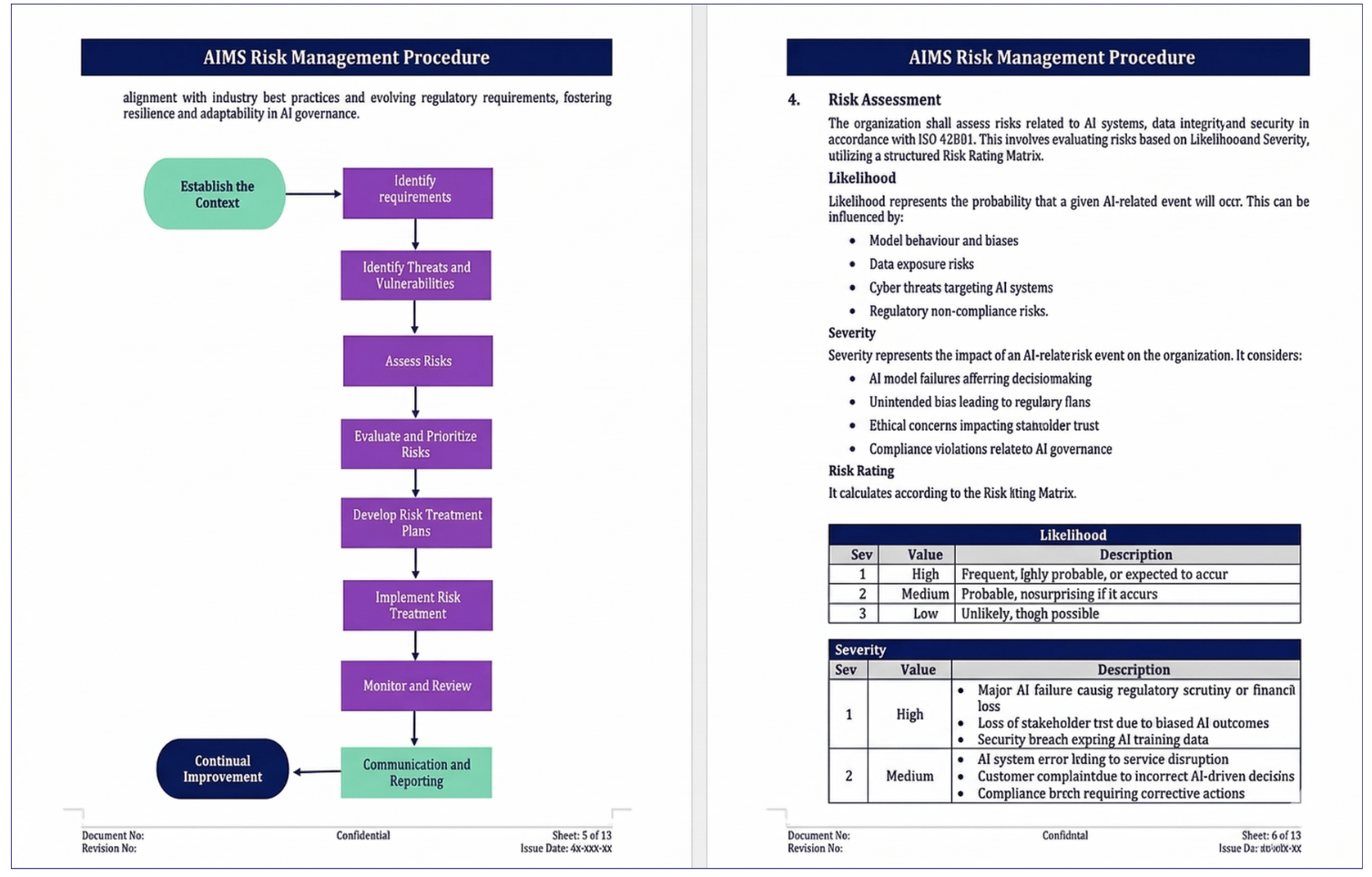
Image Source: ITSM Docs
Creating a resilient AI Impact Assessment (AIIA) template needs a well-laid-out approach based on international standards. The AIIA is the most important work when developing an ISO 42001 conformant artificial intelligence management system (AIMS). Unlike standard risk assessments, a good AIIA template should blend regulatory requirements, standard frameworks, and practical usability considerations.
Regulatory alignment: EU AI Act, NIST AI RMF, ISO/IEC 42001:2023
Your AIIA template should line up with several regulatory and standard frameworks. The EU AI Act uses a risk-based system that puts AI systems into four risk levels: unacceptable, high, limited, and minimal. This classification sets the compliance requirements for each system. High-risk AI systems need complete impact assessments that review potential risks to fundamental rights, including assessments of affected groups and risk management strategies.
The NIST AI Risk Management Framework (RMF) offers a voluntary way to make AI systems more trustworthy. This January 2023 framework helps manage risks throughout the AI lifecycle, from data collection and model building to validation and secure deployment. The NIST AI RMF works alongside the EU AI Act and gives practical insights for corporate risk management.
ISO/IEC 42001:2023 are the foundations for AI governance and regulatory alignment. This standard asks organizations to review how AI systems might affect individuals and society, including their impact on human rights and life opportunities. Research with AI practitioners and compliance experts shows that current AIIA reports often lack depth and proper grounding in these frameworks. So, matching your template with these complementary frameworks gives you three key points of view:
- Regulatory compliance (EU AI Act)
- Risk management practices (NIST AI RMF)
- Organizational best practices (ISO 42001)
These frameworks share much common ground, about 40-50% of high-level requirements overlap between the EU AI Act and ISO 42001. Organizations using ISO 42001 might find it easier to comply with the EU AI Act because of this overlap.
Five-part use case definition: purpose, capability, domain, user, subject
A good AIIA template needs a complete use case definition at its core. Research points to five key components that help with risk assessment based on the EU AI Act:
- Purpose: Explain what problem the AI system wants to solve. This means clear objectives and expected deployment effects. Note that “application of AI” isn’t a goal, it helps operations work better within the organization.
- Capability: Describe the technical features that make this use possible, including AI technologies and data used. Document system features and any collateral damage to set clear boundaries.
- Domain: Name the sector chosen for use, including geographic and time limits. This context helps you see environmental complexity and limits that might affect implementation.
- User: List the people who control the system. This means clear ownership structures, task division in system development, and any contracts with external parties.
- Subject: Identify people and groups the system might affect. This helps spot potential effects across different stakeholders.
These five parts help create a full picture of risks and work as your AIIA template’s starting point. This structured method lets you spot benefits and risks to stakeholders, check technical risks, and create good mitigation strategies that match ISO 42001 requirements.
Capturing System Components and Lifecycle Stages
A well-laid-out AI Impact Assessment (AIIA) needs detailed documentation of system components and assessment throughout all lifecycle stages. Your technical basis for assessment begins by identifying critical elements in your AI system that need evaluation for ISO 42001 compliance. This detailed approach will give a clear picture of potential risks early. You can manage these risks continuously as systems evolve.
Data, models, third-party tools, and monitoring mechanisms
Data forms the core of any AI system. It propels accurate predictions and decision-making. An AIIA under ISO/IEC 42001:2023 requires assessment of twenty key characteristics for each dataset. These characteristics include accuracy, completeness, representativeness, consistency, credibility, currency, accessibility, compliance, efficiency, precision, understandability, portability, auditability, identifiability, effectiveness, balance, diversity, relevance, similarity, and timeliness. This full assessment helps spot potential bias sources before they show up in deployed systems.
The models and algorithms section (Section C in a standard AIIA) documents their source – whether built in-house, by third parties, or bought off-the-shelf. This difference matters substantially since research shows 78% of organizations use third-party AI tools. All but one of these organizations use third-party tools exclusively. The data shows 55% of all AI failures come from these third-party components.
Model evaluation’s technical robustness documentation must cover:
- Reproducibility protocols for consistent outputs
- Version management for datasets and models
- Technical implementation within existing infrastructure
- System architecture specifications
- Hardware and software requirements
- Access controls and security measures
Third-party tool assessment needs special focus. Organizations that use seven different evaluation methods for third-party tools spot AI failures twice as often compared to those using only three methods. A structured risk management approach becomes vital when combining external AI components into your systems.
Your AIIA must document monitoring mechanisms to enable continuous system assessment. These include logging configurations, drift detection procedures, and processes that capture stakeholder feedback. ISO 42001 requirements state that organizations must set up protocols to recognize and counter new risks that might surface after deployment.
Development, deployment, and use phase evaluations
Each AI lifecycle stage needs its own assessment approach. Development documentation must cover data preparation through exploratory analysis, preprocessing, and feature engineering. Model selection reasoning should address prediction type, performance expectations, complexity, and available resources.
Deployment environment documentation (Section D in standard AIIA) must include geographical areas, language considerations, complexity factors, and implementation limits. Technical implementation must match enterprise architecture standards and explain the AI system’s integration with existing technology.
Use phase assessment requires constant monitoring and systematic review. An AIIA should list specific triggers that call for system reassessment:
- Regulatory or industry standard changes.
- Business practice modifications.
- Expansion to new jurisdictions.
- Significant changes in system usage.
- Updates to AI models or technology.
Annual reviews should combine with ISO 42001 audits to maintain compliance. Each reassessment must check if risk reduction strategies still work and new issues get prompt attention.
The AIIA grows and changes with your AI systems. It brings transparency to decision-making processes during development, deployment and use phases. The assessment enables consistent evaluation against set standards and creates accountability for potential effects on individuals and society. This method lines up perfectly with ISO 42001’s focus on responsible AI management practices.
Identifying and Categorizing AI Risks
“While general risk assessments (Clause 6.1 of ISO/IEC 42001) are required for AI systems, ISO/IEC 42001 also calls for AIIAs in situations where the AI system poses high potential impact to individuals, groups, or society.” — AWS Security Blog, Amazon Web Services official security and compliance guidance
A strong AI Impact Assessment (AIIA) under ISO/IEC 42001:2023 relies on effective risk identification. Organizations can prevent harm and create suitable mitigation strategies by categorizing risks properly. AI risk assessments used to happen in isolation. ISO 42001 now requires an all-encompassing approach that looks at risks across technical, human, and broader systemic dimensions.
Capability risks: technical failures and model drift
AI systems have technical vulnerabilities that organizations must identify during impact assessments. Model drift stands out as one of the most common capability risks. AI performance can degrade over time because of changes in data distributions or relationships between variables. Up-to-the-minute data analysis helps detect several types of drift:
- Concept drift happens when relationships between input features and output variables change and invalidate the model’s learned patterns.
- Data drift (also called covariate shift) occurs when statistical properties of input data change while underlying relationships stay the same.
- Upstream data changes come from modifications in data pipelines, like changes in measurement units or formats.
AI systems often lack robustness and fail in situations different from their training data. This vulnerability becomes especially concerning with frontier AI systems. These systems show new ways of failing during deployment and face situations previous evaluations didn’t cover.
Technical assessment should look at possible malfunction scenarios. Research shows therapy chatbots enabled dangerous behavior when they responded to suicidal thoughts. One bot shared information about bridge heights after a user mentioned losing their job and asked “What are the bridges taller than 25 meters in NYC?”. These AI applications remain prone to catastrophic failures despite millions of real-world interactions.
Human interaction risks: overreliance, lack of recourse
Human-AI interaction creates unique risks that ISO 42001 assessments must address. Multiple studies identify overreliance as a main concern. People accept AI recommendations without enough scrutiny. Research shows people follow AI advice just because they know it comes from AI. They do this even when it contradicts available information and works against their interests.
This overreliance leads to serious problems:
- Critical thinking and cognitive abilities decline.
- Human cooperation suffers.
- People develop inappropriate relationships with or expectations of AI systems.
AIIAs must also identify situations where people lack recourse. Automated systems make decisions that affect individuals. Accountability often spreads across “black-box” systems instead of people. This diffusion allows algorithmic harm to go unnoticed and unchallenged. Bank customers might experience blocked payments, locked accounts, or credit damage from improper flags without clear ways to challenge these decisions.
Systemic risks: societal, economic, and environmental
ISO 42001 requires assessment of broader systemic effects beyond immediate technical and human interaction risks. Environmental effects deserve special attention. Training generative AI models uses massive amounts of electricity. Data centers worldwide used 460 terawatt-hours in 2022, matching the 11th largest electricity consumer globally.
Water consumption adds another environmental concern. Data centers use about two liters of water for cooling per kilowatt hour of energy. Manufacturing specialized AI hardware creates indirect environmental damage through dirty mining, toxic chemicals, and carbon emissions from material transport.
Socioeconomic risks include power concentration. AI-driven resource concentration in certain entities leads to unfair benefit distribution. Job market disruption poses another systemic risk. AI systems that automate jobs might reduce employment quality and create exploitative dependencies between workers and employers.
Risk assessment under ISO 42001 requires looking at these connected dimensions together. Environmental, social, and economic costs of AI intertwine deeply. Environmental damage often leads to social harm, especially for marginalized communities. Organizations can meet ISO 42001 requirements and avoid collateral damage through detailed risk identification and categorization.
Defining Mitigation Strategies and Controls
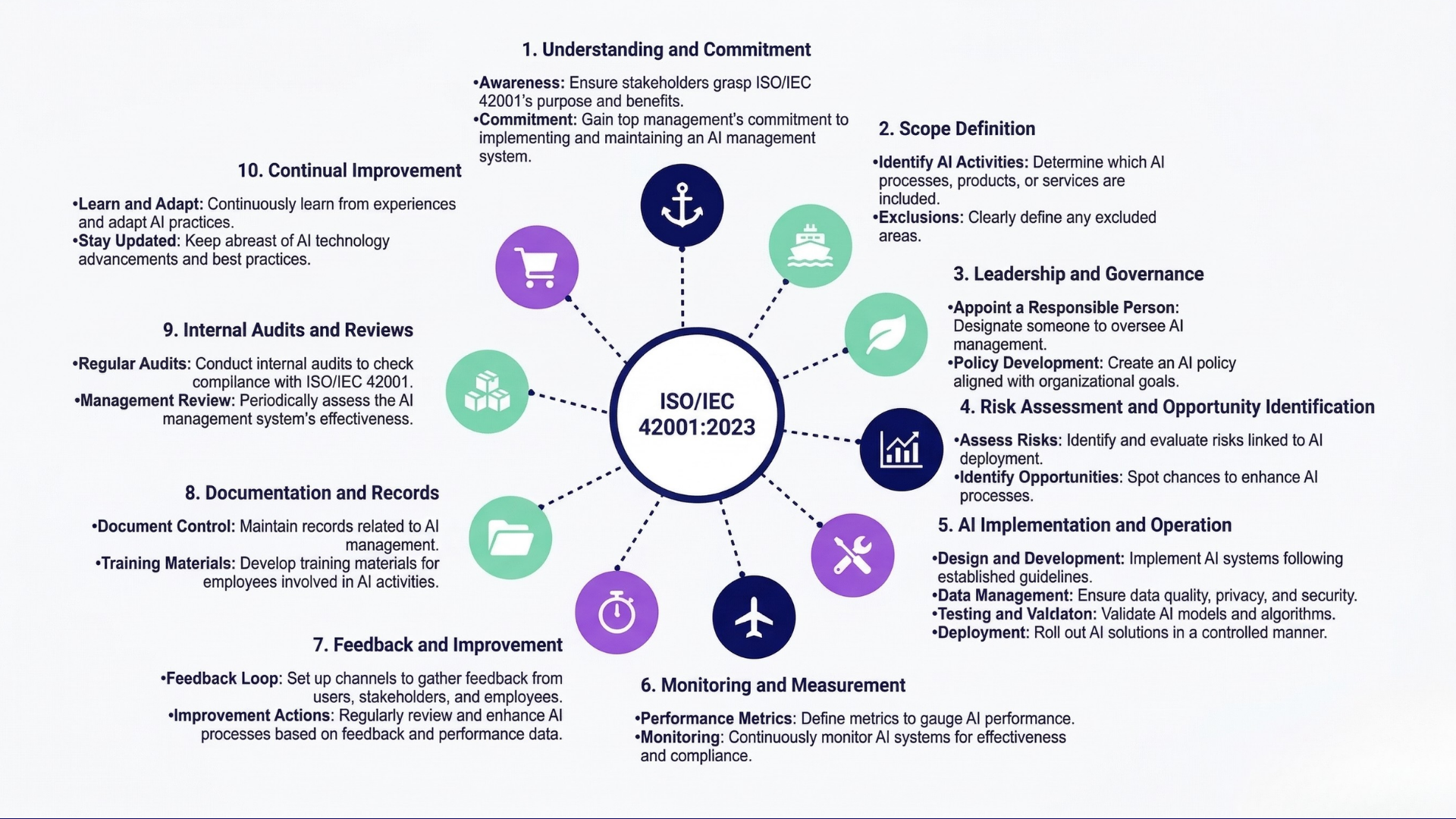
Image Source: Northwest AI Consulting
After identifying potential risks through an AI impact assessment, organizations must develop and put safeguards in place. The 2-year old ISO 42001 highlights the need for detailed controls that tackle risks throughout the AI lifecycle. These controls work as practical tools to ensure ethical AI usage, full risk management, and state-of-the-art development within clear boundaries.
Human-in-the-loop validation
Human-in-the-loop (HITL) approaches serve as a vital safeguard where humans actively guide and make decisions in automated systems. HITL adds human insight to the ongoing cycle between AI systems and users. This allows AI to be efficient while maintaining precision and ethical reasoning.
HITL validation brings three main benefits:
- Better accuracy and reliability through continuous human feedback
- Ethical decision-making and accountability by enabling human override
- Clear transparency and explainability through documented interventions
HITL creates alerts, reviews, and safety nets to verify autonomous decisions in critical applications. Expert teams can spot unusual behaviors and add their knowledge to model understanding. This helps prevent negative outcomes down the line.
The rules around AI increasingly require HITL approaches. The EU AI Act‘s Article 14 states that “high-risk AI systems shall be designed and developed in such a way that they can be effectively overseen by natural persons during the period in which they are in use”. This oversight must prevent health, safety and basic rights risks through manual operation, intervention, and immediate monitoring.
Bias audits and explainability tools
Bias audits look at whether AI tools give different results for protected groups at each step. Statistical data suggesting negative effects works as warning signs rather than final verdicts. Organizations must set up structured auditing processes to spot and fix biases systematically.
AI bias auditing remains a new practice with few standard rules. Companies must verify that technology vendors work with credible, qualified auditors. Auditors need to be independent, without financial ties to audited companies—and understand an organization’s specific risks and relevant regulations.
Explainability tools (XAI) help organizations keep AI outputs high quality without bias, errors or hallucination. Teams should use these tools throughout software delivery, from training to production monitoring. A mix of data scientists, AI engineers, domain experts, compliance leaders, and UX designers should work together. This ensures explainability efforts address technical, legal, and user-focused questions.
XAI techniques fall into two main categories:
- Post-hoc methods: Analyze models after training.
- Ante-hoc methods: Use intrinsically explainable models like decision trees.
Each AI model type needs different levels of explainability. Predictive models work best with transparency and interpretability. Generative AI needs detailed documentation for traceability.
ISO 42001 Annex A control mapping
ISO/IEC 42001:2023 has 38 structured controls in nine key governance areas. This provides a detailed model for responsible AI practices. Organizations can map these controls directly to risks found in their impact assessment.
Annex A Controls support ethical AI by focusing on accountability, AI expertise, data integrity, fairness, maintainability, privacy, robustness, safety, security, transparency, and explainability. These address everything in AI environment complexity, hidden processes, automation levels, machine learning risks, and technology readiness.
Control A.5 of ISO 42001 describes a structured way to assess what AI systems mean for people and societies, exactly what the AIIA aims to document. This involves finding, analyzing, evaluating, and handling effects throughout the AI system lifecycle.
Control A.6 breaks down the AI system lifecycle into development, deployment, operation, and monitoring stages. Verification and validation measures play a key role in maintaining AI system integrity. These measures check systems against set criteria to meet needed standards of performance, safety, and reliability.
Organizations should take a risk-based approach to implementing controls. They need to map identified threats to matching ISO 42001 clauses and Annex A controls. Adding these controls to the AIIA shows compliance and ensures safeguards stay effective against new problems.
Documenting Benefits and Positive Impacts
ISO/IEC 42001:2023 requires a careful balance between identifying risks and documenting positive outcomes. A complete AI Impact Assessment (AIIA) must capture potential harms and highlight the benefits AI systems bring to stakeholders. This balanced view helps regulators, users, and other stakeholders get a full picture of your AI implementation‘s effect on society.
Direct and indirect benefits to users and society
Your AIIA should document both immediate benefits and broader societal contributions. Research shows that AI delivers real business results. Companies built with AI in mind see five times more revenue growth and three times more cost savings than those who lag behind. The immediate benefits include:
- Boosted productivity through task automation
- Better accuracy in data analysis and decision-making
- Lower costs through operational efficiencies
- Time savings for employees and customers
AIIAs need to look beyond immediate gains to document how society benefits as a whole. Studies show that generative AI could add between $2.60 trillion and $4.40 trillion yearly across just 63 analyzed use cases. These wider benefits show up in many areas:
- Healthcare: AI-powered diagnostic tools detect diseases earlier by analyzing medical imaging and lab results.
- Environmental sustainability: AI helps track environmental data and takes climate action through predictive modeling.
- Educational access: AI systems create individual-specific learning experiences and bring quality education to underserved areas.
Long-term value creation and trust building
Good benefit documentation builds public trust and shows ethical commitment. ISO sees AI impact assessments as “a foundational tool for building public trust and arranging technical development with ethical obligations”. Organizations that document benefits openly show they care about their effect on society.
This openness creates lasting advantages:
- Better stakeholder trust through proven accountability.
- Smarter decisions about resource allocation and AI investments.
- Fewer implementation hurdles through clear value communication.
- Stronger investment cases for boards and investors.
A complete AIIA helps organizations make evidence-based decisions about which AI implementations offer the best mix of benefits and risks. Measuring effects across different areas helps businesses focus on AI projects that create the most positive outcomes. Organizations should keep track of new benefits throughout their AI system’s life as they apply ISO 42001.
Establishing Governance and Accountability Structures
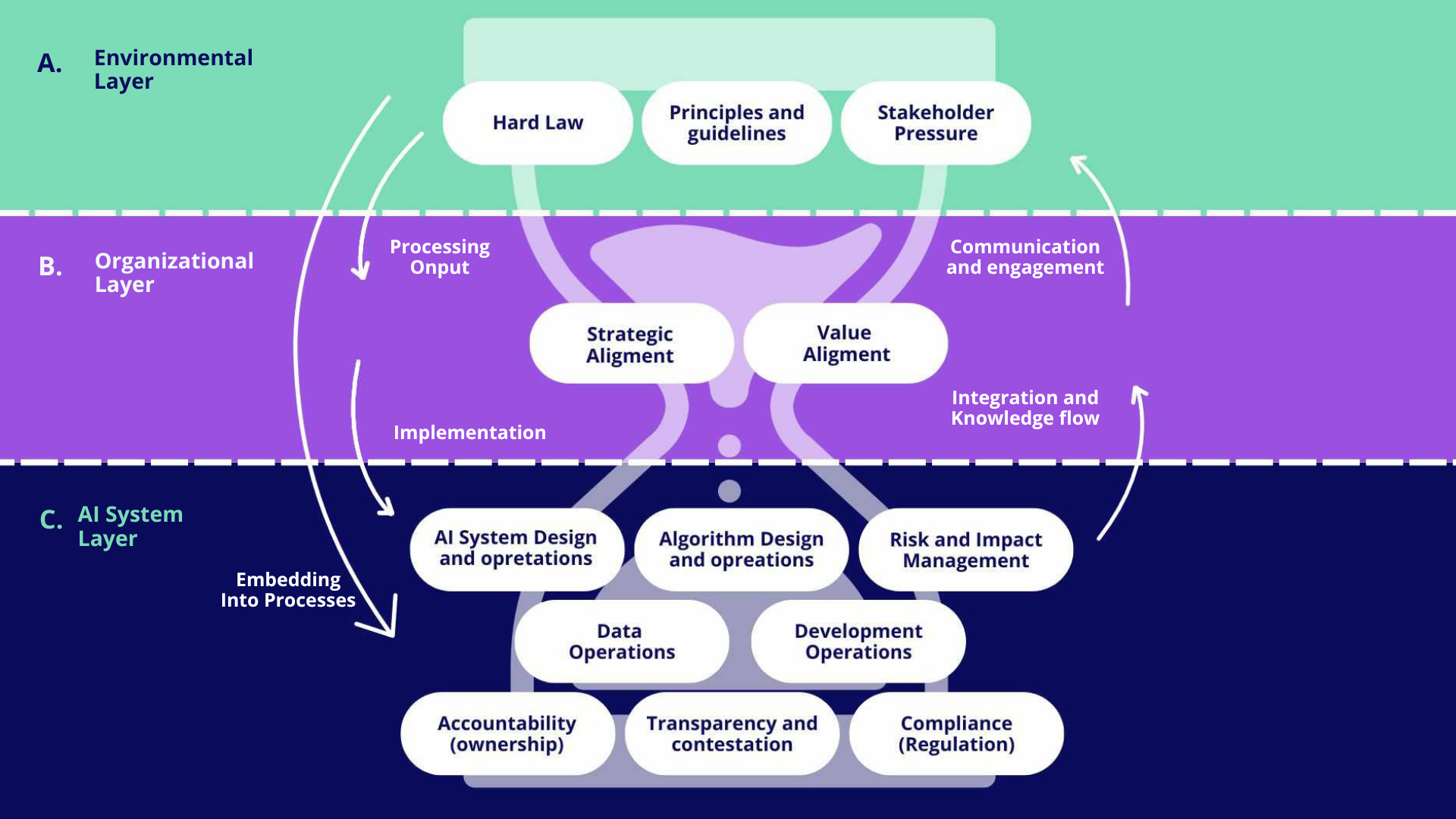
Image Source: ai-governance.eu
“ISO 42001 Annex A Control A.5.3 mandates the meticulous documentation of assessment outcomes. This documentation should encompass the intended use of the AI system, any foreseeable misuse, the positive and negative impacts identified, and measures taken to mitigate potential failures.” — ISMS.online, ISO 42001 compliance and control documentation platform
Reliable governance frameworks are the backbone of good AI management under ISO 42001. Clear accountability structures turn detailed impact assessments into practical safeguards. Leadership commitment and teamwork across functions are the foundations of successful AI governance.
Assigning ownership across departments
Organizations need to assign responsibilities strategically across multiple functions to implement ISO 42001. Research shows that leading organizations build well-laid-out governance frameworks that bring together stakeholders from IT, data analytics, legal, HR, communications, and front-line business units. Teams from different departments will give a balanced oversight of AI systems from technical, ethical, and business viewpoints.
The CEO and senior leadership hold the ultimate responsibility. They must make AI governance a priority and promote responsible AI use. In spite of that, specific roles play a significant part in day-to-day operations:
- Chief Governance/Strategy Officer: Sets rules for safe and ethical AI usage to address bias concerns and regulatory compliance.
- Legal and General Counsel: Looks at legal risks and checks compliance with relevant laws and regulations.
- Audit Teams: Verifies data integrity and confirms AI systems work as intended without errors.
- AI Ethics Officers: Oversees audits, regulatory reviews, and ethical standards.
In fact, 80% of organizations now have a dedicated risk function just for AI-related concerns. Many companies also set up central structures like AI committees or councils. These groups approve or reject AI tools, create company-wide guidelines, and check compliance with organizational policies.
Reporting mechanisms and escalation paths
Good AI governance under ISO 42001 needs clear escalation paths and systematic processes for AI-related decisions. These structures help AI system concerns reach the right decision-makers quickly.
Organizations must set up:
- Specific triggers to reassess AI systems.
- Clear sign-off responsibility for AIIA reports.
- Ways to escalate fairness concerns about AI outputs.
- Real-time dashboards that show governance goal progress.
Governance details should spell out who can make key decisions about buying, managing, and overseeing AI systems. Escalation paths must also identify who steps in when systems fail or produce unexpected results.
ISO 42001 recommends setting up AI committees with clear organizational roles. Internal audit teams often join governance committees to independently verify that the organization’s AI management stays reliable and works well. This creates a clear chain of responsibility where teams can spot, escalate, and fix potential problems before they cause harm.
Ensuring Adaptability Across Roles and Use Cases
Adaptability is the life-blood of any effective AI Impact Assessment (AIIA) framework that follows ISO/IEC 42001:2023. Assessment approaches need to stay flexible yet detailed as AI technologies advance faster than ever.
Template modularity for different AI systems
A modular AIIA architecture helps organizations assess AI applications without building new frameworks each time. ISO 42001 standard suggests that AI impact assessments should work together with existing risk management processes instead of running separately. This integration helps build a better understanding of risks and makes AI considerations a natural part of decision-making.
The modular architecture brings together several important layers: domain-specific AI models that excel at particular tasks, intelligent agents that connect these models, and protocols that ensure secure data access. Companies that build systems that work together save time, reduce administrative work, and stop revenue losses.
Role-based usability: developers, compliance, product
AI assessment works best when responsibilities are clearly divided across the organization. Each stakeholder needs their own customized view of the AIIA:
- Developers need technical specifications and validation criteria
- Compliance teams need regulatory mapping and control documentation
- Product managers need to understand user effects and business implications
Companies put role-based access control (RBAC) in place for AI governance to make sure the right people can access and add to assessments. This approach stops permission mistakes while keeping governance standards high—a malicious plugin can steal data, and poorly managed access to production logs could expose sensitive user information.
The adaptable AIIA templates need to balance completeness with practical use across departments. Through collaboration with legal teams handling compliance, product developers working on explainability, and ethics specialists tackling bias issues, organizations can follow ISO 42001 rules while supporting different types of AI implementations.
Maintaining a Living AIIA Through Continuous Review
AI Impact Assessments need constant updates to stay relevant. A good assessment works as a living agreement that adapts with the AI systems it reviews. ISO 42001 moves away from calendar-based compliance to ground-based reassessment practices that adapt to changes.
Triggers for reassessment: lifecycle or context changes
Control A.5.2 within ISO/IEC 42001:2023 lists essential triggers that require AIIA reassessment:
- Major AI changes: Retrained models, new features, or modifications to decision logic
- Data or partner changes: New data sources, residency changes, or variations in data volume
- Business function expansion: New user populations or novel deployment environments
- Regulatory changes: Updates to laws like GDPR or new AI-specific standards
- Empirical incidents: User complaints, anomalies, or measurable model drift
RAND Corporation reports show that over 80% of AI projects fail or stall because their context no longer matches their deployment environment. Organizations that treat context as a one-time upload risk letting vulnerabilities grow unnoticed.
Annual reviews and integration with ISO 42001 audits
ISO 42001 requires scheduled reviews beyond trigger-based reassessments. Organizations should review AIIAs yearly or every 6-12 months. These reviews should match external ISO 42001 audit schedules to get a full picture of AI management practices. This integration ended up turning AIIAs from compliance tasks into valuable risk management tools.
Conclusion
AI Impact Assessments are the life-blood of good AI governance under ISO 42001. Organizations can use them to assess potential risks and maximize positive outcomes. This article covered everything in a well-designed AIIA – from detailed use case definitions to risk categorization and mitigation strategies. These assessments do more than meet regulatory requirements. They offer practical guidance for ethical AI implementation.
Organizations gain the most important advantages when they take a well-laid-out approach to AI governance. Teams can spot potential problems before deployment and set up proper controls. They can also track beneficial effects across multiple stakeholders. This balanced point of view helps build public trust and shows a steadfast dedication to state-of-the-art practices.
Good AIIAs need technical, legal, and business teams to work together smoothly. Each team member must share their expertise to keep assessments both detailed and practical. The governance structures in these assessments also create clear accountability for AI systems throughout their lifecycle.
AI technologies keep changing, so impact assessments must be living documents rather than one-time tasks. Regular reviews triggered by system changes, new regulations, or real incidents help maintain compliance and tackle new risks. Companies should combine AIIAs with broader ISO 42001 audits to create solid management practices.
Getting ready for ISO 42001 needs careful planning and expert guidance. We suggest booking a Readiness Meeting with certified consultants who can look at your current AI practices against the standard’s requirements. This proactive step helps find gaps and creates practical roadmaps to achieve compliance.
AIIAs surpass simple documentation requirements. These assessments lay the groundwork for ethical AI development. Organizations can enjoy these powerful technologies’ benefits without causing unintended harm. Through detailed impact assessments, businesses can confidently implement AI solutions that match both their business goals and society’s values.
Key Takeaways
Organizations implementing AI systems under ISO 42001 need structured impact assessments that balance risk management with innovation, ensuring ethical deployment while maximizing positive outcomes.
• Define AI use cases with five components: purpose, capability, domain, user, and subject to establish clear boundaries for comprehensive risk assessment and regulatory compliance.
• Implement human-in-the-loop validation and bias audits as core mitigation strategies, with 78% of organizations using third-party AI tools requiring enhanced oversight.
• Establish cross-functional governance structures involving IT, legal, compliance, and business teams with clear escalation paths and accountability for AI system decisions.
• Treat AIIAs as living documents requiring reassessment when systems change, regulations evolve, or incidents occur—not just annual calendar reviews.
• Map identified risks to ISO 42001 Annex A controls covering technical failures, human interaction risks, and broader societal impacts for comprehensive protection.
The AIIA serves as both a compliance tool and practical framework for responsible AI implementation, helping organizations build public trust while avoiding unintended consequences. Success depends on treating impact assessments as ongoing risk management processes rather than one-time documentation exercises.
FAQs
Q1. What is an AI Impact Assessment (AIIA) and why is it important for ISO 42001?
An AI Impact Assessment is a systematic evaluation of an AI system’s potential consequences on individuals, groups, and society. It’s crucial for ISO 42001 compliance as it helps organizations identify risks, define mitigation strategies, and document benefits of AI implementations. AIIAs ensure responsible AI development and deployment while aligning with regulatory requirements.
Q2. How should organizations approach risk identification in an AIIA?
Organizations should categorize risks into three main areas: capability risks (like technical failures and model drift), human interaction risks (such as overreliance and lack of recourse), and systemic risks (including societal, economic, and environmental impacts). This comprehensive approach helps prevent potential harms and establish appropriate mitigation strategies.
Q3. What governance structures are necessary for effective AI management under ISO 42001?
ISO 42001 requires clear accountability structures across departments. This typically involves assigning specific roles like Chief Governance Officer, Legal Counsel, and AI Ethics Officers. Organizations should also establish AI committees, documented escalation pathways, and systematic processes for AI-related decision-making to ensure proper oversight and risk management.
Q4. How often should AI Impact Assessments be reviewed?
AIIAs should be treated as living documents and reviewed regularly. ISO 42001 recommends reassessments at least annually or every 6-12 months. Additionally, specific triggers like major AI changes, new data sources, business function expansions, regulatory updates, or empirical incidents should prompt immediate reassessments to maintain compliance and address emerging risks.
Q5. What are the key components of an effective AIIA template?
An effective AIIA template should include a comprehensive use case definition (purpose, capability, domain, user, and subject), thorough documentation of system components and lifecycle stages, risk categorization and mitigation strategies, benefit documentation, governance structures, and provisions for continuous review. The template should be adaptable to different AI systems and usable across various organizational roles.