SWIFT Cybersecurity Compliance & CSP Assessment
What is SWIFT CSP Compliance
A SWIFT CSP assessment confirms that your institution meets the Customer Security Controls Framework (CSCF) before you attest through the KYC-SA portal, where your counterparties can see the result. The SWIFT Customer Security Programme (CSP) is the framework that strengthens cybersecurity across the global financial network, and every SWIFT user must attest annually against the CSCF.
For the 2026 cycle, the framework expanded in ways that can turn a previously compliant institution into a non-compliant one without a single change to its environment. Elevate Consult’s certified assessors guide you through the assessment process so your SWIFT-related infrastructure meets the current standard and your attestation holds up under independent review.
From the Field: How to Pass Your SWIFT CSP Assessment
A SWIFT CSP Certified Assessor walks through what assessors actually find inside financial institutions: the two CSCF v2026 changes catching compliant institutions off guard, the five failure points that show up in almost every engagement, and how to walk into your attestation window prepared.
Why Is Compliance With SWIFT Important?
SWIFT connects more than 11,000 financial institutions across more than 200 countries and underpins virtually every international money and securities transfer in the world. That scale is also why it is a target. In 2016, attackers used compromised local SWIFT credentials to send fraudulent payment instructions and stole roughly USD 81 million from a bank in Bangladesh. That attack led SWIFT to create the Customer Security Programme and the Customer Security Controls Framework.
The CSCF is updated every year, which means an institution that was fully compliant in 2025 may have new gaps in 2026 without changing anything in its environment. Every SWIFT user must attest annually against the CSCF, and that attestation must be validated through an independent assessment, internal or external, before it is submitted via KYC-SA. A self-attestation on its own is no longer sufficient.
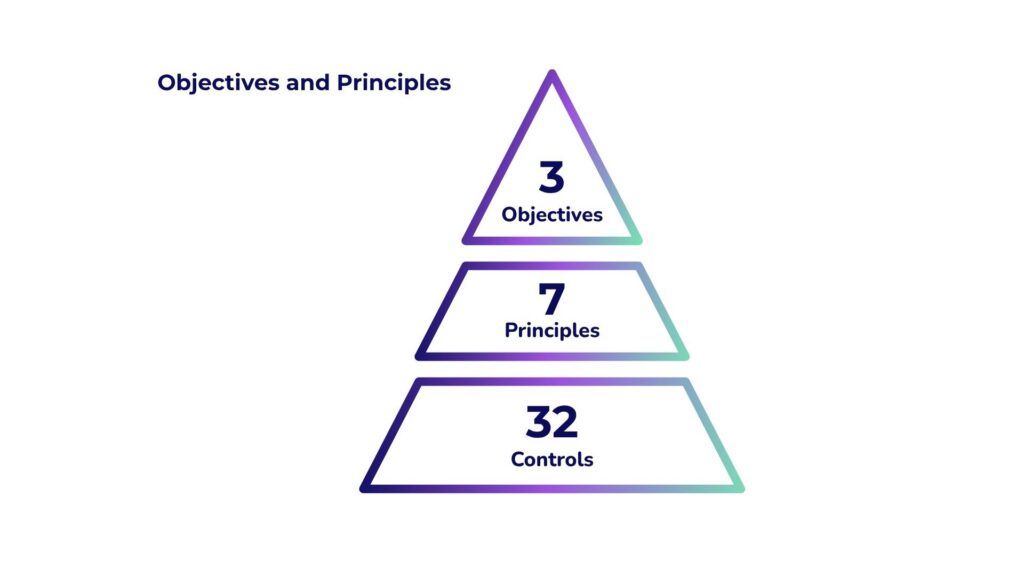
CSCF v2026 is organized across 3 objectives, 7 principles, and 32 controls. The framework is not bureaucratic overhead. It is the shared security baseline that keeps global financial messaging trustworthy, because when one institution has gaps, those gaps create risk for every institution it transacts with.
CSCF v2026 defines 32 security controls in total. For 2026, 26 are mandatory and 6 are advisory. Which controls apply to you, and whether each is mandatory or advisory, depends on your architecture type.
Objectives
Secure Your Environment
Know and Limit Access
Detect and Respond
Principles
- Restrict Internet access and protect critical systems from general IT environment.
- Reduce attack surface and vulnerabilities.
- Physically secure the environment.
4. Prevent Compromise of credentials.
5. Manage Identities and separate privileges.
6. Detect anomalous activity to systems or transaction records.
7. Plan for incident response and information sharing.
Controls
13 Mandatory
4 Advisory
5 Mandatory
1 Advisory
6 Mandatory
3 Advisory
Objectives
Principles
Controls
Secure Your Environment
- Restrict internet access and protect critical systems.
- Reduce attack surface and vulnerabilities.
- Physically secure the environment.
System hardening, network segmentation, vulnerability management, and, new for 2026, back-office data flow security
Know and Limit Access
4. Prevent Compromise of credentials.
5. Manage Identities and separate privileges.
Privileged access control, multi-factor authentication, and identity management
Detect and Respond
6. Detect anomalous activity to systems or transaction records.
7. Plan for incident response and information sharing.
Logging and monitoring, anomaly detection, and incident response
Two CSCF v2026 Changes That Catch Compliant Institutions Off Guard
These two changes do not require you to have altered your environment. The framework changed and the scope expanded. That is exactly why institutions that passed in 2025 can find new gaps in 2026.
Back-office data flow security is now mandatory. Control 2.4, Back Office Data Flow Security, moved from advisory to mandatory. Security expectations now extend across the end-to-end data flow that supports SWIFT payment processing, including middleware, bridging servers, file transfer mechanisms, and the flows between SWIFT and back-office systems. Systems that were never part of your SWIFT scope before may now be in scope.
Customer-client connectors are now mandatory in scope. APIs, middleware, file transfer clients, indirect connectors through service providers, and client-side applications that participate in SWIFT data flows now require formal mapping, documentation, and assessment. In v2026, 14 of the 32 controls apply to customer client connectors.
CSCF v2026 also formally acknowledges AI-related risk for the first time, expecting the same confidentiality, integrity, and availability standards for AI tools used in compliance or operations as for any other system. See our AI governance services
.
SWIFT Architecture Types
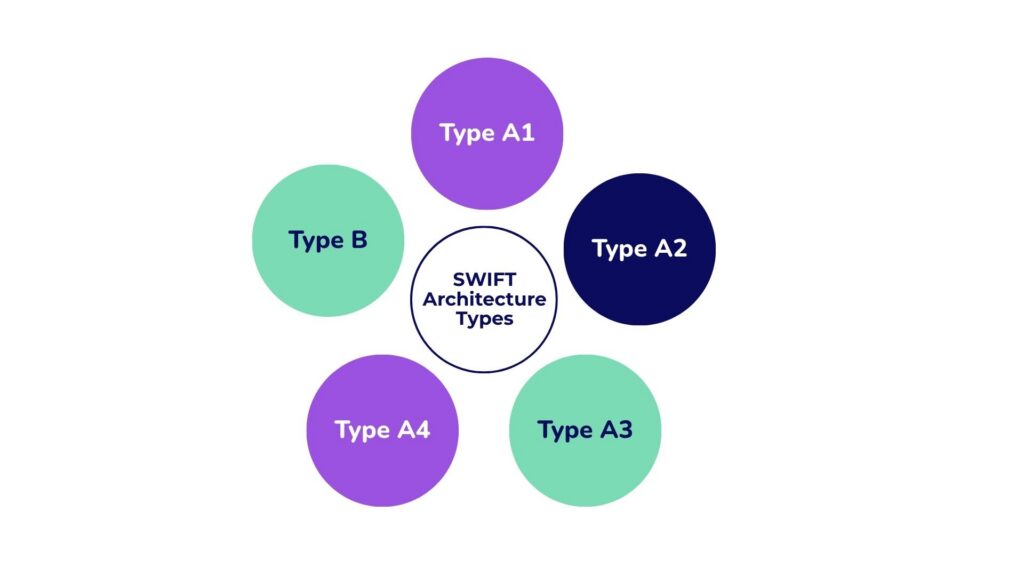
The scope and applicable controls for your assessment depend on your SWIFT architecture type:
Type A1: User owns communication and messaging interface.
Type A2: User owns messaging interface, not communication interface.
Type A3: User employs SWIFT connector for application-to-application communication.
Type A4: User connects via application-to-application with service provider hosting.
Type B: User has no SWIFT-specific infrastructure, uses GUI or API access.
New for 2026: some Type B institutions may now need to reclassify to Type A4. An institution that classified itself as Type B because its SWIFT footprint looked isolated, but that runs standing batch file transfers, middleware, or automated scripts moving payment messages into downstream systems, may now have those connectors and back-office flows in scope. The technology did not change. The framework did. Reclassification means more mandatory controls, additional evidence, broader scope, and sometimes real remediation work, so confirm your architecture type before anything else.
Five Reasons Institutions Fail Their First SWIFT CSP Assessment
These failure points show up consistently across institutions of every type and size.
1.Wrong architecture type. Misclassification leads to under-scoping, missing controls that apply to you, or over-scoping, wasting effort. In both cases the attestation is inaccurate.
2. Controls without defensible evidence. The most common gap. The controls are in place, but the institution cannot produce adequate evidence. Assessors evaluate evidence, not intent. Most findings come from missing, outdated, inconsistent, or non-defensible evidence, not from missing controls.
3. Third-party blind spots. Compliance responsibility stays with you regardless of who operates the infrastructure. Without a documented third-party inventory, risk assessments against CSCF expectations, and contracts that reflect SWIFT CSP obligations, assessors will find gaps.
4. Treating attestation as a December project. The framework changes every year and your environment drifts. Institutions that start in October consistently have more findings and less time to remediate. Implementing a control in November does not produce defensible evidence by December.
5. Weak vulnerability and privileged-access hygiene. Unsupported operating systems, delayed patching, inconsistent MFA, shared administrative accounts, and excessive access rights. These are the weaknesses attackers exploit to move laterally into payment processing infrastructure.
What Assessors Look For: Key Controls and Strong Evidence
| Control | What it requires | What strong evidence looks like |
|---|---|---|
| 5.1 Logical Access Control | Access to SWIFT-related systems restricted to authorized users on least privilege | An access review completed within the last 90 days, with who conducted and approved it, plus revocation tied to HR offboarding |
| 4.1 Password Policy | Password policy aligned to CSCF and enforced for all in-scope accounts | Policy and system configuration that match exactly, with MFA enforced for privileged accounts without exceptions, including service accounts |
| 6.4 Logging and Monitoring | SWIFT-related activity logged and actively monitored for anomalies | Logs centralized in a SIEM, defined monitoring frequency, enforced retention, and evidence that alerts were reviewed and addressed |
| 7.1 Vulnerability Management | Vulnerabilities identified, evaluated, and remediated on risk-based timelines | Authenticated scans across all in-scope systems, remediation tied to severity, and formal exceptions with compensating controls for legacy systems |
| 1.2 Network Segmentation | The SWIFT environment segregated from the general enterprise environment | Current segmentation diagrams that match the live environment, least-necessary firewall rules reviewed and approved, and temporary rules removed |
| 2.4 Back Office Data Flow Security (new for 2026) | Flows between the secure zone and back-office systems identified and secured | Comprehensive, current data-flow mapping across middleware, APIs, and downstream systems, with documented controls and assigned ownership |
A recurring pattern: the policy says one thing and the system is configured to do another. That mismatch is one of the most common and most avoidable findings.
Our SWIFT CSP Assessment Process
- Architecture Validation. Independently validate your architecture type against current CSCF guidance and your actual transaction ecosystem, rather than carrying last year’s classification forward.
- Scoping and Document Collection. Define what is in scope and issue a document request list to gather documentation and evidence for each applicable control.
- Gap Assessment. Assess your environment against the v2026 mandatory controls and identify where controls or evidence fall short.
- Data-Flow and Connector Mapping. Map the back-office data flows and customer-client connectors now in scope under v2026.
- Evidence Review. Confirm that each control can be demonstrated with current, consistent, defensible evidence, not just described.
- Remediation Planning. Build a prioritized remediation plan timed to the attestation window, so fixes have operating history before the assessment.
- Independent Assessment and Attestation. Complete the independent assessment and support your KYC-SA attestation.
How to Pass Your SWIFT CSP Attestation the First Time
Start now, not in October. Use June for an internal gap assessment against CSCF v2026, July to September to remediate, and October to December for the independent assessment and final attestation. Evidence of effective operation takes time to accumulate.
Confirm your architecture type first. It sets control applicability, scope, and evidence expectations. If it is wrong, the entire self-assessment is built on the wrong foundation.
Treat documentation as your primary deliverable. Policies, diagrams, access reviews, and configuration evidence need to reflect how the organization operates today.
Run a targeted delta if you complied in 2025. Reassess architecture, scope, data-flow documentation, and connectors under the v2026 guidance, not just the control language.
Get your third parties in order before the assessment starts. Confirm what each provider supports, review their posture against CSCF expectations, and check contracts for SWIFT CSP obligations.
Understand that non-compliance is not private. Your status is visible to counterparties, regulators, and SWIFT itself.
What Non-Compliance Actually Means
- Counterparties can see whether you hold valid attestations through KYC-SA.
- SWIFT randomly selects institutions for mandatory external independent assessment each year, and non-compliant or high-risk institutions face a higher probability of selection, on SWIFT’s timeline rather than yours.
- SWIFT may report institutions to local supervisory authorities. In the United States, that can include the Federal Reserve Board.
- In more serious cases, this can mean heightened oversight, mandatory remediation expectations, and restrictions related to your SWIFT connectivity.
These are not theoretical consequences.

Why Choose Our SWIFT CSP Assessment Services?
Certified assessors. The team includes certified SWIFT CSP assessors with deep financial-sector cybersecurity experience, holding CISA, CRISC, CICA, and ISO 42001 Lead Auditor credentials.
Comprehensive approach. Evaluation of both mandatory and advisory controls for a holistic view of your security posture.
Actionable insights. Detailed, prioritized recommendations to strengthen your SWIFT-related security measures.
Compliance assurance. Engagements designed so your attestation meets SWIFT’s requirements and holds up under independent review.
Field experience. 18+ years of practice, 500+ clients, and a 100% client audit pass rate. Audits don’t reward good intentions. They reward evidence.
Key Takeaways
- A SWIFT CSP assessment verifies your compliance with the CSCF before you attest through KYC-SA, where counterparties can see your status.
- CSCF v2026 has 32 controls, 26 mandatory and 6 advisory, across three objectives and seven principles.
- Two changes can create new gaps without any change to your environment: back-office data flow security is now mandatory, and customer-client connectors are now mandatory in scope.
- Some Type B institutions may need to reclassify to Type A4. Confirm your architecture type before anything else.
- Most findings come from weak evidence, not missing controls. Documentation is your primary deliverable.
- Start in June. The institutions that pass the first time are the ones that find their gaps before the window opens.
Frequently Asked Questions
Is an independent assessment mandatory for SWIFT CSP?
Yes. SWIFT requires an independent assessment of at least all mandatory controls, performed either internally by an independent function or by an external assessor. A self-attestation on its own is not sufficient.
When is the SWIFT CSP attestation deadline for 2026?
The attestation window runs from July 1 to December 31, 2026. Attestations are submitted through the KYC-SA portal.
How many controls are in CSCF v2026?
CSCF v2026 defines 32 security controls, of which 26 are mandatory and 6 are advisory, organized across three objectives and seven principles.
What changed in CSCF v2026?
Control 2.4, Back Office Data Flow Security, moved from advisory to mandatory, and customer-client connectors such as APIs, middleware, and file transfer clients are now mandatory in scope. As a result, some institutions that attested as Type B may need to reclassify to Type A4.
Can a Type B institution be required to reclassify to Type A4?
Yes. If an institution uses connectors, middleware, or automated flows that touch SWIFT-related data, those components may now be in scope under v2026, which can require reclassification from Type B to Type A4.
Can screenshots be used as evidence in a SWIFT CSP assessment?
Yes, if they include enough context to show the system, the setting, the date, and relevance to the control. Where possible, screenshots should be paired with exports, reports, tickets, or configuration files.
What if a service provider will not share detailed evidence?
Request a SOC report, ISO certifications, or a bridge letter, and consider a shared-responsibility matrix, completed security questionnaires, or right-to-audit language. If a provider supporting SWIFT-related processing refuses to provide meaningful assurance, document and escalate it as a third-party risk.
How does SWIFT CSP relate to ISO 27001, SOC 2, and NIST CSF?
Map the CSCF controls to your existing control framework rather than creating a separate set, since many requirements overlap. The key is ensuring those enterprise controls are applied specifically to the SWIFT-connected environment and supported by SWIFT-specific evidence.
GET STARTED
Ready to evaluate your SWIFT environment and pass your 2026 attestation?
Book a SWIFT CSP gap review. Elevate Consult’s certified assessors will assess your posture against CSCF v2026, find your gaps, and build a remediation plan before the window closes.