
Cybersecurity and Compliance for Retail and Hospitality
PCI DSS, Consumer Privacy and Physical Security Across Distributed Sites
Retail and hospitality carry a risk profile no other industry shares: payment card data at every point of sale, consumer personal information at scale, high staff turnover, and physical premises the public walks into by design. PCI DSS v4.0.1 is the framework that matters most, and the 51 previously future-dated requirements became mandatory on 31 March 2025 with no grace period. Elevate Consult builds the payment security, privacy and physical security programme that fits a distributed, high-turnover operating model.
UPDATE
What changed and what it costs
PCI DSS v4.0.1 is fully mandatory
Version 4.0.1 has been the only active standard since 31 December 2024, and the 51 requirements originally designated as future-dated best practices became mandatory on 31 March 2025 with no grace period. An organization that validated under v4.0 in 2024 while treating those as optional will fail its next assessment.
E-commerce payment page security is where most fail
Requirements 6.4.3 and 11.6.1 address script tampering and skimming on payment pages. They apply to e-commerce merchants whose sites can affect payment transactions, and they are the most commonly failed of the new requirements because they require script inventory and integrity monitoring that most sites never had.
Authenticated internal vulnerability scanning is new
Unauthenticated scanning no longer satisfies the requirement. That changes both the tooling and the credential management around it.
The consumer privacy patchwork grew past California
More than twenty US states now have comprehensive privacy statutes with differing thresholds and rights. California added a dedicated enforcement agency, expanded consumer rights from four to six, and its automated decision-making regulations phase in through 2027, which reaches personalization and dynamic pricing.
Physical access is a real vector here, not a theoretical one
High foot traffic, seasonal staff, back-of-house areas adjacent to the network, and unattended terminals are the conditions physical penetration testing exists to evaluate. Retail and hospitality environments produce findings that corporate offices do not.
WHO WE HELP
Distributed operations with payments and consumers
Retailers with physical locations and e-commerce, hotels and hospitality groups, restaurant and food service operators, franchise organizations, and the technology and service providers supporting them.
The operating reality is what shapes the programme: many locations, many staff, high turnover, thin local IT, and payment acceptance at every site. Security controls designed for a single corporate environment do not survive contact with that.
WHERE THE EXPOSURE CONCENTRATES
Payments, consumers and premises
Three risk categories account for most of the real exposure, and each maps to a different framework and a different internal owner.
Every requirement is mandatory since 31 March 2025. The heaviest areas are e-commerce payment page and script integrity, expanded multi-factor authentication, authenticated internal vulnerability scanning, and formalized scope and risk analysis.
Payment card data
Six consumer rights under the CCPA as amended, opt-out preference signals including Global Privacy Control, and the automated decision-making regulations that reach personalization and pricing. More than twenty states now have comprehensive laws.
Consumer personal information
Consent configuration, tracking and pixel inventory, opt-out mechanisms and the accessibility of those mechanisms. A banner that exists is not a banner that complies.
Website and cookies
Public-facing sites with back-of-house network access, unattended terminals, and seasonal staff who have not been trained to challenge a stranger. This is the one industry where the physical test regularly finds a path to the network.
Physical premises
Payment processors, booking platforms, loyalty providers and marketing technology all touch cardholder or consumer data, and the obligation to oversee them sits with the merchant.
Vendors and processors
For groups with European operations or customers, including the cookie divergence between the two regimes since February 2026.
EU and UK operations
HOW ELEVATE HELPS | SERVICES FOR TECHNOLOGY COMPANIES
A programme sized for distributed operations
Elevate builds controls that a location manager can actually run, because a control that only works at headquarters is not implemented.
PCI DSS readiness and assessment
Scoping, control design, evidence structure and audit support for the reports enterprise buyers request by name. See the SOC 1 and SOC 2 service pages.
Penetration testing
Network, web and API, wireless and social engineering, plus physical penetration testing scoped to the site types that actually carry risk.
Privacy programme
CCPA and multi-state compliance, consumer rights operations across all six rights, opt-out preference signal handling, and the data inventory underneath them.
Website privacy and cookie review
Cookie and tracker inventory, consent platform configuration, opt-out mechanism validation and the accessibility of consent and opt-out controls.
SOC 2 and ISO 27001
Where the organization supplies services to enterprise partners or franchisees and is asked to evidence its own posture.
Virtual CISO
Security leadership for organizations with distributed operations and no dedicated security function, which describes most of this sector below enterprise scale.
NIST CSF assessment
A baseline across the six functions where the organization needs a defensible overall posture rather than a single framework answer.
ENGAGEMENT PHASES
How the work runs
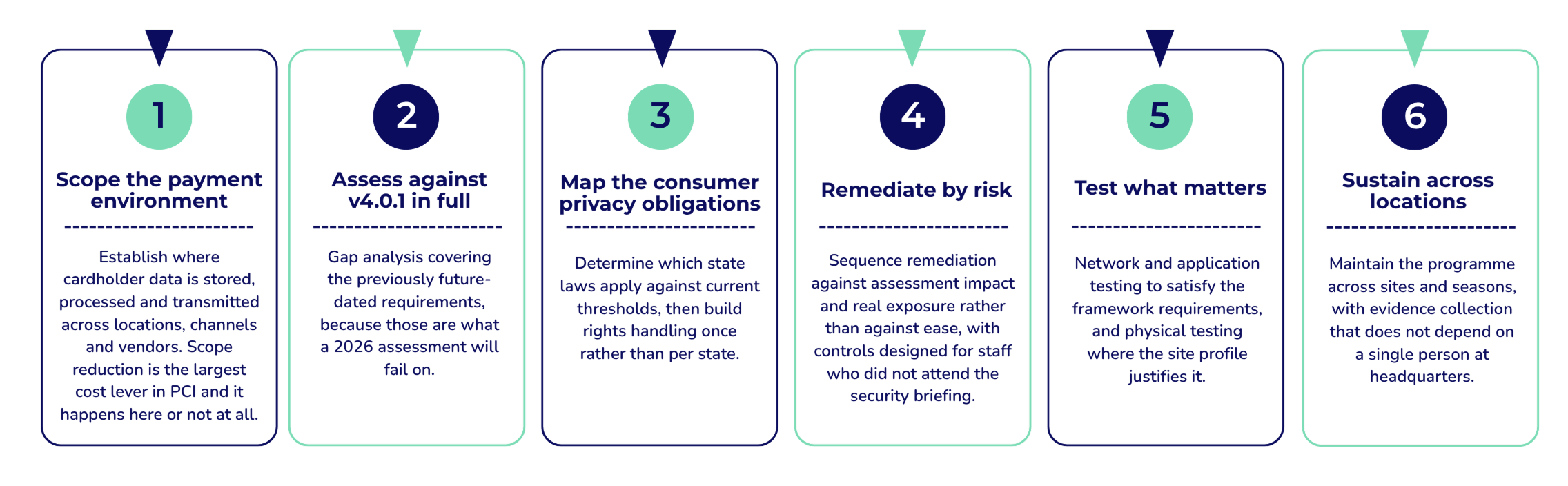
WHO THIS IS FOR
Roles Elevate works with on this standard
CISOs and IT directors
Payment and treasury operations
Privacy and legal counsel
Loss prevention and physical security
Franchise and multi-site operators
GET STARTED
Ready to close the gap between your PCI documentation and your locations?
Elevate Consult scopes the payment environment, assesses against the full v4.0.1 requirement set, builds the consumer privacy operations the state patchwork demands, and tests the physical and technical paths an attacker would actually use.
FAQ
Common Questions
Is PCI DSS v4.0.1 fully in force?
Yes. It has been the only active version since 31 December 2024, and the 51 requirements originally designated as future-dated best practices became mandatory on 31 March 2025 with no grace period. Every assessment from that date forward is scored against the full standard.
Which new PCI requirements cause the most failures?
The e-commerce payment page controls at Requirements 6.4.3 and 11.6.1, which address script tampering and skimming and require script inventory and integrity monitoring. After those, expanded multi-factor authentication, authenticated internal vulnerability scanning, and the formalized scope and risk analysis requirements absorb most of the remediation work.
Does PCI compliance cover consumer privacy?
No. PCI DSS protects cardholder data. Consumer privacy obligations under the CCPA and the other state statutes cover a much broader category of personal information including purchase history, loyalty data, location and inferences, and they carry rights and opt-out mechanics PCI does not address. The two programmes overlap on data inventory and access control and diverge everywhere else.
Why would a retailer need physical penetration testing?
Because the operating model creates the conditions the test exists to evaluate: public access by design, back-of-house areas adjacent to the network, unattended terminals, and high seasonal turnover among staff who have not been trained to challenge an unfamiliar person carrying a box. Physical testing in this sector regularly finds a path from the sales floor to the network.
How do we handle privacy across many states?
Build the common core once and configure per jurisdiction only where the law genuinely differs. Most state statutes share the same structure: notice, rights, opt-out and data minimization. The divergence sits in thresholds, specific rights, cure periods and enforcement. California is the outlier with a dedicated enforcement agency and automated decision-making rules no other state matches.
We have hundreds of locations. How does that change the programme?
It changes the design rather than the requirement. Controls have to be executable by staff who did not attend a security briefing, evidence has to be collected without depending on one person at headquarters, and scope decisions have to account for variation between sites. A programme that works at corporate and nowhere else produces a passing document and a failing environment.