The ISO 42001 AI Governance & AIMS Master Bundle
Everything you need to define scope, govern AI responsibly, map evidence, and operationalize an audit-ready AI Management System.
Stop stitching together AI policies from scratch. Start with a structured AIMS built to ISO 42001.
Define scope, map controls to evidence, and surface readiness gaps before the auditor does.
Align ISO 42001 and EU AI Act expectations in one coherent governance framework.
Built for operational reality: governance, lifecycle, impact assessments, risk treatment, and continual improvement.
AI governance stalls when scope, risk, and evidence aren’t aligned.
Most organizations don’t fail ISO 42001 because they don’t care about responsible AI. They stall because:

Scope isn’t clearly defined (cloud, models, pipelines, teams).
AI risks are discussed but not formally assessed or treated.
Policies exist, but they’re not mapped to lifecycle controls or Annex A.
Evidence isn’t
structured for internal audit or certification review.

EU AI Act obligations are being interpreted in isolation.
This bundle solves that bottleneck: A centralized, structured AI governance system you can tailor, implement, and audit against.
What You’re Getting
This bundle consolidates three critical components of ISO 42001 and AI governance readiness into one system:
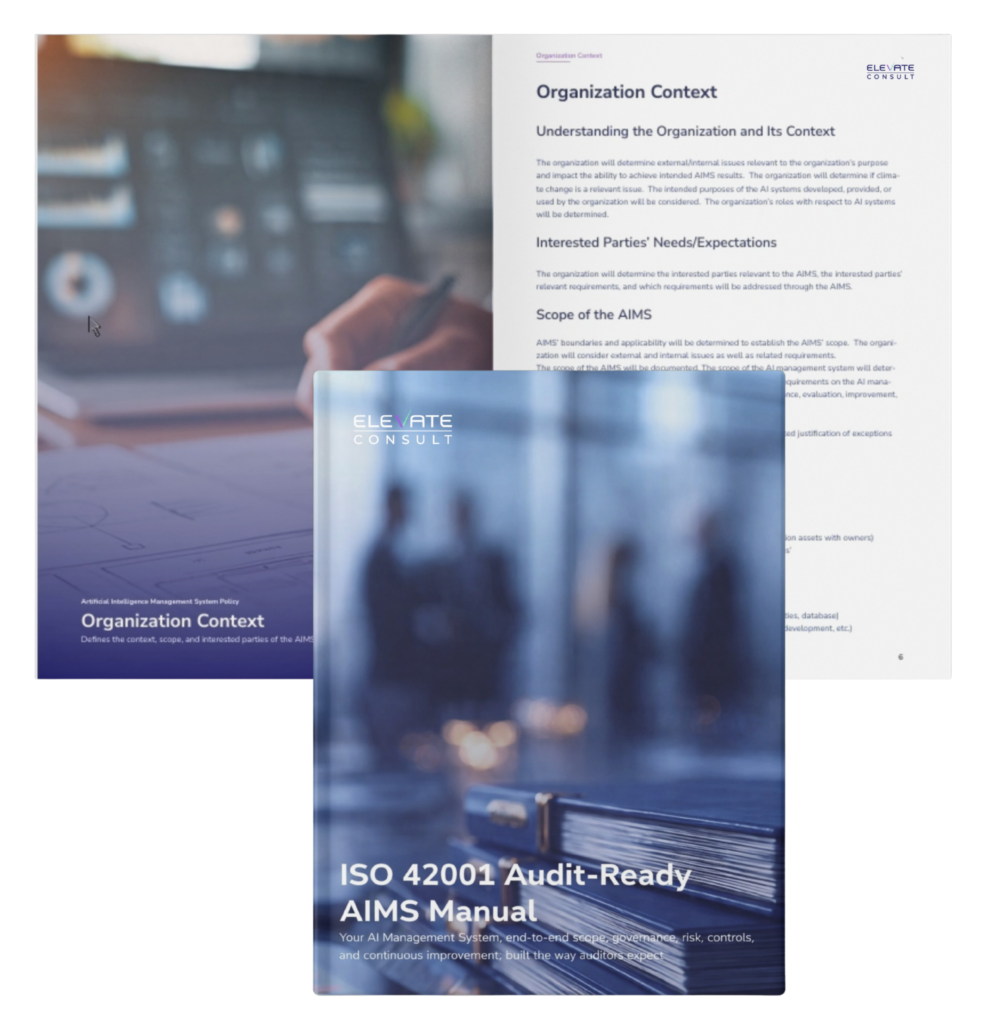
- ISO 42001 Audit-Ready AIMS Manual
A clause-by-clause AI Management System framework covering:
- Organization Context (scope, boundaries, stakeholders)
- Leadership & AI Governance Policy
- AI Risk Assessment & Risk Treatment
- AI System Impact Assessments
- Lifecycle operational controls
- Monitoring & internal audit program
- Management review inputs & outputs
- Nonconformity & corrective action
- Continual improvement model
Built exactly the way auditors expect to see it structured.
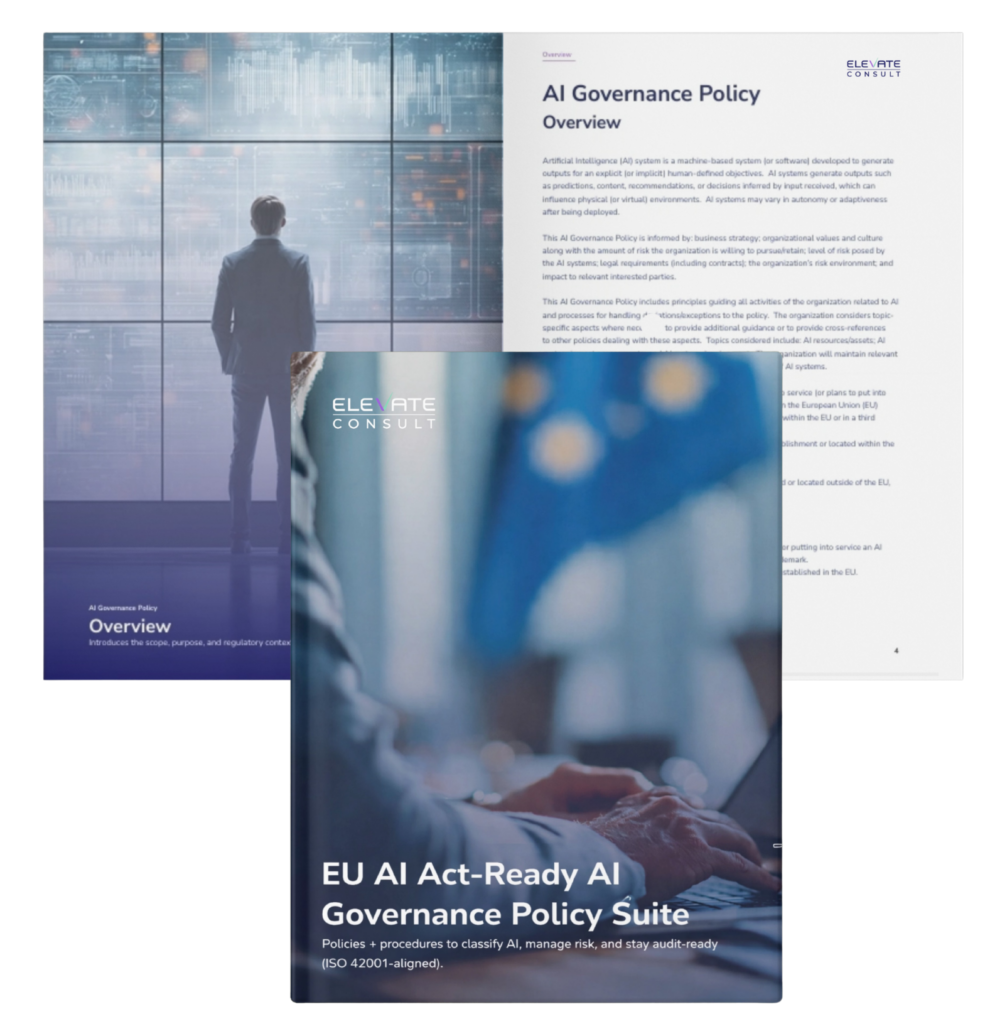
- EU AI Act–Ready AI Governance Policy Suite
Policies and procedures to:
- Define responsible AI use
- Establish AI risk governance
- Assign accountability
- Address lifecycle risk and misuse
- Align contractual AI obligations
- Document third-party AI controls
- Support regulatory disclosures
This bridges ISO 42001 with emerging regulatory obligations, especially in the EU.
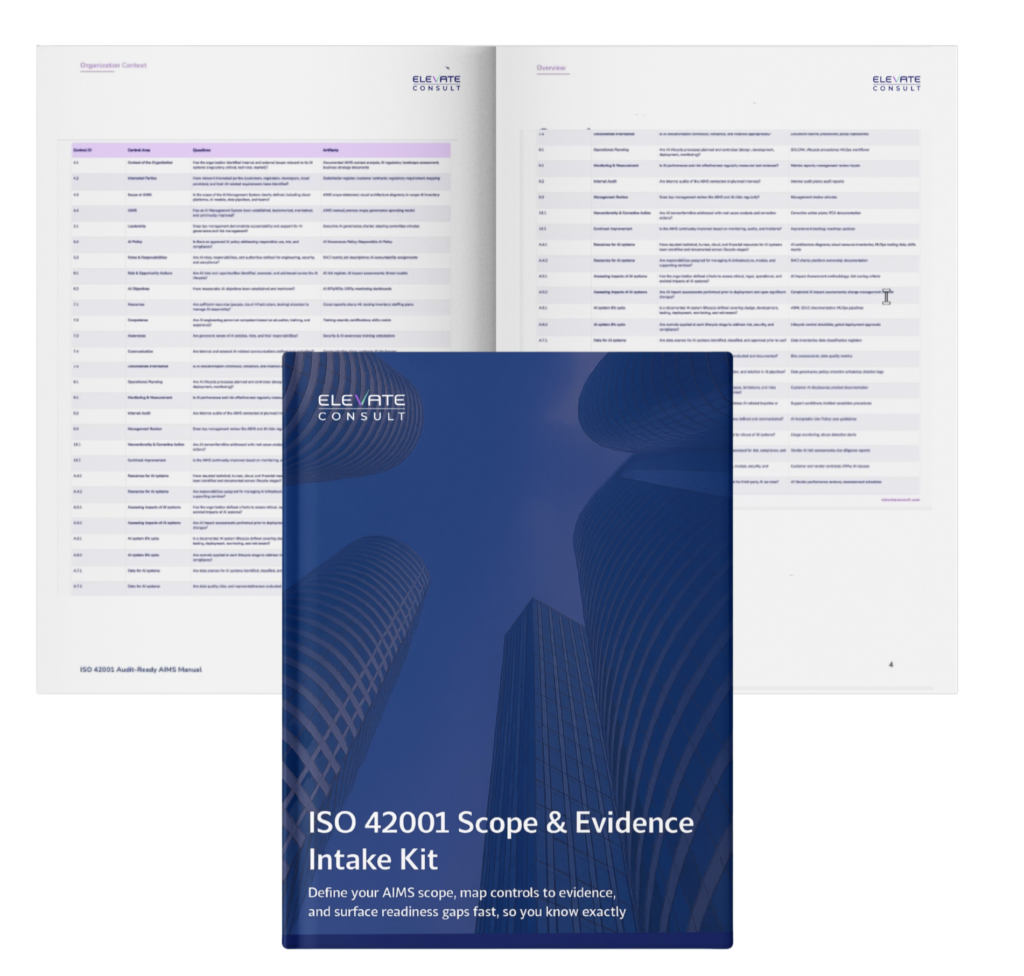
- ISO 42001 Scope & Evidence Intake Kit
- Define your AIMS scope.
- Map controls to artifacts.
- Surface readiness gaps fast.
Includes:
- Clause-by-clause control questions (4.1 through 10.2 + Annex A)
- Required artifact mapping
- Lifecycle resource verification
- AI data governance checkpoints
- Third-party AI risk validation
- Audit preparation documentation matrix
This is how you avoid “we think we’re ready” surprises.
Use it to structure governance, accelerate certification readiness, and reduce audit friction.
Download the structured framework for developing an audit-ready AI Management System and ensuring alignment with responsible AI governance expectations, exactly as ISO 42001 auditors would require.
What’s Inside
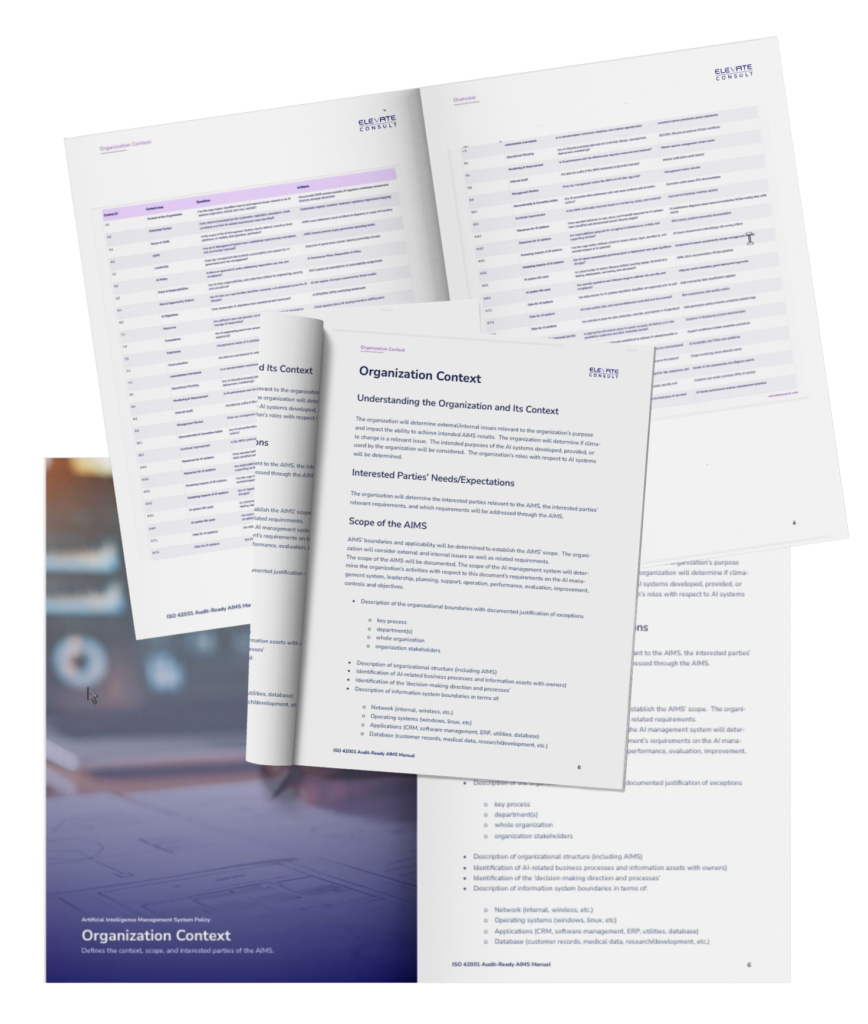
Full ISO 42001 Clause Coverage
4 — Context of the Organization
5 — Leadership & AI Governance Policy
6 — AI Risk & Impact Assessment
7 — Resources, Competence, Documentation
8 — Operational Planning & Lifecycle Control
9 — Monitoring, Internal Audit, Management Review
10 — Nonconformity & Continual Improvement
Annex A — AI lifecycle, data governance, impact controls, third-party governance
AI Risk & Impact Governance
AI risk criteria definition
Formal AI risk assessment process
AI risk treatment plan + Statement of Applicability (SoA)
AI system impact assessment methodology
Residual risk approval process
Management review integration
AI Lifecycle Control
AI/ML SDLC documentation
MLOps workflow governance
Data quality & bias controls
Acceptable use policies
Abuse detection & misuse monitoring
Third-party AI provider oversight
Policy language you can operationalize
Examples of the specificity included:
- Defined AI risk assessmentmethodologyaligned to objectives and Annex A.
- Required documentation for AI impact assessments before deployment and after significant changes.
- Clear lifecycle controls from design → development → deployment → monitoring → retirement.
- Governance structure defining executive accountability and AI oversight roles.
- Internal audit program expectations specific to AI governance.
- Defined documentation control, versioning, and retention requirements.
This is not high-level “ethical AI” marketing language.
It is structured management system documentation.

You build your AIMS the way ISO 42001 expects: structured, documented, reviewable)
Use it as an AI Governance Operating System (not a PDF library). This bundle is modular by design. You do not implement everything at once.

Implementation principles:
Define scope first (cloud, models, data, teams).
Establish governance & accountability.
Perform risk + impact assessments.
Build your Statement of Applicability.
Implement lifecycle controls.
Align monitoring + internal audit.
Institutionalize continual improvement.
Built for leaders accountable for AI risk
This is for you if you are:

A CTO or CISO responsible for AI governance.

An AI Product or ML Engineering Lead deploying AI into production.

A Compliance or Risk Leader preparing for ISO 42001 certification.

A Legal or Regulatory team aligning to EU AI Act.
A Board-level executive demanding structured AI oversight.
FAQs
What is ISO 42001?
ISO 42001 is the international standard for establishing, implementing, maintaining, and continually improving an Artificial Intelligence Management System (AIMS). It defines governance, risk, lifecycle, and impact requirements for responsible AI.
What is an AI Management System (AIMS)?
An AIMS is a structured governance framework that defines scope, leadership accountability, AI risk management, lifecycle controls, monitoring, internal audit, and continual improvement for AI systems.
How does ISO 42001 relate to the EU AI Act?
ISO 42001 provides a management system structure that supports regulatory alignment. While it is not a substitute for the EU AI Act, it provides governance, documentation, risk assessment, and lifecycle control mechanisms that support compliance readiness.
What documentation is required for ISO 42001?
Organizations must document:
- AIMS scope
- AI Governance Policy
- AI risk assessment process
- AI risk treatment plan
- Statement of Applicability
- AI impact assessments
- Internal audit program
- Management review records
- Corrective actions
- Evidence of lifecycle controls
This bundle structures all of it.
What is an AI Impact Assessment?
An AI Impact Assessment evaluates potential consequences of AI systems on individuals, groups, and society, including ethical, legal, operational, and societal impacts, prior to deployment and after significant changes.
How often should AI risks be reviewed?
AI risk assessments should be performed at planned intervals and whenever significant changes occur (new models, new data, new use cases, or regulatory changes).