Cybersecurity and Compliance for Financial Services
Banking, Insurance and Asset Management Across Overlapping Regulators
Financial institutions do not have a compliance problem, they have an overlap problem. GLBA, FedLine, SWIFT CSP, the CRI Profile and FFIEC examination expectations all test controls that substantially overlap, each with its own examiner, timeline and report format. Running them separately produces audit fatigue without producing better assurance. Elevate Consult assesses the environment once against every applicable requirement and delivers a separate, regulator-ready report for each.
UPDATE
What changed across the frameworks
The FFIEC CAT was retired and not replaced by the FFIEC
The Cybersecurity Assessment Tool was removed from the FFIEC website on 31 August 2025 and is no longer maintained. Examiner expectations for a structured self-assessment did not change. Regulators point institutions toward NIST CSF 2.0 and the CRI Profile, and prior CAT work maps onto both rather than being discarded.
A financial sector AI framework now exists
The CRI published the Financial Services AI Risk Management Framework in February 2026 with the Financial Services Sector Coordinating Council, the US Treasury and more than a hundred institutions. It scales obligations to a documented AI adoption stage rather than applying one control set to every firm.
The Safeguards Rule testing cadence is the most-missed obligation
Covered non-bank financial institutions must conduct annual penetration testing and semi-annual vulnerability assessments, or implement continuous monitoring achieving comparable outcomes. It is dated, concrete, and where the distance between a documented programme and an actual posture becomes visible.
CRI Profile moved to version 2.2
Released in 2026 without changing the core diagnostic statements, so assessment work against v2.0 or v2.1 carries forward. It added mappings including DORA and the Financial Services AI Risk Management Framework, which lets an institution fold AI risk into the same control set.
SWIFT CSCF v2026 expanded scope without anyone changing anything
Control 2.4, back office data flow security, moved from advisory to mandatory, and customer client connectors are now mandatory in scope. Some institutions that attested as architecture Type B may need to reclassify to Type A4. An institution fully compliant in 2025 can have new gaps in 2026 with no change to its systems.
WHO WE HELP
Institutions and the providers that serve them
Banks and credit unions, insurers, asset and wealth managers, payment and fintech providers, and the technology and service organizations supplying them. Institutions with EU operations carry DORA obligations alongside the US framework set.
The pressure is structural. New products and revenue sources have to be developed against a regulatory landscape that redefines how they can be marketed and how compliance risk is managed. A proactive and uniform approach to that wave is the first line of defence on compliance cost.
THE FRAMEWORK STACK
Overlapping controls, separate obligations
The assessment work can be unified. The obligations cannot. Each framework keeps its own deadline, its own attestation and its own submission path, and mapping a control is not the same as meeting a regulatory clock.
The written risk assessment, nine programme elements and eight technical safeguards, with the annual penetration testing and semi-annual vulnerability assessment cadence the Rule requires.
GLBA and FTC Safeguards Rule
Annual self-assessment against the FedLine Security Requirements, a written remediation plan for gaps, and attestation by a senior officer by 31 December.
FedLine Assurance Program
32 controls with 26 mandatory, architecture type validation, the newly mandatory back office data flow control, and independent assessment before attestation through KYC-SA.
SWIFT Customer Security Programme
More than 3,500 regulatory expectations harmonized into 318 diagnostic statements, scoped by impact tier, with mappings to NIST CSF 2.0, DORA and the FS AI RMF.
CRI Profile
Transition from the retired Cybersecurity Assessment Tool onto NIST CSF 2.0 or the CRI Profile, carrying prior maturity work forward rather than restarting.
FFIEC examination readiness
Directly applicable since 17 January 2025, with a four hour initial incident notification from classification and an annual Register of Information filing due 30 April.
DORA
HOW ELEVATE HELPS | SERVICES FOR FINANCIAL INSTITUITONS
One assessment, separate reports
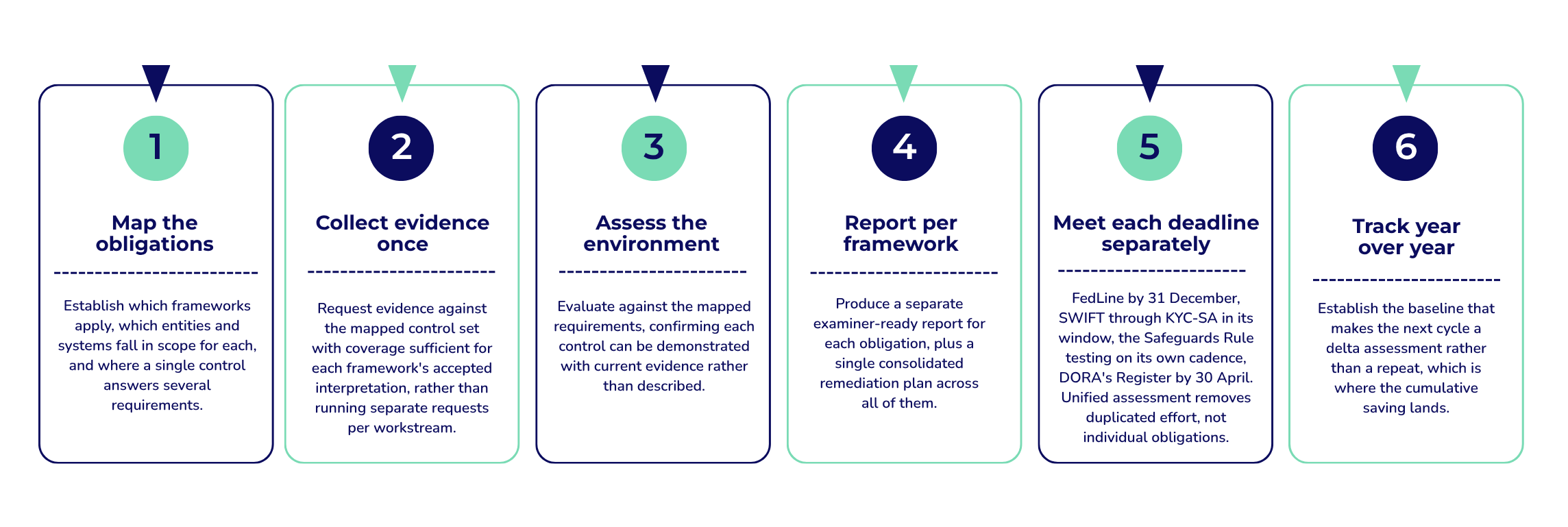
Elevate evaluates the environment once against all applicable requirements, maps the findings to each framework, and produces a tailored report for every one plus a single consolidated remediation plan

Unified banking cybersecurity assessment
One engagement covering GLBA 501(b) and the Safeguards Rule, SWIFT CSP, FedLine, the CRI Profile, NIST CSF 2.0 and a general risk assessment, with a separate examiner-ready report for each.

SWIFT CSP assessment
Certified assessors covering architecture type validation, CSCF v2026 gap assessment, data flow and connector mapping, evidence review and attestation support.

FedLine Assurance Program
Impact tier determination, gap assessment against the applicable diagnostic statements, and evidence built against the Examples of Effective Evidence packages.

FS AI RMF readiness
Adoption stage determination, control objective gap analysis and the integrated control design that folds AI risk into model risk, third-party risk and operational resilience rather than beside them.

DORA readiness
ICT risk framework, incident capability that can file within four hours of classification, resilience testing and the Register of Information.

Internal audit and SOX
Co-sourced or outsourced internal audit under the current Global Internal Audit Standards, IT audit, and SOX programmes sized to actual filer status.

Penetration testing
Network, application, wireless and physical testing scoped to satisfy the testing obligations the applicable frameworks carry.

Virtual CISO
Security leadership for institutions without a dedicated function, covering the period between assessments rather than only during them.
ENGAGEMENT PHASES
How the work runs
WHO THIS IS FOR
Roles Elevate works with on this standard
Chief Risk Officers
CISOs and information security leads
Payments operations leads
Compliance and regulatory affairs
Internal audit
GET STARTED
Ready to stop running the same assessment five times?
Elevate Consult evaluates your environment once against every applicable framework, delivers separate examiner-ready reports and one consolidated remediation plan, and keeps each individual deadline on its own calendar.
FAQ
Common Questions
🡪 What replaced the FFIEC Cybersecurity Assessment Tool?
No single tool. The FFIEC retired the CAT on 31 August 2025 and did not issue a successor. Regulators direct institutions toward NIST CSF 2.0 and the CRI Profile. Prior CAT work maps onto both, so the transition is a mapping exercise rather than a restart, and treating it as a restart is the most expensive available option.
🡪 Can one assessment satisfy all our regulators?
The assessment work can be unified; the obligations stay separate. Each framework keeps its own deadline, attestation and submission path. What a unified approach removes is the duplicated effort of assessing the same control five times for five reports, not the individual regulatory clocks.
🡪 What changed in SWIFT CSCF v2026?
Control 2.4, back office data flow security, moved from advisory to mandatory, and customer client connectors including APIs, middleware and file transfer clients are now mandatory in scope. As a result some institutions that attested as architecture Type B may need to reclassify to Type A4. An institution compliant in 2025 can have new gaps in 2026 without changing anything in its environment.
🡪 Do we need a separate AI risk programme?
Not separate. The CRI published the Financial Services AI Risk Management Framework in February 2026, built on the NIST AI RMF structure and designed as a supplement to existing risk functions rather than a parallel programme. CRI Profile v2.2 includes a mapping to it, so AI risk can enter the existing control set and assessment cycle.
🡪 Does DORA apply to us?
If the institution operates in the EU as one of the twenty one categories of financial entity, yes, and directly rather than through national transposition. The obligation most often misunderstood is the incident deadline: an initial notification within four hours of classifying an incident as major, not 48 hours, with a separate 24 hour limit from awareness.
🡪 We are a non-bank financial institution. Does the Safeguards Rule reach us?
Probably. The FTC’s definition of a financial institution extends well beyond banks to mortgage lenders and brokers, auto dealers, finance companies, insurers, tax preparation firms, investment advisers and others. The testing cadence, annual penetration testing and semi-annual vulnerability assessments or equivalent continuous monitoring, is the requirement most frequently missed.