
An AI governance operating model turns AI from a source of unmanaged risk into a capability the business can scale with confidence, and a clear RACI matrix is what makes ownership unambiguous across the AI lifecycle. The need is not theoretical: in McKinsey’s most recent State of AI survey, 88 percent of organizations reported using AI in at least one business function, up from 78 percent a year earlier, yet most remain stuck in piloting rather than scaling. That distance between fast adoption and disciplined AI governance is exactly where an operating model earns its keep.
This guide walks through designing that operating model with the RACI framework, short for Responsible, Accountable, Consulted, and Informed. It covers how to assess your governance gaps first, build role-based ownership across legal, data, and engineering, operationalize approvals and escalation in day-to-day workflows, and keep the structure durable as models and regulations change.
Assessing AI Governance Gaps Before Designing RACI
“AI safety requires AI governance, and the dirty secret in the AI industry is that the weakest link in AI governance is data pipelines.” — Bjorn Reynolds, CEO of Safeguard Global, expert in AI data governance and security
Most organizations underestimate how much AI is already in use. Surfacing shadow AI, the tools employees adopt without approval, is the starting point, followed by a structured inventory that records every model in use, its purpose, owner, and the data it touches. Building that inventory is widely regarded as one of the first and most important steps in standing up a governance program, and it is the same discipline Elevate applies when scoping AI assets for risk management.
Evaluate governance maturity against a framework
Once you know what you have, measure maturity against an established framework rather than an internal opinion. The NIST AI Risk Management Framework offers a structured way to identify, measure, and manage AI risk, and maturity is often described in stages that run from reactive, where teams handle problems as they surface, to proactive and then transformative. If you are choosing between frameworks, it helps to see how the main options compare against one another before committing.
Identify compliance blind spots
Many AI programs carry predictable blind spots: no continuous monitoring, thin audit trails, and risk reviews that check technical accuracy but skip ethical, societal, and regulatory impact. Closing these gaps before you design the RACI gives the matrix something real to govern, rather than formalizing ownership over a process no one fully understands.
Designing a Role-Based AI Governance Framework
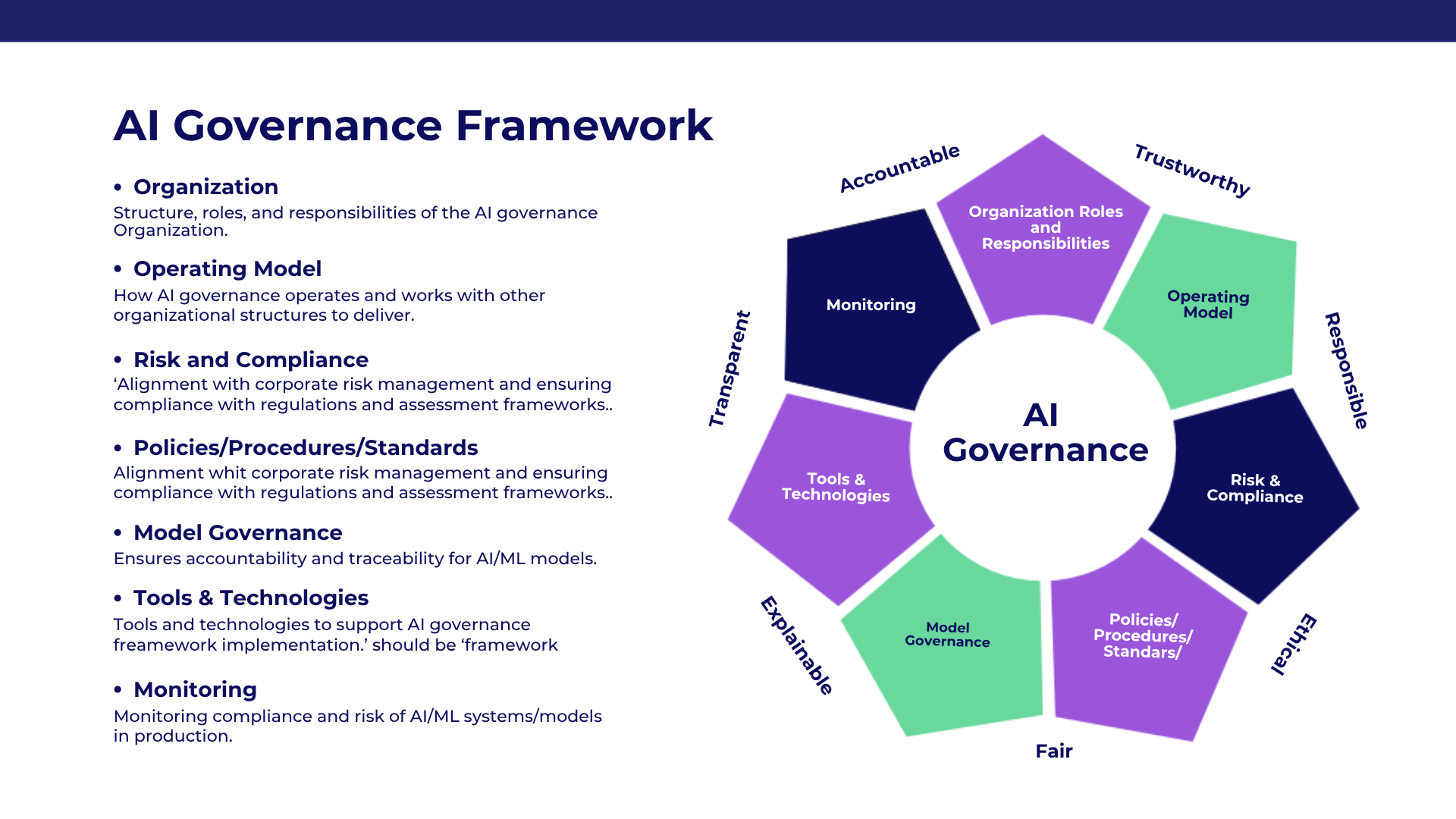
Effective AI governance is cross-functional by design. The programs that work pull in privacy, IT, security, legal, compliance, data science, and product, because no single function can see the full risk surface of an AI system on its own.
Stand up a Responsible AI committee
A dedicated AI governance committee is the engine of oversight. It brings together legal, IT, security, human resources, compliance, data science, and management to oversee implementation, monitoring, and auditing. In a mid-sized organization, engineering leadership typically owns strategy, security and compliance assess risk, data science supplies technical depth, legal handles regulatory alignment, and product ties the work to business goals. Sector-specific contexts may also need their own policies, such as a dedicated AI policy for universities.
Assign roles across legal, data, and engineering
Clear titles prevent gaps. Core positions worth defining include a Chief Data and Analytics Officer or Chief AI Officer who champions governance as business strategy, data and AI stewards who own quality, metadata, and lineage, AI ethics officers who oversee responsible use, and model owners who remain accountable for performance and incidents. The Chief AI Officer role itself has emerged quickly as organizations centralize this accountability, and legal teams play an outsized part in making sure AI systems meet data protection and ethical obligations.
Use RACI to define model ownership
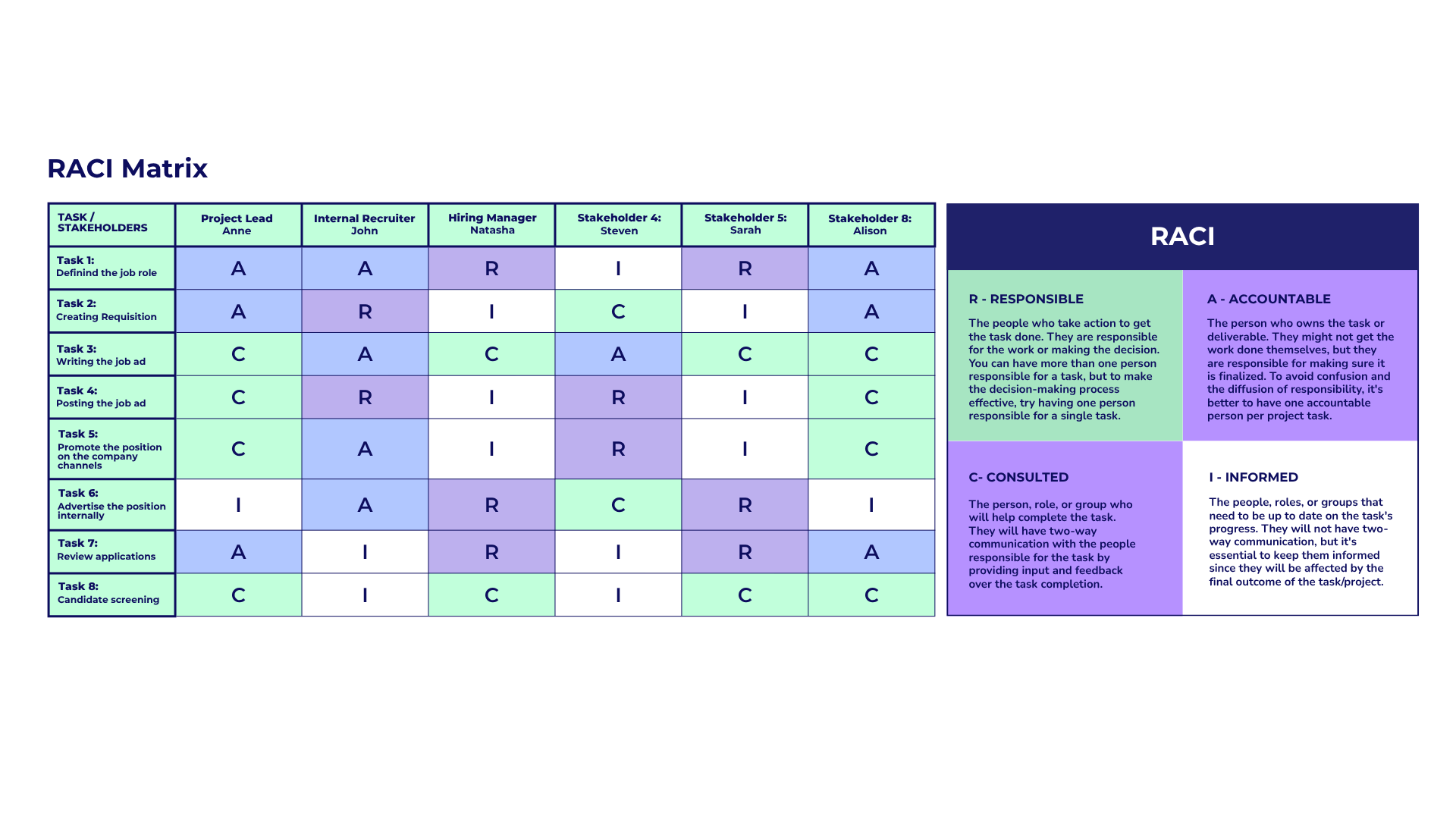
The RACI matrix clarifies who does what for every AI activity, from data preprocessing to model training to deployment approval. Unclear ownership is one of the most common reasons projects stall, which is why each activity should map to the four roles below.
| Role | What it means in AI governance |
|---|---|
| R – Responsible | Performs the work or makes the decision, such as preparing data or training the model. There can be more than one. |
| A – Accountable | Owns the outcome and signs off. There should be exactly one named person per activity to avoid diffused responsibility. |
| C – Consulted | Provides input through two-way dialogue, such as domain specialists, security, or legal advisors. |
| I – Informed | Kept up to date on progress through one-way communication, such as executives or clients. |
Applied across the lifecycle, a simplified matrix might look like the illustrative example below, which organizations adapt to their own roles and risk tolerance.
| Activity | CDAO / CAIO | Model Owner | Ethics & Legal | Executives |
|---|---|---|---|---|
| Set AI policy | A | C | R | I |
| Build and train model | I | R | C | I |
| Validate and bias-test | A | R | C | I |
| Approve deployment | A | R | C | I |
| Monitor in production | A | R | C | I |
Want a RACI built around your actual roles?
Elevate helps teams map AI governance ownership across legal, data, and engineering, then turn it into approval and escalation workflows that hold up under audit.
Operationalizing RACI in AI Workflows
“Think of AI as a sports car: the engine is powerful, but without brakes and steering, it’s a liability. AI governance isn’t about slowing down progress—it’s what enables us to move faster, with confidence.” — Christina Fung, SVP and Head of Global AI Enablement Center of Excellence at CGI, AI governance leader
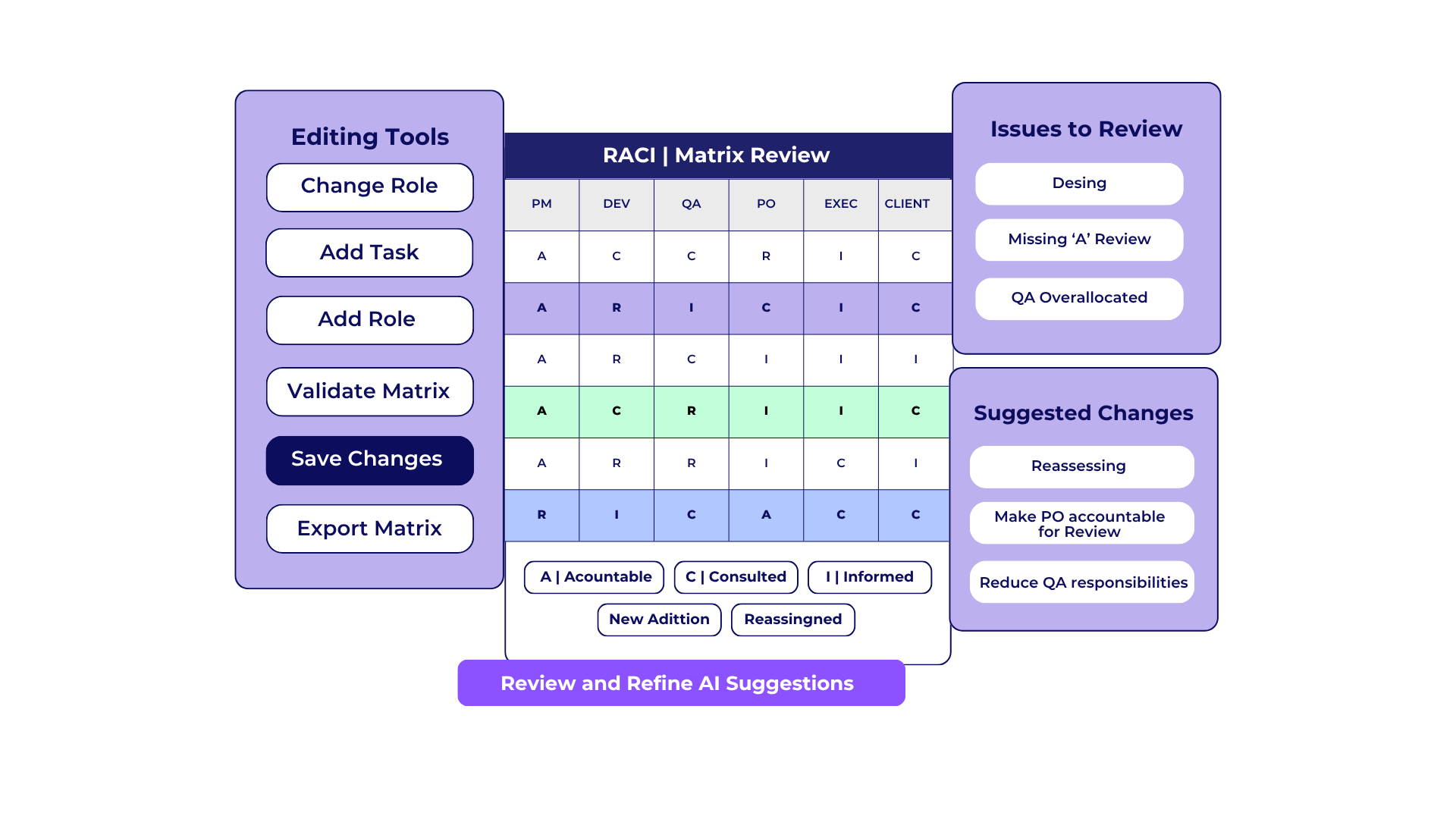
A matrix on a slide changes nothing. The value appears when those roles are wired into the workflows teams use every day.
Approval workflows for model deployment
Two things should require approval before going live: the model itself and its deployment endpoint. Most mature teams require models to pass quality checks, bias assessments, and feature-importance tests, and many automate this with MLOps pipelines that compare artifacts against set thresholds, update model status, and alert a named approver when a deployment needs review. The result is faster decisions with a clear record of who approved what.
Automated compliance reporting and audit trails
Detailed audit trails are the backbone of defensible governance. They should capture every meaningful decision, change, update, and approval tied to a model, from dataset origins to version history, stored centrally and protected against tampering. When this record exists, regulatory reporting becomes a matter of retrieval rather than reconstruction.
Escalation protocols for governance violations
Escalation protocols are the safety switches of an AI governance system. They define how and when a model decision can be reviewed or overridden, with responses tiered to the severity of the issue. Automated triggers, such as unusual confidence scores or a pattern of user complaints, can start the process, routing the decision to compliance, legal, or a human supervisor depending on what is at stake.
Future-Proofing the RACI Model
AI systems and the rules that govern them are moving quickly, so the operating model needs to be built to adapt.
Versioning and auditability
Model versioning keeps governance stable as models change. Pinning a specific, fixed version rather than always running the latest one gives predictable behavior while allowing controlled, risk-managed updates. Each version should carry documentation of why it was selected, what validation it passed, and when it will next be reviewed.
Adapting RACI to new regulations and model types
Regulation is now a design input, not an afterthought. The EU AI Act, the first comprehensive AI law, requires meaningful human oversight of high-risk AI systems. The governance implication for your RACI is direct: a model or AI system can be Consulted or Informed, but a named human must always hold the Accountable and Responsible roles, especially for generative AI where a person has to verify output before it is relied upon. Different model types also call for different controls, which is why governance should be tailored to your model portfolio rather than applied uniformly. For organizations formalizing all of this into a certifiable management system, ISO 42001 provides the structure.
Scaling with AI governance tools
As the number of models grows, manual oversight stops scaling. Governance platforms that support policy definition, monitoring, enforcement, and reporting give organizations a central place to apply their rules consistently across ethics, compliance, and risk, so the RACI you designed does not quietly erode as the portfolio expands.
Conclusion
A well-built AI governance operating model is a strategic advantage, not red tape. The sequence is what makes it work: find the gaps first, assign unambiguous ownership through a RACI matrix, wire that ownership into approval, reporting, and escalation workflows, and keep the structure adaptable as models and regulations evolve. Done well, governance lets an organization move faster precisely because accountability is clear and risks are managed rather than discovered after the fact.
For leadership, the throughline is trust. Customers, regulators, and boards increasingly expect evidence that AI is overseen responsibly, and a clear operating model is how that evidence gets produced. It is the same case Elevate makes to executives in its C-suite brief on compliance and trust: governance maturity is becoming a competitive position, not a cost center.
Turn your governance model into an operating reality
Elevate helps security and compliance leaders design the committee, the RACI, and the workflows behind a defensible AI governance program, aligned to NIST, ISO 42001, and the EU AI Act.
Key Takeaways
A RACI-based operating model is how organizations convert AI enthusiasm into governed, scalable capability.
- Assess before you assign. Surface shadow AI, build a model inventory, and measure maturity against a framework like the NIST AI RMF before designing the matrix.
- Make governance cross-functional. Effective programs combine legal, security, data science, compliance, and product, coordinated by a Responsible AI committee.
- One Accountable per activity. RACI works when exactly one named person owns each outcome, with experts Consulted and stakeholders Informed.
- Operationalize or it fails. Approval workflows, tamper-resistant audit trails, and tiered escalation turn a matrix into real safeguards.
- Keep humans accountable. Under the EU AI Act, a model can be Consulted or Informed, but a human must remain Responsible and Accountable for high-risk decisions.
Build the model to adapt through version pinning, regulatory flexibility, and governance tooling so it stays durable as AI evolves.
FAQs
Q1. What is a RACI matrix in AI governance?
A RACI matrix is a tool that assigns roles and responsibilities across the AI lifecycle. RACI stands for Responsible, Accountable, Consulted, and Informed, and it clarifies who executes the work, who owns the outcome, who provides input, and who is kept informed, from development through deployment and auditing.
Q2. How can organizations assess their AI governance gaps?
Start by surfacing shadow AI and building a complete inventory of every model in use, its purpose, owner, and data sources. Then measure maturity against an established framework such as the NIST AI Risk Management Framework, and identify compliance blind spots like missing monitoring, weak audit trails, or risk reviews that skip ethical and societal impact.
Q3. What are the key components of an effective AI governance operating model?
A working model includes a current AI inventory, regular risk assessments, clearly defined roles and accountabilities, model testing and documentation, regulatory tracking, vendor risk management, and ongoing training. A cross-functional committee and a RACI matrix tie these components to named owners.
Q4. How do companies operationalize RACI in AI workflows?
By embedding the roles into daily operations: approval workflows for both the model and its deployment endpoint, automated compliance reporting backed by tamper-resistant audit trails, and tiered escalation protocols that route serious issues to compliance, legal, or human review.
Q5. How can organizations future-proof their AI governance framework?
Adopt strong model versioning and auditability, keep the RACI adaptable to new regulations and model types, and use governance platforms to scale policy, monitoring, and enforcement. Under regulations like the EU AI Act, ensure a human always holds the Accountable and Responsible roles for high-risk AI.