

CMMC 2 compliance has become mandatory for defense contractors, yet a report reveals that only 1% of defense contractors are ready for their CMMC audits. Every executive in the defense industrial base should be worried about this alarming statistic. The CMMC final rule became effective in December 2024, and manufacturers might need CMMC certification by October 2025 to bid on and receive new government contracts.
Non-compliance brings harsh and quick penalties. Your organization will lose the ability to bid on new DoD contracts starting December 2024 without proper certification. Any misrepresentation of your compliance status on annual attestations could violate the False Claims Act, exposing the organization to treble damages, meaning three times the government’s damages, plus a civil penalty of $14,308 to $28,619 for each false claim.
In this piece, we want to learn about why most CMMC 2 compliance efforts fail. We’ll look at critical documentation pitfalls and operational gaps that cause audit failures. You’ll get a clear C-Suite action plan to help your organization achieve and maintain compliance with CMMC 2.0 requirements. The Department of Defense continues to strengthen the Defense Industrial Base against cyber threats, making these risks crucial to your business survival.
Why Most CMMC 2 Audits Fail: A C-Suite Overview
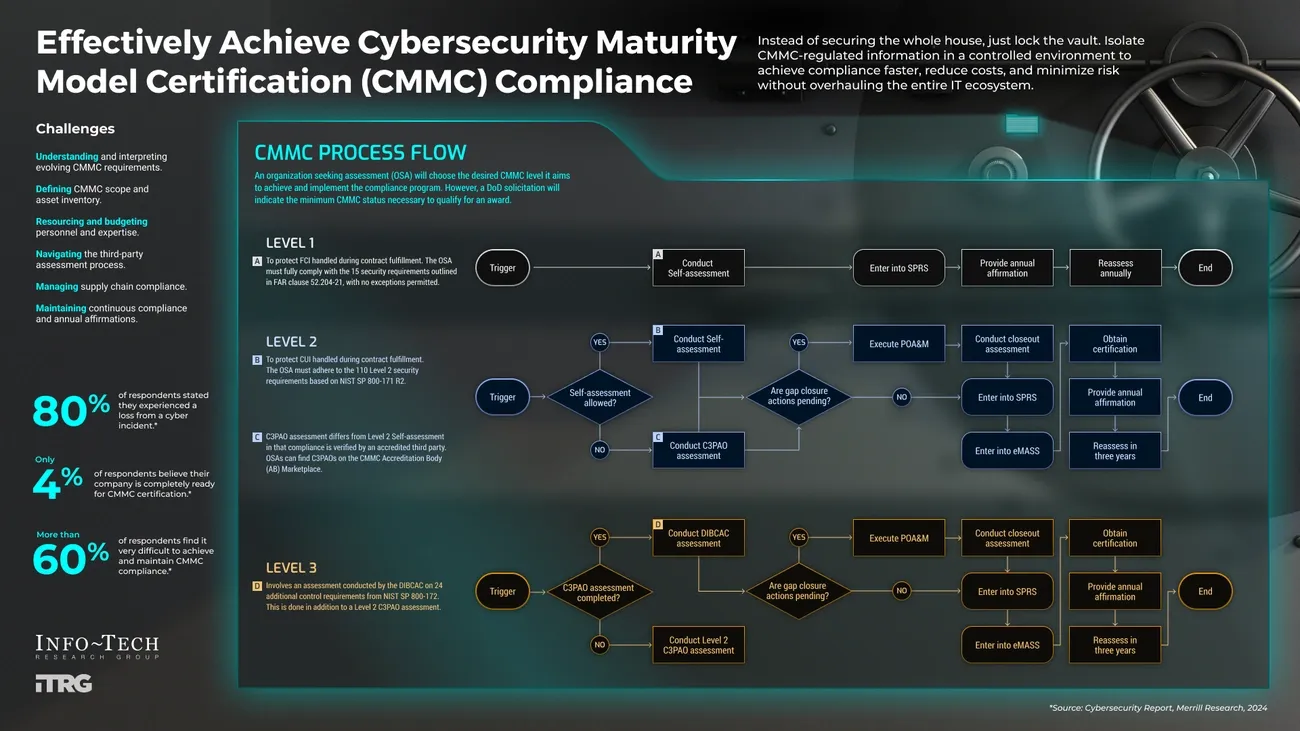
Image Source: Info-Tech
Defense industrial base executives face a harsh truth about CMMC 2 compliance. Defense contractors still struggle with simple cybersecurity requirements and fail audits regularly, despite having years to prepare.
Only 1% of Contractors Fully Prepared (CyberSheath Report)
The 2025 State of the DIB Report by Merrill Research paints a grim picture. Just 1% of defense contractors stand ready for upcoming CMMC assessments. The numbers paint an even bleaker picture – this percentage dropped from 8% in 2023 and 4% in 2024, as the deadline approaches. The situation is dire – roughly 80,000 defense contractors need Level 2 certification, yet only 270 organizations hold final CMMC certificates.
While 69% of contractors say they meet DFARS compliance through self-assessment, only 30% have completed medium or high-level assessments to verify their security posture. On top of that, just 42% have submitted their Supplier Performance Risk System (SPRS) scores – a requirement that proves compliance. The median SPRS score improved from 20 in 2022 to 60 in 2025, yet remains nowhere near the required 110 measure, and 17% of contractors report negative scores.
Disconnect Between Policy and Implementation
CMMC 2 audits typically fail due to the gap between written procedures and daily operations. Companies often create excellent security policies on paper that don’t match their system configurations and employee behaviors. Assessors spot this mismatch between documentation and operational reality immediately.
“You can have the most beautiful security policy ever written, but if you can’t verify it with a single log file, it’s worthless in an audit”. The inconsistency destroys auditor trust. Security programs appear unimplemented when policies state one thing, procedures show another, and system security plans reference outdated tools.
Employee interviews often reveal another critical weakness. Auditors see it as an operational failure when staff members can’t express their security process roles. This reveals that documentation exists without real implementation.
CMMC 2 Controls Lacking Verifiable Evidence
CMMC 2 ended up being an evidence battle rather than a paperwork exercise – and many organizations show up unprepared. Auditors follow a simple yet strict rule: without continuous, verifiable evidence, the control implementation never happened. To cite an instance, claims about enforcing multi-factor authentication need configuration screenshots, access event logs, and continuous proof that the MFA system blocks unauthorized attempts.
Organizations fail because they can’t produce two pieces of evidence for each control – one usually being a policy or procedure. Companies that try to create months of evidence just before assessment get caught quickly. Their artificial evidence lacks the consistency patterns of genuine, ongoing operations.
Cyber incidents have already caused financial, reputational, or business losses for 89% of defense contractors. This highlights both the real-life consequences and urgent need for genuine compliance. Critical security solutions remain underused across defense contractors of all sizes – 79% lack vulnerability management solutions, 78% lack patch management solutions, 74% lack data leakage protection, and 73% lack multi-factor authentication.
Top Documentation Pitfalls in CMMC 2 Compliance
Documentation failures are the main reason organizations fail CMMC 2 assessments. Even companies with strong technical controls don’t deal very well with documentation requirements, which ruins their compliance efforts.
Outdated or Inconsistent Policies
Audit red flags appear when departments use different versions of policies. The credibility suffers substantially when IT teams use one access control policy while HR refers to an older document. Assessors can’t determine which procedures are active. Policies that mention decommissioned systems or former employees show poor document management rather than simple mistakes.
Auditors reject policies without leadership approval. Documentation appears unofficial without management’s endorsement, which points to immature security practices. Vague policy language or undefined parameters like scan frequencies or logging thresholds will definitely lead to “NOT MET” findings.
Missing System Security Plan (SSP) and POA&M
A System Security Plan forms the foundations of CMMC Level 2 certification. Assessments cannot move forward without a current SSP. This vital document must specify system boundaries, security controls implementation status, and system interconnections. Simply reusing SSPs from PCI DSS or SOC compliance frameworks isn’t enough.
Plans of Action and Milestones (POA&Ms) now face stricter regulations. CMMC Level 1 doesn’t allow POA&Ms at all. Level 2 permits them for some requirements—but organizations must fully implement “critical requirements” during assessment. Each POA&M needs specific details:
- The relevant control
- Responsible party
- Planned remediation actions
- Start and completion dates
- Milestones with interim dates
- Status updates
POA&Ms must close within 180 days. Items that remain open after this period cause non-compliance.
Lack of Direct Mapping to CMMC 2 Requirements
Organizations often miss the connection between documentation and specific CMMC requirements. CMMC Level 2’s 110 controls actually contain 320 distinct assessment objectives. Documentation should address each applicable objective explicitly, not just the control family.
Companies often make vague claims like “we use encryption” instead of explaining implementation details. These generic statements trigger deeper assessor reviews, while specific explanations show a full picture of requirements.
Documentation must line up perfectly. Network diagrams showing three CUI-handling servers need matching references in asset inventories, data-flow diagrams, and SSP controls. Assessors become suspicious and investigate further when these documents don’t match.
Treating documentation as an afterthought leads to assessment failure. Teams should develop documentation while implementing security controls, not rush it before assessment.
Operational Gaps That Trigger Audit Failures
Security assessors find serious gaps in daily operational security practices that lead to CMMC 2 audit failures. Three operational weaknesses repeatedly surface and hurt compliance efforts.
Untrained Staff on CUI Handling Procedures
Technical controls become useless without well-trained personnel. Many organizations don’t provide proper training on Controlled Unclassified Information (CUI) handling procedures. CMMC 2 requirements make this training mandatory, but companies often skip it. Staff members don’t understand the basics to access, mark, safeguard, and destroy CUI.
Single training sessions don’t meet the “continuous” requirement in the Awareness and Training domain. Staff members forget vital concepts and updates without quarterly refresher training. Companies can’t show proof of completed training, which results in scoring penalties during audits.
This negligence has real consequences. Staff might email, share, or store CUI incorrectly. Systems and files stay unmarked, and accidental mishandling breaks compliance rules.
Overprivileged Accounts and Access Control Failures
Bad credential management stands out as a common reason for CMMC 2 audit failures. Companies don’t review user access properly or follow least privilege principles. These security gaps catch an assessor’s attention right away.
Users share accounts and passwords to make their work easier, which creates security holes. The lack of multi-factor authentication makes these problems worse. About 73% of defense contractors haven’t implemented multi-factor authentication solutions.
Good access control needs clear protocols to give and remove permissions when employees join or leave. Without these rules, former employees might keep their access long after they’re gone.
No Record of Risk Assessments or Incident Response Tests
CMMC 2 compliance requires regular risk assessments, but many companies can’t prove they’ve checked their threats, vulnerabilities, and potential risks. Companies must do and document these assessments each year.
Companies also need to test their incident response plans to verify they work and find weak spots. These tests should answer basic questions: What’s the response during an incident? Who leads the response? What does IT handle? How do we get more resources if needed?
Companies that skip tabletop exercises, simulations, or detailed tests can’t prove they’re ready to handle incidents. These drills reveal problems that might not show up during normal operations. Companies must keep forensic data for at least 90 days to allow proper investigation of incidents.
How Non-Compliance Impacts Business Continuity
Defense contractors face serious consequences when they fail to meet CMMC 2 requirements. The effects reach way beyond the reach and influence of regulatory penalties and threaten their business survival.
Suspension or Debarment from DoD Contracts
The Department of Defense strictly enforces cybersecurity violations. Contractors who fail CMMC requirements see their contracts terminated immediately, which counts as a material breach of their obligations. The contracting officers must check certification status at award time and throughout the contract’s lifecycle, including extensions.
Companies risk suspension or debarment if they willfully violate cybersecurity rules. The Department of Homeland Security suspended a license-plate scanner supplier after a hack in 2019. Companies that lose their government contracts cannot bid on future work, which locks them out of the defense market completely.
Loss of Trade Secrets and Sensitive IP
Organizations that don’t comply with CMMC 2 risk losing their valuable trade secrets, sensitive data, and intellectual property. This loss can destroy their competitive edge in both government and commercial markets.
Yes, it is concerning that nine out of ten defense contractors (89%) have already lost money, reputation, or business from cyber attacks. The risk of IP theft stays high since 79% lack vulnerability management tools, 78% don’t have patch management systems, and 74% miss data leakage protection.
Delayed Project Timelines Due to Failed Assessments
Companies that fail CMMC assessments get detailed reports about what they need to fix before trying again. This fixing process often delays projects significantly and strains client relationships.
Failed audits stop contract work immediately, which delays deliverables and blocks cash flow. Companies running multiple connected contracts see delays spread across their entire business. Prime contractors now prefer “CMMC-compliant only” vendors, which makes things harder for non-compliant organizations.
Most companies need months to fix these issues, so they lose revenue while paying extra to become compliant.
C-Suite Action Plan for CMMC 2 Audit Readiness
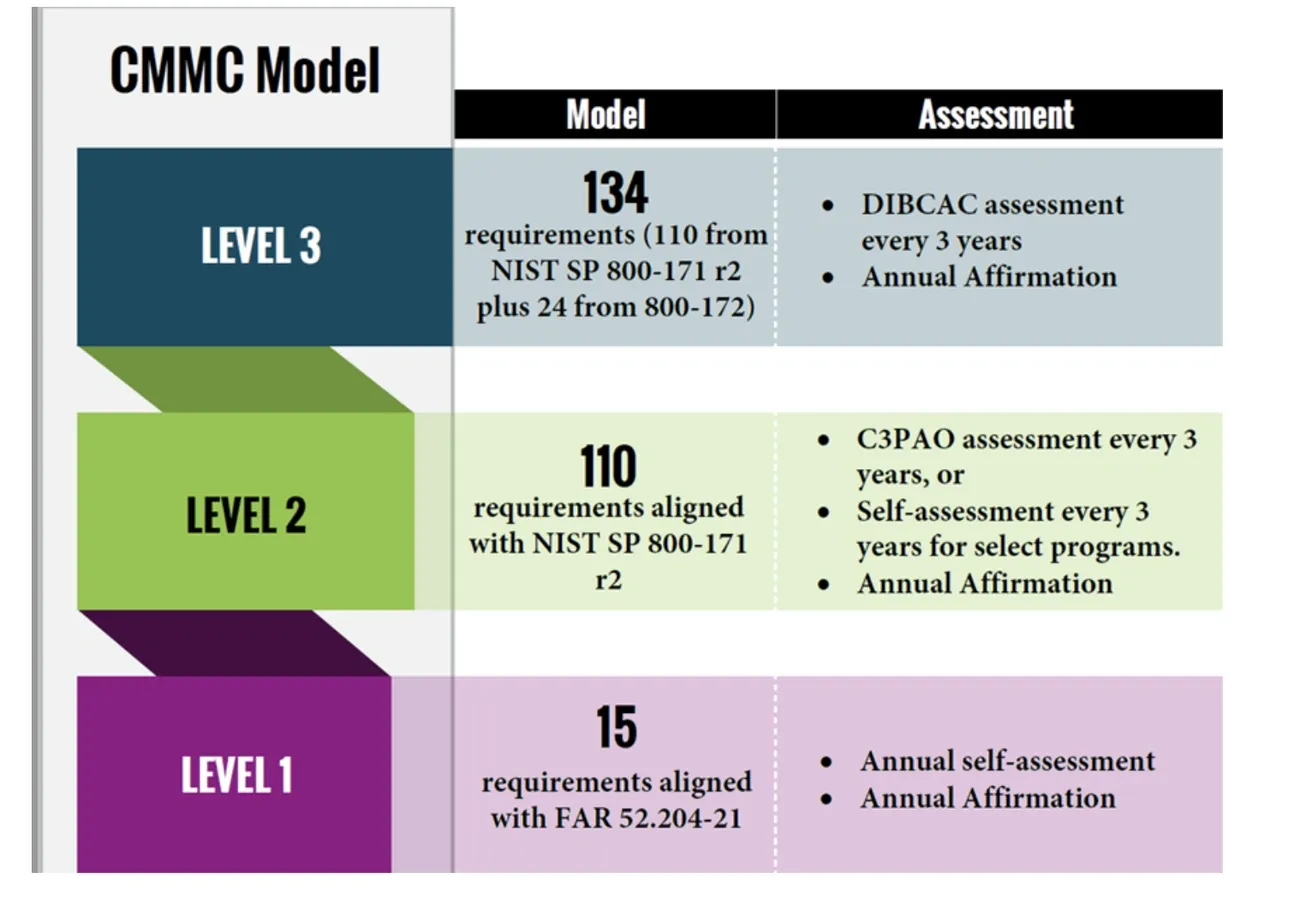
Image Source: Kiteworks
CMMC 2 assessment preparation demands strong leadership from the C-suite. Executives who champion these five vital actions will help their organizations achieve certification successfully.
Define Scope of CUI and FCI Environments
A well-defined scope serves as the foundation of CMMC compliance. Start by identifying where Federal Contract Information (FCI) and Controlled Unclassified Information (CUI) exist within your organization. You need detailed data flow diagrams that show how sensitive information moves through your systems. Your organization can reduce compliance costs by creating a CUI enclave—a segmented environment built specifically to process sensitive data. Keep in mind that CUI qualifies as FCI, but not all FCI needs the strict protections required for CUI.
Conduct Internal Gap Assessments Quarterly
Regular gap analyzes detect compliance issues before they lead to audit failures. These reviews measure your cybersecurity status against CMMC Level 2’s 110 controls. Your team should perform internal assessments every quarter to stay ready for compliance. Each review should produce an updated System Security Plan (SSP) and Plan of Action & Milestones (POA&M). Most organizations need 18-24 months to complete a full gap analysis properly.
Centralize Documentation with Version Control
The golden rule states: “If it’s not documented, it doesn’t exist”. Build a secure, central repository for all compliance materials. Your team must use strict version control to avoid outdated or mismatched policies. The documentation should cover policies aligned with CMMC’s 14 security domains, detailed procedures, network diagrams, and evidence artifacts. A qualified compliance partner can help with your first assessment—Book a Readiness Call to start your documentation strategy.
Engage CMMC 2.0 Certified Third-Party Assessors
Certified Third-Party Assessor Organizations (C3PAOs) have exclusive rights to conduct formal CMMC assessments. A C3PAO cannot provide consulting and assessment services to the same organization. Work with a C3PAO early to understand what they expect and prepare accordingly. Mock assessments with a trusted partner can reveal problems before the formal evaluation.
Train Executives on CMMC 2 Requirements and Risk Ownership
Your executive training should match specific roles and responsibilities. Leaders must show their steadfast dedication to cybersecurity and promote a culture of compliance. Training needs to cover role-based security risks, including how to spot potential insider threats. Detailed training records provide vital evidence during assessments.
Conclusion
Defense contractors face a stark reality with CMMC 2.0 compliance. A mere 1% of organizations are ready for certification now that the December 2024 deadline has passed. The risks are substantial. Companies that fail to comply could lose their contracts, face False Claims Act liability including treble damages and civil penalties of $14,308 to $28,619 per false claim, and might be barred from future Department of War contracts.
Getting compliant means tackling three major failure points we’ve identified in this piece. Companies need to bridge the gap between their security policies on paper and what happens day-to-day. Their documentation must stay up-to-date and map directly to all 110 CMMC 2 controls and 320 assessment objectives. They also need to fix operational issues in CUI handling, access control, and risk management.
Executives must act now to safeguard their government contracts and sensitive intellectual property. A clear path to certification exists through our C-Suite action plan. This means properly defining CUI environments, running quarterly gap checks, managing documentation with version control, and working with qualified third-party assessors. Book a Readiness Call with our compliance experts to get a full picture of your status and create a custom fix-it plan.
CMMC 2.0 compliance goes beyond just checking boxes. It builds the cybersecurity foundation that protects national security and your company’s future in defense contracting. Companies that focus on real security instead of just paperwork will definitely gain an edge as the DoD keeps raising cybersecurity standards across its supply chain.
Key Takeaways
Defense contractors face critical compliance challenges with CMMC 2.0, where failure means immediate exclusion from Department of War contracts and potential False Claims Act penalties of $14,308 to $28,619 per false claim plus treble damages.
• Only 1% of defense contractors are fully prepared for CMMC 2 audits, despite the December 2024 implementation deadline having passed.
• Documentation failures consistently trigger audit failures – policies must align with actual operations and directly map to all 320 CMMC assessment objectives.
• Operational gaps in CUI handling, access controls, and incident response testing immediately expose organizations to compliance violations during assessments.
• Non-compliance results in contract termination, potential debarment from future DoD opportunities, and loss of sensitive intellectual property through cyber incidents.
• C-suite leaders must define CUI scope, conduct quarterly gap assessments, centralize documentation, and engage certified third-party assessors for successful certification.
The path to CMMC 2.0 compliance requires genuine security implementation rather than paper exercises. Organizations that act decisively on these critical areas will secure their position in the defense industrial base while protecting national security interests and their competitive advantage.
FAQs
Q1. Which organizations are required to comply with CMMC? CMMC applies to all contractors and subcontractors in the Department of Defense (DoD) supply chain. This includes companies working directly with the DoD, such as research labs and repair services, as well as those indirectly supporting DoD operations, like cloud service providers and construction companies.
Q2. What are the key requirements for CMMC Level 2 certification? CMMC Level 2 certification requires meeting 110 federal security rules, passing an independent audit, encrypting all sensitive defense data, implementing multi-factor authentication, using government-approved cloud services, and achieving a minimum score of 88 out of 110 points.
Q3. What are the consequences of failing to achieve CMMC certification? Non-compliance with CMMC requirements can result in the loss of DoD contracts, potential debarment from future opportunities, and financial penalties. Organizations may also face increased risk of cyber incidents leading to the loss of sensitive information and intellectual property.
Q4. How often should organizations conduct internal CMMC assessments? It’s recommended to conduct internal gap assessments quarterly to maintain continuous compliance readiness. This helps identify and address deficiencies before they become audit failures and ensures ongoing alignment with CMMC requirements.
Q5. What role does executive leadership play in CMMC compliance? Executive leadership is crucial for successful CMMC compliance. C-suite leaders should champion compliance efforts by defining CUI scope, ensuring regular assessments, centralizing documentation, engaging certified assessors, and fostering a culture of cybersecurity throughout the organization.