
CMMC Level 2 compliance has become a crucial priority for defense contractors as the Department of Defense finalizes its cybersecurity requirements. The DoD published the CMMC Program Rule on October 15, 2024. Assessments will begin in Q1 2025, and contract implementation starts in Q3 2025 . Companies need 6-18 months to prepare for a CMMC Level 2 assessment, which creates real pressure on their timeline .
The final rule takes effect November 10, 2025, marking a radical change in the defense industrial base’s approach to cybersecurity . DoD contracts above the micro-purchase threshold will require CMMC certification when contractors handle Federal Contract Information (FCI) or Controlled Unclassified Information (CUI) . This detailed framework has 110 controls that come straight from NIST 800-171, creating the foundations to protect sensitive defense information . Defense contractors must understand these requirements to stay eligible for DoD contracts.
This piece will show DoD suppliers everything they need to know about CMMC Level 2 compliance. We’ll cover certification requirements, assessment preparation, and subcontractor relationship management. You’ll get a clear roadmap to handle these new cybersecurity mandates effectively.
CMMC 2.0 Final Rule and Its Impact on DoD Suppliers
The Department of Defense has finalized the regulatory framework for CMMC 2.0. This marks one of the most important milestones in cybersecurity requirements for defense contractors. Defense contractors must understand these regulations to stay eligible for future DoD contracts and prepare for compliance.
Effective Date and Rulemaking Timeline
Two complementary rules make up the CMMC program. The 32 CFR Part 170 rule (CMMC Program Rule) appeared in the Federal Register on October 15, 2024, and took effect December 16, 2024. The 48 CFR rule that amended the Defense Federal Acquisition Regulation Supplement (DFARS) came out on September 10, 2025.
This DFARS final rule takes effect on November 10, 2025. This date launches the first phase of CMMC implementation. The DoD has created a four-phase implementation approach that spans three years:
- Phase One (November 10, 2025 – November 9, 2026): The original implementation focuses on CMMC Level 1 and Level 2 self-assessments. C3PAO assessments remain optional for select high-priority acquisitions.
- Phase Two (November 10, 2026 – November 9, 2027): Implementation expands to include more contracts that need Level 2 C3PAO certification. Level 3 requirements stay optional for select contracts.
- Phase Three (November 10, 2027 – November 9, 2028): More contracts will need Level 3 certification.
- Phase Four (Beginning November 10, 2028): Full implementation brings CMMC requirements to all applicable DoD contracts with FCI or CUI.
Program managers and requiring activities will choose which solicitations include CMMC requirements during the first three years. Contracts solely for COTS items stay exempt. CMMC requirements will apply to all DoD contracts where contractor systems process, store, or transmit FCI or CUI after November 10, 2028.
DFARS 252.204-7012, 7019, 7020, 7021 Integration
The CMMC framework builds on existing DFARS clauses and adds new requirements. These clauses work together to create a complete cybersecurity compliance framework:
DFARS 252.204-7012 are the foundations that require contractors to protect covered defense information and report cyber incidents. Contractors must implement all 110 NIST SP 800-171 controls, develop System Security Plans, and report cyber incidents quickly.
DFARS 252.204-7019 requires contractors to assess themselves using the NIST SP 800-171 DoD Assessment Methodology. They must submit scores to the Supplier Performance Risk System (SPRS) before contract award.
DFARS 252.204-7020 makes prime contractors responsible for their subcontractors’ valid SPRS scores before awarding subcontracts.
DFARS 252.204-7021 is new and requires CMMC certification at the specified level to win a contract. Contractors must keep their certification throughout the contract and pass these requirements to applicable subcontractors.
CMMC in Title 32 of the Code of Federal Regulations
Title 32 CFR Part 170 creates the legal framework for the CMMC Program. It outlines the purpose, applicability, and requirements. This regulation:
- Makes CMMC Program DoD’s way to verify contractor implementation of cybersecurity requirements
- Sets requirements to protect FCI and CUI on contractor information systems
- Covers all DoD contractors and subcontractors that handle FCI or CUI, except COTS items
- Describes how assessments and certifications work
- Provides a base to integrate CMMC into the acquisition process
The Title 32 rule sets up the program structure. The Title 48 rule (DFARS amendment) enforces it through solicitations and contracts. Together, these rules change CMMC from a framework into a requirement that DoD suppliers must follow.
Understanding CMMC Level 2 Certification Requirements
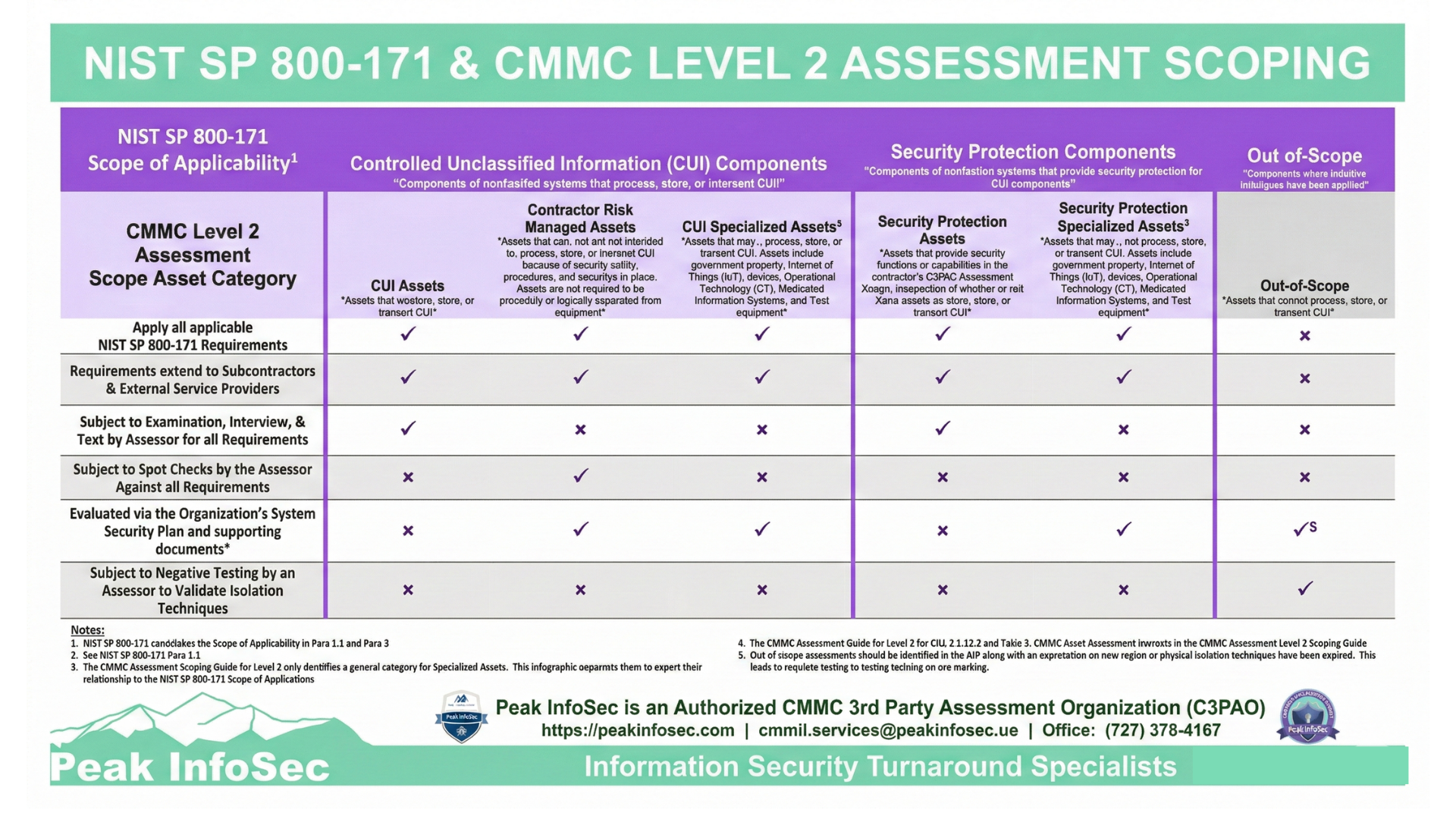
Image Source: Peak InfoSec
CMMC Level 2’s technical foundation builds on federal standards that protect sensitive defense information. Organizations working with the Department of Defense and handling Controlled Unclassified Information (CUI) need to know these requirements inside and out.
NIST SP 800-171 Rev. 2 as the Baseline
CMMC Level 2 uses all security requirements from NIST Special Publication 800-171 Revision 2. This standard serves as the complete baseline for Level 2, and it doesn’t add any new security controls beyond NIST SP 800-171. Organizations that already follow NIST SP 800-171 requirements under DFARS 252.204-7012 will find this approach familiar. The CMMC Level 2 controls match the NIST SP 800-171 Rev 2 controls exactly, with just a ‘DD.L2’ prefix added to the control number.
Level 2 focuses on protecting Controlled Unclassified Information (CUI), defined as “information the Government creates or possesses, or that an entity creates or possesses for or on behalf of the Government, that a law, regulation, or Government-wide policy requires or permits an agency to handle using safeguarding or dissemination controls”.
CMMC Level 2 Controls and Assessment Objectives
Level 2 includes 110 security controls spread across 14 domains. These domains range from Access Control with 22 controls to Audit and Accountability with 9 controls, Awareness and Training with 3 controls, and Configuration Management with 9 controls.
CMMC Level 2 goes beyond simple practice statements to detailed assessment objectives. The 110 practices need 320 assessment objectives that work as specific verification criteria. This difference matters because organizations must meet all assessment objectives to fulfill a practice.
NIST SP 800-171A defines these assessment methods:
- Examining policies, procedures, and system security plans
- Interviewing personnel responsible for security implementation
- Testing controls through demonstrations and technical validation
Differences Between Self-Assessment and C3PAO Review
CMMC Level 2 provides two ways to get assessed based on how critical the CUI is:
Organizations can do self-assessment for non-prioritized acquisitions with non-critical CUI. They must do these reviews every three years, submit results to the Supplier Performance Risk System (SPRS), and confirm compliance yearly.
C3PAO assessment becomes necessary for prioritized acquisitions that handle critical national security information. The Department of Defense expects about 80,000 Defense Industrial Base organizations will need this higher-level assessment. Only Certified Third-Party Assessment Organizations authorized by the CMMC Accreditation Body can conduct these assessments.
The reporting process differs between the two paths. Organizations submit their self-assessment results directly to SPRS, while C3PAO assessors post their results in the Enterprise Mission Assurance Support Service (eMASS) system.
Assessment outcomes fall into three categories: “MET,” “NOT MET,” or “NOT APPLICABLE” for each practice. Organizations need either a “MET” or “N/A” finding on all required CMMC practices to get certified.
Assessment Process and Certification Validity
Getting CMMC Level 2 certification needs a well-laid-out assessment to verify your security controls. Your certification path depends on how sensitive your CUI data is and what your contract needs.
Triennial Third-Party Assessment by C3PAO
DoD contractors who handle CUI must get a formal assessment from a Certified Third-Party Assessment Organization (C3PAO) every three years. Certified Assessors will review your information systems against all 110 NIST SP 800-171 security requirements. The C3PAO puts assessment results into the CMMC Enterprise Mission Assurance Support Service (eMASS), which sends the data straight to SPRS.
A successful assessment gives you a “CMMC Level 2 Final Certification Assessment” status that lasts three years from your certification date. Organizations that haven’t met all requirements might get a “Conditional CMMC Status” if they have:
- Implemented all baseline controls
- Achieved a score of at least 80%
- Established Plans of Action and Milestones (POA&Ms) to fix issues
These POA&Ms need closure within 180 days to upgrade from conditional to final status. Your certification then stays valid for three years from the date of your original conditional status.
Annual Affirmation in SPRS
CMMC Level 2 needs yearly proof that you still meet the requirements. Each organization picks an “Affirming Official” – a senior leader who makes sure CMMC compliance stays on track. This official must submit affirmations:
- After the original assessment
- When POA&Ms close out
- Every year after that
The affirmation states that your organization “has implemented and will maintain implementation of all applicable CMMC security requirements” within the assessed scope. Missing these yearly affirmations leads to expired certification, which could make you ineligible for contracts needing CMMC Level 2.
CMMC Level 2 Assessment Guide and Documentation
The DoD offers detailed documentation to help with the assessment process. The CMMC Level 2 Assessment Guide helps both C3PAOs and organizations doing self-assessments. This guide takes assessment objectives from NIST SP 800-171A and adds CMMC-specific guidance.
Your organization must define its assessment scope clearly before starting. This scope shows all assets that need CMMC requirements assessment and must match the rules in 32 CFR § 170.19.
Your organization needs to keep detailed records, including System Security Plans (SSPs) and proof of control implementation. All assessment records must stay on file for at least six years from your certification date.
Preparing for Compliance: Key Steps for DoD Contractors
Getting ready for CMMC Level 2 certification needs careful planning and implementation. DoD contractors need a well-laid-out approach to guide them through this complex compliance landscape. This structured method substantially increases their chances of success on the first try.
CMMC Level 2 Checklist for Readiness
Organizations should start with a complete gap analysis to check their current security practices against CMMC requirements. This assessment reveals vulnerabilities and compliance gaps that need fixing. A detailed remediation plan with specific timelines and responsibilities comes next.
Security controls must be implemented in all 14 domains. Multi-factor authentication and role-based access control need special attention. Regular security checks help maintain readiness and verify how well these controls work. The core team needs proper training because your security depends on their understanding of CUI protection.
System Security Plan (SSP) and Evidence Collection
The System Security Plan is the life-blood of CMMC compliance. Assessment guidelines state that an up-to-date SSP must exist at assessment time. Without it, you won’t comply with DFARS 252.204-7012.
Your SSP needs these critical elements:
- Description of the CMMC Assessment Scope
- Environment of operation details
- Implementation methods for security requirements
- System connections and relationships
- Defined frequency of updates (typically annual)
Evidence collection plays a vital role in assessment preparation. Organizations should gather documentation, artifacts, physical reviews, and screen shares that prove compliance with each control requirement.
Engaging a Registered Provider Organization (RPO)
CMMC compliance can feel overwhelming on your own. An RPO provides expert guidance that fits your business size and complexity. The Cyber AB authorizes these organizations to provide CMMC advisory services, and each one must employ at least one Registered Practitioner.
RPOs are a great way to get pre-assessment preparation, documentation development, CUI scoping strategies, and remediation support. Look at their CMMC experience, knowledge depth, and service offerings before choosing an RPO.
Want to speed up your CMMC compliance experience? Book a Readiness Call with an experienced RPO to check your current posture and create a custom compliance strategy.
Subcontractor Flowdown and Multi-Tier Compliance
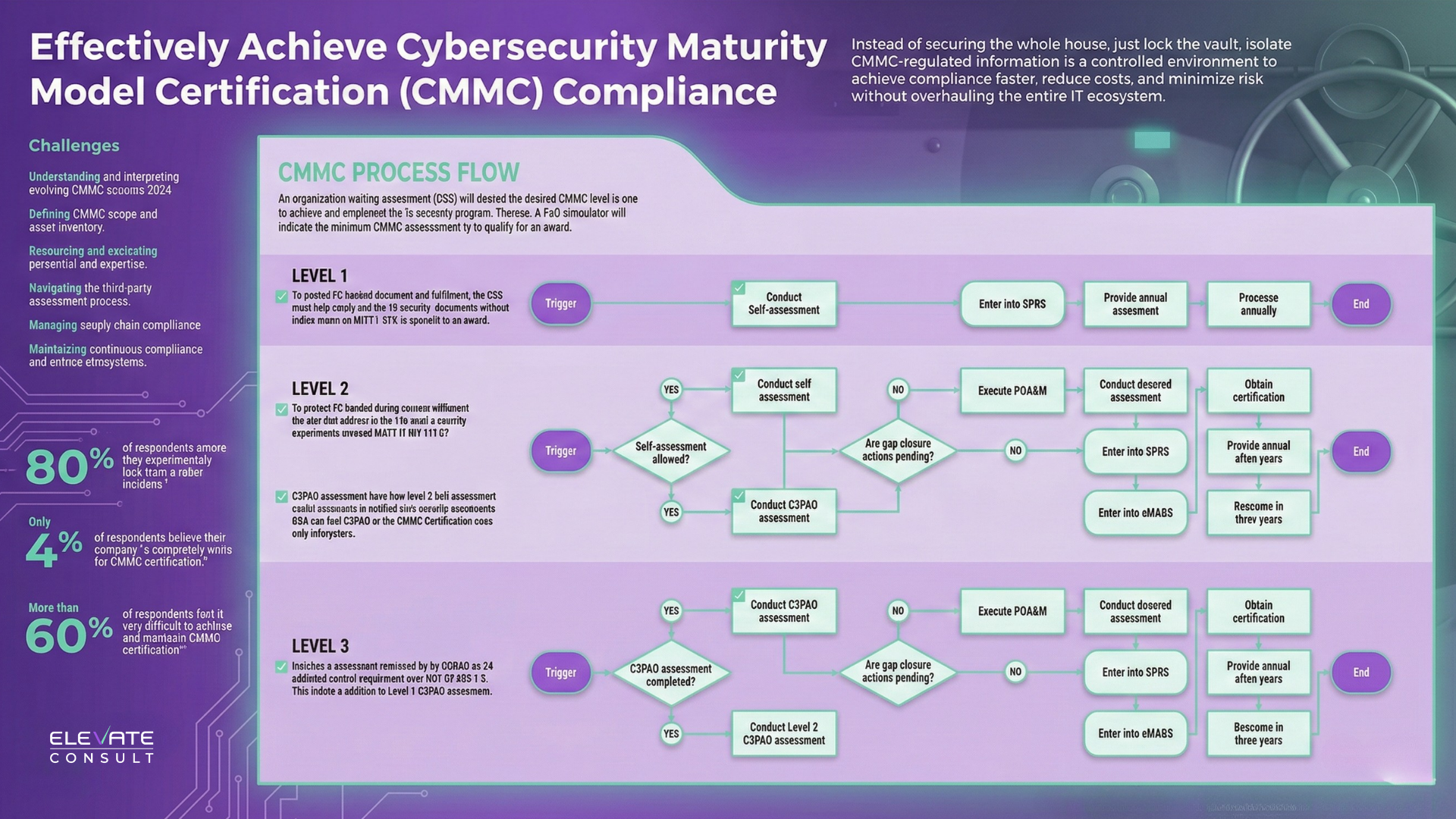
Image Source: Info-Tech
Supply chain security is a critical component of CMMC compliance. The final rule extends requirements beyond prime contractors to cover their entire subcontractor network.
Prime Contractor Responsibilities for Flowdown
Prime contractors are directly responsible to make sure their subcontractors comply throughout the supply chain. They must pass these obligations to any subcontractor that will process, store, or transmit Federal Contract Information (FCI) or Controlled Unclassified Information (CUI). Prime contractors must verify each covered subcontractor’s current certification at the appropriate CMMC level before they share sensitive information or award subcontracts.
CMMC adds a new layer of diligence that sets it apart from other contractual requirements. Prime contractors can’t directly view their subcontractor’s status in SPRS. Instead, they must rely on documentation like SPRS screenshots or certification copies from their subcontractors.
Subcontractor Certification and SPRS Reporting
The type of information determines the required certification level:
- Level 1 (self-assessed): For subcontractors handling only FCI
- Level 2 (self-assessed): For subcontractors processing CUI
- Level 2 (C3PAO-assessed): For subcontractors handling CUI when the prime requires C3PAO-assessed Level 2 or DIBCAC-assessed Level 3
Prime contractors must also confirm in SPRS each year that they meet applicable security requirements through continuous compliance affirmations.
Handling CUI Across Multiple Tiers
Requirements flow through multiple supplier tiers in CMMC’s cascading system. This multi-tier approach protects sensitive information wherever it flows. Subcontractors must comply even when they receive CUI indirectly through prime contractors or government-furnished equipment. Suppliers who don’t comply create major risks, including contract termination, lost bidding opportunities, and potential legal consequences under DoD’s Civil Cyber-Fraud Initiative.
Conclusion
CMMC Level 2 compliance marks a fundamental change in how defense contractors handle cybersecurity. The framework’s finalization with its November 10, 2025 effective date sets a clear timeline. Organizations need 6-18 months to prepare for a successful assessment, making quick action vital to keep DoD contract eligibility.
This piece dives into the complete nature of CMMC Level 2 requirements – from 110 controls across 14 domains to detailed assessment objectives that C3PAOs will check. We break down key differences between self-assessment and third-party certification options based on your organization’s CUI handling.
Preparation is the life-blood of successful compliance. A solid plan needs thorough gap analyzes, robust System Security Plans, proper security controls, and the right evidence. Many companies find their path to compliance smoother when they work with experienced partners. Book a Readiness Call today to check your current position and build a custom compliance strategy with experts who know CMMC inside out.
The flowdown requirements show why this certification matters in the defense supply chain. Prime contractors must make sure their subcontractors have proper certification levels. This creates accountability at every tier where sensitive information moves.
Companies that prepare now will lead the pack as the DoD rolls out its phased implementation. Those who wait risk losing contracts. CMMC compliance ended up making the entire Defense Industrial Base more secure, protecting vital national security information from sophisticated threats. Now is the time to act, before mandatory assessments create bottlenecks among certification providers.
Key Takeaways
CMMC Level 2 compliance is becoming mandatory for DoD contractors, with implementation beginning November 10, 2025. Here are the essential insights every defense supplier must understand:
• Timeline is critical: CMMC assessments begin Q1 2025, with contract implementation in Q3 2025, requiring 6-18 months preparation time for successful certification.
• Level 2 requires all 110 NIST SP 800-171 controls: Organizations must implement comprehensive cybersecurity measures across 14 domains, evaluated through 320 specific assessment objectives.
• Two assessment paths available: Self-assessment for non-critical CUI or mandatory C3PAO third-party assessment for prioritized acquisitions handling critical national security information.
• Supply chain compliance is mandatory: Prime contractors must verify all subcontractors have appropriate CMMC certification before sharing CUI or awarding subcontracts.
• Certification requires ongoing maintenance: Organizations need triennial assessments plus annual affirmations in SPRS to maintain valid certification status throughout contract duration.
The phased implementation approach gives organizations time to prepare, but early action provides competitive advantages. Organizations that delay preparation risk contract ineligibility as CMMC becomes fully mandatory across all applicable DoD contracts by November 2028.
FAQs
Q1. What is CMMC Level 2 and why is it important for DoD suppliers? CMMC Level 2 is a cybersecurity certification requirement for Department of Defense contractors handling Controlled Unclassified Information (CUI). It’s crucial because it will be mandatory for many DoD contracts starting November 10, 2025, and failure to comply could result in loss of contract eligibility.
Q2. How long does it typically take to prepare for a CMMC Level 2 assessment? Preparation for a CMMC Level 2 assessment usually takes between 6 to 18 months. This timeframe allows organizations to conduct gap analyzes, implement necessary security controls, and gather required documentation.
Q3. What are the key differences between self-assessment and C3PAO assessment for CMMC Level 2? Self-assessment is allowed for non-prioritized acquisitions involving non-critical CUI, while C3PAO assessment is required for prioritized acquisitions handling critical national security information. C3PAO assessments are conducted by certified third-party organizations and have more stringent reporting requirements.
Q4. How often do organizations need to renew their CMMC Level 2 certification? CMMC Level 2 certification is valid for three years. However, organizations must submit annual affirmations of continued compliance to maintain their certification status throughout this period.
Q5. What are prime contractors’ responsibilities regarding subcontractor CMMC compliance? Prime contractors are responsible for ensuring their subcontractors have appropriate CMMC certification before sharing CUI or awarding subcontracts. They must verify subcontractor compliance and flow down CMMC requirements throughout their supply chain.