
ISO 27001 and SOC 2 are two of the most prominent frameworks businesses rely on today for information security. ISO 27001 enjoys global recognition as a detailed approach to information security management, while SOC 2 has established itself as “the currency of trust” in the U.S. tech and SaaS market. Choosing between these frameworks can be challenging.
Both security standards share about 80% of their requirements, but they serve different purposes and markets. ISO 27001’s recognition remains strong worldwide, especially in Europe and Asia. SOC 2 leads the United States market, particularly among SaaS companies and cloud service providers. The implementation timelines are different too. SOC 2 Type 1 needs 4-8 weeks while Type 2 requires 3-12 months. ISO 27001 usually takes 3-10 months for complete implementation and certification.
This piece will get into the main differences between ISO 27001 and SOC 2 to help you choose the framework that best suits your business’s growth strategy. You might face pressure from enterprise clients during vendor due diligence or want to show your steadfast dedication to information security globally. Understanding these frameworks will help you make smart decisions about your security compliance journey.
Aligning Security Frameworks with Business Growth
Security frameworks have grown beyond simple regulatory checkboxes into powerful drivers of business growth. The choice between ISO 27001 and SOC 2 means more than meeting compliance requirements—it shapes your company’s strategic position for expansion and market access.
Why compliance matters for scaling companies
Security breaches now come with unprecedented financial risks. The global average cost of a data breach reached $4.45 million in 2023, which is a big deal as it means that costs rose 15% over three years. Proper compliance frameworks can help alleviate this existential threat to scaling companies.
Security frameworks create a solid foundation to manage risk. Companies that implement resilient security programs like ISO 27001 or SOC 2 build processes that prevent disruptions and setbacks. A strong security approach not only protects assets but creates business resilience that supports growth.
Security assurance directly opens new revenue opportunities. Companies that showed compliance credentials close deals faster and face fewer objections during vendor reviews. The operational integrity from these frameworks meets stakeholder expectations, transforming a cost center into a competitive advantage.
How frameworks support trust and market access
Different markets open up with each framework. SOC 2 has become essential for companies selling to U.S.-based clients, especially in SaaS, fintech, and cloud services. ISO 27001 certification carries more weight for companies expanding into Europe, Asia-Pacific, and the Middle East.
Different stakeholder groups trust these frameworks. Organizations that protect data and manage risk through recognized standards build trust with customers, board members, auditors, and partners. This trust leads to faster deals and efficient audit processes.
Companies looking at both frameworks will find about 80% overlap between ISO 27001 and SOC 2 criteria. This overlap makes it practical to get both certifications if you have global plans. Each framework still offers unique benefits—SOC 2 proves operational excellence for quick sales, while ISO 27001 builds governance structures for lasting resilience.
Scaling businesses must meet or exceed these standards to enter markets, particularly in regulated industries. Your security approach needs to match your growth goals as a core business strategy, not just a compliance checkbox.
ISO 27001 vs SOC 2: Strategic Fit for Your Organization
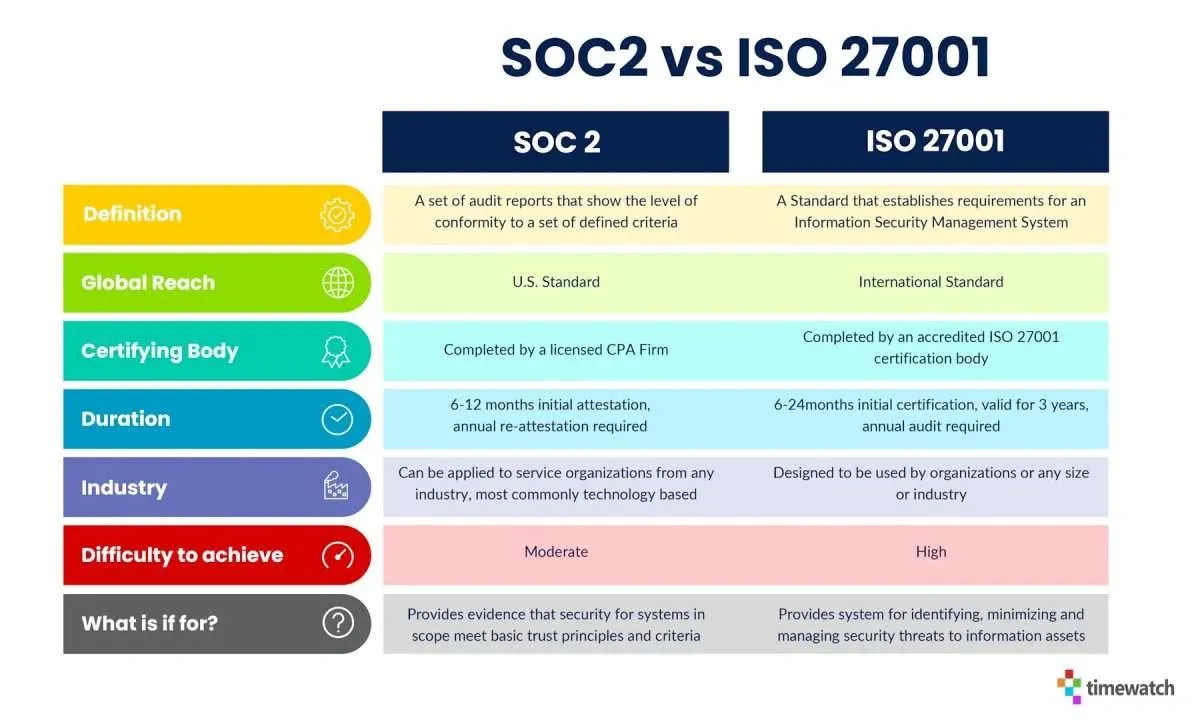
Image Source: Timewatch
Your organization’s strategic goals should guide the choice between security frameworks. The best choice depends on your business model, target market, and your security governance vision.
ISO 27001 for governance and long-term resilience
ISO 27001 creates a detailed Information Security Management System (ISMS) that makes security part of your organization’s DNA. This internationally recognized standard takes an all-encompassing approach to information security by requiring all 93 controls in Annex A. The framework builds institutional accountability that helps controls and processes mature over time.
ISO 27001 certification gives global credibility to organizations with international goals. The certification enjoys strong recognition worldwide, especially in Europe and Asia. Businesses targeting global markets need this certification. ISO 27001 champions a risk-based security approach that creates systems to adapt to emerging vulnerabilities.
The certification turns cybersecurity from a defensive measure into a growth driver. Companies with ISO 27001 build processes that prevent disruptions from getting pricey. They create a security culture that stays strong through leadership changes and market shifts.
SOC 2 for operational proof and ever-changing sales
SOC 2 focuses on operational performance and control effectiveness evidence. This framework has become “the currency of trust” in the U.S. tech and SaaS market. B2B SaaS startups selling to Fortune 500 companies can’t close deals without a SOC 2 Type II report.
SOC 2 speeds up deal closure and brings real business value. Enterprise buyers following regulatory compliance rules check SOC 2 reports before signing contracts. This can reduce procurement cycles from months to weeks. A SOC 2 report helps distinguish your organization by showing a reliable security posture. This gives you an edge over competitors without these compliance reports.
Your SOC 2 report replaces hundreds of security questions from each prospect. This efficient approach is a great way to get faster growth for startups focused on rapid expansion.
Framework flexibility vs structure
These frameworks have fundamental differences in flexibility and structure. SOC 2 offers more choices—you pick which Trust Services Criteria to include in your audit. Only Security remains mandatory. Organizations can tailor their compliance approach to their specific services.
ISO 27001 uses a more prescriptive approach with its required 93 Annex A controls. Organizations must document and justify any excluded controls. This rigid structure creates stronger foundations to add more compliance frameworks.
Many organizations choose both frameworks. They start with SOC 2 to access markets quickly, then add ISO 27001 to build long-term governance.
Operational Impact and Resource Requirements
ISO 27001 and SOC 2 implementations require substantial organizational resources. Each framework needs different operational commitments. Companies can prepare better by understanding these differences.
Documentation and process depth in ISO 27001
ISO 27001 requires extensive documentation to establish a formal Information Security Management System (ISMS). The standard mandates several key documents. These include an ISMS Scope, Information Security Policy, Risk Assessment Methodology, Statement of Applicability, and Risk Treatment Plan. These documents are the foundations of ISO 27001 compliance.
ISO 27001:2022 needs detailed records like training certificates, measurement reports, internal audit reports, and management review minutes. Documentation gaps could result in non-compliance or lengthy discussions with auditors. The 2022 revision asks for fewer mandatory documents than the 2013 version. Yet, the depth of process documentation remains considerable.
Control testing and evidence in SOC 2
SOC 2 emphasizes control effectiveness and operational proof. It produces an attestation report instead of following ISO 27001’s certification model. This difference shapes evidence collection and presentation during audits.
Evidence collection plays a crucial role in SOC 2. Organizations must show concrete proof that controls work as described. This often includes screenshots, access logs, change records, and monitoring alerts. SOC 2 evidence must have system timestamps. These verify when data was extracted and confirm it falls within the audit period. The evidence should also confirm data source—usually the production environment. This reflects actual operational conditions.
Team readiness and tooling needs
Both frameworks need thorough preparation but focus on different aspects. ISO 27001 certification takes six to twelve months. Teams need members who can handle complex documentation requirements and maintain process discipline.
SOC 2 Type 1 might take just a few months to complete. Type 2 needs three to twelve months of auditor observation. Companies can adapt SOC 2 controls to their unique systems and services.
Automated compliance tools have become essential for both frameworks. These platforms map controls across frameworks, centralize evidence collection, and create audit-ready reports. They save hundreds of hours that teams would spend on preparation and compliance management.
Decision-Making Factors for Framework Selection
The right security framework depends on several significant factors that go way beyond technical details. Your organization’s business context and goals should guide this choice.
Geographic market and customer base
Your customers’ location plays a big role in determining which framework provides the most value. SOC 2 leads the way in North America and U.S. companies see it as the standard. Digital businesses that target American enterprises need SOC 2 as a “table-stakes requirement” when they handle sensitive customer data.
ISO 27001, on the other hand, holds major importance worldwide. Companies around the globe accept and recognize this certification as a universal standard. Organizations expanding to Europe, Asia, or the Middle East can boost their credibility with ISO 27001, as potential customers look for globally recognized certifications.
Companies that target a variety of markets often need both frameworks. These frameworks share about 80% of their requirements, though this varies with organizational size and audit scope. One expert points out, “If you have international clients with a strong presence in the US, you’ll mostly need both frameworks”.
Industry norms and regulatory alignment
Each industry has its own compliance culture. Finance, healthcare, and government contracting sectors need more structured governance and international standards. Their contracts might specifically ask for ISO 27001 certification or compliance with its principles.
Take a look at your top clients’ RFPs and your competitors’ standards to see which certifications your industry typically needs. Book a Readiness Call to get a full picture of your industry requirements and find the best compliance path.
Internal risk posture and leadership goals
Your risk management approach should help you pick the right framework. Today’s compliance frameworks require you to show ongoing security monitoring, prove control testing, and demonstrate security improvements over time.
SOC 2 lets you customize controls to match your operations. ISO 27001 provides a more structured, detailed system that works well for organizations seeking stability. Think about whether you need a lighter assessment or a stronger standard that builds your security credibility.
Dual Certification Strategy: When and Why to Pursue Both
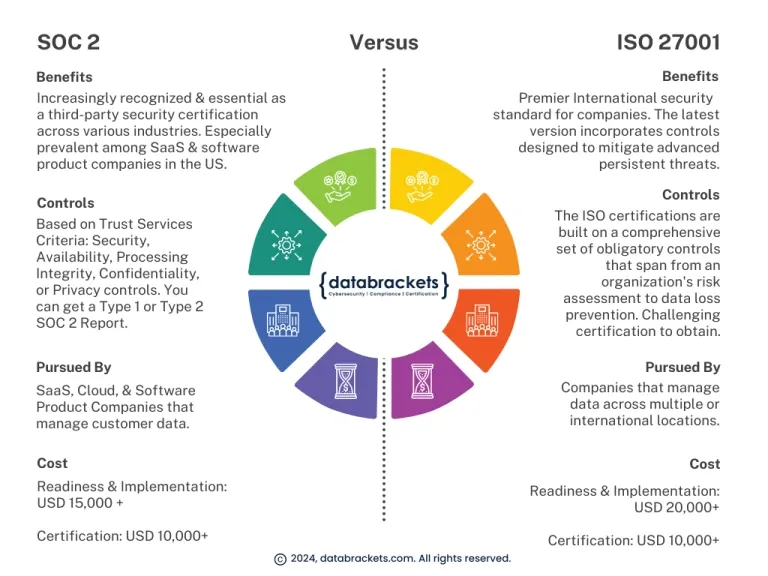
Image Source: databrackets
Companies often struggle to choose between ISO 27001 and SOC 2 certifications. Smart businesses now see the value of getting both certifications at once. This approach brings unexpected benefits that weren’t possible with separate certifications.
Overlap in controls and audit efficiencies
ISO 27001 and SOC 2 share common ground that ranges from 43% to 95%, based on your company’s scope and type. Companies need 25-50% less time and effort to implement both frameworks together compared to doing them one after another. A project that takes 200 hours when done separately might need only 150-175 hours when tackled together.
Companies can save money beyond just time savings. A united approach cuts down on shared costs like auditor travel, lodging, and paperwork. Your organization can get both certifications without doubling your compliance spending.
Mapping ISO 27001 vs SOC 2 (xls tools and templates)
AICPA recognized this potential and created detailed mapping spreadsheets that arrange SOC 2 Trust Services Criteria with ISO 27001 controls. These tools help companies build one compliance system instead of separate ones for each framework.
Evidence mapping matrices provide a quick way to reuse requirements by finding overlapping needs. A single security policy can meet both SOC 2 confidentiality requirements and ISO 27001 risk management criteria. Book a Readiness Call to see how your current controls can work for both frameworks.
Benefits of combined trust signals
Having both certifications sets you apart from competitors. Each framework opens new doors—SOC 2 serves U.S. markets while ISO 27001 helps with international growth. Organizations with both certifications gain exceptional global credibility.
Getting both standards at once builds a strong internal security system. This complete approach creates a better security culture and reduces gaps that might appear from separate compliance efforts.
Companies with both certifications see faster vendor reviews, quicker sales, and greater trust from stakeholders.
Comparison Table
| Aspect | ISO 27001 | SOC 2 |
| Geographic Recognition | Worldwide recognition with strong presence in Europe and Asia | U.S. market leader, especially among SaaS and tech companies |
| Implementation Timeline | 3-10 months to complete implementation and certification | Type 1: 4-8 weeks Type 2: 3-12 months |
| Control Requirements | 93 mandatory controls in Annex A | Adaptable framework with Security Trust Services Criteria as minimum requirement |
| Documentation Approach | Requires detailed documentation (ISMS Scope, Security Policy, Risk Assessment, etc.) | Prioritizes operational proof and control effectiveness |
| Framework Structure | Structured and standardized approach | Adaptable framework that fits specific services |
| Primary Focus | Detailed Information Security Management System (ISMS) and sustained governance | Operational performance and proven control effectiveness |
| Market Impact | Vital for global business growth | Key requirement for U.S. tech and SaaS market entry |
| Evidence Collection | Documented processes and risk management take priority | Relies on timestamps, logs, and operational proof |
| Certification Type | Certification-based | Attestation report-based |
| Industry Fit | Suits highly regulated sectors and global markets | Matches B2B SaaS and cloud service providers’ needs |
Conclusion
The choice between ISO 27001 and SOC 2 comes down to your organization’s needs, target markets, and security goals. SOC 2 leads the way for U.S.-based tech companies, while ISO 27001’s governance structures appeal more to European and Asian markets. These frameworks share about 80% of their requirements but differ in their timeline, documentation, and certification process.
Enterprise clients put pressure on vendors during evaluations. The right security certification speeds up sales cycles and builds trust with stakeholders. SOC 2 lets you customize Trust Services Criteria, while ISO 27001 gives you a well-laid-out foundation through its mandatory controls and documentation requirements.
Smart companies see the advantage of getting both certifications at once instead of one after another. This strategy helps them stand out in the market and builds global credibility. It also saves 25-50% of time and effort compared to doing them separately. Companies getting ready for either framework should Book a Readiness Call to find their best compliance path based on their industry needs and security level.
Security breaches cost more every year. Companies need to see these frameworks as business tools rather than just boxes to check. ISO 27001 and SOC 2 both show your steadfast dedication to information security, each with its own approach and market recognition. Whatever framework you pick, reliable security practices build trust and resilience needed to grow in today’s security-focused market.
Key Takeaways
Understanding the strategic differences between ISO 27001 and SOC 2 is crucial for making informed security compliance decisions that align with your business growth objectives and target markets.
• SOC 2 dominates U.S. tech markets while ISO 27001 provides global credibility, especially in Europe and Asia • Dual certification saves 25-50% effort compared to sequential implementation due to 80% overlap in requirements • SOC 2 offers faster implementation (4-8 weeks for Type 1) versus ISO 27001’s 3-10 month timeline • Choose based on customer geography – SOC 2 for U.S. clients, ISO 27001 for international expansion • Both frameworks accelerate sales cycles by eliminating lengthy security questionnaires and vendor evaluations
The decision isn’t just about compliance—it’s about strategically positioning your organization for market access and building stakeholder trust that directly impacts revenue growth.
FAQs
Q1. How do ISO 27001 and SOC 2 differ in their approach to information security? ISO 27001 focuses on establishing a comprehensive Information Security Management System (ISMS) with mandatory controls, while SOC 2 emphasizes operational performance and control effectiveness. ISO 27001 is more prescriptive, while SOC 2 offers greater flexibility in its implementation.
Q2. Which framework is better suited for international business expansion? ISO 27001 is generally better suited for international business expansion, particularly in Europe and Asia. It’s globally recognized and accepted worldwide as a comprehensive approach to information security management, making it valuable for organizations targeting global markets.
Q3. How long does it typically take to implement ISO 27001 compared to SOC 2? ISO 27001 typically requires 3-10 months for full implementation and certification. In contrast, SOC 2 Type 1 can be completed in 4-8 weeks, while SOC 2 Type 2 takes 3-12 months. The timeline difference is due to the varying depth and scope of each framework.
Q4. Can pursuing both ISO 27001 and SOC 2 certifications simultaneously offer any advantages? Yes, pursuing both certifications simultaneously can offer significant advantages. There’s approximately 80% overlap in requirements, which can lead to time and cost savings of 25-50% compared to sequential implementation. This dual approach also provides unmatched global credibility and market differentiation.
Q5. How do ISO 27001 and SOC 2 impact sales cycles and client trust? Both frameworks can significantly accelerate sales cycles by eliminating the need for lengthy security questionnaires during vendor evaluations. They build credibility with stakeholders, including customers and partners, leading to faster deal closures. SOC 2 is particularly impactful for U.S.-based tech companies, while ISO 27001 carries more weight internationally.