
Defense contractors nationwide must comply with CMMC Level 2 requirements starting November 10, 2025. The Cybersecurity Maturity Model Certification (CMMC) program sets security levels based on the type of information contractors handle. Many organizations find it hard to spot the key differences between Federal Contract Information (FCI) and Controlled Unclassified Information (CUI).
The government provides or generates FCI as non-public data under contract. CUI needs strict security measures even though it’s not classified. Contracts that only deal with FCI need CMMC Level 1 self-assessments. Those handling CUI under the Defense Organizational Index Grouping must get CMMC Level 2 certification. A CMMC Level 2 assessment looks at both FCI and CUI, which makes things tricky. Some organizations might want to keep these information types separate. On top of that, contractors need to meet all 110 NIST 800-171 security requirements. The right scoping and classification help create economical security solutions.
This piece will show you the timeline for CMMC Level 2 compliance, the quickest way to scope your environment, and practical ways to handle both FCI and CUI while meeting DoD’s cybersecurity requirements.
CMMC Level 2 Scope: Does It Cover Both FCI and CUI?
You need to understand if CMMC Level 2 includes both Federal Contract Information (FCI) and Controlled Unclassified Information (CUI). This difference is vital for contractors who want to prepare for assessments and use their resources well.
Default Inclusion of FCI in Level 2 Assessments
A CMMC Level 2 assessment covers protection requirements for both FCI and CUI. Certified Third-Party Assessment Organizations (C3PAO) review compliance with all practices from Level 1 through Level 2. This happens whatever type of information your organization handles. Organizations that get Level 2 certification meet Level 1 requirements automatically within the same assessment scope.
CMMC Level 2 builds on Level 1 and includes all 110 security requirements from NIST SP 800-171. Level 1 focuses on simple FCI protection through 15 controls in FAR 52.204-21. Level 2 adds reliable protections that we designed for CUI. The Department of Defense expects about 35% of defense contractors will need Level 2 C3PAO assessments. Only 2% will need Level 2 self-assessments.
Optional Segregation of FCI and CUI Environments
Companies can split their FCI and CUI environments for strategic reasons. DoD guidance states that “If FCI and CUI do not share an environment, the two assessments would be conducted independently and methods to implement security requirements in one scope would not apply to the other scope”. This split lets contractors limit stricter CMMC Level 2 controls to systems that handle CUI.
This approach could lower compliance costs since only CUI environments must meet all 110 NIST SP 800-171 requirements. The FCI environment would then need a simpler CMMC Level 1 self-assessment.
Implications for CMMC Level 2 Certification
Your choice to combine or separate FCI and CUI environments affects certification greatly. A shared environment means everything falls under Level 2 assessment criteria. Separate environments create different compliance boundaries with their own requirements and assessment methods.
Companies should consider several factors:
- Assessment timing (three-year assessments plus yearly affirmations)
- Cost to implement 110 security controls in different environments
- Challenge of running separate environments
- Risk of CUI spreading beyond planned areas
The right scope remains the foundation to achieve compliance efficiently while protecting sensitive government information properly.
Creating a CMMC Enclave for Level 2 Compliance
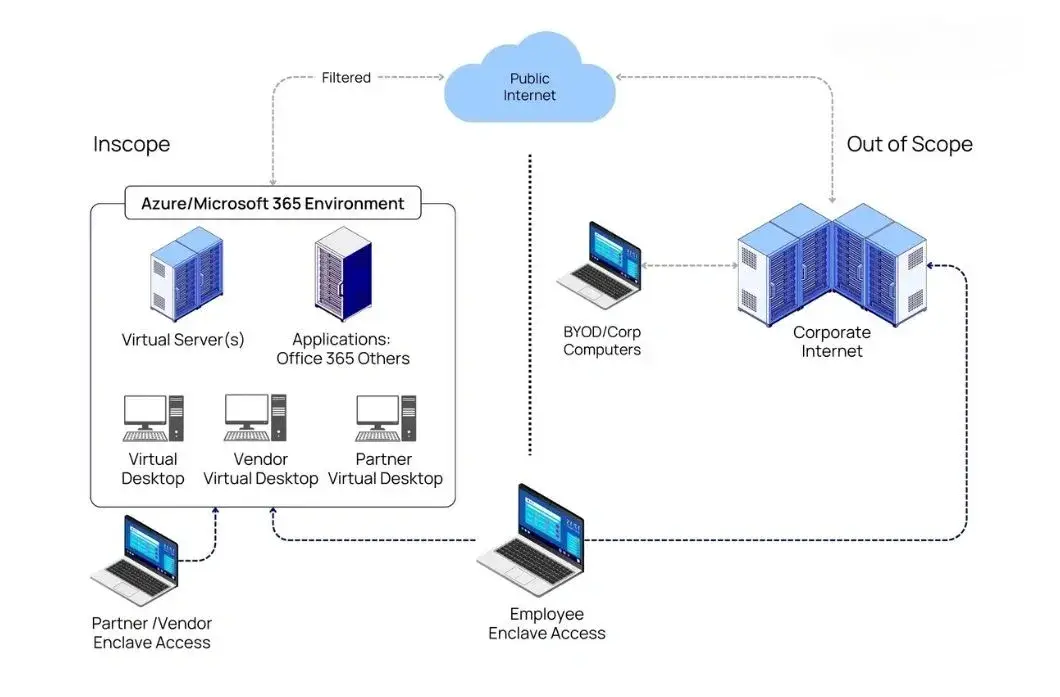
Image Source: InterSec Inc.
Organizations can streamline their CMMC Level 2 certification by creating a dedicated enclave. This approach is more practical than implementing controls across the entire environment. A specialized boundary can substantially reduce assessment complexity.
What is a CMMC Enclave?
A CMMC enclave works as a secure computing environment that stores, processes, and protects Controlled Unclassified Information. It serves as a digital fortress that keeps CUI safe from the rest of your network through enhanced security measures. Your organization can choose between physical, virtual, or hybrid enclaves based on specific needs.
The CyberAB’s CMMC Assessment Process describes an enclave as “a set of system resources that operate with the same security domain and share the protection of a single, common, and continuous security perimeter”. This segmentation builds a boundary around CUI systems that separates sensitive information from other networks.
Scoping Systems that Store or Transmit CUI
The first step in proper scoping is identifying assets that handle CUI. The DoD asks organizations to document these assets in an inventory and provide a network diagram to help pre-assessment discussions. Assets within your CMMC assessment scope typically include CUI Assets, Security Protection Assets, and Contractor Risk Managed Assets.
Organizations must isolate assets logically or physically for effective separation. NIST SP 800-171 states: “If nonfederal organizations designate specific system components for the processing, storage, or transmission of CUI, those organizations may limit the scope of the security requirements by isolating the designated system components in a separate CUI security domain”.
Reducing Assessment Scope Through Encryption
Encryption is crucial in scope management but comes with limitations. Advanced file-level encryption protects contents from unauthorized access during breaches. The DoD has made it clear that “data does not lose its status as Controlled Unclassified Information simply because it is encrypted”.
The DoD requires encrypted CUI to be stored in a cloud environment authorized at FedRAMP Moderate or equivalent. Organizations that thought encryption alone would meet cloud storage requirements need to fix both control gaps and scoping issues.
When Enclaves Are Not Cost-Effective
Enclaves provide great benefits but aren’t always the best choice. Some organizations might find enclaves complicate compliance efforts, especially those where many staff members handle CUI or process large CUI volumes. Setting up an enclave usually means duplicating systems like email, file storage, or collaboration tools to maintain separation.
Your current infrastructure needs a thorough review before choosing an enclave approach. This includes looking at existing security measures and potential vulnerabilities. Book a Readiness Call with CMMC experts to see if an enclave strategy fits your organization’s structure and compliance needs.
Deciding Whether to Separate or Combine FCI and CUI
The choice between keeping Federal Contract Information (FCI) and Controlled Unclassified Information (CUI) environments separate or combined is a key strategic decision for defense contractors working toward CMMC Level 2 compliance.
Benefits of Treating FCI Like CUI
CUI-level protections for FCI come with several advantages. Organizations dealing with mixed data environments can eliminate daily classification challenges by using uniform protection standards. This approach:
- Creates consistent security protocols across all government-related data
- Reduces risk of compliance violations through misclassification
- Makes employee training and operational procedures simpler
- Speeds up certification timelines by avoiding separate controls
Most contractors discover that keeping FCI separate doesn’t save much money because of the complex nature of maintaining different protection systems. Organizations without advanced data classification tools often find the “play it safe” approach works best.
Risks of Mislabeling or Misclassifying CUI
Wrong classifications can lead to serious operational, financial, and security risks. Even small classification mistakes can cause contract delays, regulatory penalties, and cybersecurity incidents. Contractors who mistake CUI for FCI leave sensitive data vulnerable.
These vulnerabilities make perfect targets for cyberattacks and can result in serious data breaches that hurt customer trust. Poor communication between IT, compliance, engineering, and HR departments often creates inconsistent classification practices without clear standards.
When to Separate Based on IT Infrastructure
Separation works best for organizations with sophisticated IT environments that can create distinct enclaves. Large businesses using ERP solutions to manage contracts might choose to keep FCI-only environments separate.
Keeping systems apart can boost CUI security (especially if FCI systems get compromised), make compliance easier to prove, and lower data governance costs. You should Book a Readiness Call with CMMC experts to get a full picture of whether your infrastructure supports effective separation.
Impact on CMMC Level 2 Assessment Scope
The way you handle separation substantially affects your assessment scope. Without proper separation, your entire network must meet CMMC Level 2 assessment requirements—creating complex compliance scenarios. Setting up dedicated CUI enclaves can limit Level 2 requirements to those specific environments.
Your organization’s structure, technical capabilities, and risk tolerance will guide your choice of separation approach. Both unified and separated approaches can help you achieve compliance, but each comes with its own set of operational challenges.
Handling Edge Cases: When FCI Becomes CUI
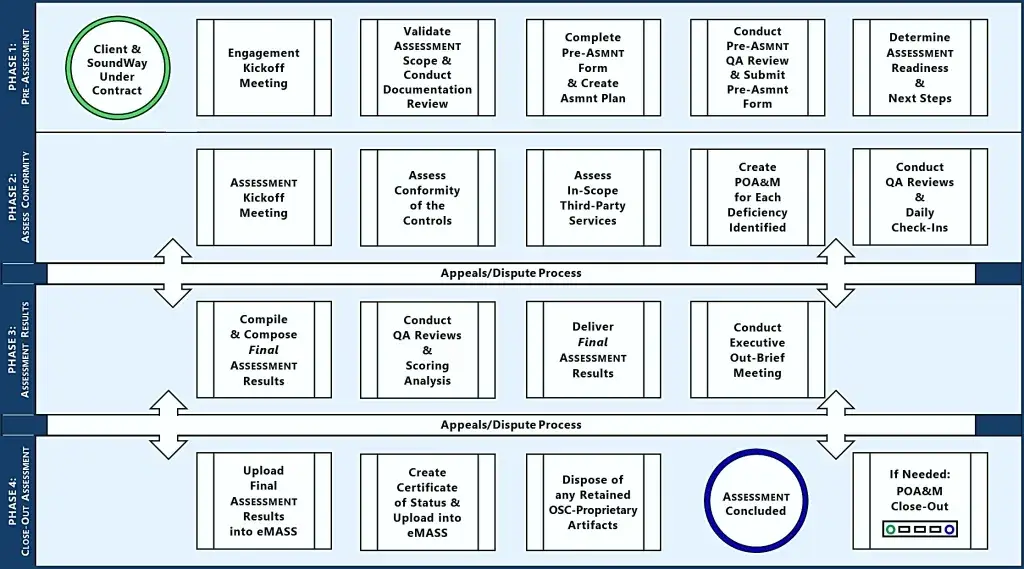
Image Source: SoundWay Consulting
Data classification in defense contracting can be tricky. The line between Federal Contract Information (FCI) and Controlled Unclassified Information (CUI) often blurs. This creates complex compliance scenarios for CMMC Level 2 implementation.
Examples of Contractual FCI Turning into CUI
Simple contract details can evolve into CUI through several paths. A good example shows a contractor receiving specifications for a “wind deflector” from a government representative labeled as FCI. The information becomes CUI when the contractor creates a CAD drawing labeled “Use on US Army fighting vehicle.” This change happens because it now qualifies as “technical information of a military or space application” under the National CUI Registry.
DoD contracts might contain information that starts as FCI but needs CUI protection once specific details are added. Basic research projects usually don’t need CMMC requirements, yet they might receive FCI or CUI as part of data from the department.
Best Practices for Data Classification and Labeling
The key difference lies in understanding that “CUI requires additional safeguarding and may also be subject to dissemination controls” beyond FCI protections. Here’s how to handle this effectively:
- Use consistent labeling systems on all communication platforms
- Create processes that identify CUI correctly in digital documents, emails, and file transfers
- Keep detailed, unchangeable audit logs that track all CUI and FCI activities
- Check both the National CUI Registry and DoD CUI Registry for proper classifications
CUI markings should include category abbreviations where needed (e.g., “CUI//PRIV” for privacy information). Decontrolled information needs a line through CUI markings or a note showing decontrol.
Avoiding Compliance Gaps in Mixed Data Environments
Mixed environments need constant watchfulness. Defense contractors often find it easier to treat all non-classified government information as CUI and apply the same protection standards. This strategy reduces the risk of misclassification that could lead to contract delays, regulatory penalties, and cybersecurity incidents.
Role-based access control with least-privilege principles works best to protect mixed environments. Proper CUI identification aids compliance by ensuring sensitive information gets the right protection levels and reaches only authorized individuals.
The DoD has made it clear that CMMC requirements “do not become real for a given project until the presence of actual CUI is established”. Organizations get extra time to put controls in place when FCI changes to CUI.
Conclusion
Defense contractors facing CMMC Level 2 compliance deadlines must know the difference between Federal Contract Information and Controlled Unclassified Information. The November 2025 implementation deadline is approaching fast. Proper classification and protection of government information will determine your DoD contract eligibility.
Organizations handling CUI must implement all 110 NIST 800-171 security requirements. Those processing only FCI need nowhere near as many controls for Level 1. This means contractors can benefit by a lot from identifying which information qualifies as CUI to scope their compliance efforts properly.
Defense contractors have two main options. They can treat all government information at the higher CUI protection level or create separate environments with different security controls. Each approach has its advantages based on your organization’s size, technical capabilities, and CUI processing volume. Setting up separate environments through enclaves can make assessments easier but creates operational challenges when problems are systemic.
Data classification becomes tricky, especially when FCI changes into CUI as projects progress. So you need reliable systems to identify, label, and manage data whatever implementation strategy you pick. Getting classifications wrong goes beyond compliance problems – it could lead to security breaches that hurt your reputation and contract eligibility.
CMMC Level 2 certification needs careful planning that matches your organization’s specific needs. We strongly recommend you Book a Readiness Call with experienced CMMC experts who can review your current infrastructure, data flows, and compliance readiness before you lock in your implementation strategy.
Your choice between integrated or separated environments will shape your CMMC Level 2 compliance. Success depends on proper preparation, accurate data classification, and consistent security controls. Your approach should balance streamlined processes with detailed protection of sensitive government information to ensure both compliance and strong cybersecurity.
Key Takeaways
Understanding CMMC Level 2 requirements is crucial for defense contractors as mandatory compliance begins November 2025, affecting organizations handling Controlled Unclassified Information.
• CMMC Level 2 covers both FCI and CUI by default, requiring all 110 NIST 800-171 security controls across the entire assessment scope unless environments are properly segregated.
• Creating dedicated CMMC enclaves can significantly reduce compliance costs by isolating CUI systems and limiting Level 2 requirements to specific environments rather than entire networks.
• Proper data classification is critical – FCI can transform into CUI through project evolution, making robust identification and labeling systems essential to avoid compliance gaps.
• Organizations have two viable strategies: treat all government information uniformly at CUI protection levels, or separate FCI and CUI environments with distinct security controls.
• Misclassification carries serious risks including contract delays, regulatory penalties, and cybersecurity vulnerabilities that could damage reputation and contract eligibility.
The key to successful CMMC Level 2 compliance lies in thorough preparation, accurate data classification, and choosing an implementation strategy that balances operational efficiency with comprehensive protection of sensitive government information.
FAQs
Q1. What is the main difference between DoD FCI and CUI? Federal Contract Information (FCI) is non-public information provided by or generated for the government under contract, while Controlled Unclassified Information (CUI) is sensitive information requiring stringent security protections despite not being classified. CUI requires additional safeguarding and may be subject to dissemination controls beyond FCI protections.
Q2. Does CMMC Level 2 cover both FCI and CUI? Yes, by default, a CMMC Level 2 assessment covers both FCI and CUI protection requirements. However, organizations can choose to separate their FCI and CUI environments, which would result in independent assessments for each type of information.
Q3. What is a CMMC enclave and how does it help with compliance? A CMMC enclave is a secure computing environment specifically designed to store, process, and protect Controlled Unclassified Information. It isolates sensitive data from the rest of the network, reducing assessment complexity and potentially lowering compliance costs by limiting CMMC Level 2 controls to specific systems handling CUI.
Q4. How can organizations handle cases where FCI becomes CUI? Organizations should implement consistent labeling systems, develop processes to correctly identify CUI across all platforms, maintain comprehensive audit logs, and consult both the National CUI Registry and DoD CUI Registry when determining classifications. Some contractors find it simplest to treat all non-classified government information as CUI to minimize risks of misclassification.
Q5. What are the key considerations when deciding to separate or combine FCI and CUI environments? Organizations must consider factors such as assessment frequency, implementation costs for security controls, operational complexity of maintaining separate environments, and the risk of CUI expanding beyond intended boundaries. The decision should be based on the organization’s structure, technical capabilities, and risk tolerance, as both approaches can achieve compliance but carry distinct operational implications.