
Your business needs to prepare for CMMC 2 compliance. The Department of Defense expects more than 80,000 contractors to get Level 2 or Level 3 certification — and this number will likely be much higher. Right now, only 82 certified Third-Party Assessment Organizations (C3PAOs) exist. The first wave of certifications could take about two years to process.
DoD contractors must follow 110 security practices from NIST SP 800-171 to meet CMMC Level 2 requirements and protect Controlled Unclassified Information (CUI). These practices cover access management, incident response, audit logging, and encryption. The final rule became active on December 16, 2024, and the DoD plans to phase in requirements over three years. Your DoD contract eligibility could be at risk if you’re not ready by November 10, 2025, when CMMC requirements can appear in contracts.
CMMC compliance needs more than just checking boxes. Your organization must make major changes to people, processes, and technology. The upfront costs range from $60,000 to $200,000. On top of that, it takes our customers 12-18 months to feel ready for a CMMC audit. Your DoD contractor business faces serious risks if you haven’t started preparing for compliance yet.
CMMC 2.0 Readiness Strategy for DoD Manufacturers
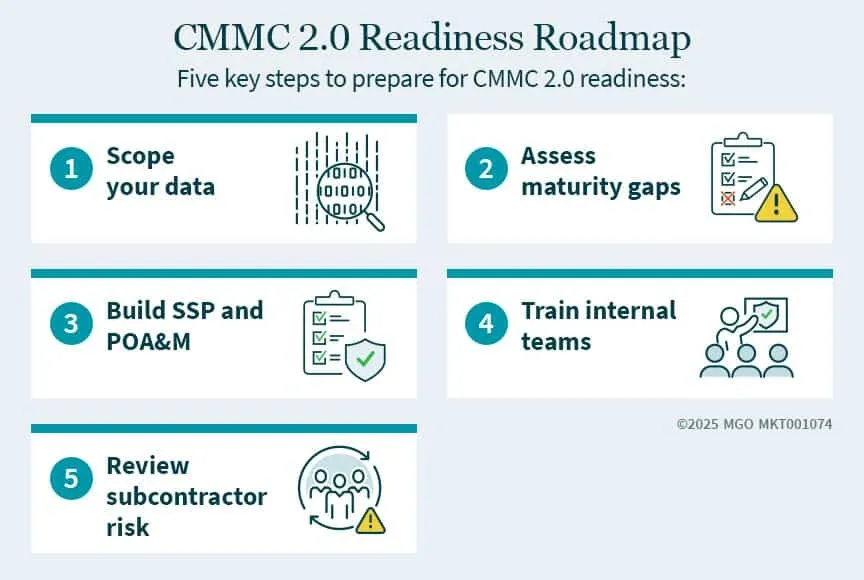
Image Source: MGO CPA
Defense contractors across the nation must get ready for CMMC 2.0 requirements. Implementation will begin soon. Your survival in the defense contracting ecosystem depends on building a resilient readiness strategy if you’re a manufacturer in the defense industrial base (DIB).
Why CMMC 2.0 Compliance is a Business Imperative
CMMC Level 2 certification is more than a regulatory checkbox. Your ability to compete in the defense sector depends on it. The impact of non-compliance reaches way beyond the reach and influence of simple penalties.
Your contract eligibility directly ties to CMMC 2.0 compliance. Companies without certification will lose their DoD contract eligibility once phased implementation starts. This poses an existential threat to manufacturers who depend on defense contracts. Your revenue stream and business stability could take a severe hit.
CMMC certification sets you apart in the market. Companies that adopted early report smoother contract renewals and fewer project delays. Prime contractors now just need compliance visibility across their supply chains. Your certification status will determine your place in the procurement process. Companies that wait may lose opportunities, while those who prepare early show maturity, professionalism, and reliability to procurement officers.
CMMC compliance also strengthens national security by protecting Controlled Unclassified Information (CUI) from cyber threats. This protection reduces data breach risks that could disrupt sensitive research, supply chain integrity, military operations, and critical infrastructure.
Manufacturers working with engineering data face high stakes. Non-compliance can lead to lost contracts and damaged reputation. Note that cybersecurity breaches can cause:
- Contract losses and competitive disadvantage
- Major financial penalties
- Industry reputation damage
- Legal and regulatory consequences
Your organization shows its commitment to protecting sensitive information by lining up with CMMC 2.0 early. This builds trust with the DoD and other partners.
Managing Compliance Across the Supply Chain
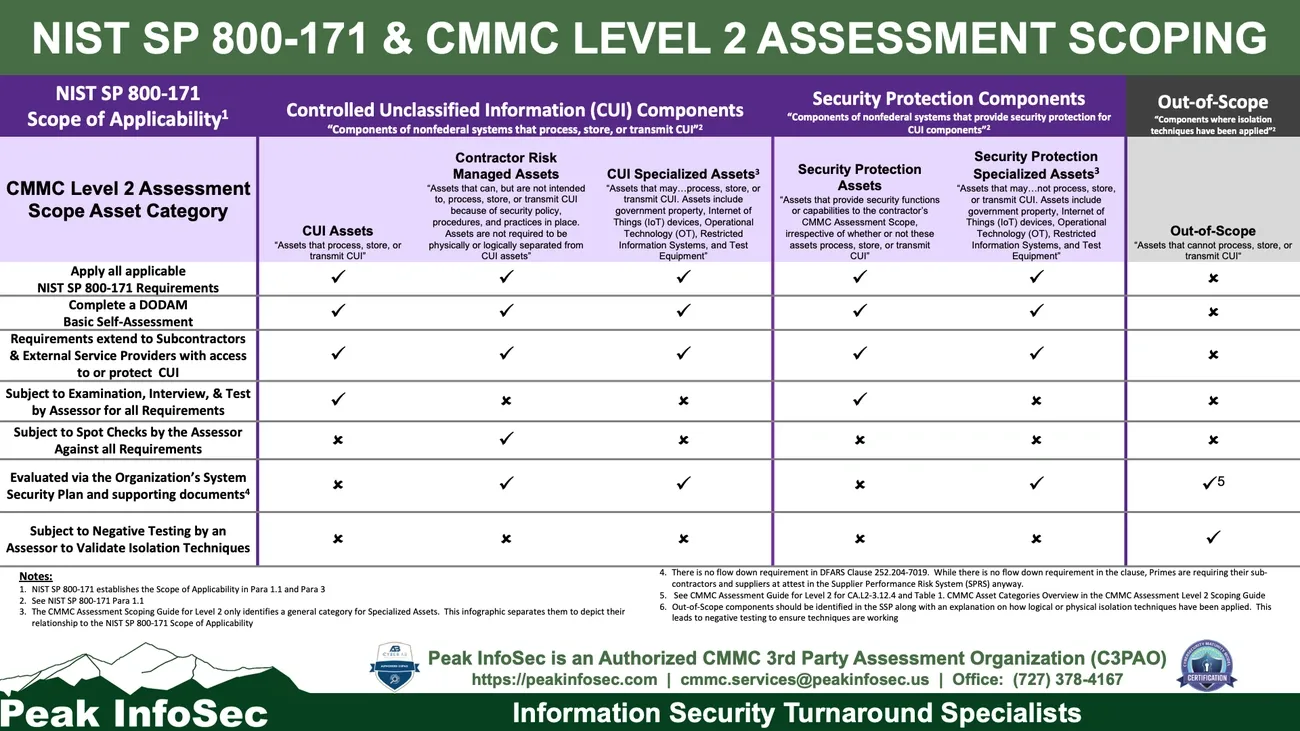
Image Source: Peak InfoSec
Supply chain management has become crucial as the CMMC program expands throughout the Defense Industrial Base. Prime contractors must verify their entire supply chain meets strict cybersecurity requirements. This creates a ripple effect of compliance obligations that changes how defense contractors work with their subcontractors and suppliers. A new system for managing third-party risk has emerged.
Subcontractor Flow-Down Requirements and Risk
The CMMC final rule clearly states that CMMC requirements “apply to prime contractors and subcontractors throughout the supply chain at all tiers that will process, store, or transmit FCI or CUI on contractor information systems in the performance of the contract or subcontract”. This creates multiple layers of compliance obligations that affect the entire defense supply chain.
Prime contractors must verify all subcontractors have proper CMMC status before contract award or sharing sensitive information. Access to the Supplier Performance Risk System (SPRS) is limited to the entity that owns the certification. Prime contractors must set up verification processes based on documentation from subcontractors, such as SPRS screenshots or copies of certificates.
The flow-down requirements follow a structured matrix based on information sensitivity. Table 2 in the final rule outlines these minimum flow-down requirements:
- If a prime has Level 1 (Self) requirement: Subcontractors handling FCI must meet Level 1 (Self), with no requirements for CUI handling
- If a prime has Level 2 (Self) requirement: Subcontractors handling FCI must meet Level 1 (Self), while those handling CUI must meet Level 2 (Self)
- If a prime has Level 2 (C3PAO) requirement: Subcontractors handling FCI must meet Level 1 (Self), while those handling CUI must meet Level 2 (C3PAO)
- If a prime has Level 3 (DIBCAC) requirement: Subcontractors handling FCI must meet Level 1 (Self), while those handling CUI must meet Level 2 (C3PAO)
The DoD creates a cybersecurity baseline across the defense supply chain through these flow-down provisions. CyberSheath states, “This is how a policy framework becomes a procurement filter”. Companies must “flow down with intent” by including level and evidence expectations in teaming agreements and purchase orders. They need to verify supplier status before proposal, not after award.
Evidence shows that adversaries often exploit supply chain vulnerabilities. Threat actors target smaller supply chain members because they expect them to have weaker cybersecurity protections. This makes them an easier way to access all supply chain members.
Recent industry reports reveal an alarming trend – third-party vendors caused over 60% of data breaches. This poses serious risks in the defense sector where national security is at stake. Such vulnerabilities can lead to theft of intellectual property, sensitive government data, or other protected information.
Conclusion
CMMC 2.0 marks a defining moment for defense manufacturers and subcontractors in the United States. More than 80,000 contractors will need Level 2 or 3 certification, yet only a few assessment organizations exist. Early preparation isn’t just an option anymore – it’s crucial. Your future in DoD contracts depends on CMMC compliance, which surpasses basic regulatory requirements.
Several key factors will determine your success. A precise scope of your CUI environment will cut down compliance complexity and costs. Your executive team should treat cybersecurity as an ongoing business strategy, not a one-off project. You’ll also need to check compliance across your entire supply chain of subcontractors.
Most companies spend between $34,000 and $112,000 on compliance, but smart planning makes this investment worthwhile. Starting early gives you clear advantages. You’ll have time to show control maturity, plan your budget better, pick your vendors carefully, and stand out from competitors.
The gradual rollout might seem comforting, but don’t let it fool you. By November 2025, CMMC requirements will appear in contracts. Unprepared contractors won’t even make it to the bidding stage. The 12-week roadmap we’ve outlined helps speed up your certification process.
CMMC 2.0 serves two purposes – it protects national security and builds a stronger defense industrial base. Companies that tackle these requirements head-on will become trusted defense partners, ready to protect vital information and win contracts well into the future.
Time is running out for CMMC compliance. Your company’s role in protecting Controlled Unclassified Information shapes both your business future and our nation’s security framework. Starting your compliance work today isn’t just smart business – it’s your patriotic duty.
Key Takeaways
CMMC 2.0 compliance is no longer optional for defense contractors—it’s a business survival requirement that will determine your eligibility for DoD contracts starting November 2025.
• Start immediately or risk elimination: With only 82 certified assessors for 80,000+ contractors, delays could lock you out of DoD contracts permanently.
• Scope strategically to reduce costs: Properly defining your CUI boundary can cut compliance costs from $200K+ to $34K-112K range.
• Plan for 12-18 month journey: CMMC requires demonstrating 90-180 days of control maturity before assessment, making early preparation critical.
• Manage supply chain compliance: Prime contractors must verify all subcontractors meet appropriate CMMC levels before sharing sensitive information.
• Use POA&Ms strategically: The 180-day conditional certification window allows phased implementation but requires disciplined execution to avoid contract loss.
The stakes extend beyond individual companies—CMMC 2.0 strengthens national security by protecting critical defense information from cyber threats. Organizations that act now gain competitive advantages through smoother contract renewals, stronger market positioning, and demonstrated commitment to safeguarding sensitive data. Those who delay face existential threats to their defense contracting business.
FAQs
Q1. Are subcontractors required to comply with CMMC? Yes, CMMC requirements apply to subcontractors throughout the supply chain. Prime contractors must flow down CMMC obligations to any subcontractor that will process, store, or transmit Federal Contract Information (FCI) or Controlled Unclassified Information (CUI) in connection with contract performance.
Q2. What are the key requirements for CMMC Level 2 certification? CMMC Level 2 requires organizations to implement 110 security practices from NIST SP 800-171 to protect Controlled Unclassified Information (CUI). This includes controls for access management, incident response, audit logging, and encryption. Organizations must also demonstrate maturity of these practices over time.
Q3. How does CMMC differ from previous DoD cybersecurity requirements? CMMC builds upon previous standards like NIST SP 800-171 but adds third-party assessments and certification requirements. It also introduces a tiered model with different levels of cybersecurity practices and processes, ranging from basic cyber hygiene to advanced security operations.
Q4. Is CMMC only applicable to Department of Defense contracts? While CMMC was initially developed for DoD contracts, it will be required in all applicable DoD contracts involving FCI or CUI, except those solely for Commercial Off-The-Shelf (COTS) items. There are discussions about potentially expanding CMMC to other federal agencies in the future.
Q5. What is the timeline for CMMC implementation? The DoD plans to phase in CMMC requirements starting November 2025. By October 2028, all new DoD contracts involving FCI or CUI are expected to include appropriate CMMC level requirements. Organizations should start preparing now to ensure compliance when these requirements take effect.