
Recent research by Merrill Research reveals a startling fact: 96% of defense contractors aren’t ready for Cybersecurity Maturity Model Certification compliance. The Department of Defense (DoD) will finalize the CMMC rule on September 10, 2025. Implementation begins November 10, 2025, putting prime contractors under immense pressure to ensure compliance for themselves and their subcontractors.
The CMMC program validates that DoD contractors protect Federal Contract Information (FCI) and Controlled Unclassified Information (CUI) by meeting specific cybersecurity requirements. These requirements will affect more than 300,000 organizations in industries of all types, from construction to healthcare. Prime contractors must ensure their subcontractors meet appropriate cybersecurity standards under CMMC 2.0 regulations, particularly when handling CUI.
Poor management of subcontractor compliance leads to serious consequences. Companies risk contract termination, lower Supplier Performance Risk System scores, damage to their reputation, and heightened scrutiny from auditors. Compliance preparation takes 6-18 months and costs between $34,000-$112,000 based on company size. Organizations that take action now gain competitive advantages, while those who wait risk losing valuable contracts.
This piece outlines essential information for prime contractors about CMMC requirements, subcontractor obligations, and practical strategies to manage supply chain compliance effectively.
What is Cybersecurity Maturity Model Certification (CMMC)?
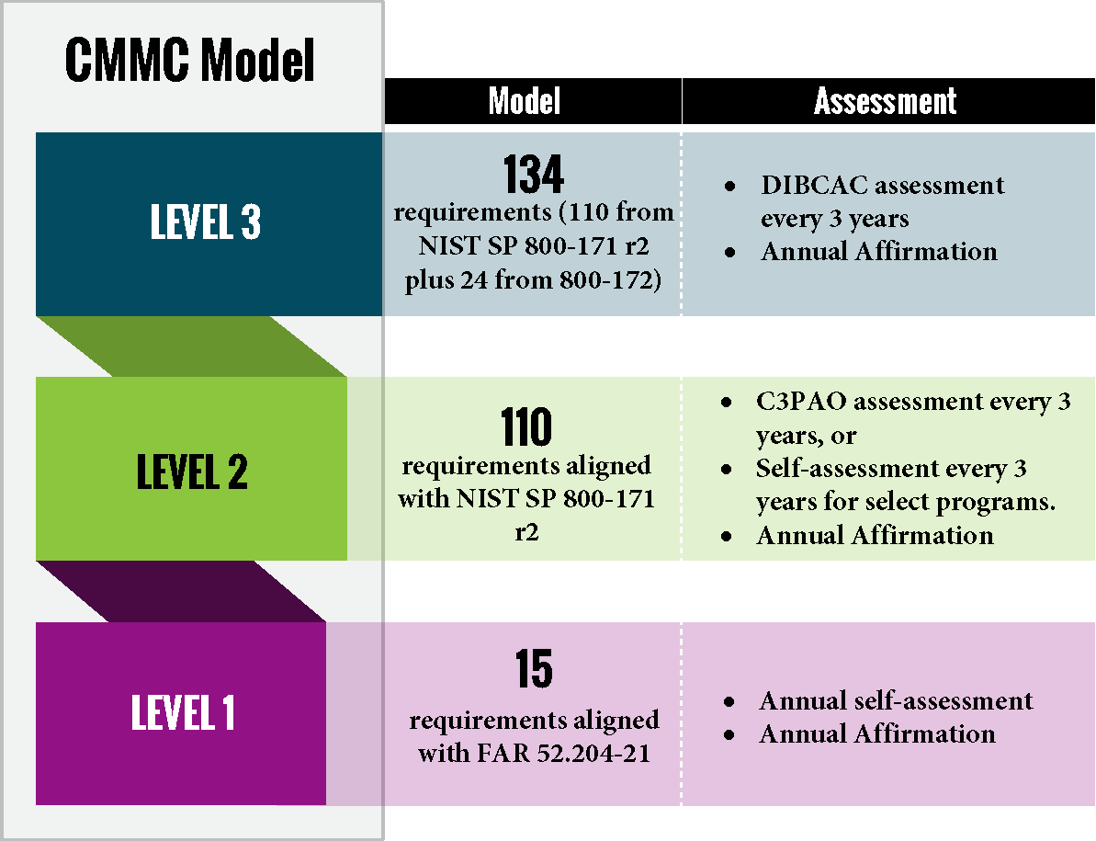
Image Source: DoD CIO – Department of War
“The Cybersecurity Maturity Model Certification (CMMC) program is the Department’s program to assist Industry to meet adequate security requirements of 32 CFR Part 2002, DFARS 252.204-7012, and DoDI 5200.48 in the implementation of National Institute of Standards and Technology (NIST) SP 800-171.” — Defense Counterintelligence and Security Agency (DCSA), U.S. Department of Defense, Industrial Security Division
The Cybersecurity Maturity Model Certification shows how the Department of Defense works to secure sensitive defense information throughout its supply chain. The DoD created this framework with industry experts and academic institutions. CMMC sets verifiable cybersecurity standards that defense contractors need to bid on and keep DoD contracts.
CMMC framework and DoD objectives
The DoD created CMMC to improve the security of the Defense Industrial Base (DIB) and protect sensitive information from sophisticated cyber threats. The framework changed from policy to binding contractual requirements when the final rule appeared in the Federal Register. These requirements take effect November 10, 2025.
CMMC uses a tiered structure with three progressive levels of cybersecurity maturity:
- Level 1 (Basic Safeguarding): Systems that handle Federal Contract Information (FCI) need this level. Companies must complete annual self-assessment against 15 simple security requirements in FAR clause 52.204-21.
- Level 2 (Intermediate): This applies when contractor systems handle Controlled Unclassified Information (CUI). The level has 110 security requirements from NIST SP 800-171. Companies can do internal assessment or work with a Certified Third-Party Assessment Organization (C3PAO).
- Level 3 (Advanced): This level protects the most sensitive CUI. It builds on Level 2 requirements and adds controls from NIST SP 800-172. The Defense Industrial Base Cybersecurity Assessment Center (DIBCAC) conducts these assessments.
The DoD uses a four-phase implementation approach. Program offices can decide how to add CMMC to solicitations in the first three years. CMMC compliance becomes mandatory for all DoD contracts by November 2028, except those for commercially available off-the-shelf (COTS) items.
CMMC vs. NIST SP 800-171: Key differences
CMMC and NIST SP 800-171 standards are different in several ways. CMMC requires mandatory audits, while NIST SP 800-171 relies on self-assessments without verification.
CMMC takes a broader approach to cybersecurity. It adds three domains not covered in NIST 800-171: asset management, recovery capabilities, and situational awareness. These additions show the DoD’s focus on building a resilient security posture in the defense supply chain.
Certification timelines vary between the frameworks. CMMC Level 1 certifications last one year. Level 2 and 3 certifications can last up to three years if companies affirm their compliance annually. NIST SP 800-171 does not specify certification periods.
A CMMC certification does not guarantee NIST 800-171 compliance. CMMC focuses on CUI controls, while NIST 800-171 includes Non-Federal Organization controls too.
Why CMMC matters for prime contractors
CMMC raises cybersecurity from a technical consideration to a business necessity for prime contractors. Companies need certification to win and keep DoD contracts. Without proper certification, contractors cannot bid on new DoD contracts and might lose existing ones.
Prime contractors must manage their subcontractors’ compliance carefully. They need to verify that each covered subcontractor has current certification at the right level before sharing FCI or CUI or giving them work. This creates unique challenges. Primes cannot directly check subcontractor status in the Supplier Performance Risk System (SPRS). They must rely on documentation from subcontractors.
Annual compliance affirmations create recurring risk points, especially without proper verification. Wrong or incomplete cybersecurity claims could lead to False Claims Act liability. Companies need strong internal verification processes.
CMMC makes cybersecurity a core business requirement. It affects everything from contract eligibility to supply chain management for defense contractors.
Understanding CMMC Flow-Down Requirements for Subcontractors
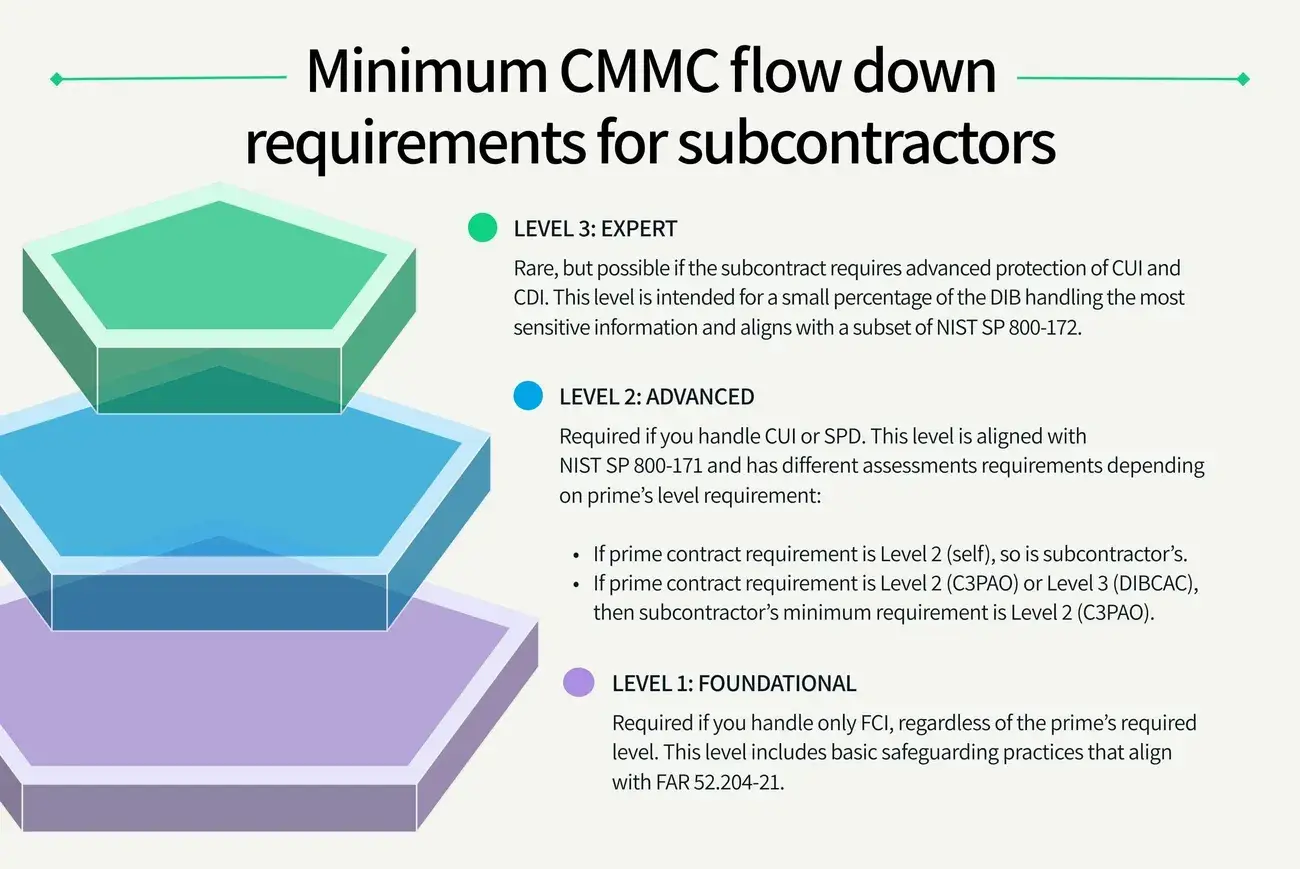
Image Source: Secureframe
CMMC flow-down requirements are the foundations of what prime contractors need to become skilled at in the coming months. These requirements explain how Cybersecurity Maturity Model Certification obligations extend beyond prime contractors to include subcontractors throughout the Defense Industrial Base (DIB). The Defense Department made this mandatory because protected information remains valuable as it moves through the supply chain.
CMMC Level 1 vs Level 2 obligations
A subcontractor’s type of information handling determines their CMMC level. This risk-based approach creates different cybersecurity obligations:
For Level 1 subcontractors handling only Federal Contract Information (FCI):
- Implementation of 17 simple cybersecurity practices from FAR clause 52.204-21
- Annual self-assessment without third-party verification
- No Plans of Action and Milestones (POA&Ms) permitted
- Affirmation of continuous compliance submitted annually to SPRS
Level 2 subcontractors processing Controlled Unclassified Information (CUI) face much higher requirements:
- Implementation of all 110 security controls from NIST SP 800-171
- Either self-assessment or third-party assessment by a C3PAO, depending on contract specifications
- Limited use of POA&Ms with 180-day maximum resolution timeframe
- Triennial assessment cycle with annual affirmation of continued compliance
Small businesses with modest resources can manage Level 1 requirements. Level 2 demands heavy investment in cybersecurity infrastructure, personnel training, and documentation processes.
Flow-down application to subcontractors
Flow-down requirements target subcontractors who will “process, store or transmit FCI or CUI in performance of the subcontract”. The DoD created a clear matrix to determine appropriate flow-down:
- A subcontractor handling only FCI must meet Level 1 requirements whatever the prime contractor’s level
- A subcontractor handling any CUI must meet Level 2 requirements, even if working with a Level 3 prime
- Flow-down does not apply to purchases of commercially available off-the-shelf (COTS) products or micro-purchases below $10,000
The DoD made a risk-based decision not to require Level 3 flow-down to subcontractors unless explicit contractual guidance requires it. This practical approach prevents excessive compliance burdens while maintaining security levels.
These requirements will apply to all new DoD solicitations and contracts starting November 10, 2025. Verification must happen before subcontractor award. Existing contracts need bilateral modification to incorporate CMMC.
Contractual language for flow-down enforcement
Prime contractors must include specific DFARS clauses in subcontracts to enforce CMMC flow-down requirements:
- DFARS 252.204-7012: The foundational clause requiring adequate security for CUI and flow-down to relevant subcontractors
- DFARS 252.204-7020: Formalizes responsibility to verify valid SPRS scores before subcontract award
- DFARS 252.204-7021: Makes CMMC certification a condition of contract award for both primes and subcontractors
Prime contractors must prevent sensitive information from reaching non-compliant subcontractors. The contractual language must establish:
- Verification procedures for subcontractor certification status
- Requirements for annual affirmation of continued compliance
- Remedial actions for subcontractors losing certification status
- Reporting obligations for cybersecurity incidents
This enforcement strategy marks a fundamental change from previous approaches. It focuses on verification rather than mere attestation. Prime contractors must develop resilient processes to monitor and manage subcontractor compliance throughout the contract lifecycle, not just include clauses in contracts.
Prime Contractor Responsibilities Under CMMC 2.0
“The Department intends to allow companies to receive contract awards with a limited time Plan of Actions and Milestones (POA&M) in place to complete CMMC requirements.” — Defense Counterintelligence and Security Agency (DCSA), U.S. Department of Defense, Industrial Security Division
Prime contractors must do more than just understand CMMC requirements. They need to meet specific operational duties to stay compliant with CMMC 2.0. These responsibilities cover the entire contract lifecycle. They involve constant verification, documentation, and management of internal systems and subcontractor relationships.
Affirmation of continuous compliance in SPRS
The Department of Defense asks prime contractors to submit regular compliance confirmations in the Supplier Performance Risk System (SPRS). This process serves as a formal declaration that contractors’ systems meet all CMMC requirements. The “Affirming Official” plays a key role – a senior representative who can certify compliance.
Affirming Officials must complete these attestations:
- After getting Final or Conditional CMMC status
- Every year after the Final CMMC Status Date
- After any POA&M closeout assessment
- When significant changes happen to cybersecurity compliance status
Each affirmation confirms that the contractor “has implemented and will maintain implementation of all applicable CMMC security requirements” for systems within the assessment scope. The DoD checks these affirmations in SPRS to ensure they meet contract requirements.
Verifying subcontractor CMMC status
Prime contractors must verify their subcontractors’ CMMC compliance before sharing sensitive data or giving them contracts. No one else can do this job. Prime contractors need to check if each subcontractor has current CMMC status at the right level for their information access.
Prime contractors face a practical challenge here. SPRS access stays limited to certification owners, which means primes can’t directly check subcontractor status. They must rely on what subcontractors show them, like SPRS screenshots or certificates.
Prime contractors act as the DoD’s first line of defense for cybersecurity requirements. A well-laid-out verification process helps manage compliance across the supply chain.
Handling conditional CMMC status and POA&Ms
Contractors seeking CMMC Levels 2 and 3 can get contracts with “conditional” status for up to 180 days. This works if they address items in their Plan of Action and Milestones (POA&M). Organizations can fix non-critical gaps during this time while keeping contract eligibility.
Level 1 requirements are different. They need final status at award time – conditional status isn’t an option. This strict rule shows the DoD expects simple cybersecurity practices to be fully ready.
The 180-day timeline for conditional status contractors can’t be extended. Contractors must get “final” CMMC status through a POA&M closeout assessment after finishing their POA&M. Missing this deadline means automatic expiration of conditional status. This could lead to contract termination.
Prime contractors should watch these conditional periods closely, especially for key subcontractors who affect program delivery. Setting up systems to track POA&M progress becomes crucial for managing supply chain risks under CMMC 2.0.
Common Challenges in Managing Subcontractor Compliance
Image Source: Ignyte Assurance Platform
Prime contractors face special problems when they try to manage how their subcontractors comply with Cybersecurity Maturity Model Certification requirements. The DoD continues to finalize its guidelines, but practical obstacles keep coming up in efforts to secure the defense supply chain. These challenges greatly affect project timelines, costs, and security across the contractor ecosystem.
Lack of visibility into subcontractor readiness
Prime contractors deal with a major operational roadblock. They can’t directly check their subcontractors’ certification status in the Supplier Performance Risk System. Privacy protections mean primes must depend on what subcontractors choose to share, like SPRS screenshots or copies of certificates. This makes it hard to verify compliance in complex supply chains.
Working with international subcontractors makes supply chain transparency even tougher. Different jurisdictions have their own cybersecurity requirements, data protection laws, and ways they want things reported. Primes find it hard to spot non-compliant vendors quickly without live monitoring tools. This leaves them more open to cyber-attacks.
Balancing enforcement with relationship management
Asking subcontractors for detailed proof of compliance often strains business relationships. Prime contractors need to find the sweet spot between strict cybersecurity standards and good working relationships that projects need to succeed. This becomes harder with long-term subcontractors who might see new requirements as too demanding or intrusive.
Prime contractors feel pressure from having to verify everything, but weak oversight could lead to False Claims Act problems. The key to balance lies in setting clear expectations early. This means adding CMMC compliance clauses to RFIs and RFPs, and creating standard verification steps that apply equally to all subcontractors.
Dealing with varying levels of cybersecurity maturity
Subcontractors in the defense industrial base show huge differences in their cybersecurity capabilities. Many run on tight budgets with small IT teams—sometimes just one administrator—and limited expertise. Small businesses often lag behind in cybersecurity despite handling sensitive information.
The cybersecurity knowledge gap makes these problems worse:
- Many subcontractors don’t see how their work connects to broader DoD cybersecurity duties
- Some handle CUI without knowing it, putting their compliance at risk
- Others think having cybersecurity policies on paper is enough, but CMMC needs proof of actual implementation
- Technical setup poses the first big challenge, especially in manufacturing settings that use old systems not built with cybersecurity in mind
C3PAO availability remains scarce—roughly one certified assessor exists for every 1,000+ DoD subcontractors who need Level 2 certification. This wide range in readiness creates bottlenecks that prime contractors must plan for to keep their supply chains compliant.
Building a Subcontractor Risk Management Strategy
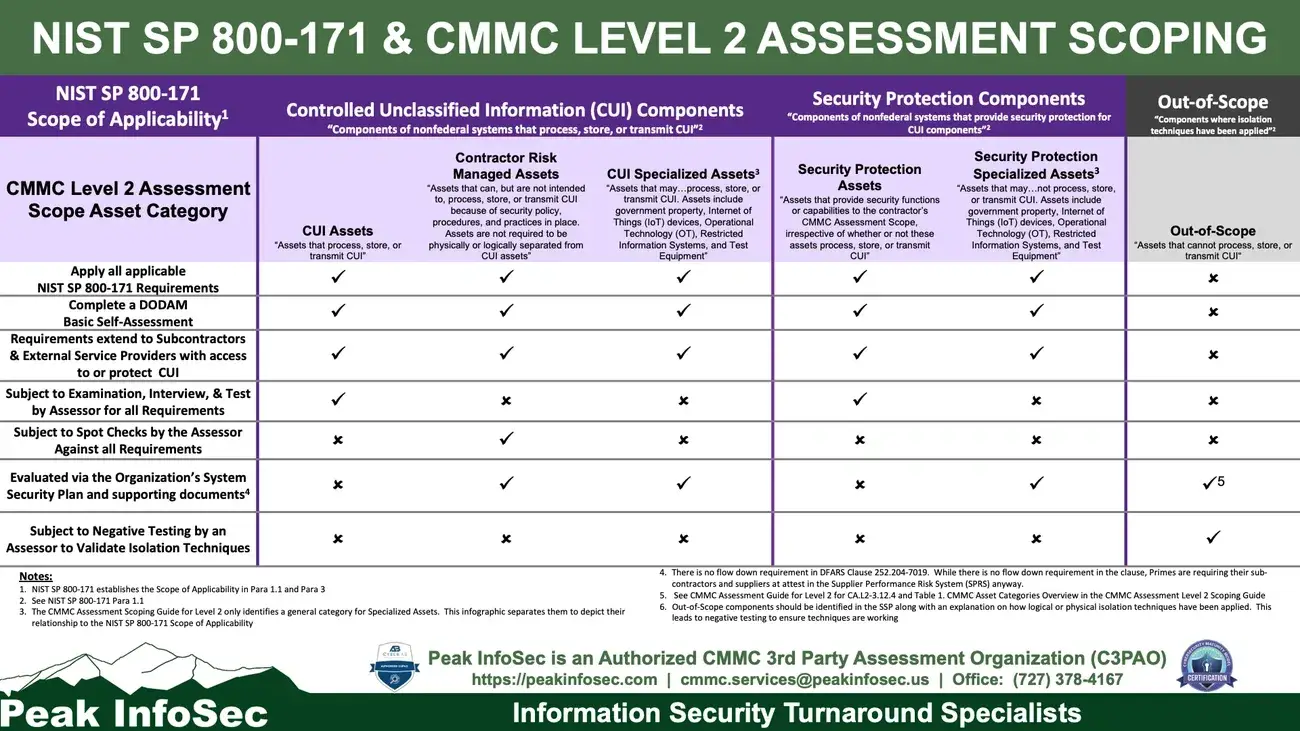
Image Source: Peak InfoSec
A well-laid-out approach to subcontractor management helps prime contractors direct the complexities of Cybersecurity Maturity Model Certification flow-down. Primes can watch over their supply chain and stay compliant with contracts by putting a detailed risk management strategy in place.
How to group subcontractors based on data they handle
Your subcontractor management starts with grouping partners based on their information access. You need to spot which subcontractors work with Federal Contract Information versus those dealing with Controlled Unclassified Information. This difference sets their required CMMC level—Level 1 for FCI-only handlers, Level 2 for any CUI access.
This grouping lets you:
- Match oversight resources to risk levels
- Set contract requirements based on data exposure
- Target your monitoring on high-risk relationships
Getting and checking SSPs, POA&Ms, and SPRS scores
Direct access to subcontractor SPRS entries comes with restrictions, so you need solid verification processes. You should ask for:
- System Security Plans (SSPs) showing cybersecurity policies and processes
- Plans of Action & Milestones (POA&Ms) listing pending fixes
- Screenshots or exports of SPRS scores that prove compliance
Note that subcontractors using a POA&M must fix all items within 180 days of getting Conditional CMMC Status. Missing this deadline leads to automatic expiration. Each POA&M needs the control reference, responsible party, planned actions, completion dates, and current status.
Track compliance deadlines and progress
Set clear goals for subcontractor compliance that match contract needs. Schedule reviews at 30, 60, and 90 days for subcontractors with Conditional Status to check their POA&M progress.
Use a dashboard or tracking system to watch:
- When certifications expire
- How POA&M fixes are moving along
- Yearly affirmation status
- Security changes that might affect compliance
Help non-compliant subs succeed
Instead of just enforcing rules, think over helping subcontractors who struggle. This shared approach keeps valuable relationships strong while building up your supply chain’s security.
You could provide:
- Templates that match CMMC requirements
- Guides about CMMC assessment prep
- Connections to Registered Provider Organizations (RPOs) for expert help
- Training for subcontractor teams
These steps and being organized can turn subcontractor management from a compliance task into a strategic plus within the defense industrial base.
Evaluating and Selecting CMMC-Ready Partners
Picking partners with strong cybersecurity practices is a vital part of CMMC compliance in your supply chain. You need to assess several factors to minimize risk when you look at potential subcontractors.
Certification status and audit history
Smart prime contractors set clear standards to assess their manufacturing partners’ CMMC readiness. The first step is to get into their current certification status and group them into tiers:
- Preferred Partners: Organizations that have current CMMC certification at required levels
- Acceptable Partners: Organizations that show documented compliance programs with realistic certification timelines
- Avoid: Organizations lacking clear compliance strategies or those that see CMMC as optional
Certification remains valid for three years, and companies must affirm compliance annually. You should ask for key documents like System Security Plans (SSPs), assessment reports from authorized C3PAOs, and Plans of Action and Milestones (POA&Ms) to verify their status.
Cybersecurity infrastructure and investment
The partner’s steadfast dedication to long-term cybersecurity investments matters beyond just getting certified. Look for these signs:
- Modern cybersecurity tools and infrastructure
- Active personnel training programs
- Security built into manufacturing processes
- Regular assessment and improvement activities
Companies that see CMMC as a competitive edge rather than a burden tend to stay compliant throughout their contracts. Mid-size firms that secure Level 2 certification early often gain advantages and stay eligible for sole-source and limited-competition contracts.
Business continuity and incident response planning
Your partners need solid incident response capabilities to meet CMMC requirements. Their plan should spell out roles, responsibilities, detection systems, reporting procedures, and post-incident reviews. They should also prove they can keep operations running during cyber incidents and recover quickly. This matters because malicious cyber actors constantly target the Defense Industrial Base.
Conclusion
CMMC marks a fundamental change in the Department of Defense’s approach to supply chain security. Prime contractors must achieve their own compliance and watch over their subcontractors’ cybersecurity standards. This dual responsibility brings operational challenges but also creates new chances for growth.
The clock is ticking toward the November 2025 deadline. About 96% of defense contractors aren’t ready for CMMC compliance yet. It takes 6-18 months to prepare properly, which makes immediate action crucial. Companies that focus on compliance now will gain a competitive edge, while others risk losing their contracts.
Prime contractors must see cybersecurity as a core business need rather than just a technical requirement. The tiered system lets companies apply security measures based on how sensitive their information is. Without direct SPRS access, verification becomes tricky. A systematic process to manage subcontractors becomes vital.
To manage subcontractors well, companies should rank partners by data sensitivity, ask for detailed documentation, set clear deadlines, and offer support when needed. This shared approach strengthens the supply chain while you retain control over compliance.
Smart prime contractors see CMMC as more than just a requirement – it’s a way to build safer, stronger operations. They pick partners with solid cybersecurity practices, check their infrastructure investments, and review their emergency response plans. This creates a more reliable defense industrial base.
Sophisticated cyber threats constantly target the defense industrial base, making these rules necessary. While managing subcontractors poses challenges, prime contractors who create detailed verification processes will succeed in the CMMC world. The reward? They’ll keep their DoD contracts, lower cyber risks, and stay competitive in a security-focused defense market.
Key Takeaways
Prime contractors face critical compliance deadlines and supply chain management challenges as CMMC 2.0 becomes mandatory for DoD contracts starting November 2025.
• CMMC compliance is now mandatory for contract eligibility – 96% of defense contractors are unprepared, with implementation beginning November 10, 2025, making immediate action essential for maintaining DoD contract opportunities.
• Prime contractors must verify all subcontractor compliance – You cannot directly access subcontractor SPRS status and must rely on documentation they provide, creating verification challenges across your supply chain.
• Flow-down requirements depend on data sensitivity – Subcontractors handling only FCI need Level 1 certification, while those accessing CUI require Level 2, regardless of prime contractor level.
• Preparation requires 6-18 months and significant investment – Costs range from $34,000-$112,000 depending on organization size, with annual affirmations and ongoing monitoring required for continuous compliance.
• Build a tiered subcontractor risk management strategy – Categorize partners by data sensitivity, establish verification processes, set compliance timelines, and offer support resources to strengthen your entire supply chain.
Companies that act now gain competitive advantages in sole-source and limited-competition contracts, while those delaying risk losing contract eligibility in an increasingly security-focused defense marketplace.
FAQs
Q1. What is CMMC and why is it important for defense contractors? CMMC (Cybersecurity Maturity Model Certification) is a framework developed by the Department of Defense to enhance the security of the Defense Industrial Base. It’s crucial for defense contractors because it establishes verifiable cybersecurity standards that must be met to bid on and retain DoD contracts, protecting sensitive information across the entire supply chain.
Q2. How does CMMC differ from NIST SP 800-171? While CMMC is based on NIST SP 800-171, it introduces mandatory audits and certification, whereas NIST SP 800-171 relied on self-assessments. CMMC also includes additional cybersecurity domains and has specific certification timelines, making it a more comprehensive and stringent framework.
Q3. What are the responsibilities of prime contractors regarding subcontractor compliance? Prime contractors must verify that their subcontractors have appropriate CMMC certification before sharing sensitive information or awarding subcontracts. They need to incorporate specific DFARS clauses into subcontracts, monitor subcontractor compliance, and manage the flow-down of CMMC requirements throughout their supply chain.
Q4. How can prime contractors effectively manage subcontractor compliance? Prime contractors can manage subcontractor compliance by tiering subcontractors based on data sensitivity, requesting and reviewing documentation like System Security Plans and SPRS scores, setting clear compliance timelines, and offering support to non-compliant subcontractors. Implementing a structured risk management strategy is key to overseeing the supply chain effectively.
Q5. What are the potential consequences of non-compliance with CMMC? Non-compliance with CMMC can result in serious consequences, including contract termination, negative impacts on Supplier Performance Risk System scores, reputational damage, and increased scrutiny from auditors. Additionally, non-compliant contractors may become ineligible for new DoD contracts and risk losing existing ones, significantly impacting their business opportunities in the defense sector.