
Data breaches cost U.S. companies $10.22 million on average — a 9% increase from last year. The Department of Defense created CMMC (Cybersecurity Maturity Model Certification) as a complete response to growing cybersecurity threats that defense contractors and suppliers face.
Defense contractors can’t ignore CMMC compliance anymore as identity-based attacks grow and AI-enabled exploits become more sophisticated. The program validates that DoD contractors protect Federal Contract Information (FCI) and Controlled Unclassified Information (CUI) properly. DoD contracts above the micro-purchase threshold will include CMMC requirements when contractors handle sensitive information.
These requirements will enter contracts starting November 10, 2025. The certification process could take up to 12 months. CMMC 2.0 has made the previous framework more efficient with three distinct levels: Foundational (Level 1), Advanced (Level 2), and Expert (Level 3). This is a big deal as it means that Level 2 assessments could cost $100,000, not including extra technology investments.
Let’s explore everything executives need to know about CMMC in this piece — from core requirements to proper budgeting and certification preparation.
What is CMMC Compliance and Who Enforces It
“The DoD introduced Cybersecurity Maturity Model Certification (CMMC) in 2020 to ensure companies protect sensitive information when working on government contracts.” — Department of Defense, Official U.S. Department of Defense Cybersecurity Policy
The Cybersecurity Maturity Model Certification (CMMC) program marks a transformation in how the Department of Defense (DoD) protects sensitive information across its network of contractors and subcontractors. This 4-year old program serves as the DoD’s framework to verify that defense contractors properly safeguard Federal Contract Information (FCI) and Controlled Unclassified Information (CUI).
DoD’s role in enforcing cybersecurity standards
DoD created CMMC as a direct response to cyber-attacks that increasingly targeted the defense industrial base (DIB). Previous approaches relied on contractor self-attestation. Now, CMMC requires contractors to prove they have implemented cybersecurity controls.
The timeline is clear. The CMMC final rule takes effect on November 10, 2025. The implementation has four phases:
- Phase 1 (Nov 2025-Nov 2026): We focused on Level 1 and Level 2 self-assessments
- Phase 2 (Nov 2026-Nov 2027): Level 2 C3PAO certifications take priority
- Phase 3 (Nov 2027-Nov 2028): Level 3 requirements come into play
- Phase 4 (by Nov 2028): DoD’s solicitations and contracts must have applicable CMMC requirements
DoD enforces CMMC through its acquisition and contracting process. CMMC will become mandatory to win contracts once the rulemaking finishes. DoD specifies which CMMC level contractors need in their solicitations. Prime contractors must determine what information goes to subcontractors and what CMMC requirements apply to them.
CMMC’s arrangement with NIST frameworks
CMMC builds on existing federal cybersecurity standards and makes use of information from National Institute of Standards and Technology (NIST) frameworks. This arrangement creates efficiency and reduces risk. The three-tiered model links directly to NIST frameworks:
- Level 1 (Foundational): Has 15 simple safeguarding requirements from FAR 52.204-21 to protect FCI
- Level 2 (Advanced): Covers all 110 security requirements from NIST SP 800-171 Rev 2 needed for CUI handling
- Level 3 (Expert): Has all Level 2 requirements plus 24 more controls from NIST SP 800-172 for contractors supporting critical programs
CMMC and NIST share basic principles. Yet CMMC adds maturity levels and needs third-party validation. The structure keeps standards uniform across defense suppliers of all sizes. This ensures they meet the same maturity standards to avoid weak links.
What is CMMC certification vs compliance
CMMC certification and compliance mean different things. Compliance means continuously working to meet CMMC controls, practices, and processes for your organization’s level. It involves building and maintaining cybersecurity infrastructure that protects sensitive defense information.
CMMC certification proves that a defense contractor meets specific cybersecurity requirements at one of three levels. Each level has its own process:
- Level 1: Yearly self-assessment with results going into the Supplier Performance Risk System (SPRS)
- Level 2: Either a three-year valid self-assessment or assessment by a Certified Third-Party Assessment Organization (C3PAO)
- Level 3: Needs CMMC Level 2 (C3PAO) status first and assessment by the Defense Industrial Base Cybersecurity Assessment Center (DIBCAC)
All certifications need yearly confirmations that compliance continues. Assessments expire if not confirmed. Defense contractors must get certified at the right level. Without it, they can’t compete for DoD contracts.
Organizations unsure about their needs can start with self-attested compliance before getting certified. This shows their steadfast dedication to protecting sensitive data. It also strengthens their cybersecurity and makes them less vulnerable to breaches.
CMMC 2.0 Maturity Levels Explained
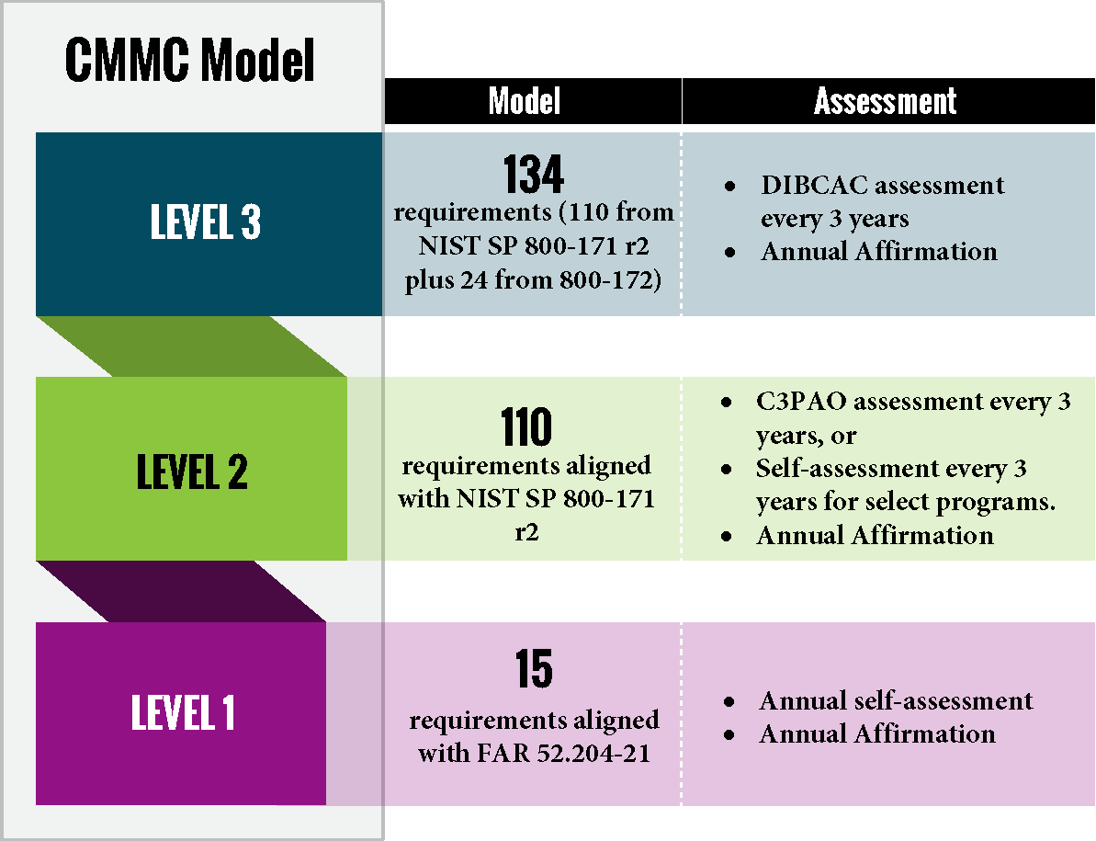
Image Source: DoD CIO – War.gov
“The CMMC Program provides assessments at three levels, each incorporating security requirements from existing regulations and guidelines.” — Department of Defense, Official U.S. Department of Defense Cybersecurity Policy
The Cybersecurity Maturity Model Certification 2.0 framework groups multiple cybersecurity standards into three levels of increasing strictness. Each level builds on the one before it to create a complete security maturity approach. Companies seeking DoD contracts must learn about these levels to figure out their requirements and plan their resources.
Level 1: Foundational – Self-assessment only
Level 1 aims to protect Federal Contract Information (FCI) and matches the simple safeguarding requirements in Federal Acquisition Regulation (FAR) Clause 52.204-21. This foundation level has 17 simple cybersecurity practices that every defense contractor needs.
Contractors can easily assess Level 1 by doing yearly self-checks against these 17 controls. A senior company leader must confirm compliance by uploading results to the Supplier Performance Risk System (SPRS). This statement shows the contractor meets all simple safeguarding requirements for FCI.
Companies can do this assessment themselves or get help from outside experts. All the same, it stays a self-assessment rather than a formal certification even with external help. Many contractors who handle FCI but not Controlled Unclassified Information (CUI) will find Level 1 meets their needs.
Level 2: Advanced – 110 NIST SP 800-171 controls
Level 2 takes cybersecurity up a notch. It’s made for contractors who handle CUI. This level includes all 110 security requirements from NIST SP 800-171 Revision 2. These controls cover access control, identification and authentication, media protection, and system integrity.
Level 2 assessment needs vary based on information sensitivity:
- Contractors with critical national security information need an assessment every three years by a Certified Third-Party Assessment Organization (C3PAO)
- Organizations handling non-critical CUI just need yearly self-assessments
This level started as Level 3 in CMMC 1.0 but lines up with NIST SP 800-171 requirements in CMMC 2.0. The assessment process demands more than Level 1 because it protects more sensitive information.
Level 3: Expert – 24 additional NIST SP 800-172 controls
Level 3 stands at the top of the CMMC framework. It targets organizations that handle the most sensitive unclassified information in critical defense programs. Level 3 contractors must use all Level 2 controls plus 24 advanced security controls from NIST SP 800-172.
These advanced controls protect against sophisticated attacks and persistent threats targeting valuable defense data. The government’s Defense Contract Management Agency’s Defense Industrial Base Cybersecurity Assessment Center (DCMA DIBCAC) handles Level 3 assessments directly. Certification needs renewal every three years.
The DoD hasn’t released full details about Level 3 implementation yet and “will provide them later”. This level takes the place of the original framework’s CMMC Level 5.
The CMMC self-assessment method uses data-centered security that works the same way whatever the contractor’s size, limits, or complexity. Small, medium, and large contractors can all achieve any CMMC level. Contractors must define their assessment scope and identify which assets need evaluation before starting any CMMC assessment.
CMMC Compliance Checklist for Executives
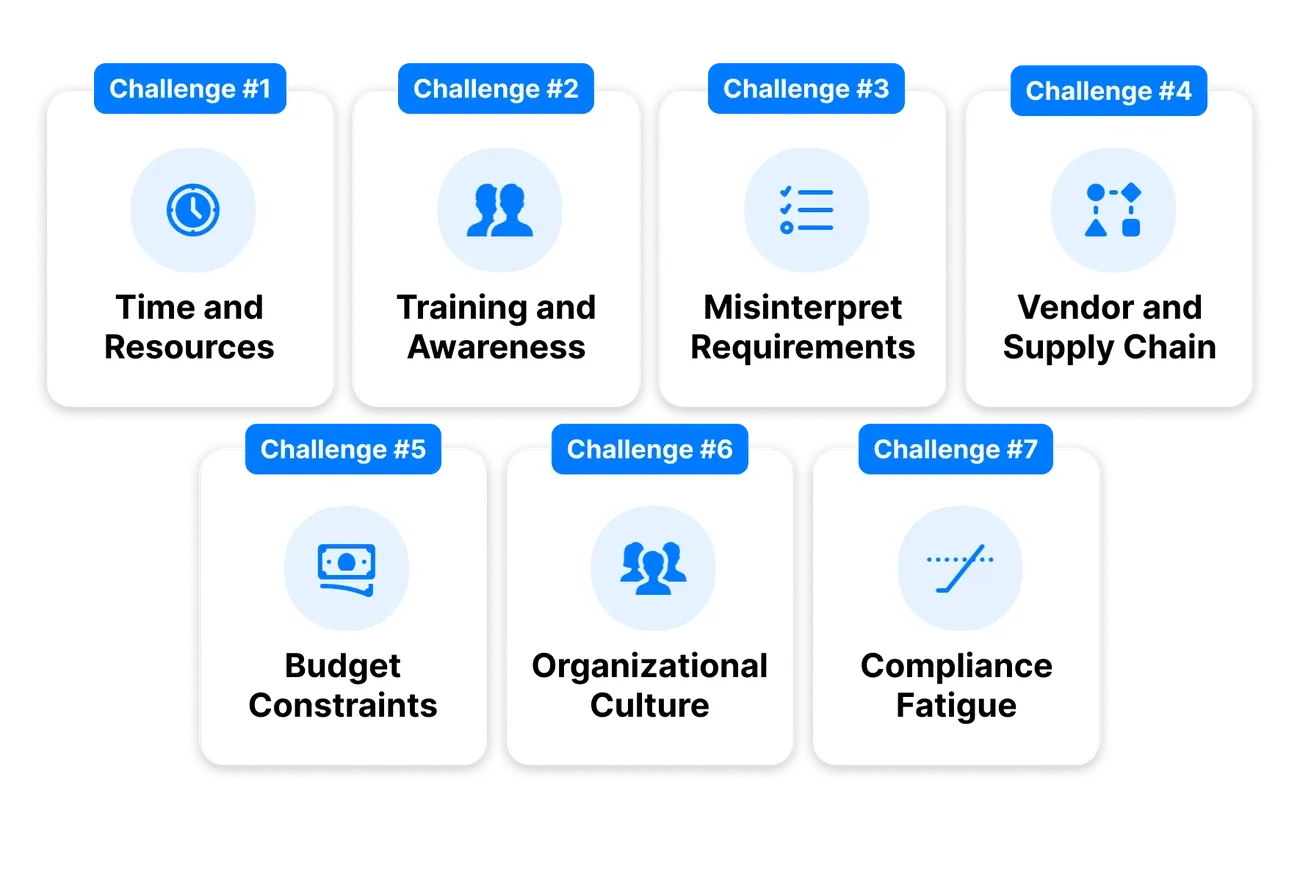
Image Source: Encompass Consultants
Defense contractors need a clear process to handle CMMC compliance. DoD contract eligibility now depends on meeting these requirements. This guide offers a well-laid-out path to help you earn your CMMC certification.
Determine applicable CMMC level
Your first step is to figure out which CMMC level your organization needs. Your company’s required level depends on the information you handle:
- Level 1 works if your contracts only deal with Federal Contract Information (FCI)
- You’ll need Level 2 when you handle Controlled Unclassified Information (CUI)
- Level 3 might be needed if you work with critical national security or sensitive weapons systems
Look through your contracts for specific details: FAR 52.204-21 shows Level 1 requirements, while DFARS 252.204-7012 points to Level 2 compliance. Your contracting officer or supply chain organization can help if you’re not sure.
Conduct a gap analysis and risk assessment
Once you know your level, you need a gap analysis to measure your current cybersecurity against CMMC requirements. This step shows where your controls need work and helps you plan improvements.
A full picture reveals:
- Technical gaps like missing multifactor authentication
- Documentation gaps such as incomplete incident response procedures
- Process gaps including undocumented access removal during offboarding
Level 2 means checking all 110 NIST SP 800-171 controls in 14 domains. This analysis helps you plan your timeline and budget. Book your Readiness Call to work with experts on your gap analysis.
Develop a System Security Plan (SSP)
The System Security Plan is the life-blood of CMMC compliance at Levels 2 and 3. NIST defines an SSP as a “formal document that provides an overview of the security requirements for an information system and describes the security controls in place or planned for meeting those requirements”.
Your SSP should spell out:
- Assets within the CMMC assessment scope
- Security requirements that apply
- How security controls work
- Systems connected to the covered system
C3PAOs usually start their assessment by looking at the SSP. Companies going for Level 2 should start working on this documentation early.
Create a Plan of Action and Milestones (POA&M)
Your POA&M comes next to fix any security gaps. This document tracks how you fix system weaknesses and shows your commitment to getting better.
POA&Ms come with strict rules under CMMC:
- Level 1 doesn’t allow POA&Ms
- You get 180 days to close POA&Ms at Levels 2 and 3
- Some critical controls can’t go in POA&Ms
Each POA&M item needs clear details about the problem, steps to fix it, who’s responsible, and when it will be done.
Select a C3PAO if required
Level 2 certification needs a third-party assessment. You’ll find Certified Third-Party Assessment Organizations (C3PAO) in the Cyber AB marketplace. When picking one, look at:
- Their technical know-how and industry knowledge
- How soon they can assess you
- Where they’re located
- How well they communicate
Make sure to check their credentials and avoid any conflicts of interest. Most organizations spend 6-12 months getting ready for assessment.
Schedule internal readiness reviews
Run internal reviews to verify your compliance before the real assessment. These practice runs help catch anything you might have missed.
Your reviews should:
- Check if documentation matches what you do
- Make sure staff knows security policies
- Test controls in each CMMC domain
- Plan fixes for any remaining issues
Companies that do these reviews well almost always pass their first assessment. Schedule these reviews often, especially before big compliance deadlines.
Preparing for a CMMC Audit or Assessment
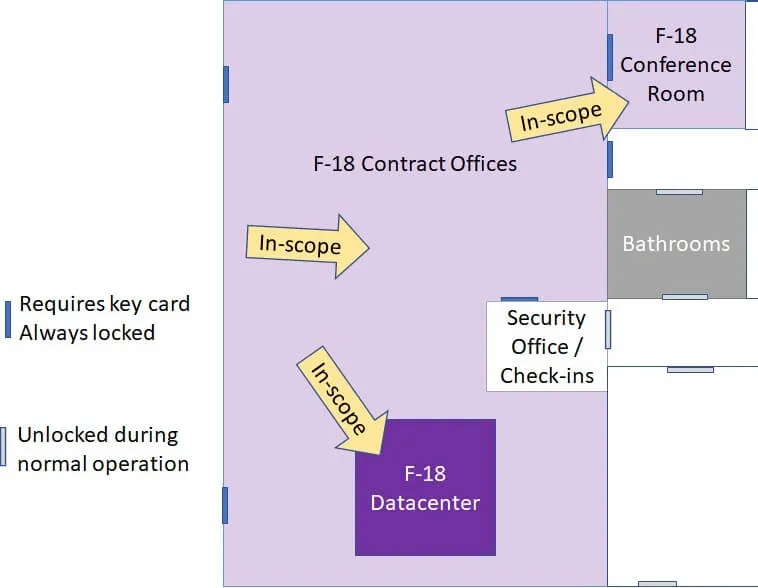
Image Source: CMMC Audit Preparation
A successful CMMC assessment needs more than just technical implementation – it needs detailed preparation. Your success depends on knowing the assessment methodology, whether you plan to do a Level 1 self-assessment or get ready for a formal C3PAO evaluation.
Understanding NIST SP 800-171A and 172A
NIST SP 800-171A guides Level 2 CMMC assessments while NIST SP 800-172A covers Level 3. These documents help certified assessors evaluate your compliance. Each procedure outlines specific objectives that connect determination statements with requirements.
Assessors use three main methods:
- Examine: They review specifications, mechanisms, and documentation
- Interview: They talk with your team to understand implementation details
- Test: They check if systems behave as expected
Level 1 assessments need contractors to point out which assets handle FCI. The same goes for Level 2 assessments, but they focus on CUI systems.
Documentation and evidence collection
Documentation stands as the cornerstone of CMMC compliance. You need detailed evidence that shows how you’ve implemented controls for all requirements. The System Security Plan (SSP) is your foundation document – it appears 145 times in NIST SP 800-171A Rev2 requirements.
Your essential documents should include:
- Policies and procedures for each control domain
- Control implementation proof through screenshots and config files
- Records showing staff training completion
- System logs that demonstrate ongoing monitoring
A compliance matrix helps you track documents against CMMC controls. This matches financial audit standards and connects requirements directly to evidence. Book your Readiness Call and we’ll help create a documentation strategy that fits your environment.
Common audit pitfalls and how to avoid them
Most organizations fail CMMC assessments because they lack proper documentation. Even the best security controls need evidence to prove they work.
Watch out for these problems:
- Scope creep that makes things too complex or misses vital systems
- A gap between what’s written down and what actually happens
- Forgetting about third-party compliance needs
- Skipping pre-assessment reviews
The best way to prepare is running internal mock assessments that mirror the real thing. Your team gets practice answering questions with confidence while you spot any missing documentation early.
Budgeting and Resource Planning for CMMC
Organizations must plan for the financial impact of CMMC implementation. A proper budget helps keep defense contracts viable and protects sensitive information.
Cost factors by CMMC level
Your target level and organizational complexity will determine the financial investment needed for CMMC:
- Level 1 (Foundational): USD 5,000-USD 30,000 for self-assessment and simple controls implementation
- Level 2 (Advanced): USD 50,000-USD 300,000 for implementing all 110 NIST 800-171 controls
- Level 3 (Expert): USD 300,000-USD 1,000,000+ for improved security requirements
The size of your organization plays a crucial role in these costs. Small businesses (≤100 employees) might need USD 30,000-USD 150,000 total, while large enterprises (1,000+ employees) could need USD 500,000-USD 2,000,000+ for compliance.
DoD estimates show 8,350 medium and large entities will need CMMC Level 2 C3PAO assessment. A typical standardized assessment costs between USD 20,000-USD 40,000. Small entities pay about USD 102,000 and larger organizations around USD 112,000 per assessment.
Staffing and training requirements
Personnel costs are often the biggest ongoing expense. The current cybersecurity talent shortage means 3.4 million positions remain unfilled worldwide. This makes qualified staff expensive and hard to find.
The core team options include:
- Dedicated CMMC Compliance Officer (USD 60,000-USD 120,000 annually)
- IT Security Specialists (USD 70,000-USD 130,000 annually per specialist)
- Virtual CISO services (USD 3,000-USD 10,000 monthly)
Many organizations choose hybrid staffing models. They combine internal resources with external expertise to manage costs. Book your Readiness Call to find the right staffing approach for your organization’s size and compliance needs.
Using CMMC consulting services effectively
External consultants bring specialized expertise without the need for full-time hires. These services usually cost USD 150-USD 300 per hour and provide several benefits.
Consultants can give you a full picture of your compliance position through gap assessments (USD 15,000-USD 35,000). They also help with documentation, implementation support, and assessment preparation.
Start working with consultants early in your compliance experience. This approach will help you avoid high remediation costs that often become the largest expense.
Timeline for CMMC Implementation and Contract Readiness
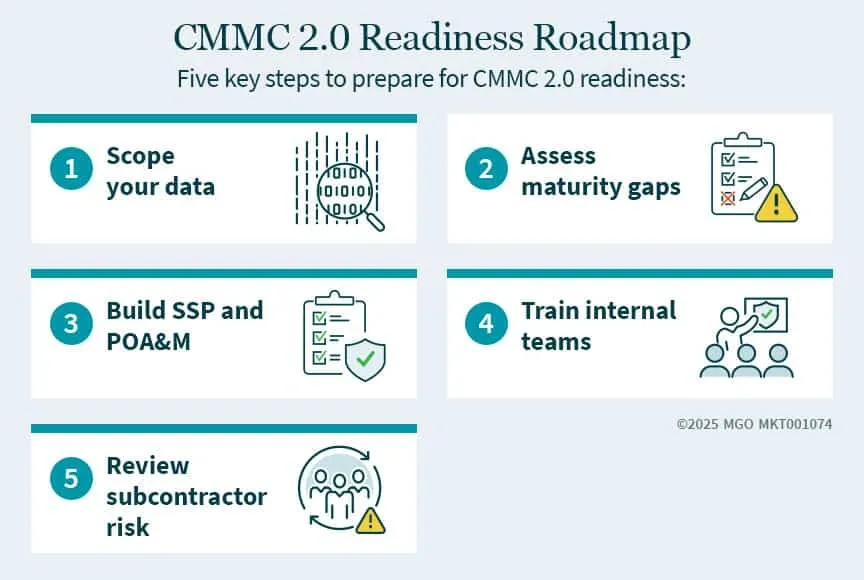
Image Source: MGO CPA
The DoD will start implementing CMMC requirements on November 10, 2025. Defense contractors need to act quickly to obtain their compliance certification.
CMMC Requirements in DoD Solicitations
The DoD plans to include CMMC requirements through the DFARS 7021 clause starting November 10, 2025. The implementation rolls out in four phases:
- Phase 1 (Nov 2025-Nov 2026): We focused on Level 1 and Level 2 self-assessments
- Phase 2 (Nov 2026-Nov 2027): C3PAO certification requirements begin for Level 2
- Phase 3 (Nov 2027-Nov 2028): Level 3 requirements take effect along with Level 2 for option periods
- Phase 4 (by Nov 2028): CMMC requirements apply to all eligible DoD contracts
Tracking CMMC Clauses in RFIs and RFPs
Defense contractors should watch for DFARS 252.204-7021 and 252.204-7025 clauses in solicitations. Prime contractors must pass these requirements to their subcontractors before awarding any subcontract with FCI or CUI.
Re-certification and Ongoing Compliance
CMMC certification remains valid for three years at Levels 2 and 3. Level 1 needs annual self-assessments. The DoD expects C3PAOs to complete 135 certifications in year one, 673 in year two, 2,252 in year three, and 4,452 in year four. Contractors must maintain active certification to qualify for contract awards. This makes preparation an ongoing priority.
Conclusion
CMMC compliance has moved from an optional choice to a must-have requirement for defense contractors who want to keep their DoD contract eligibility by November 2025. This piece shows how this complete framework protects sensitive information in the defense industrial base with its three-tiered approach. Without doubt, a lot is at stake. Organizations that handle CUI must implement all 110 NIST SP 800-171 controls. Those who process only FCI still need to meet 17 foundational security practices.
Your organization needs solid preparation to get certified. You should first figure out your required CMMC level based on the information types you handle. A complete gap analysis will help spot weaknesses in your current security setup and guide your fixes. This analysis helps you create essential documents like System Security Plans and Plans of Action and Milestones.
Money matters need equal focus because implementation costs vary widely. Level 1 compliance starts at $5,000, while Level 3 certification can exceed $1,000,000. The cybersecurity talent shortage creates staffing challenges that need smart solutions. These solutions often mix internal resources with outside expertise.
Time plays a crucial role in CMMC readiness. Book your Readiness Call today to avoid delays that could risk your future DoD contract eligibility. Getting compliant might look tough, but early action and proper preparation will put you ahead when CMMC requirements show up in solicitations in November 2025.
The defense contracting world has changed fundamentally. Companies that accept these cybersecurity standards early will not only secure their contract eligibility but also boost their security against sophisticated threats. Your CMMC certification starts now. Success depends on proper preparation, smart resource use, and strategic planning.
Key Takeaways
CMMC compliance is now mandatory for DoD contractors, with implementation beginning November 10, 2025. Understanding these requirements and preparing early is critical for maintaining contract eligibility and protecting sensitive defense information.
• CMMC has three levels: Level 1 (17 basic controls, self-assessment), Level 2 (110 NIST controls), and Level 3 (134 total controls with government assessment)
• Implementation costs range dramatically: From $5,000-$30,000 for Level 1 to potentially over $1,000,000 for Level 3, requiring careful budget planning
• Certification takes 6-12 months: Organizations need immediate action to meet November 2025 deadlines when CMMC clauses appear in DoD contracts
• Documentation is critical for success: System Security Plans and proper evidence collection are essential, as insufficient documentation is the top reason for assessment failures
• Level 2 applies to most contractors: Any organization handling Controlled Unclassified Information (CUI) must implement all 110 NIST SP 800-171 controls
The phased rollout means contractors have limited time to achieve compliance before becoming ineligible for DoD contracts. Early preparation, thorough gap analysis, and strategic resource allocation will determine success in this mandatory cybersecurity transformation.
FAQs
Q1. What is CMMC and why is it important for defense contractors? CMMC (Cybersecurity Maturity Model Certification) is a framework developed by the Department of Defense to ensure that defense contractors adequately protect sensitive information. It’s important because it’s becoming mandatory for DoD contract eligibility, with implementation beginning in November 2025.
Q2. What are the three levels of CMMC certification? CMMC has three levels: Level 1 (Foundational) requires 17 basic cybersecurity practices, Level 2 (Advanced) involves 110 NIST SP 800-171 controls, and Level 3 (Expert) includes 134 total controls with additional requirements from NIST SP 800-172.
Q3. How much does CMMC compliance typically cost? CMMC compliance costs vary widely based on the level and organization size. Level 1 may cost $5,000-$30,000, Level 2 can range from $50,000-$300,000, and Level 3 could exceed $1,000,000 for large enterprises.
Q4. How long does it take to achieve CMMC certification? Organizations typically need 6-12 months to prepare for CMMC certification. This includes time for gap analysis, implementing required controls, developing documentation, and undergoing assessment.
Q5. What is the most common reason for failing a CMMC assessment? The most frequent reason organizations fail CMMC assessments is insufficient documentation. Even if security controls are properly implemented, they cannot be verified without proper evidence and documentation.