
The Defense Industrial Base (DIB) cybersecurity system relies on specialized assessors to confirm compliance through the CMMC AB ecosystem. C3PAOs, or Certified Third-Party Assessment Organizations, are the exclusive entities that can assess and certify defense contractors for CMMC Level 2 compliance. The Cyber AB, which serves as the official CMMC accreditation body, vets and authorizes these organizations to conduct assessments that confirm DoD cybersecurity requirements.
Your organization needs to understand these implications. Defense contractors handling Controlled Unclassified Information (CUI) or Federal Contract Information (FCI) must obtain C3PAO certification to maintain DoD contract eligibility. These assessors ensure compliance with all 110 security requirements in NIST SP 800-171. CMMC Certified Assessors make up each C3PAO team and receive DoD approval after completing comprehensive training and examinations. We will explore C3PAO functions, assessment procedures, and essential guidelines to help you prepare and choose the right C3PAO partner in this piece.
Understanding the Role of a C3PAO in the CMMC AB Ecosystem
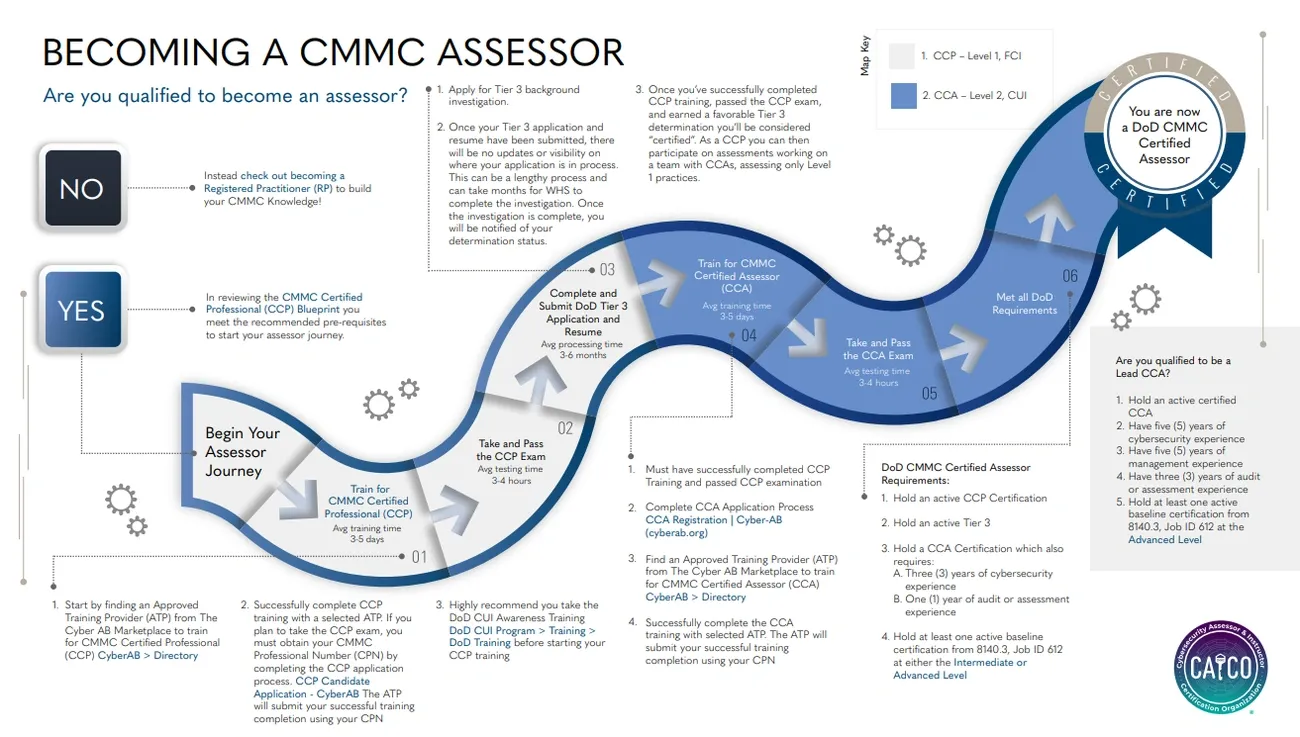
Image Source: CyberAB
The CMMC AB ecosystem consists of specialized organizations that help defense contractors meet cybersecurity standards. Let me explain how these vital entities work within the certification framework.
Definition of a Certified Third-Party Assessment Organization
A C3PAO (Certified Third-Party Assessment Organization) works as an independent entity with Cyber AB authorization to conduct CMMC assessments. These organizations certify that Organizations Seeking Certification (OSCs) meet their required maturity level. Each specialized firm employs CMMC Certified Assessors (CCAs) to review whether contractors have set up the right security controls that protect sensitive information. C3PAOs act as the sole gatekeepers for CMMC compliance since they are the only organizations that can conduct formal assessments for defense contractors seeking certification.
C3PAO Authorization by the Cyber AB
Cyber AB sets strict standards for C3PAO authorization. Organizations must complete several steps:
- Pass an organizational background check via Experian
- Complete a FOCI (Foreign Ownership, Control, or Influence) review
- Show compliance with CMMC Level 2 or achieve a perfect 110 score on NIST SP 800-171
- Meet minimum insurance requirements (USD 1M for general liability, errors and omissions, and cybersecurity liability)
The process requires significant financial commitment. Application fees cost USD 6,000 and authorization fees reach USD 15,000. Most C3PAOs spend between USD 20,000 to USD 150,000 before they can conduct their first assessment.
Why C3PAOs Are Required for CMMC Level 2
Organizations that handle Controlled Unclassified Information (CUI) must get external certification for CMMC Level 2, unlike Level 1 where self-certification is allowed. A third-party assessment proves that an organization has implemented all 110 controls from NIST SP 800-171. The Department of Defense relies on this independent verification as proof that contractors can protect sensitive information. The certification stays valid for three years after a C3PAO approves it, though organizations must still provide yearly affirmations.
Core Responsibilities of a C3PAO During a CMMC Assessment
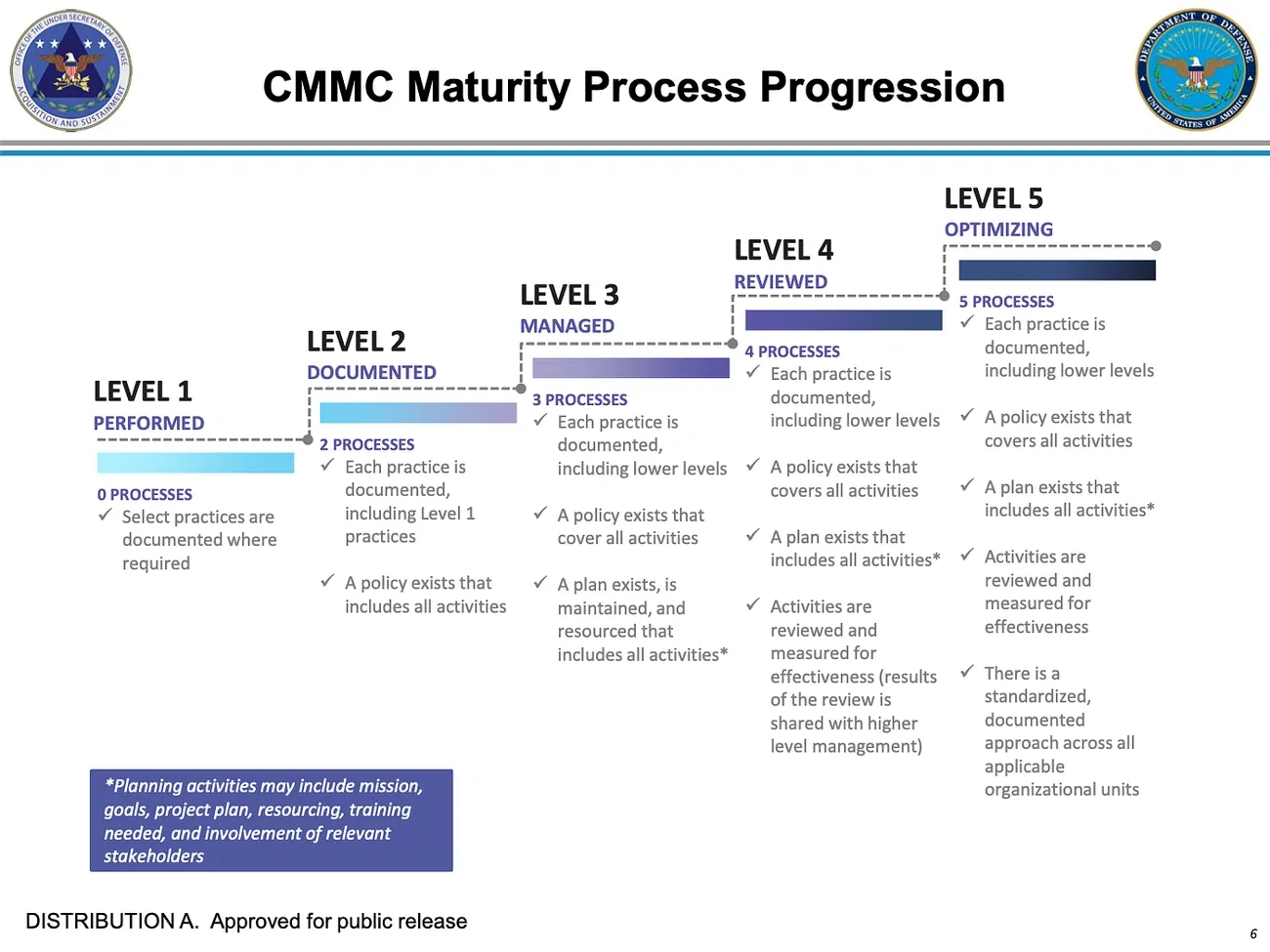
Image Source: Ensar Seker – Medium
C3PAOs use a well-laid-out four-phase assessment methodology created by the CMMC AB to confirm cybersecurity compliance. Let me get into the key responsibilities these assessors handle during the certification experience.
Planning and Scoping the Assessment
A C3PAO starts by confirming the Organization Seeking Certification’s (OSC) readiness. They review the System Security Plan (SSP) and establish the assessment scope. The pre-assessment phase helps determine if the OSC has set proper boundaries for systems that process, store, or transmit CUI. The team makes sure all documentation is complete and evidence is available. Any scope disagreements need resolution before moving forward. On top of that, the C3PAO checks if external cloud service providers meet FedRAMP moderate baseline security requirements.
Evidence Review and Technical Validation
The assessment phase sees C3PAOs using three main approaches to confirm control implementation:
- Examine: Reviewing documentation, artifacts, and evidence packages
- Interview: Speaking with subject matter experts
- Test: Technically proving that security requirements work as intended
The fieldwork takes 3-5 days based on the organization’s size and complexity. The C3PAO assessment team collects solid evidence to determine if each practice meets the required standard.
Stakeholder Interviews and Process Verification
The C3PAO team talks to relevant personnel to verify process adherence. Daily checkpoint meetings give progress updates and let the OSC share new evidence that might change early findings. These meetings help control quality and create transparency between the assessment team and organizational stakeholders.
Scoring and Reporting in eMASS
The C3PAO team assesses each practice against CMMC requirements and scores them as “MET,” “NOT MET,” or “Not Applicable”. They create a Conformity Assessment report with detailed findings. The C3PAO ended up uploading these results to the DoD’s Enterprise Mission Assurance Support Service (eMASS) reporting system. The team must submit this within 20 business days after the final findings briefing.
Preparing for a Successful C3PAO Assessment
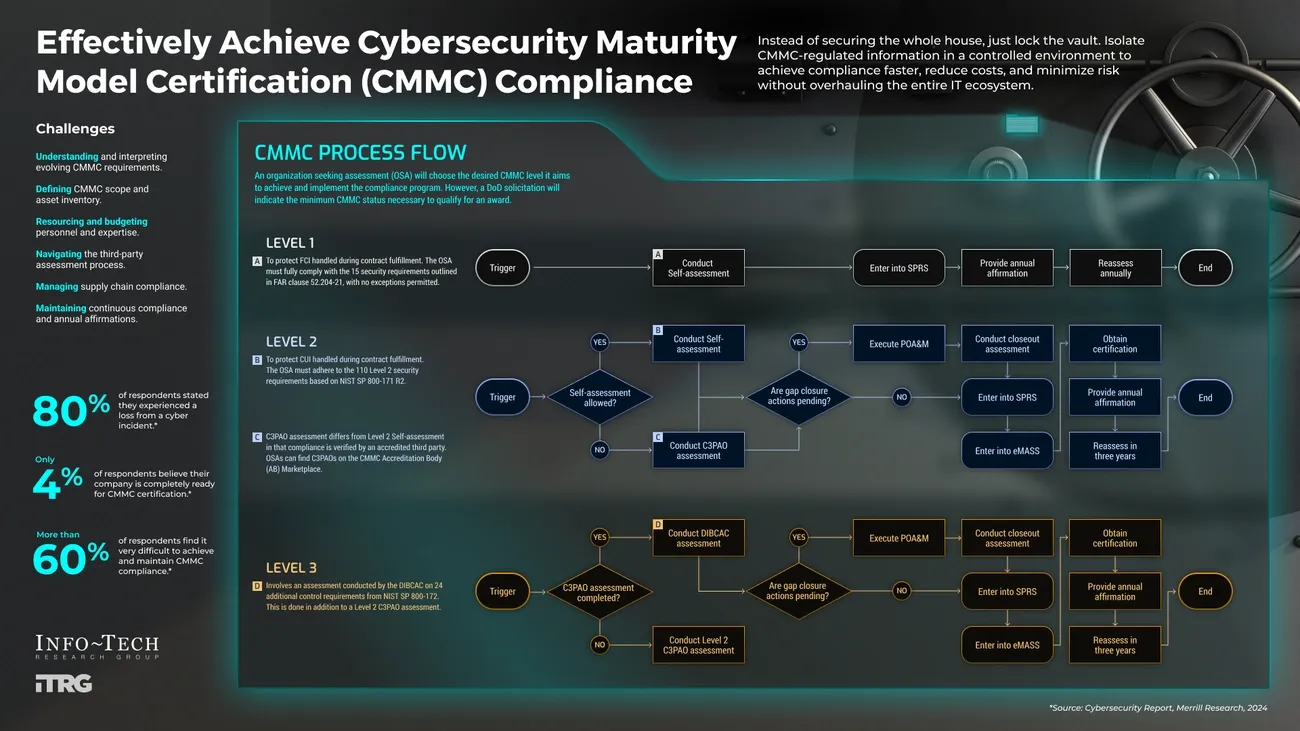
Image Source: Info-Tech
Getting ready for a C3PAO assessment needs careful planning and a complete implementation of security practices. Your success depends on several factors that need attention before assessors arrive.
Implementing All 110 NIST SP 800-171 Controls
Your organization must implement all 110 security controls from NIST SP 800-171 to achieve CMMC Level 2 certification. These controls cover 14 domains that include Access Control, Awareness and Training, and Media Protection. The key is to integrate these controls into your operational environment rather than treating them as a checklist.
Building a Complete System Security Plan (SSP)
The SSP is the life-blood of CMMC assessment. Your document should clearly define system boundaries, explain how you implement each control, and list the core team. C3PAOs expect specific descriptions of how controls work in your unique environment, so avoid generic templates.
Using a Registered Practitioner Organization (RPO) for Gap Analysis
RPOs give you a full picture to spot compliance gaps quickly. These authorized organizations work with CMMC Registered Practitioners who know assessment methods and create remediation roadmaps.
Centralizing Evidence with Automation Tools
Automation platforms make evidence collection easier by creating a unified hub for documentation. These tools simplify compliance by automating control testing and monitoring tasks.
Conducting Internal Mock Interviews
Mock assessments help teams prepare for assessor questions by simulating the official process. Your team builds confidence through this rehearsal, which reveals weak points before formal evaluation. Book a Readiness Call to begin your preparation today.
How to Select the Right C3PAO for Your Organization
The right C3PAO selection affects your CMMC certification process substantially. Here’s what you need to know about this vital decision.
Verifying Accreditation on the Cyber AB Marketplace
The official Cyber AB Marketplace serves as your first stop to verify C3PAO authorization. This directory remains the only trusted source for authorized assessment organizations. You can find qualified C3PAOs by using marketplace filters – select “C3PAO” under “Ecosystem Role” and “Assessment Services” under “Scope of Services”. Your assessment becomes invalid if you work with unlisted organizations.
Why C3PAOs Are Not Interchangeable
Treating C3PAOs as interchangeable is one of the most expensive assumptions a contractor can make. An assessor who works primarily with defense manufacturers reads an environment differently than one who specializes in aerospace, in IT and managed services, or in cloud-native software. The differences are not cosmetic. They shape how quickly an assessor understands your architecture, how many clarification cycles your evidence review takes, and how confidently the team interprets the controls in the context of your operations.
Fit shows up across several dimensions. Industry and sector matter, because the data flows and system boundaries in a machine shop look nothing like those in a managed service provider. Scope size matters, because a C3PAO geared toward large enterprises may not be the right match for a small contractor with a tightly scoped enclave, and the reverse is also true. Environment type matters, because experience with your specific stack, whether that is a GCC High tenant, an on-premise network, or operational technology, removes friction during technical validation. Pricing band matters as well, but it should be the last filter, not the first.
The takeaway is simple. The lowest bid is not the right metric, and the most prestigious name is not either. The right C3PAO is the one whose experience maps to your environment, because that match is what turns a stressful audit into a predictable one.
Understanding Availability and Cost Structures
CMMC Level 2 assessments face high demand, and most C3PAOs have long waitlists. You should ask about availability early to meet your contractual deadlines. Assessment costs typically run in tens of thousands of dollars. Focus on total value rather than the lowest cost. Make sure to ask about included services, assessment team location, and separate travel expenses.
Avoiding Conflicts of Interest and Red Flags
The separation between preparation and certification is not a courtesy, it is a rule. The Department of Defense and the Cyber AB prohibit a C3PAO from providing readiness, consulting, or remediation services to an organization it will later assess. In plain terms, the firm that prepares you cannot be the firm that certifies you, and a C3PAO that offers to do both for the same engagement is signaling a conflict you should avoid.
This is precisely where a readiness and advisory partner fits in the ecosystem. Elevate Consult is not a C3PAO and does not sell its own certification assessment. That distinction matters, because it means Elevate’s role is to get your organization assessment-ready and to help you engage an independent, authorized C3PAO that fits your environment. Since Elevate does not perform the certification itself, its recommendations are based on which assessor fits your sector and scope, not on self-interest. Contractors get the benefit of Elevate’s CMMC readiness and advisory services without the conflict that comes from a single firm trying to both coach and grade the same exam.
Beyond the conflict-of-interest rule, a few warning signs should make you walk away from any prospective assessor:
- Unrealistic guarantees of certification before the process is complete.
- A lack of references, case studies, or verifiable assessment history.
- Vague claims about fast-tracking or shortcutting the assessment.
Talk to an Advisor to map your readiness and identify a C3PAO that fits your environment before you commit.
Conclusion
Organizations handling sensitive defense information must have CMMC certification. C3PAOs serve as gatekeepers of this vital cybersecurity standard. These authorized assessors make sure defense contractors follow strong security practices that protect Controlled Unclassified Information across the Defense Industrial Base.
Getting CMMC Level 2 certification requires careful preparation. Your organization needs to implement all 110 NIST SP 800-171 controls and create a detailed System Security Plan with substantial evidence of compliance. A Registered Practitioner Organization can be a great way to get help in finding gaps before your official assessment.
You should think carefully about choosing your C3PAO partner. Start by checking their accreditation in the official Cyber AB Marketplace, then evaluate their experience and knowledge of your technology environment. It also helps to understand their availability and pricing structure to set clear expectations from the beginning.
Note that C3PAO assessments stay valid for three years, though you’ll need annual affirmations. This certification timeline gives you stability while ensuring your steadfast dedication to cybersecurity excellence. We suggest keeping open communication with your chosen C3PAO to resolve questions and understand requirements clearly.
Defense contractors who adopt CMMC certification early end up with more than just compliance—they build security foundations that protect sensitive information and boost their competitive edge in the defense marketplace. Learning about the C3PAO ecosystem now will without doubt help your organization succeed in certification.
Key Takeaways
Understanding C3PAOs is essential for defense contractors seeking CMMC Level 2 certification, as these specialized assessors are the only entities authorized to validate cybersecurity compliance for DoD contracts.
• C3PAOs are the exclusive gatekeepers for CMMC Level 2 certification, authorized only by Cyber AB to assess defense contractors handling sensitive information.
• Organizations must implement all 110 NIST SP 800-171 controls and develop comprehensive documentation before engaging a C3PAO for assessment.
• C3PAO selection requires verification through the official Cyber AB Marketplace, evaluation of industry experience, and understanding of availability timelines.
• Successful preparation involves partnering with RPOs for gap analysis, centralizing evidence with automation tools, and conducting internal mock assessments.
• CMMC Level 2 certification remains valid for three years, providing stability while requiring annual affirmations to maintain compliance status.
The investment in proper C3PAO partnership and thorough preparation ultimately builds resilient security foundations that protect sensitive information and strengthen competitive positioning in the defense marketplace.
FAQs
Q1. What exactly is a C3PAO in the context of CMMC? A C3PAO (Certified Third-Party Assessment Organization) is an independent entity authorized by the Cyber AB to conduct official CMMC assessments. These organizations employ certified assessors to evaluate and certify that defense contractors meet the required cybersecurity standards for handling sensitive information.
Q2. Why are C3PAOs necessary for CMMC Level 2 certification? C3PAOs are required for CMMC Level 2 because organizations handling Controlled Unclassified Information (CUI) cannot self-certify. They provide objective, third-party validation that a contractor has implemented all 110 controls from NIST SP 800-171, giving the Department of Defense assurance that sensitive information is properly safeguarded.
Q3. How does a C3PAO differ from a Registered Practitioner Organization (RPO)? While both are part of the CMMC ecosystem, their roles differ significantly. RPOs help organizations prepare for certification by conducting gap analyzes and providing guidance. C3PAOs, on the other hand, are the only entities authorized to perform the official CMMC assessment and grant certification.
Q4. What should organizations consider when selecting a C3PAO? When choosing a C3PAO, organizations should verify the assessor’s accreditation on the Cyber AB Marketplace, evaluate their industry experience and familiarity with relevant technologies, consider their availability and cost structures, and ensure there are no conflicts of interest.
Q5. How long is a CMMC certification from a C3PAO valid? A CMMC certification issued by a C3PAO remains valid for three years. However, organizations are required to provide annual affirmations to maintain their compliance status during this period.
Q6. Can the company that prepares me for CMMC also conduct my certification assessment? No. The Department of Defense and the Cyber AB prohibit a C3PAO from providing readiness or consulting services to an organization it will later assess. The firm that prepares you must be separate from the C3PAO that certifies you. This is why many contractors work with an independent readiness and advisory partner to get assessment-ready, then engage an authorized C3PAO for the official assessment.