Organizations face growing scrutiny from regulators, customers, and the public as AI becomes more accessible to businesses for critical decisions, strategies, and processes. Many organizations want to build trust in their AI systems and need to know how to implement structured governance over AI. ISO/IEC 42001 provides a practical solution that gives organizations a systematic approach to create trustworthy AI. The solution uses an AI Management System built on governance, risk classification, controls, documentation, and measurable oversight.
ISO 42001’s foundation rests on a simple yet powerful principle: continuous monitoring and improvement. The standard, which pioneered AI-specific management guidelines, follows ISO’s Plan-Do-Check-Act cycle. This helps organizations adapt their AI governance to new risks, opportunities, and regulations. ISO 42001 implementation helps organizations comply with global AI regulations, reduce AI-related risks like bias and security threats, and create AI transparency and accountability. It also accelerates European Union (EU) AI Act readiness by connecting control objective themes to Act requirements and delivering the operating model needed to demonstrate oversight, risk management, and compliance.
This piece guides you through a five-phase roadmap for implementing ISO/IEC 42001. You will learn everything from creating your AI inventory to setting up continuous improvement processes that lead to long-term success.
Understanding ISO/IEC 42001 and Its Role in AI Governance

ISO/IEC 42001:2023 came out in December 2023. It stands as the first worldwide recognized compliance framework designed specifically for AI management systems. This framework gives a structured way to manage and secure AI systems throughout their lifecycle, so they stay secure, ethical, and clear. Organizations that put ISO 42001 into practice demonstrate their commitment to responsible AI through organized management.
Scope of ISO 42001: AI Management System (AIMS)
The standard describes an AI Management System (AIMS) as a set of interrelated or interacting elements of an organization intended to establish policies and objectives, and processes to achieve those objectives, in relation to the responsible development, provision, or use of AI systems. This framework covers everything from design to development and deployment.
ISO 42001 works for organizations that:
- Develop AI systems for internal use
- Provide AI-powered products and services to external customers
- Use AI technologies developed by third parties
The AIMS framework helps organizations integrate AI governance with related business processes. This drives reliable outcomes, ongoing improvements, and alignment with changing regulations. Organizations that put AIMS in place gain strategic advantages: they become more flexible, innovative, and responsive to market changes.
Key Clauses: Governance, Risk, Oversight, and Improvement
ISO 42001’s structure looks familiar to anyone who knows other ISO standards, especially ISO 27001. This makes it easier to put into practice. The standard has 10 clauses. Clauses 4 through 10 contain the auditable requirements.
These key clauses form the foundation of ISO 42001:
- Clause 4 (Context): internal and external factors that affect an organization’s AIMS, including AI-related risks and stakeholder expectations.
- Clause 5 (Leadership): how top management should set up AI governance, accountability, and fit it into business strategy.
- Clause 6 (Planning): risk assessment and treatment, including the requirement for AI impact assessments.
- Clause 7 (Support): the resources, training, and documentation needed for AIMS to work well.
- Clause 8 (Operation): AI processes that are safe and clear, with plans for incident handling.
- Clause 9 (Performance Evaluation): AI performance tracking and internal audits.
- Clause 10 (Improvement): constant improvement through corrective action and handling of new risks.
Beyond these clauses, Annex A lists 38 specific AI controls. Organizations must implement these based on their risk profile. The controls cover areas like governance policies, data management, and third-party relationships. Organizations need to document a Statement of Applicability that explains why they included or excluded each control.
How ISO 42001 Lines Up with the EU AI Act and ISO AI Standards
ISO 42001 shows substantial alignment with the EU AI Act at the high-level requirements layer. Both frameworks emphasize risk-based AI governance, and the EU AI Act’s four-tier risk system maps naturally to ISO 42001’s risk assessment requirements. The exact percentage of overlap varies depending on the mapping methodology used, and organizations should review their own crosswalk rather than rely on a specific published number.
These areas line up well:
- Data Governance: the EU AI Act’s Article 10 addresses data governance and bias detection. ISO 42001 also focuses on finding and mitigating bias, with clear oversight roles.
- Risk Management: both frameworks require organizations to identify, assess, and mitigate AI risks based on severity and potential impact.
- Human Oversight: the EU AI Act requires human oversight, especially for high-risk systems. This matches ISO 42001’s controls for clarity and oversight.
- Ethical Principles: both frameworks build ethical considerations into AI governance. They promote fairness, prevent discrimination, and protect human dignity.
Organizations adopting ISO 42001 are better positioned for EU AI Act compliance and can leverage existing controls to simplify regulatory efforts. As AI laws evolve globally, ISO 42001 is emerging as a foundational standard for responsible AI management, referenced across several state and national frameworks including the Colorado AI Act.
Phase 1: Assessment – Building Your AI Inventory and Risk View

Your organization’s first step toward ISO 42001 implementation needs a full picture of your AI landscape. You need to identify AI presence throughout your enterprise and evaluate risks. This task is often more challenging than it first appears.
Centralized AI System Register
Clear visibility marks the start of successful ISO 42001 implementation. Organizations must build a detailed inventory of all AI systems they develop, deploy, or use. This inventory forms the foundation of your AIMS.
Finding AI systems becomes challenging especially when AI is hidden within features or decision logic instead of carrying clear labels. Organizations often find AI embedded in unexpected places:
- Internal tools like machine learning models powering automation
- Customer-facing features such as recommendation engines
- Third-party software and API integrations
- Decision support systems across departments
A discovery audit helps map automated decision-making both internally and externally. Each system’s purpose, components, data sources, and intended effects need documentation. This record supports compliance and enables traceability, creating a clear record of AI governance over time.
AI Risk Classification and EU AI Act Categories
After establishing your AI inventory, you must classify each system by its risk profile. ISO 42001 requires organizations to define and establish an AI risk assessment process that examines what each system means for the organization, individuals, and society.
The EU AI Act’s four-tier classification system offers a useful framework that lines up with ISO 42001 requirements:
- Unacceptable Risk: systems that threaten people’s rights and safety are banned outright (for example, social scoring by governments).
- High Risk: systems used in critical areas like healthcare, biometric identification, or essential infrastructure requiring strict oversight.
- Limited Risk: systems with fewer obligations but specific transparency requirements.
- Minimal Risk: systems largely exempt from regulatory frameworks, such as simple recommendation engines.
Organizations can choose qualitative approaches (categorizing risks as “high” or “low”) or advanced quantitative methods like Factor Analysis of Information Risk (FAIR) for risk assessments. Qualitative assessments provide intuitive solutions and suit organizations starting their compliance journey.
ISO 42001 requires assessment of AI-specific concerns from ISO 23894, beyond traditional security risks:
- Lack of transparency and interpretability
- System life cycle issues
- Technology readiness
- Level of automation
- Complexity of environment
Gap Analysis of Existing Controls
The final assessment step compares your current governance practices with ISO 42001 requirements. Organizations often find existing elements in place: controls from ISO 27001, workflows guided by the NIST AI Risk Management Framework, or GDPR compliance measures.
A clause-by-clause assessment shows where you can reuse existing controls and where new ones are needed. Annex A of ISO 42001 deserves special focus with its 38 specific AI controls covering governance policies, risk management, transparency, documentation, and stakeholder communication.
Your gap analysis results become the blueprint for your implementation plan. The overlap between ISO 42001 and other frameworks helps reduce redundancy and optimize your governance approach.
The assessment phase delivers three key items: a detailed AI inventory, a risk classification framework that meets regulatory requirements, and a documented gap analysis. These guide your implementation roadmap for the next phases of ISO 42001 adoption.
Phase 2: Planning – Defining Governance and Control Objectives

You need a detailed AI inventory and risk view before moving to the next crucial step in ISO 42001 implementation. This step will help you define your governance structure and control objectives. Your organization must turn abstract requirements into practical procedures that teams can apply to AI systems.
Annex A Control Mapping to AI Systems
Annex A sits at the core of ISO 42001. It provides a structured catalog of controls that shows organizations how to design, operate, and monitor their AI management system. These controls guide AI system development, risk assessment, transparency, fairness, and system monitoring throughout the lifecycle.
Annex A controls cover the entire AI system lifecycle. They include governance and leadership, risk management, transparency, accountability, human oversight, deployment, monitoring, safety, incident management, and continuous improvement. Your ISO 42001 implementation will work when you:
- Create a crosswalk matrix that links specific Annex A controls to your identified AI systems
- Keep control IDs consistent across frameworks to support traceability
- Document how policies and procedures connect to specific controls
This mapping creates the foundation for the Statement of Applicability (SoA). The SoA explains why you included or excluded each control based on your organization’s unique risk profile.
Control Ownership and Reviewer Assignment
AI governance needs clear ownership to succeed. Annex A Control A.3 of ISO 42001 requires organizations to clearly define accountability for AI systems.
Your team should take these steps:
- Create a detailed RACI (Responsible, Accountable, Consulted, Informed) matrix that shows which teams own specific controls
- Set up governance committees with documented terms and meeting schedules
- Keep decision logs that track key governance choices
- Create clear escalation paths for AI incidents or concerns
Engineering, legal, product, and compliance teams should work together on control ownership. Including all perspectives in AI governance decisions through this cross-functional approach is essential.
Human-in-the-Loop (HITL) Gates and KPIs
High-risk AI systems need human oversight as a basic control. The National Institute of Standards and Technology (NIST) agrees and added governance as a core function in its Cybersecurity Framework 2.0 (released February 2024). This addition highlights why human oversight in AI governance matters.
Human-in-the-Loop (HITL) adds human decision points at key moments in AI workflows. A good HITL implementation follows these steps:
- The AI agent receives a task and proposes an action
- The agent pauses and routes the request to a human approver
- The human reviews the context and either approves or rejects
- The agent resumes, executing only if approved
Your governance framework needs key performance indicators (KPIs) to measure success. Track these metrics:
- Throughput: how quickly decisions move through governance processes
- Rework percentage: frequency of rejected or revised AI actions
- Reviewer adherence: consistency of human oversight
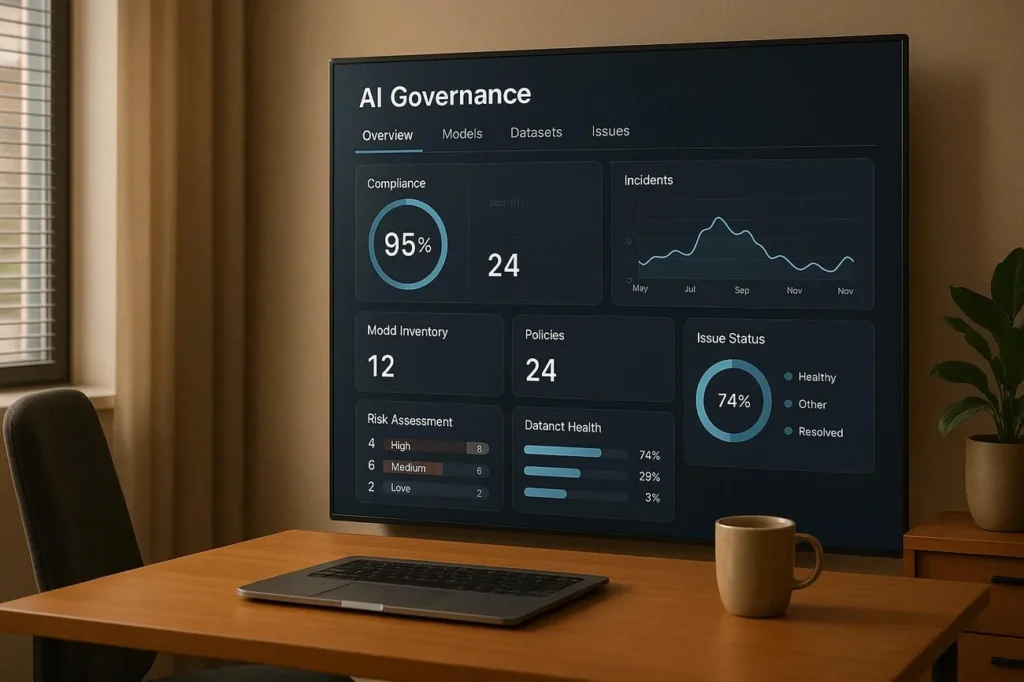
Executives, compliance officers, and engineering teams should have access to dashboards showing these metrics. This access helps maintain visibility into governance performance.
Automated reminders and escalation workflows help assign ownership for AI lifecycle checkpoints. These tools make sure tasks do not fall through the cracks and maintain human oversight where needed.
Phase 3: Implementation – Operationalizing ISO 42001 Controls

You will need resilient systems to manage documentation, collect evidence, and control changes when moving from planning to action. Your ISO 42001 governance framework will shift from theory to practice through systematic control application.
Centralized Documentation and Evidence
A centralized approach to documentation is vital to implement ISO 42001 successfully. Your organization should set up a single repository for all AIMS-related documentation to eliminate risks from scattered information across drives and wikis. This repository becomes your single source of truth and reduces evidence sprawl that might slow down conformity assessments and regulatory investigations.
A centralized documentation system should include:
- Policies that define AI principles, objectives, and scope
- Governance frameworks and committee structures
- Detailed risk assessments and impact analyses
- Model cards and system specifications
- Audit logs and evidence of human oversight
Cloud-native governance tooling can support the controls in the Statement of Applicability. Standardized model documentation (often called model cards) captures purpose, performance characteristics, and known limitations for each ML system, which helps maintain transparency and accountability. The specific platform matters less than the discipline: whatever tool your organization uses, documentation should bring clarity and traceability rather than become paperwork. Keep it lean, embed it in workflows, and tie it directly to action.
As you build your documentation system, Book a Readiness Call to see how your organization’s current documentation matches ISO 42001 requirements.
Change Control and Immutable Logs
Meticulous tracking of all changes throughout the AI lifecycle is essential for ISO 42001 implementation. Audit logs are vital because they provide detailed, immutable records of all key activities: who did what, when, and where. These records ensure transparency at every stage.
AI governance cannot work without immutability. Without it, models can be retrained silently, decision logic can change without records, or compliance checks might pass against outdated data. No one can change or delete immutable records once created, which helps maintain solid audit trails.
Organizations should implement:
- Append-only storage with cryptographic verification
- Controlled documentation procedures with versioned model cards
- Risk-based logging retention policies (minimum 180 days)
- Automated capture of every model event, weight update, and output decision
Cloud audit logging services (built into major cloud platforms) and configuration monitoring tools support continuous change tracking. These capabilities are essential for accountability and compliance reporting in AI governance frameworks. Organizations with the highest audit-integrity requirements can also use append-only or blockchain-backed storage to make audit trails tamper-proof.
Policies, Model Cards, and Data Lineage Links
Clear connections between your governance artifacts make up the final implementation aspect. Link policies to specific model cards and make sure data lineage documentation is complete.
Each high-risk AI system should have a one-page register of obligations, an evidence index, and a current conformity file. This turns audits into simple retrieval tasks instead of document hunts. Your organization should set up data lifecycle policies with supplier controls, sampling plans, and lineage tracking.
Data management records should include:
- Data source inventories with quality results
- Clear lineage diagrams showing data sources
- Usage approvals and reasons
- Documentation of preprocessing steps
Standardized model documentation practices help maintain this documentation, while identity and access management controls restrict access for proper governance. Encryption and key management capabilities are essential to enforce access governance and secure data.
Paper-only governance must go. Policies without operating reviews and metrics often fail during audits. A practical implementation puts governance into daily delivery flows by building controls into CI/CD pipelines and using existing collaboration platforms to increase visibility.
Phase 4: Evaluation, Measuring Performance and Audit Readiness
Your AI Management System’s performance and readiness needs a thorough review to reach ISO 42001 certification. Organizations need measurement protocols that show how well their governance approach works after implementing controls.
Throughput, Rework Percentage, and Reviewer Adherence Tracking
Performance metrics are the life-blood of ISO 42001 compliance. Your organization needs a systematic way to collect and analyze performance data from key metrics. Three critical indicators stand out:
- Throughput metrics: how quickly decisions flow through governance workflows
- Rework percentage: how often AI actions get rejected or need revision
- Reviewer adherence: how consistently and promptly human oversight happens
Organizations typically conduct quarterly risk reviews with full coverage of their AI inventory. They track complete dataset lineage and draft incident reports within 72 hours when issues come up. Risk tiers determine log retention periods, which typically range from 180 to 365 days.
Internal Audits and Issue Management
ISO 42001 certification requires completed internal audits, and certification bodies expect those audits to be completed before Stage 2 certification. Internal audits are distinct from the external certification audit: they are your own team’s or an independent consultant’s review of your AIMS before the certification body ever arrives.
You have two choices for internal audits:
- Use internal audit teams separate from the AIMS implementation
- Bring in third-party specialists who know ISO 42001 in depth
Internal auditors review your controls’ effectiveness, interview the core team, and check whether documentation is complete. They surface issues you need to fix before the certification body’s audit begins.
Successful organizations show three key traits during audit preparation:
- Clarity: updated AI inventories that map roles and show risk exposures
- Traceability: clear connections between requirements and proof (for example, “regulatory requirement X → test Y → evidence Z”)
- Resilience: monitoring thresholds that trigger corrective action when needed
Audit Package Export for Certification
ISO 42001 certification follows the ISO 17021 framework with Stage 1 (documentation review) and Stage 2 (operational assessment) audits. A central digital repository helps simplify this process by storing all important documents in one place.
Your audit package needs these key items:
- AIMS scope statement
- AI risk register with mitigation plans
- Policies and procedures documentation
- Model lifecycle logs
- Training records and RACI matrices
A mock audit helps teams understand what to expect and finds documentation gaps early. Final audit evidence collection for the AIMS is where most preparation efforts either pay off or fall short. The certification lasts three years. Annual surveillance audits look at clauses 8 through 10 and a subset of Annex A controls.
Phase 5: Continuous Improvement, Keeping AIMS Current
ISO 42001 certification is just the beginning. The standard requires ongoing alertness and improvement. Clause 10 makes continuous improvement a baseline requirement, not a best practice.
Periodic Review Cadence for High-Risk AI
Organizations need systematic review schedules to comply with ISO 42001. Teams should perform AI Impact Assessments (AIIAs) and threat modeling annually for existing systems. Policies need annual reviews and immediate updates after major AI system changes. High-risk AI systems typically need quarterly evaluations. Lower-risk applications can follow less frequent schedules.
Detailed reviews should look at:
- System performance against set thresholds
- Changes in use context or regulatory environment
- Emerging threats or vulnerabilities
- Data drift or model degradation issues
Controls, Training, and Documentation Updates
AI governance frameworks must evolve as technologies advance. ISO 42001 clearly requires processes that boost ongoing AI governance. Industry surveys consistently show that enterprise AI adoption is outpacing enterprise AI governance: many organizations have AI embedded in strategic initiatives while still working to stand up formal governance structures. Confirm specific benchmark figures against a citable source (such as the current PwC, Deloitte, or IBM AI governance survey) before publishing any percentage claims.
Keeping evidence is vital to demonstrate ongoing compliance. Organizations should maintain essential documentation like model design requirements, accuracy monitoring logs, and data audit trails. Workforce readiness remains a major hurdle: many organizations lack sufficient AI governance skills in-house and run informal rather than formal training programs. Building role-based training tied to your AI inventory closes this gap over time.
Trend Reports and Governance Maturity
Leadership can track compliance progress and risk status through governance metric dashboards. Teams should monitor the number of AI systems under governance, projects completing threat modeling, and training completion rates across roles. AI risk governance has moved up sharply in reported executive priority rankings year over year in industry surveys, though the specific figures shift each publication cycle.
Good trend analysis spots governance maturity patterns that help teams fix systemic problems early. This approach turns governance from reactive compliance into a strategic advantage. The result enables responsible innovation with proper guardrails.
Conclusion
This piece explores an integrated approach to implementing ISO 42001. The first international standard designed for AI management systems gives organizations a structured framework. This framework helps ensure AI systems stay trustworthy, ethical, and compliant with evolving regulations.
ISO 42001’s benefits go beyond regulatory compliance. The standard helps organizations identify and mitigate AI-related risks like bias, security vulnerabilities, and ethical concerns. It creates clear accountability and transparency throughout the AI lifecycle and builds stakeholder trust. Organizations that implement ISO 42001 differentiate themselves by demonstrating commitment to responsible AI practices.
A five-phase approach (Assessment, Planning, Implementation, Evaluation, and Continuous Improvement) creates a practical roadmap for organizations starting their AI governance journey. Teams weighing the budget and effort required for managed ISO 42001 compliance support should Book a Readiness Call. This call helps assess their current state and create a customized implementation plan based on their specific risk profile.
ISO 42001 adoption succeeds when there is commitment at every organizational level. Leaders must establish governance frameworks while developers embed controls in their workflows. The standard’s focus on continuous improvement shows that AI governance must adapt to changing technologies and regulations.
AI continues to embed itself in critical business functions. Resilient governance frameworks will set responsible organizations apart from those creating unnecessary risk. ISO 42001 implementation is more than following rules: it is a core business strategy that enables sustainable, trustworthy AI innovation.
Key Takeaways
ISO 42001 provides the first international framework for AI management systems, helping organizations build trustworthy AI through systematic governance, risk management, and continuous improvement processes.
- Start with comprehensive AI discovery. Create a centralized inventory of all AI systems across your organization, including hidden AI in third-party tools and automated decision-making processes.
- Implement risk-based governance. Classify AI systems using EU AI Act categories (unacceptable, high, limited, minimal risk) and map ISO 42001 Annex A controls to each system based on risk profile.
- Establish human oversight gates. Set up Human-in-the-Loop (HITL) checkpoints at critical decision points with clear ownership, approval workflows, and measurable KPIs for governance effectiveness.
- Maintain immutable audit trails. Use centralized documentation systems with append-only logs to track all AI lifecycle changes, ensuring transparency and audit readiness for certification.
- Embrace continuous improvement. Schedule regular reviews for high-risk AI systems, update controls based on emerging threats, and use trend analysis to drive governance maturity over time.
Organizations implementing ISO 42001 gain significant advantages beyond compliance, including systematic risk mitigation, enhanced stakeholder trust, and competitive differentiation through demonstrable responsible AI practices. The standard’s alignment with EU AI Act requirements also accelerates regulatory readiness across multiple jurisdictions.
FAQs
Q1. What are the key steps to implement ISO 42001? Implementation involves five main phases: assessment (building an AI inventory), planning (defining governance and controls), implementation (operationalizing controls), evaluation (measuring performance), and continuous improvement. Key steps include creating a centralized AI register, classifying AI risks, mapping Annex A controls, setting up human oversight, and maintaining audit trails.
Q2. How does ISO 42001 contribute to AI governance? ISO 42001 provides a structured framework for organizations to address AI-specific challenges. It guides the establishment of an AI Management System (AIMS) that covers the entire AI lifecycle, emphasizing ethical considerations, transparency, and risk management. This standard helps organizations balance innovation with responsible AI practices and regulatory compliance.
Q3. What are some best practices for implementing AI governance? Best practices include developing a comprehensive AI governance framework, ensuring compliance with standards like ISO 42001, implementing robust risk management processes, fostering transparency and accountability, and establishing AI ethics training programs. It is essential to involve stakeholders across the organization and maintain clear documentation throughout the AI lifecycle.
Q4. What are the main components of ISO 42001? ISO 42001 comprises 10 key clauses, including context of the organization, leadership, planning, support, operation, performance evaluation, and improvement. It also includes Annex A, which outlines specific AI controls covering areas such as governance policies, risk management, transparency, and stakeholder communication.
Q5. How does ISO 42001 align with other AI regulations? ISO 42001 aligns substantively with other AI regulations, particularly the EU AI Act. Both frameworks emphasize a risk-based approach to AI governance, data management, human oversight, and ethical considerations. Implementing ISO 42001 can accelerate compliance with various global AI regulations, though organizations should map their own crosswalk between ISO 42001 controls and specific regulatory requirements rather than relying on a generic overlap percentage.