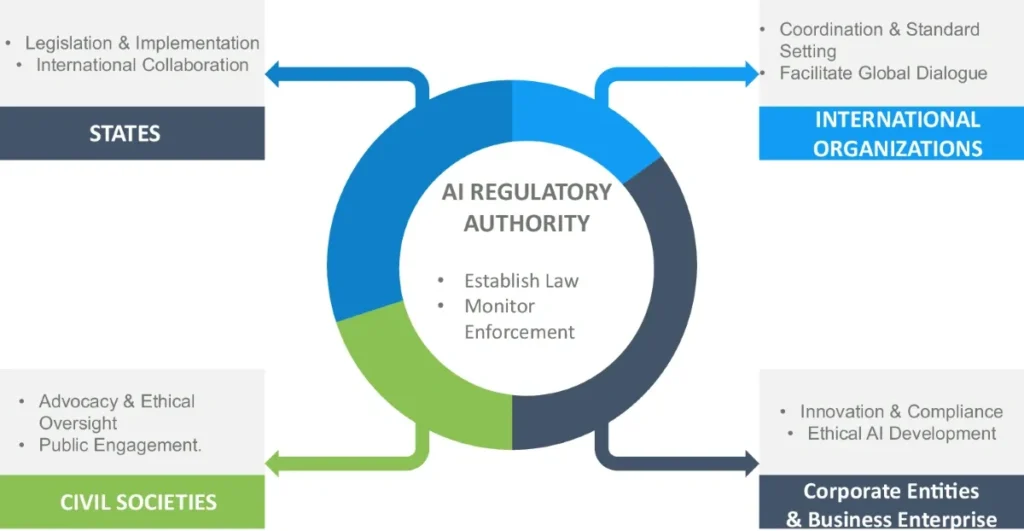
Organizations are rapidly embracing artificial intelligence – 72% now use AI in at least one business function, a significant jump from 55% last year. The world’s first international standard for Artificial Intelligence Management Systems (AIMS), ISO IEC 42001, has emerged to guide responsible AI governance.
The International Organization for Standardization and the International Electrotechnical Commission published this well-laid-out framework in December 2023. The timing proved perfect as GenAI hype decreased and boardroom concerns grew. ISO/IEC 42001 serves a broad purpose. It helps enterprises prove their accountability and match requirements with emerging regulations like the EU AI Act, which became effective August 1, 2024. Companies that obtain ISO 42001 certification can achieve compliance 40% faster compared to those beginning without it.
This piece explains ISO/IEC 42001’s importance for your AI platform and shows how AIMS implementation builds stakeholder trust through responsible AI management. You’ll learn practical implementation steps and understand how this standard supports regulatory compliance in the ever-changing AI world.
What is ISO/IEC 42001 and Why It Matters for AI Platforms
AI systems are becoming more complex, and organizations just need structured governance frameworks. ISO/IEC 42001:2023 serves as the life-blood for organizations that want to manage AI responsibly throughout its lifecycle.
Definition of ISO/IEC 42001:2023
ISO/IEC 42001 became the world’s first internationally recognized standard specifically designed for AI governance in December 2023. This groundbreaking framework gives systematic guidelines to establish, apply, maintain, and improve an Artificial Intelligence Management System (AIMS) within organizations.
The standard tackles unique AI challenges—including ethical considerations, transparency, accountability, and data privacy concerns. At its core, ISO/IEC 42001 creates a well-laid-out approach to manage AI projects, from complete risk assessment to effective risk treatment.
Organizations that implement ISO/IEC 42001 see many benefits:
- Better quality, security, traceability, and reliability of AI applications
- Boosted efficiency in AI risk assessments
- Greater confidence in AI systems
- Lower costs of AI development
- Better regulatory compliance
The standard follows the proven Plan-Do-Check-Act methodology that organizations with existing management systems know well. This approach will give proper oversight, helps organizations adapt to technology progress, and ensures regular AI risk assessments.
What is an AI Management System (AIMS)?
An Artificial Intelligence Management System is a set of interrelated or interacting elements within an organization. It establishes policies, objectives, and processes for responsible AI development and use. AIMS provides the operational framework you need to govern AI systems throughout their lifecycle.
ISO/IEC 42001’s AIMS structure covers policies to optimize, reduce risks, and continuously improve AI operations. It highlights principles like fairness, non-discrimination, and privacy respect to line up AI systems with society’s values and public interests.
On top of that, it helps organizations comply with emerging AI legislation and build trust with stakeholders. Organizations with AIMS can spot and fix potential risks before they become major problems.
How ISO/IEC 42001 is different from ISO/IEC 27001 and SOC 2
ISO and IEC jointly publish ISO/IEC 42001 and ISO/IEC 27001, but they serve different purposes. ISO/IEC 27001 focuses on Information Security Management Systems (ISMS) to ensure information confidentiality, integrity, and availability. ISO/IEC 42001 targets AI Management Systems with a focus on responsible, transparent, and explainable AI operations.
ISO/IEC 27001 concentrates on data security, access control, and network protection. We focused ISO/IEC 42001 on AI risk, ethics, data governance, and AI lifecycle management. All the same, both standards make important contributions to organizational governance and risk management.
Organizations that already have ISO/IEC 27001 certification can implement ISO/IEC 42001 up to 40% faster. This speed comes from their similar structures, despite focusing on different areas. Together, they create a unified governance structure that handles both information security and AI-specific challenges with an all-encompassing approach.
ISO/IEC 42001 brings new AI-specific requirements that ISO/IEC 27001 doesn’t have:
- Transparency and explainability documentation
- Specialized data governance and quality standards
- Model development and validation procedures
- Human oversight mechanisms
- AI ecosystem governance
Organizations that strategically implement both standards build a strong foundation. This approach helps achieve high performance standards across multiple disciplines and ensures success in today’s ever-changing technological landscape.
Core Structure of the ISO/IEC 42001 AI Management System Standard
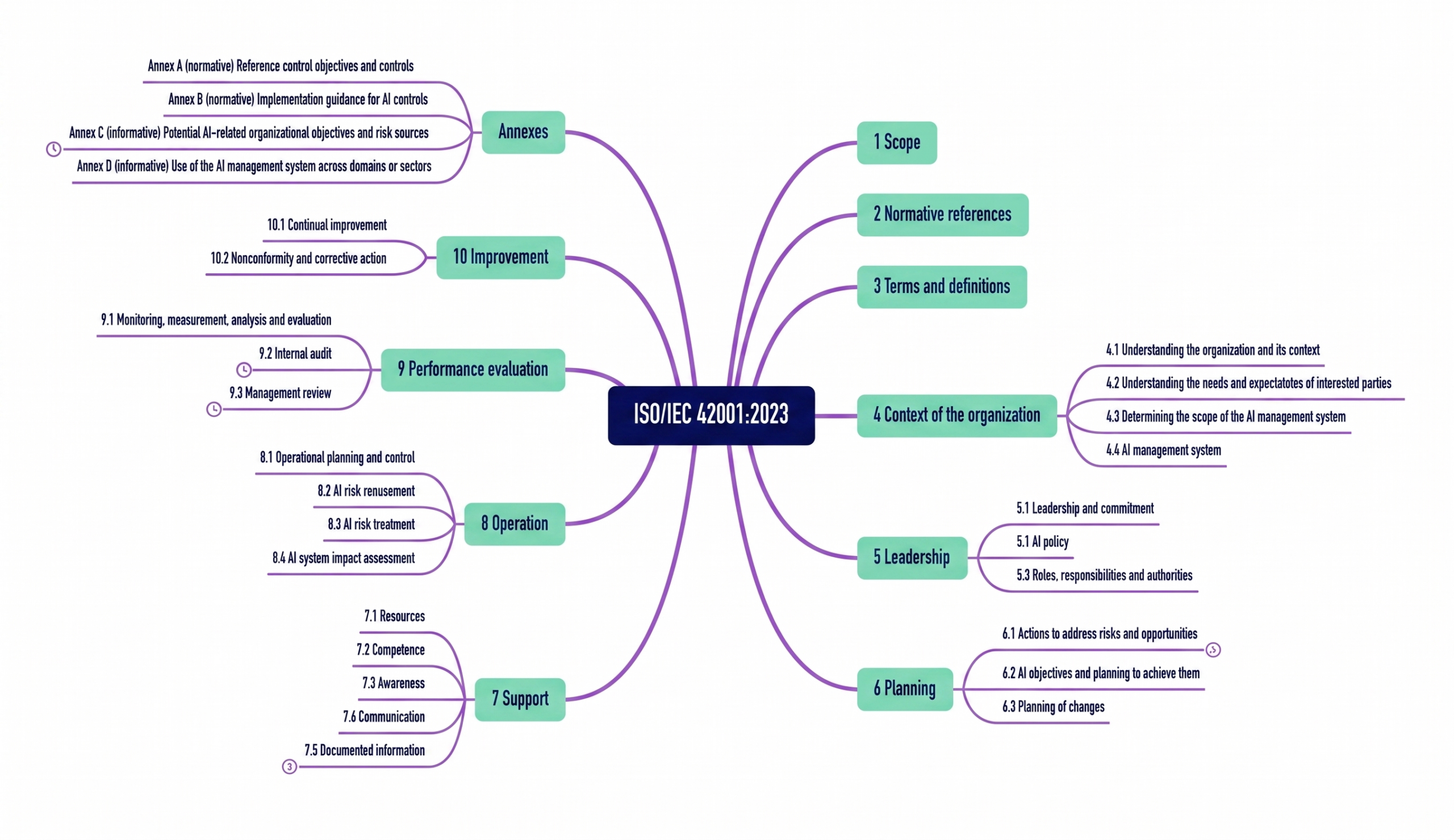
Image Source: Johner Institute
ISO/IEC 42001 uses a systematic framework that helps organizations handle AI responsibly throughout its lifecycle. The standard works like other ISO management systems. It blends core clauses with detailed annexes to create a complete governance model for artificial intelligence systems.
Clause 4–10 Overview: Context to Improvement
Seven operational clauses (4-10) make up the foundation of ISO/IEC 42001. These clauses follow the Plan-Do-Check-Act method that many organizations with management systems already know well. This cycle helps systems adapt to new AI technologies and risks.
| Clause | Focus | Purpose |
| 4: Context of the Organization | Scope definition | Define AI system boundaries and understand stakeholder expectations |
| 5: Leadership | Management commitment | Demonstrate leadership commitment through clear policies and accountability |
| 6: Planning | Risk assessment | Identify AI risks/opportunities and conduct impact assessments |
| 7: Support | Resource allocation | Ensure adequate resources, competencies, and documentation |
| 8: Operation | Implementation | Establish AI lifecycle controls reflecting principles like fairness and privacy |
| 9: Performance Evaluation | Monitoring | Regularly assess AIMS effectiveness through audits and reviews |
| 10: Improvement | Continual enhancement | Implement corrective actions based on evaluation results |
These clauses work together as a comprehensive system that fits with existing organizational processes. The standard gives you a practical framework to handle AI-related risks and opportunities across your organization, rather than focusing on specific AI applications.
Annex A Controls: Risk, Bias, and Oversight
Annex A works as the operational core of ISO/IEC 42001. It offers 38 specific controls under 10 control objectives that bring an AI Management System to life. These controls tackle key aspects throughout the AI lifecycle:
- AI Policies (A.2): Establishes policies for responsible AI development and use
- Internal Organization (A.3): Defines roles, responsibilities and reporting mechanisms
- Resources for AI Systems (A.4): Manages tangible and intangible resources essential for AI
- Assessing Impacts (A.5): Assesses AI systems’ effects on individuals and society
- AI System Lifecycle (A.6): Guides responsible development from requirements to maintenance
- Data for AI Systems (A.7): Addresses data quality, preparation, and transformation
- Information for Interested Parties (A.8): Ensures transparent communication about AI usage
- Use of AI Systems (A.9): Sets policies and controls for system deployment
- Third-Party Relationships (A.10): Manages external suppliers and customer relationships
These controls give you practical ways to put AI governance, risk management, and ethical standards into action. They help organizations spot algorithmic bias, stay privacy compliant, and use reliable auditing procedures in automated decision-making systems.
Annex B-D: Implementation Guidance and Sector Standards
ISO/IEC 42001 adds three more annexes that provide practical guidance and context:
Annex B shows you how to implement the controls from Annex A. Organizations get detailed advice on applying controls across AI lifecycle stages. You’ll find practical tips for integrating processes, enforcing policies, and verifying controls to make risk management work.
Annex C shows possible AI-related organizational goals and risk sources. Organizations can identify goals like better decision-making efficiency or staying compliant with regulations. It also points out risks such as biased outcomes, data breaches, or damage to reputation.
Annex D looks at standards for specific domains and sectors. It explains how different industries like healthcare, finance, and manufacturing can use ISO/IEC 42001. The annex shows that while the standard works everywhere, it can also fit with industry-specific rules.
These annexes give you detailed, practical guidance to support ISO/IEC 42001’s main clauses. They make it easier to prepare for audits, get certified, and keep improving your systems.
Why Your AI Platform Needs an AIMS Today
AI systems’ complexity creates unique vulnerabilities throughout the technology lifecycle. Organizations now rely heavily on AI for critical functions. A well-laid-out AIMS through ISO/IEC 42001 has become crucial to handle these new challenges.
AI Lifecycle Risks: From Data to Deployment
ISO/IEC 22989:2022 outlines distinct AI system lifecycle stages—inception, design, verification, deployment, operation, re-evaluation, and retirement. Each stage brings its own risks. Organizations struggle with training data quality, bias, and privacy issues at the data stage. AI systems can make harmful decisions and show biased results when trained on problematic data.
Technical vulnerabilities emerge during development and deployment. These include adversarial threats and exploit surfaces that need immediate attention. Teams should use frameworks like STRIDE to line up specific security threats with each lifecycle stage.
Bias, Explainability, and Human Oversight Requirements
AI bias poses one of the most important challenges. Systems often reflect and increase human biases found in training data. Healthcare diagnostics and applicant tracking systems show discriminatory outcomes, with lower accuracy rates for historically underserved populations.
AI algorithms work like “black boxes,” and researchers often can’t explain their decision-making processes. This opacity damages trust and hides potential risks. A McKinsey survey reveals that 40% of respondents saw explainability as a key risk in adopting generative AI. Only 17% actively worked to reduce this risk.
The EU AI Act took effect on August 1, 2024. It requires human oversight for high-risk AI systems. Humans must understand system capabilities, spot anomalies, interpret outputs, and step in when needed.
Stakeholder Trust and Vendor Due Diligence
Trust in AI has become essential for successful deployment. Companies must really check potential AI vendors’ data handling practices, security measures, and GDPR compliance.
Good due diligence helps organizations spot and analyze risks tied to AI tools, vendors, and use cases. ISO/IEC 42001 offers a framework to assess these elements. This framework ensures AI governance covers the whole lifecycle and builds stakeholder confidence.
Steps to Implement ISO/IEC 42001 in Your Organization
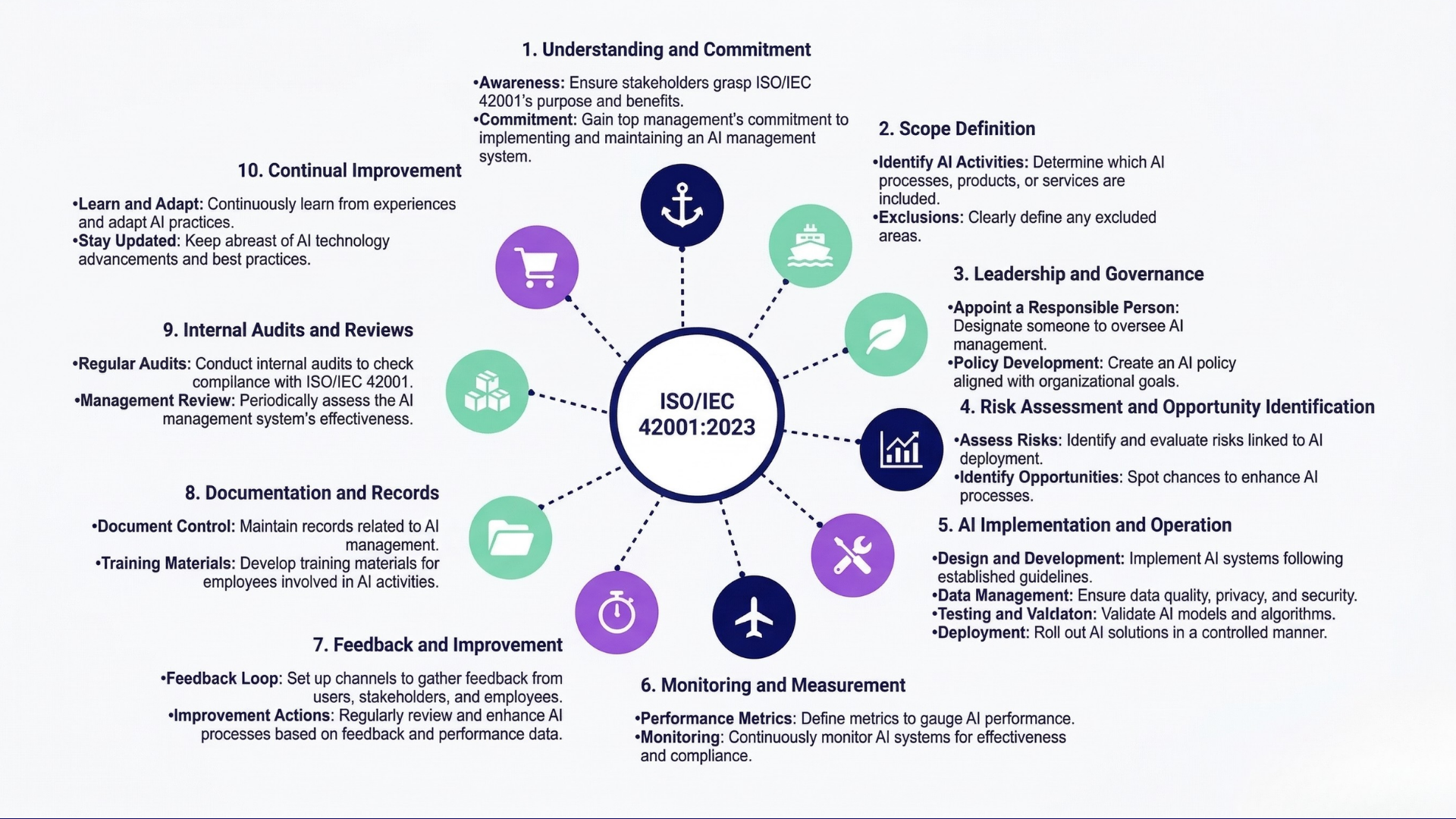
Image Source: Northwest AI Consulting
ISO/IEC 42001 implementation needs a systematic approach built on 20-year-old management practices. Organizations need certification by following a path that works for their AI contexts while meeting the standard’s requirements.
Step 1: Define Scope and Stakeholders
Your organization should clearly outline the AI Management System scope. This helps identify which AI applications, systems, and processes need governance. A clear scope will help focus your resources and set certification boundaries. Your scope definition should have:
- AI models and decision-making processes
- AI lifecycle stages covered (development through retirement)
- Geographical and regulatory boundaries
- Interfaces with third-party AI tools
The next step is to identify stakeholders who your AI governance affects. This includes internal teams (AI groups, compliance officers, executives) and external parties (customers, regulators, vendors). Executive support is vital since they must ensure AI procedures match strategic goals. Book a Readiness Call with certification experts to get a full picture of your organization’s readiness and scope accuracy.
Step 2: Conduct AI Risk and Impact Assessments
A detailed risk and impact assessment shows how AI systems affect individuals and society. This step helps identify AI-specific risks like bias, security vulnerabilities, privacy violations, and decision opacity.
The impact assessment helps determine how deployed AI systems influence society, people, and the environment. Each AI initiative needs documentation of:
- Purpose and business need
- Data sources and protection methods
- Ethical and legal boundaries
Step 3: Establish Governance and Documentation
Your organization needs a cross-functional AI Governance Committee with members from legal, IT, human resources, compliance, and management. This team oversees AI implementation, monitoring, and auditing.
Documentation helps govern AI systems effectively. It shows stakeholders how AI systems develop, work, and what risks they present. Your records should include:
- Model versions and updates
- Policy changes and decision rationales
- Testing results and bias alleviation efforts
Step 4: Monitor, Audit, and Improve Continuously
The final phase focuses on monitoring and improvement mechanisms. Regular audits help assess your AIMS against governance principles and best practices. The Plan-Do-Study-Act (PDSA) methodology ensures the system works well.
Your organization should check if process changes create desired results and adjust until you meet performance goals. This ongoing process ensures:
- AI governance stays effective as technology evolves
- You spot and alleviate risks continuously
- Your organization follows changing regulations
How ISO/IEC 42001 Supports Regulatory Compliance
ISO/IEC 42001 provides important advantages for regulatory compliance in multiple jurisdictions and frameworks, beyond establishing strong AI governance.
EU AI Act Article 15 Arrangement
ISO/IEC 42001 supports Article 15 of the EU AI Act directly. This article requires high-risk AI systems to be “accurate, robust, and secure”. The standard’s mapped controls (A.7.4, A.6.2.4, A.8.29, A.6.2.6, 10.2, A.8.7, A.8.24, A.8.20–23) create an end-to-end evidence structure that meets Article 15 requirements. The standard breaks accuracy into auditable, cross-functional controls designed for regulatory scrutiny. ISO/IEC 42001 requires versioned logs that track accuracy drift and resolution—exactly what regulators want to see.
Mapping to GDPR, DORA, and NIS2
Clause 8.4’s Data Protection Impact Assessment (DPIA) and AI System Impact Assessment (AISIA) support GDPR’s purpose limitation, data minimization, and explainability requirements. DORA’s governance, ICT risk, testing, incident and third-party management requirements match with ISO 42001 Clauses 4–9. Organizations under NIS2 will find their security requirements for risk management, reporting, and secure development operations correspond to Clauses 5–10. Book a Readiness Call with certification experts to understand how these arrangements apply to your AI implementations.
Audit-Ready Documentation and Reporting
ISO 42001 encourages audit readiness through well-laid-out documentation that meets regulatory expectations. Organizations should maintain audit-grade evidence including chain-of-custody logs, versioned model changes, and incident management records. This approach creates clear compliance when combined with proper access management that matches permissions with organizational responsibilities. Teams that implement ISO 42001 respond efficiently to audit notifications instead of managing crises.
Conclusion
AI continues to alter the map of our digital world. It creates unprecedented opportunities and complex challenges for organizations worldwide. We explored how ISO/IEC 42001 creates a critical framework to govern AI responsibly through structured Artificial Intelligence Management Systems.
Organizations need robust governance mechanisms as AI adoption grows faster across business functions. ISO/IEC 42001 gives organizations a systematic way to manage AI risks throughout its lifecycle. Traditional governance structures don’t deal very well with unique challenges like algorithmic bias, explainability issues, and human oversight requirements.
Organizations that implement ISO/IEC 42001 get more than just compliance benefits. They improve their AI applications’ quality and reliability while reducing development costs. The standard’s Plan-Do-Check-Act methodology will give a proper oversight system that adapts as technology evolves. Regular risk assessments help prevent problems before they surface.
The practical steps we covered show a clear path to certification. Organizations should start by defining their scope and stakeholders to set proper boundaries. A detailed risk assessment helps identify potential vulnerabilities. Next comes establishing governance structures and documentation for accountability. Regular monitoring and improvement keeps the AIMS working as AI capabilities change.
ISO/IEC 42001’s most important feature is how it lines up with emerging regulatory frameworks worldwide. The standard’s controls support EU AI Act requirements and map to GDPR, DORA, and NIS2 provisions. Organizations can create audit-ready documentation that proves regulatory compliance, turning potential compliance challenges into strategic advantages.
AI advances at unprecedented speed, and ISO/IEC 42001 helps organizations build stakeholder trust while managing complex risks. Building an effective AIMS is now essential business practice for the AI-driven future, whether you’re developing sophisticated AI systems or integrating third-party solutions.
Key Takeaways
ISO/IEC 42001 provides the essential framework for responsible AI governance as organizations rapidly adopt AI systems across business functions. Here are the critical insights every AI platform needs:
• ISO/IEC 42001 is the world’s first international standard for AI Management Systems (AIMS), addressing unique AI challenges like bias, transparency, and ethical considerations that traditional governance can’t handle.
• Organizations with ISO 42001 certification achieve regulatory compliance up to 40% faster than those starting from scratch, especially when building on existing ISO 27001 frameworks.
• The standard follows a structured Plan-Do-Check-Act methodology with 38 specific controls covering the entire AI lifecycle from data preparation to deployment and retirement.
• Implementation requires four key steps: define scope and stakeholders, conduct AI risk assessments, establish governance documentation, and monitor continuously for improvement.
• ISO/IEC 42001 directly aligns with major regulations including EU AI Act Article 15, GDPR, DORA, and NIS2, creating audit-ready documentation for regulatory compliance.
The standard transforms AI governance from reactive crisis management into proactive risk mitigation, building stakeholder trust while ensuring responsible AI development and deployment across your organization.
FAQs
Q1. What is ISO/IEC 42001 and why is it important for AI platforms? ISO/IEC 42001 is the world’s first international standard for Artificial Intelligence Management Systems (AIMS). It provides a structured framework for organizations to govern AI responsibly throughout its lifecycle, addressing unique challenges like bias, transparency, and ethical considerations. This standard is important as it helps improve AI quality, reduce development costs, and align with emerging regulations.
Q2. How does ISO/IEC 42001 differ from other standards like ISO/IEC 27001? While ISO/IEC 27001 focuses on information security management, ISO/IEC 42001 specifically addresses AI governance. It covers AI-specific requirements such as transparency, explainability, specialized data governance, model development procedures, and human oversight mechanisms. Organizations with existing ISO 27001 certification may implement ISO 42001 up to 40% faster due to structural similarities.
Q3. What are the key steps to implement ISO/IEC 42001 in an organization? Implementing ISO/IEC 42001 involves four main steps: 1) Define the scope and identify stakeholders, 2) Conduct comprehensive AI risk and impact assessments, 3) Establish governance structures and documentation, and 4) Implement continuous monitoring and improvement mechanisms. This systematic approach ensures proper AI oversight and adaptation as technology evolves.
Q4. How does ISO/IEC 42001 support regulatory compliance? ISO/IEC 42001 aligns with major AI regulations, including the EU AI Act, GDPR, DORA, and NIS2. It provides a framework for creating audit-ready documentation and reporting, which can significantly speed up compliance efforts. The standard’s controls map directly to regulatory requirements, helping organizations demonstrate responsible AI governance to regulators.
Q5. What are the benefits of implementing an AI Management System (AIMS) based on ISO/IEC 42001? Implementing an AIMS based on ISO/IEC 42001 offers several benefits, including improved quality and reliability of AI applications, reduced development costs, enhanced stakeholder trust, and better regulatory compliance. It provides a structured approach to managing AI risks, ensures proper oversight, and helps organizations adapt to evolving AI technologies and regulations.