
Organizations today face two major challenges in the digital world: securing sensitive information and managing artificial intelligence systems responsibly. ISO 42001 controls stand as the world’s first dedicated standard for Artificial Intelligence Management Systems (AIMS). This framework establishes a well-laid-out approach that helps manage AI lifecycles responsibly. ISO 27001, recognized internationally as the standard for information security management, enables organizations to protect sensitive data through integrated efforts of people, processes, and technology.
The difference between these two frameworks plays a vital role to work effectively. ISO 27001 secures information through technical controls such as encryption, access management, and risk mapping. ISO/IEC 42001 takes risk logic into new territory and addresses responsible AI, transparent model use, explainability, and bias mitigation. The scope of application sets these standards apart fundamentally. Companies dealing with AI systems need ISO 42001, while ISO 27001 serves any organization’s information security management needs.
This piece tucks into the overlap and gaps between ISO 42001 controls and ISO 27001 Annex A. You’ll learn when to implement one or both standards based on your organization’s requirements. The exploration of control structures, risk methodologies, and real-life implementation provides clear insights into how these standards work together or differ from each other.
Understanding ISO 27001 Annex A Controls
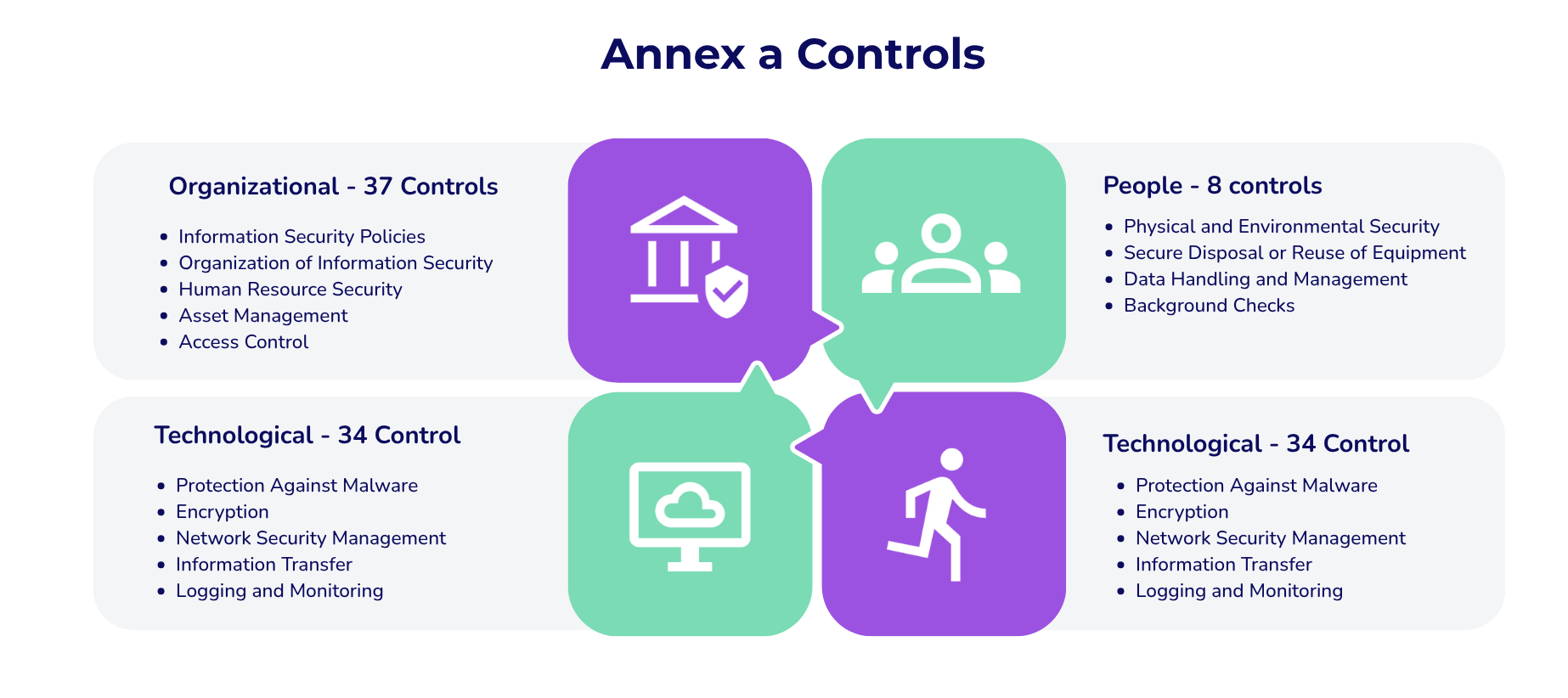 Image Source: Spectral
“ISO 27001 adopts a broader approach to risk management, concentrating on securing information assets from a wide range of threats without specific emphasis on AI.” — ISMS.online, Information Security Management Systems specialists
ISO 27001 Annex A provides a complete framework of security controls that was restructured in 2022 to deal with modern security challenges. The standard organizes its 93 controls into four themes that each target a specific part of information security management.
Organizational Controls: Roles, Risk, and Governance
Information security management system‘s foundation lies in organizational controls that include 37 controls guiding an organization’s all-encompassing approach to data protection. These measures help define clear information security policies, establish roles and responsibilities, and implement risk management methods.
The organizational controls focus on:
- Information security policies and governance structures
- Duty separation to prevent conflicts of interest
- Management’s responsibilities and accountability
- Information classification and asset management
- Access control and identity management
- Supplier relationship management
- Incident response planning and management
These controls are the foundations upon which technical measures are built and ensure that security becomes part of the organization’s culture and operations rather than an afterthought.
People Controls: Access, Awareness, and Training
People-related measures are vital in addressing security’s human element, even though they only consist of eight controls. These controls guide how personnel interact with data and each other, and they cover secure human resources management from pre-employment through termination.
People controls cover screening procedures, employment terms, security awareness training, disciplinary processes, and post-employment responsibilities. The 2022 revision added controls for remote working and information security event reporting because today’s workforce is increasingly mobile.
Organizations can implement people controls by planning objectives and scope, creating policies and procedures, conducting training, and monitoring effectiveness through audits and feedback. These measures help organizations reduce the “insider threat” – which often causes most security incidents.
Physical Controls: Facility and Equipment Security
Physical controls use 14 measures to secure tangible assets and facilities. These controls work through deterrent measures (visible security cameras, barriers), detective measures (alarms, motion sensors), and preventive measures (physical barriers, access control mechanisms).
The main aspects include:
- Physical security perimeters and entry systems
- Office, room, and facility security
- Protection from physical and environmental threats
- Clear desk and screen policies
- Equipment location, protection, and maintenance
- Equipment disposal security
Physical security controls work alongside technological safeguards, because even the strongest firewall can’t stop someone from entering an unprotected server room.
Technological Controls: Encryption, Logging, and Network Segregation
The technological controls section contains 34 cybernetic/digital regulations that organizations should adopt for a reliable, compliant IT infrastructure. These measures cover malware protection, backups, logging and monitoring, network security, and development practices.
Cryptographic controls don’t specify algorithms or methods but require organizations to create policies and key management procedures that protect information at rest and in transit.
Network segregation (Control 8.22) is a vital technological safeguard that requires organizations to separate networks into security domains based on trust levels, criticality, and sensitivity. This control stops lateral movement if systems are compromised and ensures only authorized flows exist between network segments. Organizations can use logical segregation (VLANs, subnets), physical separation (dedicated hardware), or hybrid approaches to implement this.
Organizations must balance technological controls between security and usability. Too strict measures can hurt productivity while weak controls leave vulnerabilities. Regular reviews ensure these controls work as the threat landscape changes.
Overview of ISO 42001 Annex A Control Domains
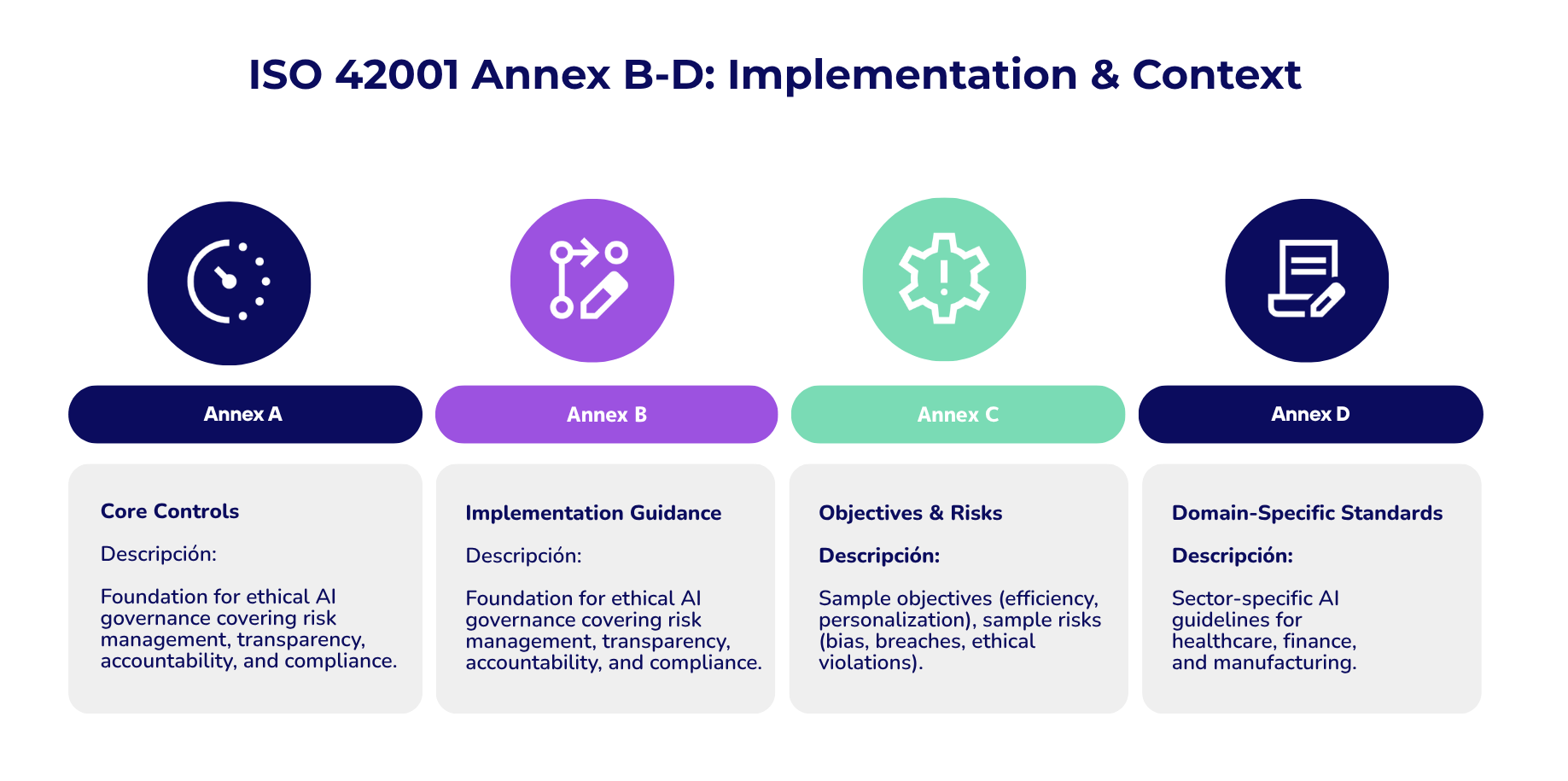
Image Source: NovelVista
“ISO 42001 governs AI systems, addressing risks like bias, lack of transparency, and unintended outcomes. It emphasizes ethical design, accountability, and alignment with organizational goals.” — Sprinto Security Team, ISO compliance and security standards experts at Sprinto
ISO 42001 Annex A groups its controls into distinct domains that are the foundations of a working AI Management System (AIMS). These controls differ from regular security frameworks. They focus on responsible AI development, deployment, and usage across the AI lifecycle.
AI Policy and Governance (A.2, A.3)
ISO 42001 starts with policy documentation and governance structures. Control A.2 requires organizations to create detailed AI policies that line up with business needs and guide AI systems strategically. These policies need to fit with existing organizational values. Regular reviews help them work as AI technologies change.
Control A.3 specifies clear roles and responsibilities for AI systems within the organization. This will give a clear oversight structure with qualified personnel in charge. A.3 also needs clear ways for both internal and external stakeholders to report concerns about how AI systems work and affect others. This helps build accountability.
AI Lifecycle Management and Impact Assessment (A.5, A.6)
Control A.5 creates a structured way to review what AI systems mean for people and societies. Organizations must spot, analyze, review, and handle effects throughout the AI system lifecycle. They need to document intended use, possible misuse, good and bad effects, and ways to handle predictable failures.
Control A.6 breaks down the AI system lifecycle into clear stages: development, deployment, operation, and monitoring. It needs verification and validation steps to make sure AI systems meet performance, safety, and reliability standards. Organizations must keep detailed records of system architecture, assumptions, limits, and monitoring procedures. These records help with compliance and ongoing improvements.
Data Management and Transparency (A.7, A.8)
Control A.7 deals with data quality and where it comes from in AI systems. Organizations must set data quality requirements and track data sources throughout the system’s lifecycle. This control needs documentation of how data is acquired, selected, and prepared. These steps are vital to prevent bias and errors while improving reliability and fairness.
Control A.8 focuses on sharing key information about AI systems with users and stakeholders. Organizations must decide what information to share, including system purpose, how to use it, technical limits, and monitoring abilities. They also need documented plans to tell users about incidents. This builds trust through openness.
Third-party and Stakeholder Communication (A.9, A.10)
Control A.9 needs processes to use AI systems responsibly. Deployments must meet ethical standards, legal requirements, and organizational policies. AI systems should work only for their intended purposes, with people watching over them to maintain accountability and transparency.
Control A.10 handles relationships with external parties. It needs clear responsibility sharing between the organization, partners, suppliers, customers, and third parties. Organizations must make sure supplier products and services match responsible AI approaches. They also need to understand and address what customers expect and need from AI systems.
These four control domains work together to create a detailed framework. They help manage AI’s unique challenges by focusing on governance, impact assessment, data quality, and involving stakeholders throughout the AI lifecycle.
ISO 42001 vs ISO 27001: Key Control Differences
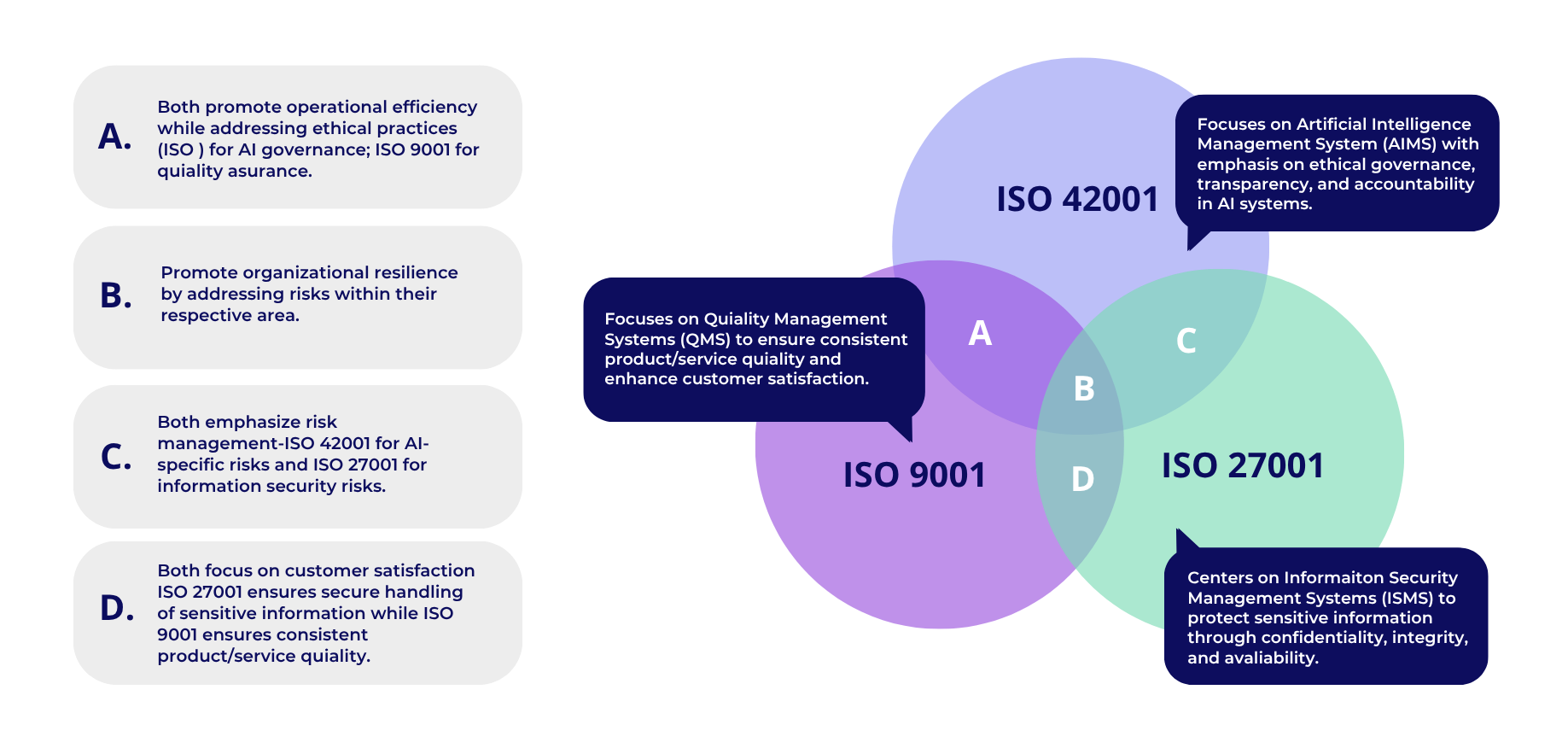
ISO 42001 and ISO 27001 look similar on the surface but are fundamentally different in how they handle controls and what they focus on. These differences shape how companies use each standard and decide if they need one or both.
Prescriptive vs Principle-Based Controls
ISO 27001 uses a prescriptive approach with 93 controls split into organizational, people, physical, and technological areas. These controls spell out exactly what you need for information security management. On the other hand, ISO 42001 takes a principle-driven path that zeros in on AI governance, transparency, and ethical use.
Every industry must follow the same ISO 27001 rules and put in place specific security measures. The way companies use ISO 42001 changes based on their AI applications and unique risks. You can see this clearly in their paperwork—ISO 27001 wants logs, firewall settings, and policy documents, while ISO 42001 needs risk logs, explainability reports, and design rationales.
Security vs Ethical Risk Mitigation
These standards tackle risks in very different ways. ISO 27001 deals with information security risks like unauthorized access, data breaches, and lost data. ISO 42001 focuses on AI-specific ethical risks such as bias, hidden processes, and possible harm from AI systems that work on their own.
The main goal of ISO 27001 is to stop breaches and data loss. It protects information through technical controls like encryption and access management. ISO 42001 wants to prevent harm, bias, and gaps in responsibility by focusing on ethical design, fairness, and human oversight. Both standards put risk assessment first—ISO 27001 looks at information security risks while ISO 42001 checks how AI affects people.
System-Level vs Decision-Level Oversight
The biggest difference lies in how they handle oversight. ISO 27001 controls systems by looking at “what’s running”—firewalls, encryption, and access management. ISO 42001 looks at “why it was designed that way” by checking the AI model’s transparency, explainability, and human oversight.
ISO 27001 protects the data security that makes AI reliable, while ISO 42001 makes sure AI systems work ethically and responsibly. Many organizations now use both standards because they work together well—ISO 27001 handles security risks while ISO 42001 takes care of AI-specific issues like bias, explainability, and model drift.
Overlap Between ISO 42001 and ISO 27001 Annex A
Organizations that implement both ISO 42001 and ISO 27001 gain advantages from their matching structures. Their compatibility helps build AI compliance strategies on top of current governance frameworks.
Shared Risk Management Methodologies
The frameworks use similar risk assessment methods that come from ISO 31000 principles. This common foundation lets organizations create risk management strategies that tackle information security and AI risks at the same time. The standards share about 40% of their controls. They support ethical AI use and security needs through combined risk assessment processes. Organizations can take a comprehensive look at how they spot, evaluate and lower their risks.
Common Documentation and Audit Trails
These standards have very similar documentation needs. Each one needs audit-proof records that share key features: they must show who owns them, contain current information, and link clearly to controls. Organizations can line up their ISO 42001 audit schedule with ISO 27001. This makes it possible to unite audits and maintain certifications more easily. The combined approach cuts down on duplicate paperwork while ensuring complete coverage of AI and security measures.
Governance and Accountability Structures
The standards follow Annex SL’s high-level structure and Plan-Do-Check-Act method. This shared design creates natural connection points for organizations that already use ISO 27001. Their governance frameworks set up similar systems—ISMS for information security and AIMS for artificial intelligence. This matching structure helps organizations build unified governance systems. These systems coordinate policies, processes, and controls in both information security and AI areas.
When to Use One or Both Standards
Your organization’s specific needs and risk profile should guide your choice between ISO standards. The systems you use and the risks you want to reduce will shape this decision.
Use Cases for ISO 27001: Data-Driven Systems
Organizations that handle sensitive information need ISO 27001 implementation. This framework helps businesses that process personal data, financial information, or intellectual property. Data classification, access control, and information security governance make ISO 27001 stand out. Technology companies, financial institutions, healthcare providers, and government agencies need ISO 27001 to build reliable information security foundations.
Use Cases for ISO 42001: AI-Driven Decision Making
Organizations that develop or deploy AI systems with autonomous decision-making capabilities need ISO 42001. This standard helps with unique AI challenges like hallucinations and prompt injection attacks. ISO 42001 proves valuable for AI agents that optimize workflows in accounting, compliance, and reporting functions.
Dual Implementation Scenarios: AI with Sensitive Data
Organizations running AI systems with sensitive information benefit from using both standards together. Healthcare, finance, and public sector AI systems need secure data handling from ISO 27001 and ethical, transparent AI use from ISO 42001. Organizations with ISO 27001 certification can achieve ISO 42001 compliance 40% faster than those starting fresh. Book a Readiness Call to learn which standard matches your organization’s requirements.
Conclusion
Organizations can make better decisions about their governance frameworks by understanding how ISO 42001 and ISO 27001 work together. These standards take different approaches. ISO 27001 secures information through prescriptive controls. ISO 42001 handles ethical AI governance with principle-based oversight.
The difference between these frameworks matters a lot when you evaluate your organization’s needs. Companies that handle sensitive data without AI systems will get more value from ISO 27001. Those developing AI solutions should focus on ISO 42001 certification. Many organizations work at the intersection and use AI to process sensitive information. These companies will benefit from implementing both standards at the same time.
These frameworks have key structural similarities despite their differences. They use similar risk assessment methods and documentation requirements. Both follow the Plan-Do-Check-Act cycle. Companies with existing ISO 27001 can achieve ISO 42001 compliance 40% faster because of this overlap.
We should see these standards as complementary tools that address different aspects of modern digital governance. ISO 27001 creates a secure foundation for responsible AI development. ISO 42001 will give a transparent and ethical operation of AI systems. Together, they offer a detailed approach to managing both information security and artificial intelligence risks.
Not sure which standard fits your organization’s needs? Book a Readiness Call today. You’ll get individual-specific guidance on your certification trip. This assessment helps determine if ISO 27001, ISO 42001, or both standards match your risk profile and business goals.
Key Takeaways
Understanding the differences between ISO 42001 and ISO 27001 helps organizations choose the right governance framework for their specific needs and risk profile.
• ISO 27001 uses 93 prescriptive controls for information security, while ISO 42001 employs principle-based controls for ethical AI governance and transparency
• Organizations with AI systems processing sensitive data benefit from implementing both standards, achieving 40% faster ISO 42001 compliance when ISO 27001 is already in place
• ISO 27001 focuses on “what’s running” (system-level security controls), whereas ISO 42001 governs “why it was designed that way” (AI decision-making transparency)
• Both standards share 40% control overlap and use similar risk management methodologies, enabling integrated governance structures and streamlined audit processes
• Choose ISO 27001 for data-driven systems handling sensitive information, ISO 42001 for AI-driven decision making, or both for AI systems processing confidential data
These complementary frameworks address different aspects of modern digital governance—ISO 27001 establishes secure foundations while ISO 42001 ensures responsible AI operations, creating comprehensive protection against both security and ethical risks.
FAQs
Q1. What are the key differences between ISO 42001 and ISO 27001? ISO 42001 focuses on AI governance and ethical use, using principle-based controls, while ISO 27001 addresses information security with prescriptive controls. ISO 42001 emphasizes AI-specific risks like bias and transparency, whereas ISO 27001 primarily targets data protection and security breaches.
Q2. Is ISO 42001 certification necessary if an organization already has ISO 27001? Not necessarily. The need for ISO 42001 depends on how an organization uses AI. If AI is central to decision-making processes or customer-facing operations, ISO 42001 may be beneficial. For internal AI use or enhancement of existing features, ISO 27001 with additional AI-specific controls might suffice.
Q3. How do the risk management approaches differ between ISO 42001 and ISO 27001? ISO 27001 focuses on information security risks like unauthorized access and data breaches. ISO 42001, however, addresses AI-specific ethical risks such as bias, lack of transparency, and potential harm from autonomous systems. Both use risk assessment methodologies, but with different focuses.
Q4. What are the overlapping areas between ISO 42001 and ISO 27001? Both standards share similar risk management methodologies, documentation requirements, and governance structures. They follow the Plan-Do-Check-Act cycle and have comparable audit trail requirements. This overlap allows for integrated governance structures and streamlined compliance processes.
Q5. When should an organization consider implementing both ISO 42001 and ISO 27001? Organizations should consider implementing both standards when they operate AI systems that process sensitive information. This is particularly relevant in sectors like healthcare, finance, and public services where both secure data handling and ethical AI use are crucial. Implementing both provides comprehensive protection against security and ethical risks.