
The market for AI governance tools is expanding quickly as organizations face mounting pressure to manage artificial intelligence responsibly. The regulatory backdrop is the main driver. In the European Union, the AI Act is binding, with fines of up to 35 million euros or 7 percent of global annual turnover for the most serious violations, while in the United States federal policy has shifted toward innovation, which paradoxically makes voluntary frameworks and certifiable standards more important for any organization that wants a defensible AI governance posture.
This guide walks through the AI governance software landscape: the principles these tools are built to support, the frameworks, standards, and regulations they help you satisfy, the leading platforms and what each does well, the organizational roles that make any of it work, and the maturity stages organizations move through on the way to automated governance.
Core Principles of Responsible AI Governance
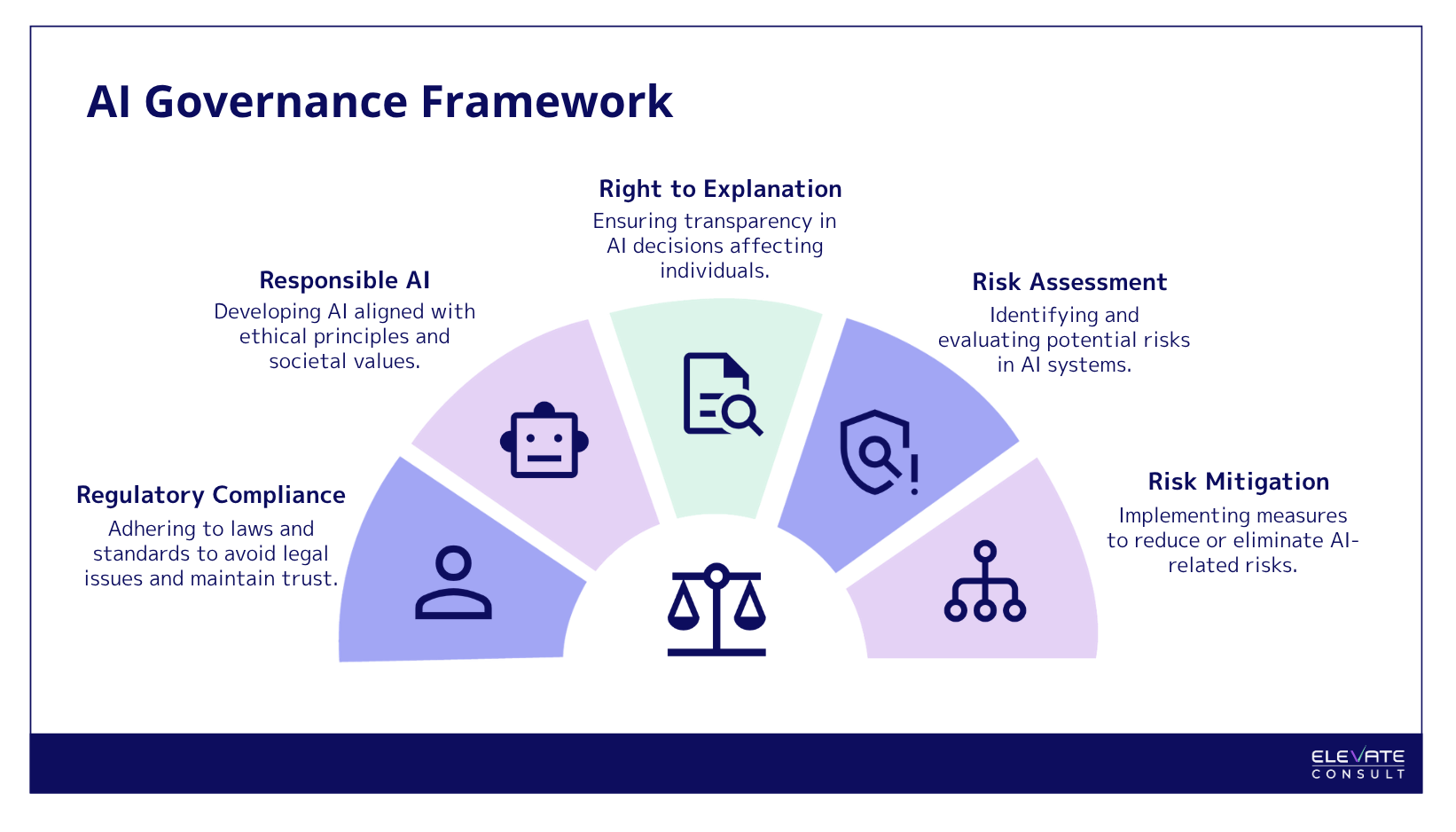
Effective AI governance rests on four foundational pillars: transparency, accountability, security, and ethics. These principles keep AI systems understandable, owned, protected, and fair across their lifecycle, and every credible governance program maps back to them.
Transparency: model cards and explainability
Stakeholders need visibility into how an AI system works. Model cards have become the standard way to document a model, much like a nutrition label, capturing its architecture, training-data sources, performance, and intended use. Trust depends on accurate predictions, traceable processes, and enough human-readable explanation that practitioners can spot bias or justify a decision.
Accountability: role-based ownership
An AI system cannot face consequences, so the organization must define who is responsible when something goes wrong. A 1979 IBM training document made the point that endures today: a computer can never be held accountable, therefore a computer must never make a management decision. In practice, leading organizations run cross-functional governance committees, often led jointly by the CIO, CISO, and legal, that approve high-risk cases and assign oversight, splitting accountability between the teams that use AI and the teams that build and maintain it.
Security: data protection and model integrity
A reliable AI system needs protection from both deliberate and accidental interference, covering data sources, algorithms, and stored information. Practical steps include anonymizing and encrypting sensitive data, granting AI systems only the access they need, signing sensor and input data cryptographically, and verifying regularly that a system has not been compromised and still serves its intended purpose.
Ethics: bias mitigation and fairness audits
Ethical AI starts with addressing bias, which can enter through training data, algorithm design, or poor sampling. Mitigations include representative training data, fairness checks built into development, techniques such as re-sampling and re-weighting, and diverse teams. Regular fairness audits have become a primary way to surface and reduce risk, and in fields like hiring, lending, and healthcare, explainability is increasingly a legal expectation rather than a nicety. Teams should keep detailed records of fairness tests and remediation as governance evidence.
Frameworks, Standards, and Regulations
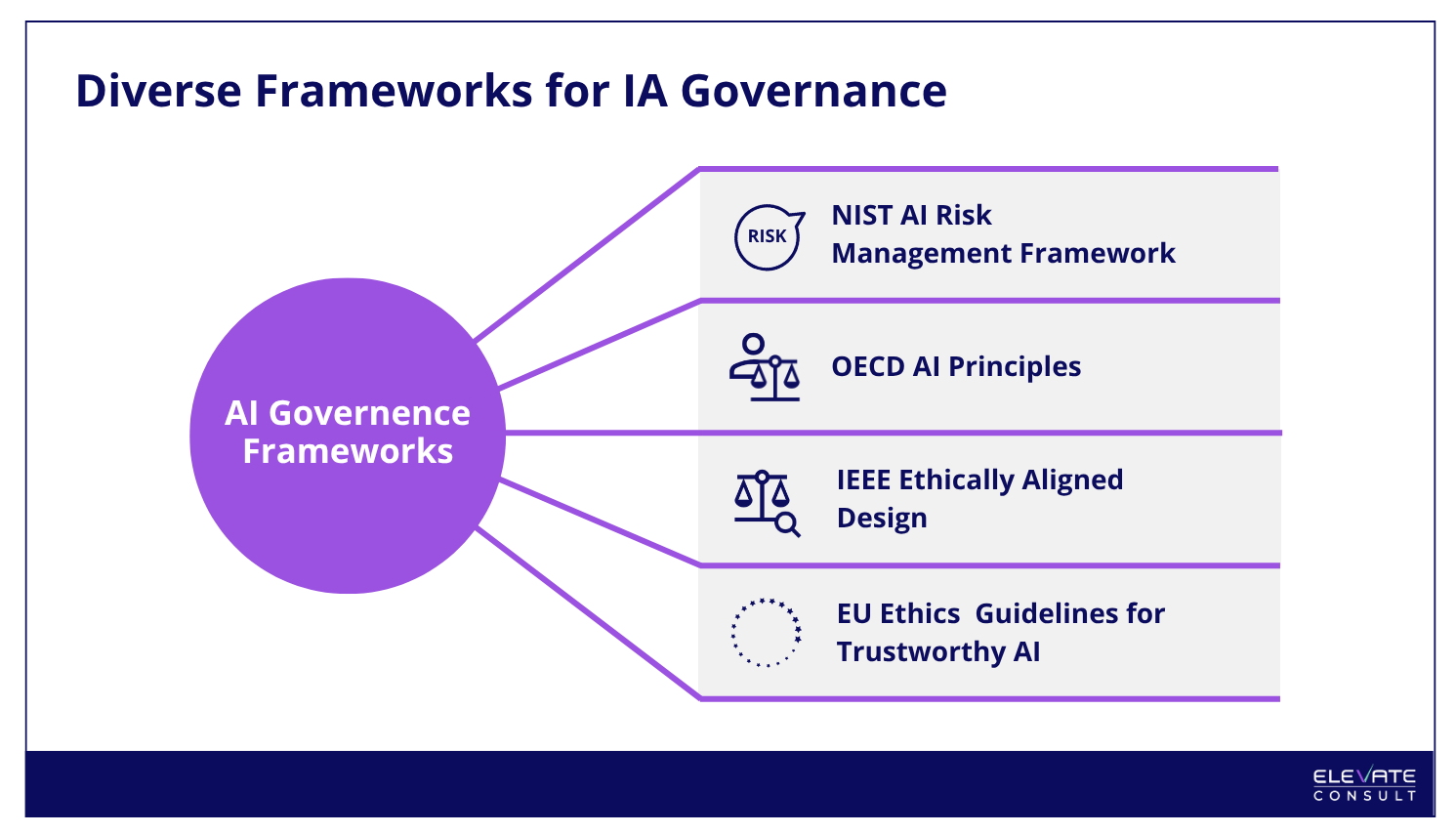
One common source of confusion is treating every governance reference point as a “framework.” They are not the same kind of instrument, and the difference matters for how you use them. The three most important are a voluntary framework, a certifiable standard, and a binding regulation. If you are weighing which to anchor on, it helps to see how the major options compare directly.
NIST AI Risk Management Framework (a voluntary framework)
The NIST AI Risk Management Framework is a voluntary framework, launched in January 2023, that helps organizations identify, assess, and reduce AI risk across the lifecycle through four functions: Govern, Map, Measure, and Manage. NIST added a Generative AI Profile in July 2024 to address risks specific to generative AI. The framework is being revised under current US policy, but its core structure remains the most widely used voluntary baseline, and any organization of any size can adapt it to its own risk profile.
ISO/IEC 42001 (a certifiable standard)
ISO/IEC 42001:2023 is the first international standard for AI management systems, and unlike a framework it can be independently certified. Built on the Plan-Do-Check-Act method, it requires AI risk management processes, AI system impact assessments, lifecycle management, third-party supplier oversight, and continuous improvement. Certification lets an organization signal its commitment to responsible AI to customers and regulators; Microsoft, for example, has pursued ISO/IEC 42001 certification for Microsoft 365 Copilot. For SaaS providers selling into the enterprise, ISO 42001 and the EU AI Act are quickly becoming a procurement gate.
EU AI Act (a binding regulation)
The EU AI Act is the world’s first comprehensive AI law, and unlike the voluntary instruments above it imposes binding obligations based on a risk classification:
- Unacceptable risk (prohibited practices): banned outright, including social scoring and subliminal manipulation.
- High risk: subject to strict requirements covering conformity assessment, risk management, data governance, transparency, and human oversight.
- Limited risk: specific transparency obligations, such as telling users they are interacting with AI.
- Minimal risk: no specific restrictions beyond existing law.
Violations of the prohibited-practice rules can draw fines of up to 35 million euros or 7 percent of global annual turnover. The Act applies in phases: prohibited practices took effect in early 2025 and obligations for general-purpose AI models in August 2025. The high-risk timeline is currently in flux. Under the EU’s Digital Omnibus package, EU institutions reached a provisional political agreement in May 2026 to defer high-risk obligations, moving Annex III use cases such as biometrics, critical infrastructure, education, and employment to December 2, 2027, and AI embedded in regulated products to August 2, 2028.
Treat the new dates as provisional. The Digital Omnibus reschedule is a political agreement, not yet settled law. It takes legal effect only on formal adoption and publication in the EU’s Official Journal, and if it is not adopted before August 2, 2026, the original high-risk deadline of August 2, 2026 still applies. Organizations planning EU activity should keep preparing against the original deadline and track formal adoption closely.
Enterprise AI Governance Tools and Their Capabilities
As the number of models grows, organizations need better ways to oversee them, and the leading platforms have specialized around distinct governance challenges. The table below compares the major options across the dimensions that matter most when selecting one, followed by a closer look at each. Note that capability claims here reflect each vendor’s stated focus, not an independent benchmark.
| Platform | Primary focus | Best for | What it monitors |
|---|---|---|---|
| Reco | Live oversight of AI in SaaS environments | Sprawling SaaS stacks and shadow AI | AI tool discovery, permissions, data-access patterns |
| Credo AI | Policy intelligence and generative-AI guardrails | Teams translating regulation into controls | Use-case registry, policy alignment, audit documentation |
| Holistic AI | Risk reduction and inventory control | Organizations scaling AI that need a full catalog | Inventory, inherent-risk classification, AI red teaming |
| DataRobot | Lifecycle governance for predictive models | Data science teams managing many models | Access control, deployment validation, model history, fairness |
| Monitaur | Centralized governance for regulated sectors | Insurance, finance, and regulated industries | Policy-to-proof record-keeping and audit evidence |
| Arthur AI | Drift detection and fairness monitoring | LLM, tabular, CV, and NLP models in production | Data drift, performance degradation, fairness across groups |
Reco focuses on visibility into AI usage across SaaS environments, detecting every AI tool, agent, and connection in the stack and monitoring permissions and data-access patterns, which matters because so many AI tools run without oversight and employee prompts sometimes carry sensitive data. Credo AI positions itself as an operating system for trustworthy AI, with generative-AI guardrails, a use-case registry, and a policy engine that turns legal and ethical requirements into operational controls and audit documentation. Holistic AI centers on end-to-end inventory and risk assessment, classifying use cases by inherent risk, flagging critical systems, and stress-testing through AI red teaming, which pairs well with governance that is tailored to your model portfolio.
DataRobot offers lifecycle governance for predictive models, with role-based access, deployment validation, model-history tracking, and fairness monitoring. Monitaur is built for regulated industries, working as a system of record with a policy-to-proof roadmap, which is especially relevant for AI governance in banking and finance. Arthur AI specializes in monitoring production models for data drift and fairness, comparing accuracy across groups using metrics like true positive rate, false positive rate, and demographic parity.
Not sure which platform fits your environment?
Tool selection is rarely a tooling decision alone. Elevate maps your AI inventory, regulatory exposure, and maturity, then recommends the platform mix that actually fits, aligned to the NIST AI RMF, ISO 42001, and the EU AI Act.
Organizational Roles in AI Governance
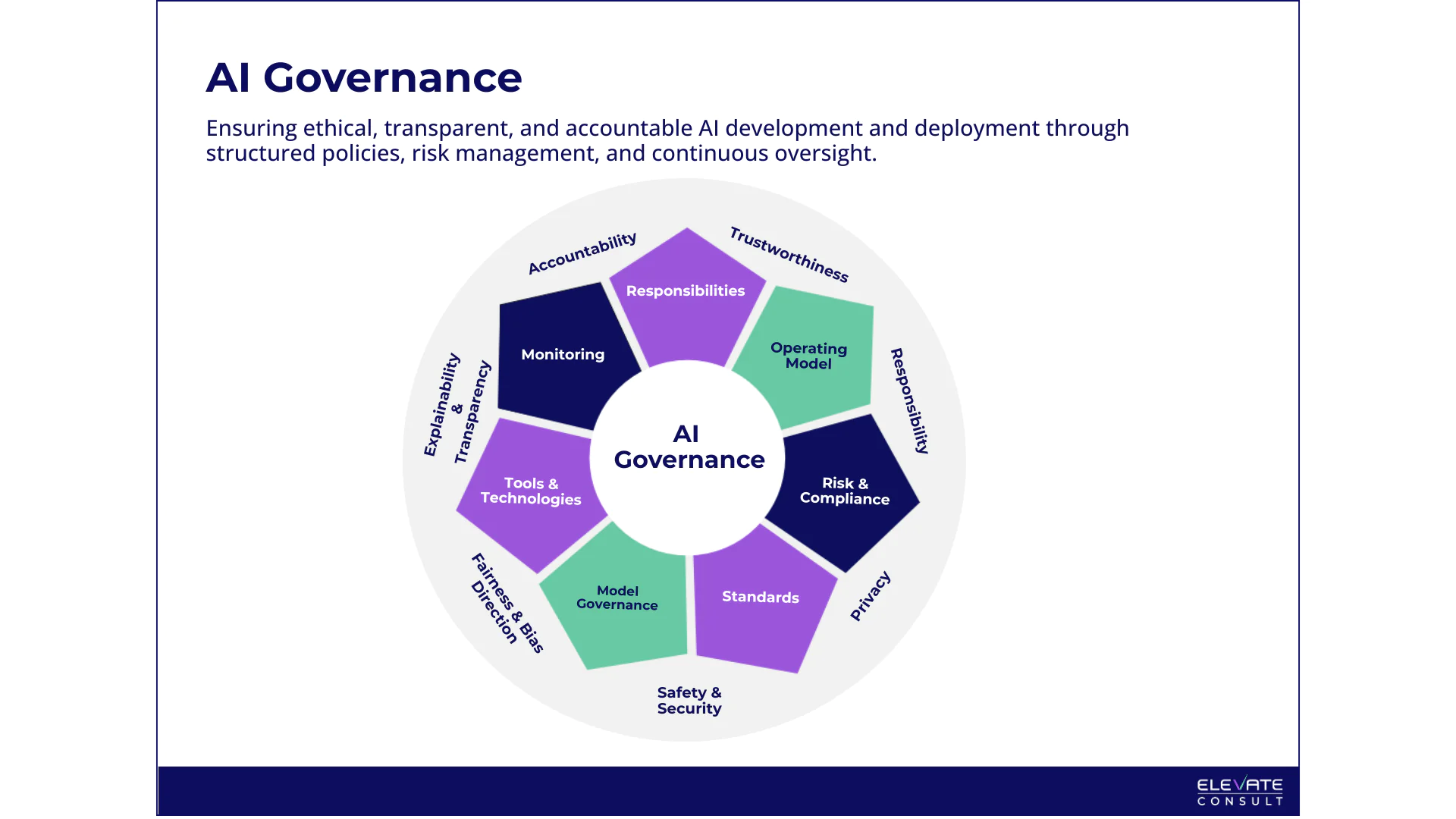
Even the best tools cannot close oversight gaps without clear ownership, and the work spans several leaders.
CISO: AI security and threat modeling
Chief Information Security Officers lead on the threats that target AI itself, monitoring for AI-specific cyber risks such as data poisoning, model evasion, inference attacks, and model extraction, building threat models tailored to AI attack vectors, and embedding security across the lifecycle before deployment. As generative AI expands the attack surface, CISOs increasingly work hand in hand with data science teams rather than reviewing systems after the fact.
Chief Compliance Officer: regulatory alignment
Chief Compliance Officers translate complex AI regulation, the EU AI Act’s risk tiers and evolving US federal policy, into practical governance, and they map where AI influences decisions and where its limits could create bias, liability, or reputational harm. Their cross-departmental visibility makes them well placed to build centralized frameworks covering ethics, privacy, regulatory requirements, and model transparency.
CTO and CDO: data quality and infrastructure
Chief Data and Technology Officers build the foundation that responsible AI depends on, setting data strategy and overseeing governance, quality, analytics, and security. Working with the CISO, they create the protocols that protect sensitive information while still enabling insight, and the CDO role has expanded from data stewardship into strategic leadership as data quality has become central to AI outcomes.
Cross-functional collaboration
Because legal, security, and privacy concerns are interconnected, governance works best as a unified effort. Successful programs run cross-functional committees with clear ownership, embed mandatory legal, privacy, and security approvals into the development lifecycle rather than bolting them on at the end, define lifecycle-based risk owners, and set escalation paths for when risk crosses domains.
AI Governance Maturity Model and Implementation Roadmap
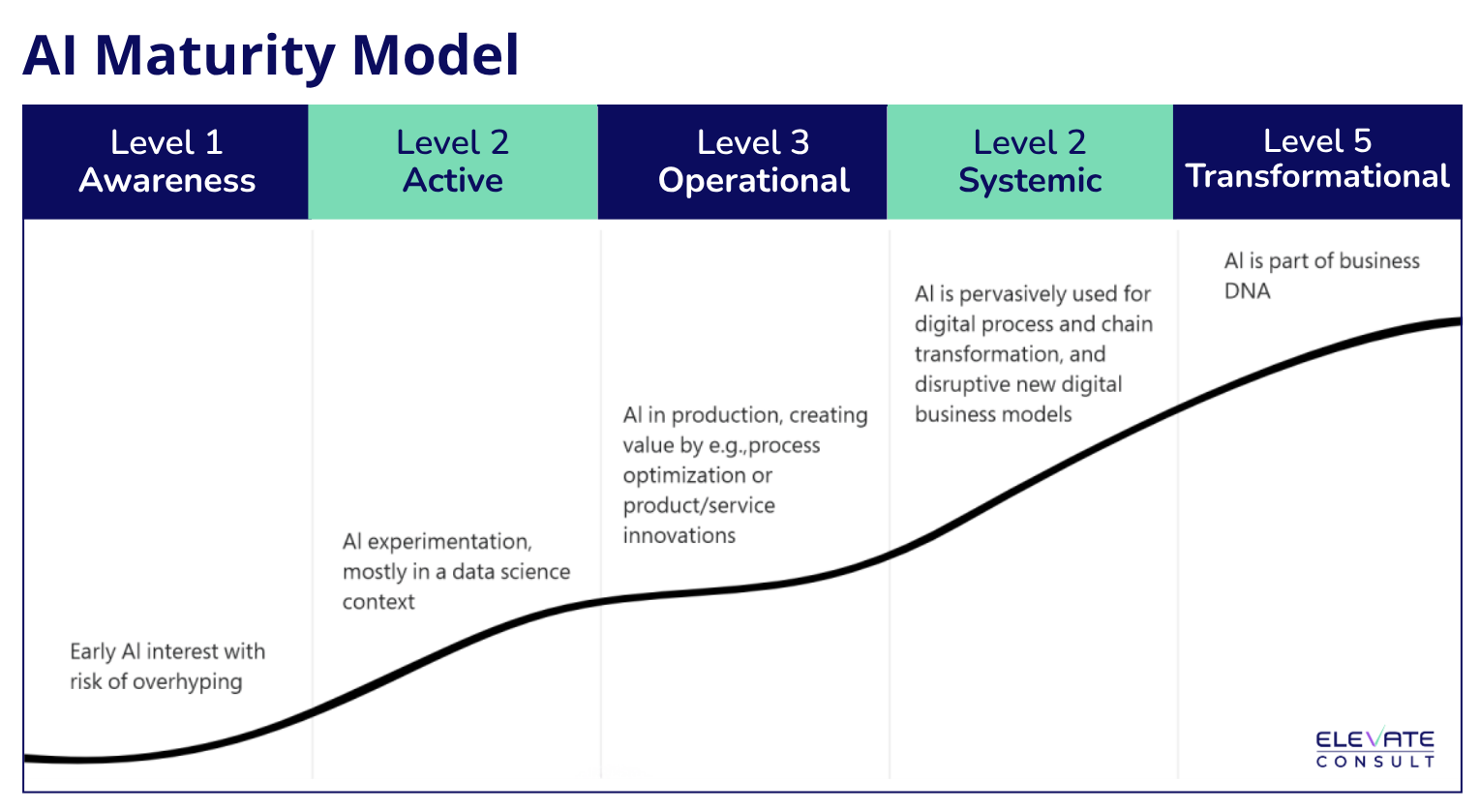
Organizations tend to move through distinct stages, and knowing where you sit makes the roadmap realistic.
Stage 1: ad hoc governance and inventory
Most organizations start with informal, reactive governance and a single priority: building an inventory, because you cannot govern what you cannot see. A useful inventory captures what each system does and where it runs, the data it processes and its sensitivity, its risk profile across bias, security, and regulatory exposure, and its owner. This is the same discipline Elevate applies when scoping AI assets, and it is also where AI literacy for the board and management begins.
Stage 2: structured policies and approval workflows
As programs mature, they formalize: ethics committees, written policies, risk-assessment templates, model-validation procedures, and AI-specific incident response. Cross-functional implementation teams, including legal, privacy engineers, ML engineers, and product managers, keep policies aligned with both business needs and technical reality, with mandatory review thresholds and clear escalation paths.
Stage 3: automated monitoring and policy-as-code
The most advanced organizations move governance from static documentation into operational infrastructure. Policy-as-code enforces rules automatically at decision points such as data ingestion and deployment, blocking actions that reference outdated model versions rather than hoping teams follow updated guidelines. At this stage governance stops being a deployment blocker and becomes a speed advantage, because risk is managed continuously instead of discovered late.
Common Pitfalls and How to Avoid Them
Many well-intentioned governance efforts fail for predictable reasons.
Over-trusting explainability metrics. Methods like SHAP and LIME are accessible but assume feature independence, which rarely holds in practice, so important variables can receive artificially low importance scores and different models can produce different explanations for the same data. Treat these scores as directional signals, not ground truth.
Treating fairness as a single number. Mathematical fairness metrics are useful but often conflict with one another, so they cannot all be optimized at once. Fairness questions need human deliberation and a broader view than discrimination prevention alone.
Letting governance go stale. AI systems drift as they are retrained, repurposed, and fed new data, so a one-time questionnaire or sign-off goes obsolete fast. Governance has to be reviewed whenever changes affect data usage, or it becomes a document that exists on paper but no longer reflects the system.
How Elevate Can Help
Choosing and implementing the right AI governance approach is rarely a tooling decision alone. It depends on your regulatory exposure, your industry, your existing roles, and where you sit on the maturity curve. Elevate Consult helps organizations assess that full picture: mapping the AI inventory, defining cross-functional ownership, selecting the platform mix that fits the environment, and aligning the whole program to the NIST AI RMF, ISO/IEC 42001, and the EU AI Act. It is the same case Elevate makes to executives in its C-suite brief on compliance and trust: done well, governance becomes a competitive advantage rather than a compliance burden.
See where your governance program stands
Elevate will assess your AI governance maturity, map it against NIST, ISO 42001, and the EU AI Act, and show you what it takes to turn responsible AI into a competitive edge.
Conclusion
The AI governance tools market is growing because the pressure to manage AI responsibly is real and rising. Success still comes back to the four pillars, transparency, accountability, security, and ethics, and to using the right instrument for the right purpose: the NIST AI RMF as a voluntary framework, ISO/IEC 42001 as a certifiable standard, and the EU AI Act as binding regulation. With US federal policy favoring innovation over prescriptive rules, the voluntary and certifiable instruments carry more weight than ever for organizations that want a defensible posture.
Platforms like Reco, Credo AI, Holistic AI, DataRobot, Monitaur, and Arthur AI each solve a different slice of the problem, but tools alone do not govern. Clear roles across security, compliance, and data leadership, a cross-functional committee, and a realistic path from inventory to policy-as-code are what turn governance from a deployment blocker into a strategic advantage. The organizations that master this will treat responsible AI as differentiation, not paperwork.
Key Takeaways
AI governance is now a board-level discipline, and tools only deliver value inside a clear framework of principles, roles, and process.
- Four pillars anchor everything. Transparency through model cards, accountability through role-based ownership, security through data protection, and ethics through bias mitigation and fairness audits.
- Know what kind of instrument you are using. The NIST AI RMF is a voluntary framework, ISO/IEC 42001 is a certifiable standard, and the EU AI Act is a binding regulation with fines up to 35 million euros or 7 percent of turnover.
- The EU high-risk timeline is provisional. A May 2026 political agreement would defer high-risk obligations to December 2027 and August 2028, but it is not law until published, and the original August 2026 deadline still applies if it is not adopted in time.
- Match the platform to the problem. Reco for SaaS oversight, Credo AI for policy intelligence, Holistic AI for inventory and risk, DataRobot for predictive-model lifecycle, Monitaur for regulated sectors, and Arthur AI for drift and fairness.
- Avoid the classic pitfalls. Do not over-trust SHAP and LIME, do not reduce fairness to a single metric, and do not let governance go stale as models evolve.
Tools plus clear roles plus a realistic maturity roadmap are what turn responsible AI into a competitive advantage.
FAQs
Q1. What are the core principles of responsible AI governance?
The four foundational pillars are transparency through model cards and explainability, accountability through role-based ownership, security through data protection and model integrity, and ethics through bias mitigation and fairness audits.
Q2. What is the difference between the NIST AI RMF, ISO 42001, and the EU AI Act?
They are different kinds of instruments. The NIST AI Risk Management Framework is a voluntary framework for managing AI risk, ISO/IEC 42001 is an international standard for AI management systems that can be independently certified, and the EU AI Act is a binding law that imposes obligations based on risk classification.
Q3. What are some leading AI governance tools for enterprises?
Widely used platforms include Reco for SaaS AI oversight, Credo AI for policy intelligence and guardrails, Holistic AI for inventory and risk control, DataRobot for lifecycle governance of predictive models, Monitaur for regulated sectors, and Arthur AI for drift detection and fairness monitoring. The right choice depends on your environment and regulatory exposure.
Q4. What are common pitfalls in AI governance implementation?
The most common are over-relying on explainability metrics like SHAP and LIME, reducing fairness to a single mathematical metric, and failing to update governance as models are retrained and repurposed. Each is best addressed proactively rather than discovered in an audit.
Q5. How does AI governance benefit organizations?
Mature AI governance reduces incidents, supports faster and more confident deployment, helps demonstrate regulatory compliance, and builds stakeholder trust. Treated well, it becomes a competitive advantage rather than a compliance exercise.