
Organizations face mounting pressure to implement AI governance frameworks as AI adoption grows rapidly. Recent data shows that 78% of organizations use AI in at least one business function. The numbers tell an interesting story – 96% of companies using AI struggle to govern these systems effectively.
The biggest problem lies in execution. A stark 42% gap exists between expected and actual AI production success. Most failures stem from governance issues that keep AI models stuck in experimental phases instead of becoming reliable business tools. The market recognizes this challenge, with projected spending on AI governance software reaching $15.8 billion by 2030. This reflects both regulatory pressures and the need for responsible AI practices.
AI adoption continues to accelerate, with two-thirds of companies now using AI systems. Yet proper governance remains a challenge for most. The stakes are high – 80% of digital organizations will fail because they don’t modernize their data governance approach. Companies need to create working AI governance frameworks that align with key regulations like the EU AI Act and market standards such as the NIST AI RMF and ISO 42001.
This piece guides you through essential steps: evaluating your AI portfolio, creating a custom governance strategy, defining team roles, and setting up efficient workflows. A well-designed AI governance framework helps manage risks and taps into the full potential of your AI investments.
Assessing Your Current AI Portfolio and Governance Gaps
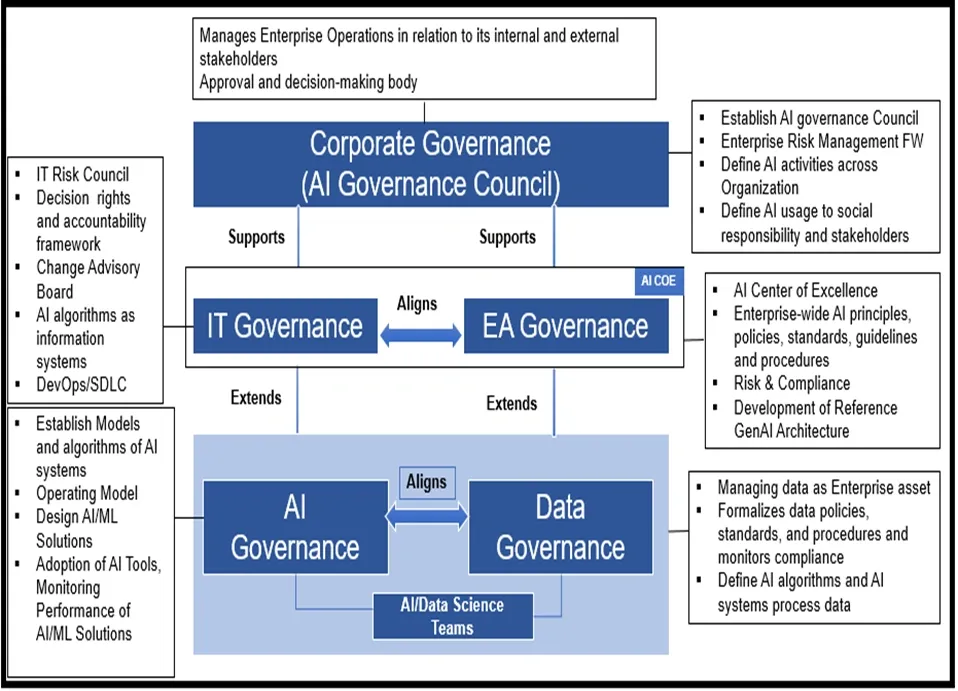
Image Source: Medium
“Organizations must be aware of the boundaries that their AI models operate within and systematically identify the strengths and weaknesses of their models.” — Colin Priest, Chief Evangelist at FeatureByte
You need to understand your current AI landscape to start any AI governance initiative that works. The first big step is to map out all the AI tools in your organization before you try to govern them. Let’s get into how to do this assessment step by step.
Shadow AI discovery and model inventory creation
Shadow AI—when employees use AI tools without IT approval—creates substantial risks for organizations. Research shows 69% of organizations either suspect or have proof that their employees use prohibited public generative AI tools. This unauthorized use leads to major vulnerabilities, from data leaks to compliance issues.
Shadow AI grows quietly. It often hides in browsers, personal accounts, or specialized workflow apps that bypass normal approval channels. Small companies with just 11-50 employees face even greater risks, with 27% of their staff using AI apps without approval. By 2030, more than 40% of enterprises will likely face security or compliance incidents that directly link to unauthorized shadow AI.
Organizations need detailed Shadow AI discovery solutions to find:
- Embedded AI inside approved SaaS applications
- Standalone AI tools and generative AI platforms
- Browser-based AI tools and extensions
- OAuth integrations and SaaS-to-SaaS AI connections
- AI agents and automated workflows
A centralized AI model inventory becomes vital after you spot shadow AI usage. This inventory should be an auditable, single source of truth that tracks all AI assets continuously—from machine learning to generative AI, internal systems, and third-party vendors. On top of that, it needs to be purpose-built and go beyond traditional model registries to include risk classification, regulatory readiness, lifecycle accountability, and compliance workflows.
Evaluating existing governance maturity
The next step after creating your AI inventory is to check your governance maturity. AI Governance Maturity Models help measure how well your organization follows best practices and regulations.
These assessments look at multiple areas—Strategy & Vision, People & Expertise, Processes & Analytics, Ethics & Oversight, and Culture & Collaboration—across different maturity stages. Most organizations start at a reactive stage and handle AI governance as needed. They then move to proactive measures before reaching a transformative stage where AI governance merges with strategic business goals.
Organizations with mature governance show more confidence. When boards fully understand AI’s security implications, 55% have detailed governance policies. About 48% of organizations with mature policies feel confident about protecting their AI systems. This number drops to 23% for those with partial guidelines and 16% for those still developing governance.
Identifying compliance blind spots
Many organizations don’t realize the full extent of AI-related risks, even as AI adoption grows. A survey revealed that while all executives know AI creates some risk, only 4% call these risks “significant,” and 52% see them as just “somewhat significant”. This gap in perception creates dangerous blind spots.
False negatives in AI-powered compliance systems are especially worrying. These silent failures can expose companies to regulatory penalties, damage their reputation, and even lead to criminal charges. The complex regulatory landscape makes things harder, particularly for companies that need to follow multiple requirements like the EU AI Act and GDPR.
Companies should map their AI risks to deal with these blind spots. This means listing every data source, processing step, and output. Each use case needs a score based on data sensitivity, privacy impact, and how critical it is to operations. A regulatory risk management playbook will also ensure full documentation of every AI lifecycle stage.
Getting a full picture of your AI portfolio and governance gaps first helps you build a governance framework that manages risks and supports innovation effectively.
Designing a Tailored AI Governance Strategy
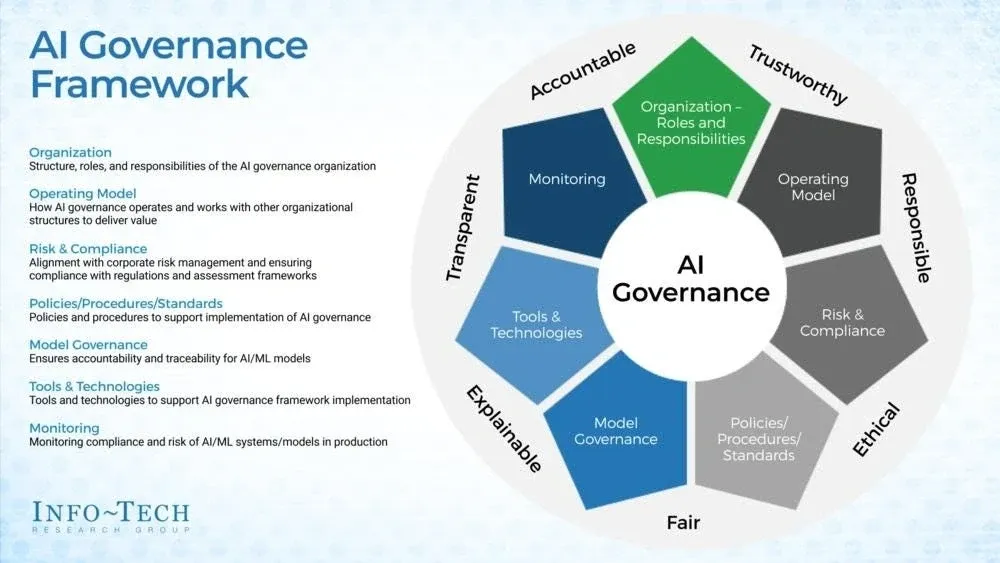
Image Source: KumoHQ
Your organization needs an AI governance framework that matches its unique AI ecosystem after completing inventory and assessment. Successful governance strategies adapt to different risk profiles and model types rather than using a one-size-fits-all approach.
Mapping AI use cases to governance tiers
Risk-based tiers form the basis of effective AI governance by categorizing AI applications. Organizations should establish a three-tier classification system as their foundation for oversight levels and control density, following industry best practices:
- Tier 1 (High-Risk): Systems that affect rights, safety, financial statements, or regulated decisions such as credit, hiring, medical diagnoses, or safety applications
- Tier 2 (Medium-Risk): Applications that affect pricing, marketing allocation, or internal efficiency with limited rights impact
- Tier 3 (Low-Risk): Experimental tools or systems with reliable human oversight
This tiering approach lets you apply proportional governance with rigorous controls for high-risk applications while avoiding unnecessary burden on lower-risk state-of-the-art solutions. Your AI system categorization should include factors like decision effect (advisory vs. automated), jurisdiction, training data sources, and whether the model processes personally identifiable information.
The ‘Map’ and ‘Govern’ functions of frameworks like the NIST AI Risk Management Framework help establish contextual analysis of data sources, system boundaries, and ethical implications during early AI adoption.
Creating a governance playbook by model type
A governance playbook outlining specific controls and procedures for each model type becomes essential once you categorize AI use cases. This playbook should turn high-level principles into testable controls that arrange with frameworks like NIST AI RMF, ISO 42001, and SR 11-7.
Your playbook should address the entire AI lifecycle through distinct control families:
Data controls come first, covering lineage, quality thresholds, and privacy safeguards. Design controls follow with risk assessments and fairness metrics. Development controls focus on reproducible pipelines and code reviews. Validation controls ensure independent testing and fairness evaluations. Deployment controls establish approval workflows and kill switches. Monitoring controls complete the cycle with drift detection and audit logging.
The strongest results come from organizations that make governance part of their DNA from day one. They treat AI risk management as a foundation rather than compliance checkboxes. Research shows that ROI becomes impossible without establishing governance at the start.
Arranging with enterprise AI governance goals
Your broader corporate governance structure must integrate AI governance. Technology capabilities, business objectives, and governance requirements work best when connected.
A Responsible AI Committee chaired by your Chief Data and Analytics Officer should lead the initiative, with risk, security, privacy, and legal leadership representation. A RACI matrix helps define clear roles and responsibilities by identifying who owns model validation and audit.
Measurable outcomes in areas of business impact must support the framework. The program needs executive endorsement, quantifiable targets like reduced processing time, and identification of departments where AI adds value.
AI governance builds guardrails for smart, sustainable speed that alleviates catastrophic risk, builds investor confidence, and embeds ethical principles into every decision – it’s not about creating bureaucratic red tape. A system that protects your organization and enables innovation emerges when you tailor your AI governance framework to your specific model portfolio.
Establishing Governance Roles and Approval Workflows
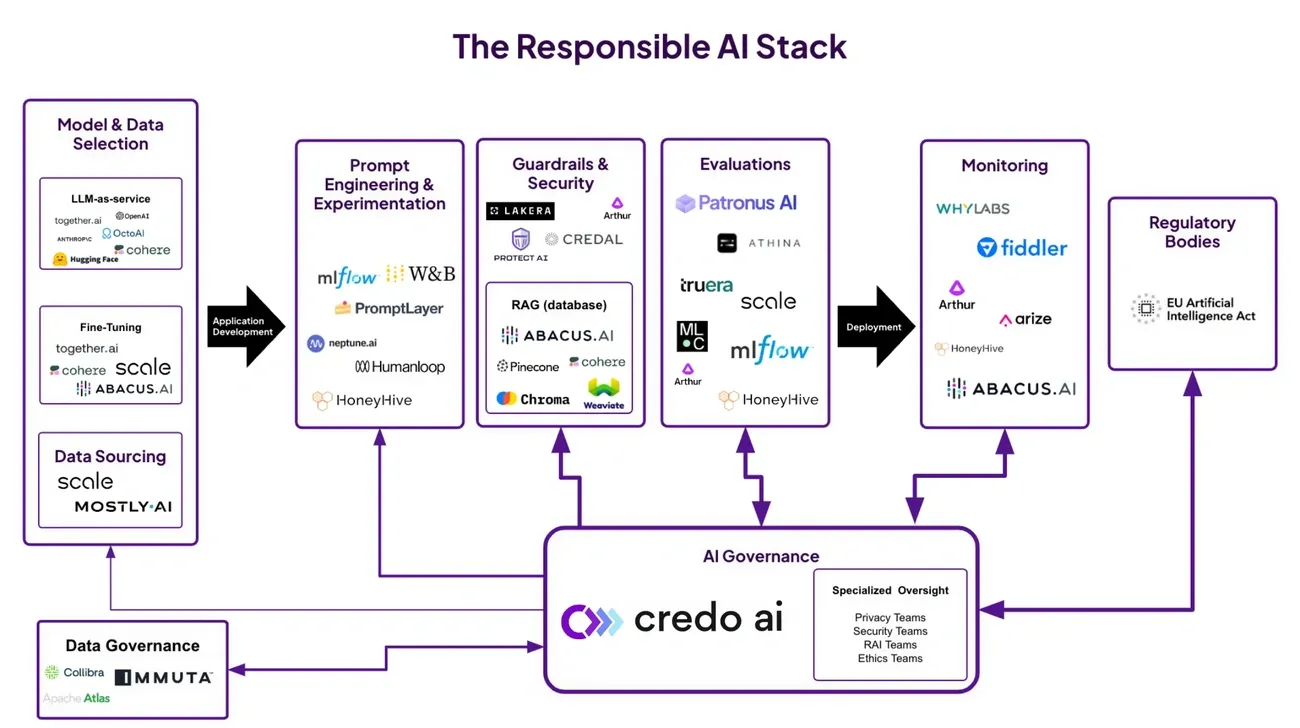
Image Source: Credo AI
Organizations that implement ai governance frameworks need well-defined roles and structured processes to oversee AI development and deployment. Research demonstrates that companies with effective cross-functional AI governance teams deploy AI 40% faster and face 60% fewer post-deployment compliance issues compared to those using siloed approaches.
Cross-functional team structure for AI oversight
Technical teams alone cannot handle AI governance effectively. A multi-tiered governance architecture creates accountability across different organizational levels. The structure needs an Executive Committee with the CEO, CTO, General Counsel, and Chief Risk Officer to provide strategic direction and make high-risk decisions. Below this level, an Operational Committee consisting of AI product managers, data science leads, legal counsel, and ethics officers manages policy development and operational oversight.
Projects built through hand-offs create a major challenge because no one owns the final outcome. Organizations should build shared ownership where teams see their roles as part of a collective mission. Legal counsel’s participation in early model scoping and policy development reduces rework and speeds up timelines.
MLOps administrators provide governance oversight during daily operations. These administrators monitor deployments that make prediction requests, ensure quality performance, and report on activity. System administrators should assign this role and grant appropriate permissions for existing and new deployments.
Approval workflows for model deployment and updates
Structured approval workflows act as vital checkpoints in the AI lifecycle. MLOps administrators must review and approve any new deployments or changes through a Model Deployment Approval Workflow. These administrators get email alerts about deployments needing review, and deployments stay marked as “NEEDS APPROVAL” in the deployment inventory until verification completes.
The approval process follows these steps:
- Deployment creator includes comments detailing reasons for creation or change
- Creator indicates whether changes should apply automatically or manually after approval
- Administrator reviews the deployment and its importance level
- Administrator either approves or requests updates with optional comments
- Upon approval, the system removes the “NEEDS APPROVAL” flag
Approval policies determine who can review deployments and what automated actions occur when reviews timeout. The system prevents self-approval loops – creating and approving a deployment from the same account is not allowed.
Escalation protocols for governance violations
AI governance violations may occur despite resilient workflows, so clear escalation pathways become necessary. AI governance needs predefined escalation routes that trigger human intervention, policy overrides, and legal reviews. These protocols work as circuit breakers to determine how and when model decisions face review, reversal, or override.
Risk levels should determine the AI escalation framework since each AI failure needs a different response. To name just one example, an ad-ranking model glitch needs different handling than a biometric denial at a border checkpoint. Escalation thresholds must match the system’s risk classification under relevant regulations.
Automated and auditable escalation triggers through predefined indicators like confidence score anomalies, repeated user complaints, or performance metric drift. Decisions route to appropriate stakeholders—compliance officers, legal counsel, human supervisors, or external regulators as needed.
Organizations create accountability mechanisms by establishing detailed governance roles and structured approval workflows. This ensures AI systems operate within established guidelines while maintaining flexibility for state-of-the-art development.
Deploying Governance Frameworks with ModelOps Principles
Organizations need a systematic way to turn AI governance policies into real-world practices. ModelOps goes beyond DevOps and MLOps to build governance into AI workflows while keeping innovation alive.
90-day ModelOps implementation roadmap
A well-laid-out timeline helps balance quick results with long-term oversight. Companies with 10-50 AI models and a reliable MLOps setup can follow this approach:
Days 1-30: Foundation Establishment Complete your AI model inventory and find shadow AI. Build your cross-functional governance team with clear roles. Pick your technology platform. This first phase creates the base that supports future steps.
Days 31-60: Core Platform Deployment Set up your chosen AI governance platform. Start automated model monitoring for your most critical AI models. Create approval workflows to manage model lifecycles. This middle phase turns theory into practice.
Days 61-90: Process Integration Set up automated compliance reports and audit trails. Train data scientists and business teams on governance processes. Add monitoring for more models based on risk levels. This final phase makes governance last.
Automating compliance reporting and audit trails
Old compliance methods like periodic audits and manual reviews can’t keep up with modern AI development. They slow down progress and cost more. Automated compliance reports cut manual audit time by 98%. What used to take weeks now takes 30 minutes.
Good AI audit trails must track:
- Model versions and parameters used for each decision
- Data sources and transformations
- User overrides and human-in-the-loop interactions
- Confidence scores and output rankings
Teams should keep audit data in searchable repositories with taggable storage. This makes evidence available within hours instead of weeks. Your governance solution should also route AI-related events to custom storage with longer retention periods. This creates reliable audit trails without changing your team’s tools.
Integrating governance into CI/CD pipelines
Continuous AI Governance builds oversight directly into development pipelines. This turns governance from a roadblock into an advantage. Unlike regular software where functional correctness comes first, AI systems need constant checks for ethical, legal, and social aspects during development.
Teams get instant feedback (green or red status) when governance checks run in CI/CD pipelines before code reaches production. These automated controls check datasets against privacy rules. They enforce model performance standards, look for bias and drift, and record governance results for audits. All these run with container builds and test jobs.
This setup helps manage risks, meet regulations, and streamline processes while building stakeholder trust—without slowing down your teams. Building safeguards into development pipelines helps companies create state-of-the-art solutions quickly while staying compliant, transparent, and accountable.
Managing Third-Party and Embedded AI Risks
“While it may not be comprehensive, it is extremely encouraging that this level of engagement is taking place – the power of AI and GenAI promises to revolutionize every business and business function. But this will only be achieved with the guardrails, governance, and trust frameworks in place.” — Michael Leach, Compliance Manager at Forcepoint
Third-party AI systems create governance challenges that go beyond your organization’s boundaries. Research shows that 92% of AI contracts claim data usage rights beyond what they need to deliver services. Your organization needs a well-laid-out approach to manage external AI risks.
Vendor risk assessments and contractual obligations
A good vendor assessment starts when you understand what your use case requires. You should conduct internal due diligence for AI vendors to map intended applications, data usage patterns, and best/worst-case scenarios. Different AI applications need different contractual protections. Marketing content creation focuses on intellectual property provisions. Resume review tools need bias protections. Customer data analysis requires privacy safeguards.
Key contractual elements should address:
- Input/output data ownership and usage rights
- Data security requirements and breach notification protocols
- Compliance with applicable regulations (especially for high-risk applications)
- Clear liability allocation and indemnification provisions
The Colorado AI Act, to cite an instance, requires deployers to use “reasonable care to protect consumers from algorithmic discrimination”. Contractual provisions should make developers represent that their AI systems don’t create unlawful bias. These representations should link to defense and indemnity provisions.
Monitoring generative AI APIs and SaaS integrations
Generative AI creates distinct security risks as businesses embed it in critical applications. Research reveals that 50% of enterprises have at least one shadow AI application running outside governance frameworks. Additionally, 90% of AI agents have too many permissions in SaaS environments.
Your team should identify all APIs in your applications that call generative AI systems. This applies to third-party providers like OpenAI and self-hosted systems. These connections need monitoring for sensitive data flows—both inbound and outbound. This helps prevent data leakage or compliance violations.
Centralizing third-party model governance
A unified governance approach for third-party AI starts with standardization. You should create a “third-party AI governance” process. This process requires AI-enabled vendors to complete: (1) questionnaires with supporting evidence, (2) contractual protections, (3) go-live assurance checks, and (4) ongoing attestations.
Your third-party AI governance reporting should fit into measurable categories on a single dashboard:
- Coverage metrics: percentage of AI vendors inventoried and risk-reviewed
- Control metrics: percentage with human-in-the-loop capabilities and exception rates
- Assurance metrics: percentage of strategic vendors with AI contract clauses
Successful governance should evolve beyond checklist approaches. A full picture of vendors combined with continuous monitoring creates transparency across your AI supply chain. This ensures risks stay visible and manageable as AI capabilities grow.
Future-Proofing Governance for Evolving AI Systems
Technology changes faster than ever, and AI governance must keep up with it. This often challenges the frameworks that are years old. AI governance now changes almost daily. Organizations that implement ai governance frameworks must be ready to adapt and change continuously.
Versioning and audit trails for model progress
AI governance needs detailed model versioning and audit trails to work well. Model versioning helps teams track changes, understand updates, and make deployment easier when they combine different features. Good versioning lets organizations do more than just follow rules:
- They can recreate and compare how different model versions perform
- They can go back to older versions if something breaks
- They can document the model’s history and origins
Good audit trails capture everything – inputs, outputs, model behavior, and decision logic at each step of an AI workflow. Without strong audit systems, generative AI models become hard to verify. This creates big risks for compliance and brand trust. Full audit trails turn AI from a “black box” into a “glass box” where you can trace every insight’s origin.
Adapting governance to new regulations and model types
Governance must change as regulatory rules shift. To name just one example, see Executive Order 14365, which starts to explore AI regulation at the federal level while it might challenge state-level AI laws. Many states now create their own AI governance laws.
Organizations should not see federal rules as a reason to reduce their governance programs. Three things prevent this: child safety rules stay protected from federal override; state attorneys general keep their power to enforce rules; and contracts/insurance now need AI governance regardless of what regulators say.
Using AI governance tools to scale with portfolio growth
AI governance tools become crucial as AI portfolios grow larger. The global AI governance market will grow from $227 million in 2024 to $4.83 billion by 2034. This shows how much organizations just need tools that ensure transparency, compliance, and risk control.
Good ai governance platforms offer key features like:
- Explainability dashboards that show reasoning paths and fairness metrics
- Automated documentation and risk assessments
- Audit logs, model cards, and metadata records for transparency
These future-proofing strategies help organizations build governance systems that stay effective as AI technology and regulations continue to change.
Conclusion
The speed of AI adoption in business functions makes it crucial to customize governance frameworks based on your model portfolio. This piece explores the key components you need to build effective AI governance that balances innovation with responsible oversight.
Your organization needs a full picture of its AI landscape through detailed shadow AI discovery and maturity assessment before designing controls. These foundations help companies create tiered governance approaches. High-risk applications get rigorous oversight while lower-risk innovations maintain flexibility.
Teams working across functions have proven especially effective. They reduce deployment timelines by 40% and post-deployment compliance issues by 60% compared to siloed approaches. Clear approval workflows act as checkpoints throughout the AI lifecycle. Predefined escalation protocols help address potential governance violations.
ModelOps principles turn theoretical governance into operational reality through phased implementation. Teams can cut manual audit time by 98% with automated compliance reporting. A task that took weeks now takes 30 minutes. It also provides teams with immediate feedback before code reaches production by embedding governance checks into CI/CD pipelines.
Third-party AI systems need extra attention. A reliable vendor assessment system creates transparency across your AI supply chain through contractual protections and ongoing monitoring. Detailed model versioning and audit trails help organizations track changes and understand updates. This makes deployment simpler when combining different features.
The regulatory landscape might be complex, but organizations should see governance as more than compliance checkboxes. Companies that make governance part of their DNA from day one achieve better results. They treat AI risk management as an enabler rather than a barrier.
AI governance ended up creating guardrails for smart, eco-friendly speed. These frameworks reduce catastrophic risk and build investor confidence. They embed ethical principles into every decision. This future-proofs AI investments while ensuring measurable business value. Organizations that become skilled at this balance can realize AI’s transformative potential responsibly.
Key Takeaways
Effective AI governance requires a tailored approach that matches your organization’s specific model portfolio and risk profile, moving beyond one-size-fits-all solutions to create sustainable frameworks for responsible AI deployment.
• Conduct comprehensive AI inventory first – Discover shadow AI usage (69% of organizations have unauthorized AI tools) and create centralized model registries before implementing governance controls.
• Implement risk-based governance tiers – Classify AI systems into high, medium, and low-risk categories to apply proportional oversight without unnecessarily burdening innovation.
• Establish cross-functional governance teams – Organizations with effective multi-disciplinary AI oversight achieve 40% faster deployment timelines and 60% fewer compliance issues.
• Automate compliance through ModelOps – Embed governance checks into CI/CD pipelines and automate audit trails to cut manual compliance time by 98%.
• Strengthen third-party AI risk management – With 92% of AI contracts claiming excessive data usage rights, implement structured vendor assessments and centralized monitoring for external AI systems.
The key to successful AI governance lies in treating it as an enabler rather than a barrier—creating guardrails that support smart, sustainable speed while mitigating catastrophic risks and building stakeholder confidence in your AI initiatives.
FAQs
Q1. What are the key components of an effective AI governance framework? An effective AI governance framework includes a comprehensive AI inventory, risk-based governance tiers, cross-functional oversight teams, automated compliance processes, and robust third-party AI risk management. It should also incorporate clear approval workflows and escalation protocols for potential violations.
Q2. How can organizations identify and manage shadow AI risks? Organizations can manage shadow AI risks by implementing comprehensive discovery solutions to identify unauthorized AI tools, creating a centralized AI model inventory, and establishing clear policies for AI usage. Regular audits and employee training on approved AI tools and processes are also crucial.
Q3. What role does ModelOps play in implementing AI governance? ModelOps principles help translate AI governance policies into operational reality. It involves a phased implementation approach, automating compliance reporting and audit trails, and integrating governance checks directly into CI/CD pipelines. This ensures oversight without slowing down innovation.
Q4. How should companies approach third-party AI vendor assessments? Companies should conduct thorough due diligence on AI vendors, focusing on data usage rights, security requirements, regulatory compliance, and liability allocation. Contractual protections should be tailored to specific use cases, and ongoing monitoring of AI APIs and SaaS integrations is essential.
Q5. What strategies can help future-proof AI governance as technology evolves? To future-proof AI governance, organizations should implement comprehensive model versioning and audit trails, adapt governance frameworks to new regulations and model types, and utilize AI governance tools that can scale with portfolio growth. Continuous learning and flexibility in governance approaches are key to staying ahead of evolving AI technologies and regulatory landscapes.