For most B2B startups, SOC 2 stops being optional the moment a serious enterprise prospect sends a security questionnaire. The deal is on the table, the buyer’s security team wants proof that customer data is protected, and suddenly compliance moves from someday to right now. SOC 2 for startups is rarely about wanting the report. It is about removing the blocker standing between the company and revenue. The good news is that an early-stage team can approach SOC 2 in a way that unblocks sales without derailing the product roadmap, as long as the scope is tight and the sequence is right. This guide explains what SOC 2 covers, whether to start with Type I or Type II, what to prioritize first, and how to choose a SOC 2 readiness partner that fits a startup’s reality.
Why SOC 2 Matters for Early-Stage B2B Startups
SOC 2 is an attestation framework from the AICPA that reports on how a service organization protects customer data. For a startup selling software or services to other businesses, it has become the default trust signal that larger customers expect before they will share their data or sign a contract.
The Deal-Blocker Moment
Enterprise procurement and vendor risk teams increasingly treat a SOC 2 report as a baseline requirement, not a nice-to-have. A startup without one often faces longer security reviews, lengthy questionnaires, and stalled deals while the buyer’s team tries to assess risk manually. A SOC 2 report shortens that cycle by giving the buyer independent evidence, which is why founders who plan for it early tend to close enterprise deals faster.
What SOC 2 Actually Covers
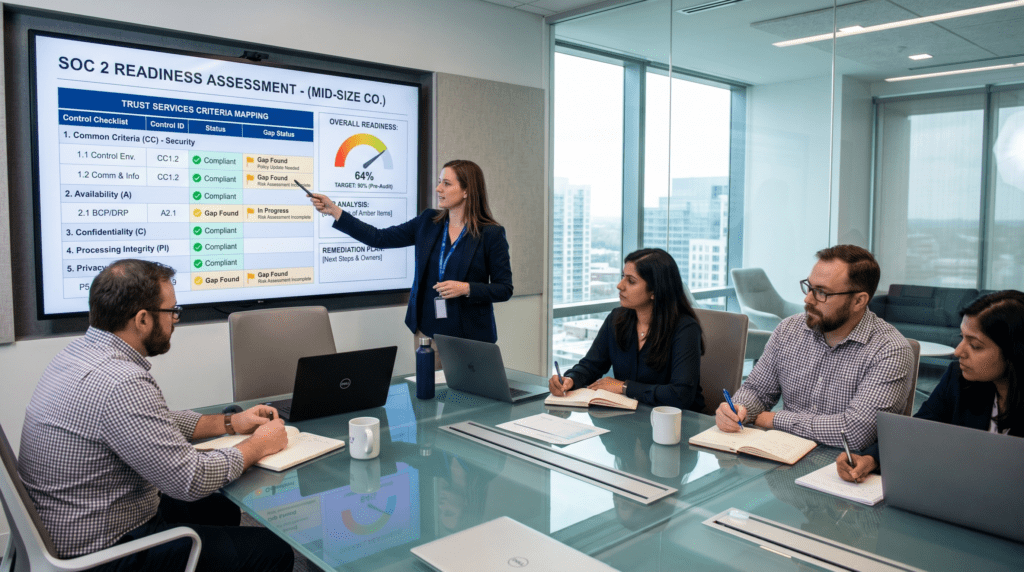
SOC 2 is built on the Trust Services Criteria. Security, sometimes called the common criteria, is the foundation and is required in every SOC 2 report. The other four categories, Availability, Processing Integrity, Confidentiality, and Privacy, are optional and included only when they are relevant to what the company promises its customers. Most startups begin with Security alone and add categories later as customer commitments grow. Scoping to what matters keeps the first effort focused and achievable.
Type I vs Type II: Where Startups Should Begin
SOC 2 comes in two report types, and the difference shapes both timeline and cost. Choosing the right starting point is one of the most important early decisions.
Start With Type I to Unblock Sales
A SOC 2 Type I report evaluates whether controls are designed appropriately at a single point in time. Because it does not require an observation period, it can be completed relatively quickly, which makes it a practical way to put a report in front of a waiting prospect. For many startups, a Type I is the fastest credible answer to a buyer asking for proof today.
Plan for Type II as the Real Standard
A SOC 2 Type II report evaluates whether those controls actually operated effectively across a period of time, commonly three to twelve months. This is what most sophisticated buyers ultimately want, because it shows the controls work in practice and not just on paper. The smart path for a startup is usually to lead with Type I to unblock the immediate deal, then move into a Type II observation window so the next report demonstrates sustained operation.
What to Prioritize When You Are Just Getting Started
A startup does not need an enterprise-grade compliance program on day one. It needs a right-sized one that holds up under review and does not collapse the week after the audit.
Scope Tightly
Define a clear system boundary covering the product, the infrastructure that supports it, and the people and processes that touch customer data. Everything outside that boundary stays out of scope. A narrow, well-defined scope reduces the number of controls to implement and the volume of evidence to maintain, which is exactly what a lean team needs.
Build Controls You Will Actually Run
The most common startup mistake is adopting a stack of polished policies that no one follows. SOC 2 is ultimately about evidence that controls operate, so a Type II will expose the gap between a written policy and daily reality. Implement access controls, change management, logging, and vendor reviews that the team can sustain, and automate evidence collection wherever possible.
Separate the Consultant From the Auditor
This distinction trips up many first-time founders. A SOC 2 report can only be issued by an independent licensed CPA firm. A consulting partner cannot attest to its own client’s controls. What a consulting partner does is the work that comes before the audit: scoping, a readiness assessment, gap remediation, and evidence preparation so the CPA firm’s audit goes smoothly. Understanding this separation helps a startup budget for both and avoid vendors who blur the line. Book a Readiness Call with Elevate’s SOC 2 specialists to map the fastest credible path for your stage.
How to Choose a SOC 2 Partner as a Startup
The right partner for a 20-person startup is not the same as the right partner for a large enterprise. Look for a firm with genuine startup experience that can right-size the program rather than imposing a one-size-fits-all checklist. It should offer both readiness and hands-on remediation, set realistic timelines, and be honest about what can and cannot be compressed. Treat any promise of a full Type II report in a few days as a red flag, because operating effectiveness genuinely takes an observation period to demonstrate. A partner that understands the startup tradeoff between speed and sustainability will help you move quickly without building something that fails the next audit.
Conclusion
SOC 2 for startups is best treated as a revenue enabler rather than a tax. Scope it tightly, lead with a Type I to unblock the deal in front of you, plan for a Type II observation window to meet the standard buyers really want, and build controls the team can actually sustain. Just as important, understand that a CPA firm issues the report while a consulting partner prepares you for it, so you can budget and sequence correctly. Book a Readiness Call with Elevate to turn SOC 2 from a blocker into a competitive advantage.
Key Takeaways
SOC 2 is usually triggered by an enterprise buyer, and startups that approach it with the right scope and sequence can unblock deals without slowing the roadmap.
- SOC 2 is a sales enabler, not just compliance – Enterprise buyers increasingly require a SOC 2 report before sharing data, so having one shortens security reviews and accelerates deals.
- Lead with Type I, then plan for Type II – A Type I report is point in time and faster to obtain, while a Type II proves controls operated over a period and is what sophisticated buyers ultimately expect.
- Scope tightly and build sustainable controls – Define a narrow system boundary and implement controls the team can actually run, since a Type II exposes any gap between written policy and daily practice.
- The consultant prepares you, the CPA firm attests – Only an independent licensed CPA firm can issue a SOC 2 report, so budget for readiness and remediation support separately from the audit itself.
- Choose a right-sized partner – Look for startup experience, both readiness and remediation, and realistic timelines, and be wary of anyone promising a full Type II in days.
The startups that win enterprise trust are the ones that build a defensible SOC 2 program early rather than scrambling when the first big deal arrives.
FAQs
Q1. What is SOC 2 and why do startups need it? SOC 2 is an AICPA attestation framework that reports on how a service organization protects customer data across criteria such as security, availability, and confidentiality. Startups need it because enterprise buyers increasingly require a SOC 2 report before they will share data or sign a contract, making it a common prerequisite for closing larger B2B deals.
Q2. Should a startup get SOC 2 Type I or Type II first? Most startups begin with a Type I report because it evaluates control design at a point in time and can be completed faster, which unblocks an immediate deal. They then move into a Type II observation window so the next report demonstrates that controls operated effectively over time, which is what most sophisticated buyers ultimately want.
Q3. How long does it take a startup to get SOC 2? Timing depends on scope and how mature the controls already are. A readiness assessment and remediation can take a few weeks to a few months, and a Type I can follow relatively quickly. A Type II requires an observation period that commonly runs from three to twelve months, so a credible Type II report takes longer by design.
Q4. Can a consulting firm perform our SOC 2 audit? No. Only an independent licensed CPA firm can perform the audit and issue the SOC 2 report. A consulting firm helps with the work that comes before the audit, including scoping, readiness assessment, gap remediation, and evidence preparation, so the audit itself goes smoothly.
Q5. What drives the cost of SOC 2 for a startup? The main cost drivers are the scope of the system, the number of Trust Services Criteria included, how much remediation is needed to close gaps, and the report type, since a Type II covers a longer period than a Type I. Startups control cost most effectively by scoping tightly and preparing well before the CPA firm’s audit begins.