
Recent Yahoo Finance data shows that 62 percent of IT leaders have boosted their investment in emerging applications. The survey reveals that 82 percent feel ready to use generative AI. Organizations are adopting AI technologies faster than ever, and the ISO 42001 artificial intelligence standard has emerged as the world’s first international framework for AI Management Systems (AIMS).
ISO 42001’s release in December 2023 offers significant guidance to organizations that design, develop, and deploy AI systems. The standard addresses vital aspects like transparency, accountability, bias mitigation, safety, and privacy. Market challenges reflect these concerns directly. Deloitte’s State of Generative AI survey shows 38% of respondents worry about regulatory compliance – a 10% increase from last year. Risk management concerns have also risen by 6%, affecting 32% of participants.
The standard provides detailed coverage of AI systems from their original concept through deployment and operation. Organizations can build trust in their AI implementations through established controls for ethics, bias, inclusion, data protection, and cybersecurity in industries of all types. This executive summary explores ISO 42001’s core structure, key governance themes, organizational roles, and certification’s strategic benefits. The framework helps prepare organizations for upcoming regulations like the EU AI Act.
Core Structure of ISO/IEC 42001 Artificial Intelligence Management System
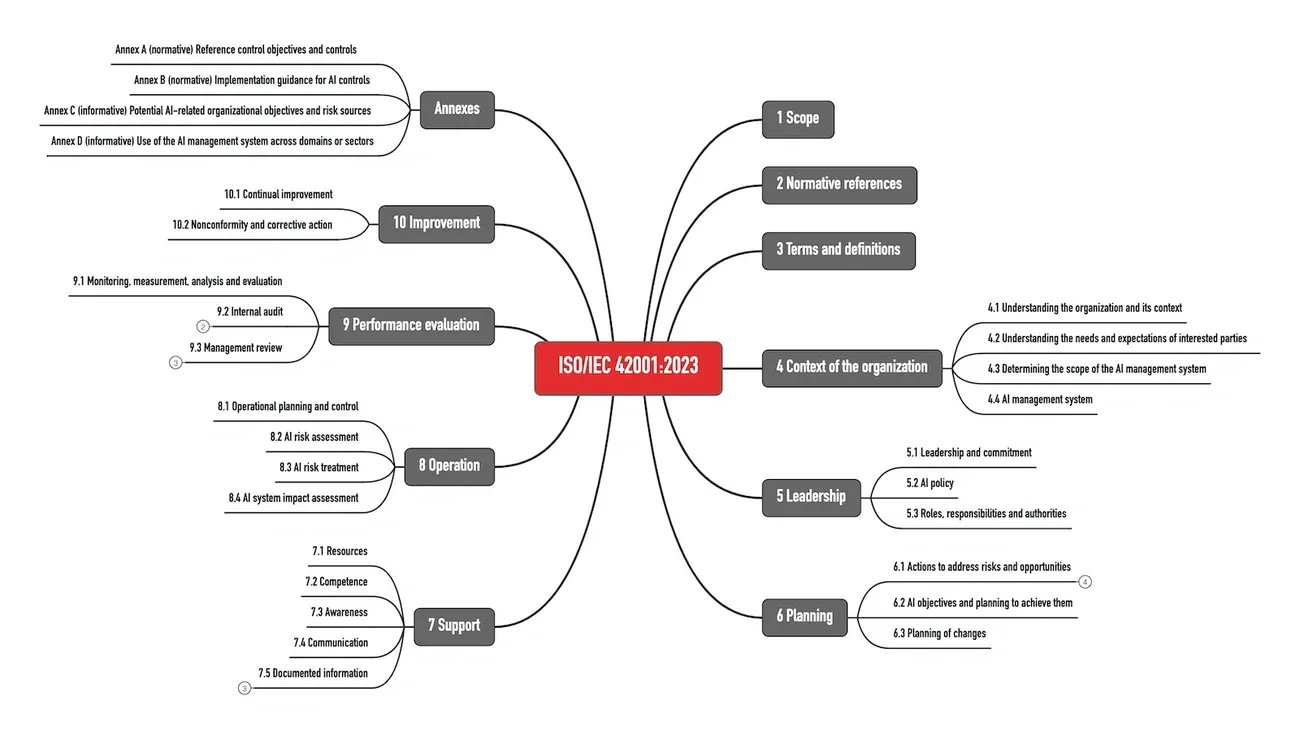
Image Source: Johner Institute
ISO/IEC 42001 uses a well-laid-out framework that helps organizations set up, run, and improve an Artificial Intelligence Management System (AIMS). The standard has two main parts: Clauses 4-10 with management system requirements, and Annexes A-D that provide extra guidance and controls.
Annex A–D Overview: Controls, Guidance, Risk Sources, and Sector Standards
These four annexes serve as practical resources that work alongside the main clauses:
Annex A has 42 control objectives arranged into 9 topics (A.2–A.10). This annex gives a detailed list of controls for responsible AI development, deployment, use, monitoring, and improvement. These controls are the foundations of AIMS implementation and deal with key aspects like fairness, transparency, safety, privacy, and security.
Annex B provides in-depth guidance to implement the controls from Annex A. You’ll find general implementation tips, AI and AIMS policies, internal guidance, resources, ways to assess impact, lifecycle factors, data governance, communication plans, and third-party relationship management.
Annex C describes AI-related organizational goals and common risk sources. It explains 11 specific objectives in areas like accountability, AI expertise, data quality, environmental impact, fairness, maintainability, privacy, robustness, safety, security, and transparency. It also shows potential risks to these objectives and ways to manage them.
Annex D covers standards for specific domains and sectors. Organizations can learn how to integrate AIMS with other tech systems based on their industry’s needs.
Clause 4–10 Breakdown: Context, Leadership, Planning, Support, Operation, Evaluation, Improvement
The standard’s core requirements follow the Plan-Do-Check-Act method through seven key clauses:
Clause 4: Context of the Organization – This clause builds the foundation by defining AIMS scope and identifying external factors (legal, ethical, cultural, technological) and internal factors (governance, contractual obligations) that shape AI implementation. Organizations need to understand what their stakeholders expect from AI usage.
Clause 5: Leadership – The core team must show commitment by developing policies and assigning clear roles. They need to create AI policies that match the organization’s values and other management systems.
Clause 6: Planning – Risk management takes center stage here. Organizations must find, assess, and handle AI-specific risks. A key requirement is the AI system impact assessment (clause 6.1.4) that looks at how AI systems might affect individuals, groups, and societies.
Clause 7: Support – Resources, staff skills, awareness, communication, and documentation are the focus. Teams need training in AI ethics, security, privacy, and relevant laws.
Clause 8: Operation – Organizations must put controls in place to meet AIMS requirements and handle risks throughout the AI lifecycle. This covers everything from design and development to shutdown of AI systems.
Clause 9: Performance Evaluation – Teams must track, measure, analyze, and assess AI systems. Internal audits and management reviews verify that systems stay within ethical, legal, and operational bounds.
Clause 10: Improvement – AIMS needs constant upgrades through finding problems and fixing them. Organizations should regularly check performance and set measurable goals for improvement.
ISO 42001 gives organizations a practical way to handle AI-related risks and opportunities across their operations. The focus stays on governance rather than technical details of specific AI applications.
Key Governance Themes in ISO 42001 Artificial Intelligence Standard
ISO 42001 is a 2-year old structured approach to AI governance that balances innovation with responsible management. Organizations can manage AI-related risks through its Plan-Do-Check-Act methodology.
Leadership and Accountability in AI Governance
Clear leadership commitment starts effective AI governance. Top management must show active support by creating policies that line up with their organization’s values and management systems. Leaders need to define and communicate AI governance structures that create oversight and accountability.
The standard highlights the need for well-defined roles and responsibilities in AI governance. Organizations should create cross-functional AI governance boards with specific priorities to watch over AI initiatives. Teams can understand their accountability better, which prevents scattered ownership that happens with AI implementation.
AI Risk Planning and Lifecycle Oversight
A detailed risk management framework sits at the heart of ISO 42001. It covers the entire AI lifecycle. Organizations need to run structured risk assessments to spot, assess, and alleviate potential AI risks. These risks include bias, accountability gaps, data protection issues, and regulatory exposure.
The AI System Impact Assessment (AIIA) stands out as a key requirement. It assesses how AI systems might affect individuals, groups, or society. These assessments answer crucial questions:
- Is the AI use justifiable, ethical, and proportionate?
- Could the system cause discrimination, exclusion, or loss of rights?
- What safeguards should be built to protect affected people?
Risk management isn’t a one-time task – it’s an ongoing process that applies to each lifecycle stage. The standard’s annexes give detailed guidance on risk sources and ways to reduce risks for different types of AI implementations.
Performance Monitoring and Continuous Improvement
Performance monitoring and improvement make up the third pillar of ISO 42001’s governance framework. AI governance needs to be part of every process throughout AI development and maintenance.
Live dashboards should show leadership the progress toward governance goals and metrics on known AI risks. Teams must track and analyze negative outcomes from AI use to make the system better.
Organizations must assess their performance against set objectives and fix issues when needed. This regular assessment will keep AI systems in line with ethical, legal, and operational parameters as technology and regulations change.
ISO 42001 helps organizations build trustworthy AI systems by combining these three governance themes. It protects both individuals and organizations from collateral damage while building confidence in AI-driven outcomes.
Organizational Roles in ISO 42001 AI Ecosystem
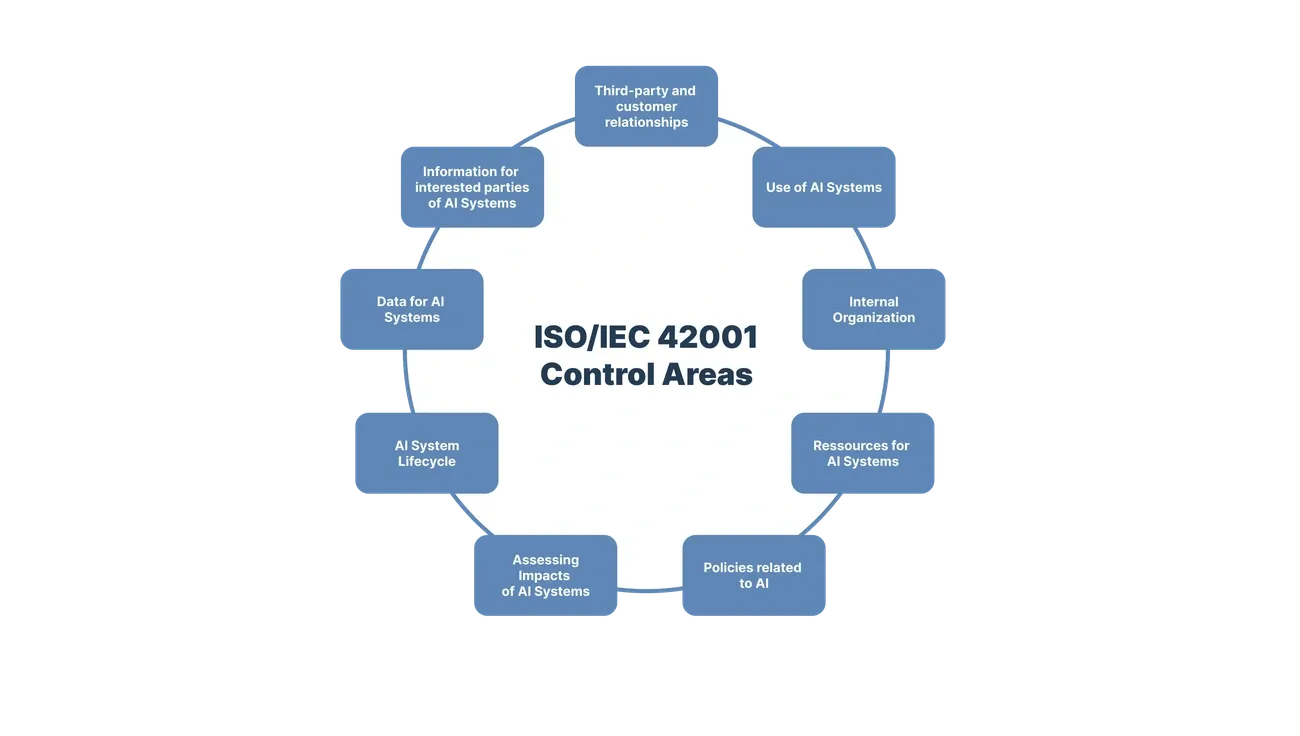
Image Source: trail AI governance platform
Your organization’s role in the AI ecosystem serves as the foundation for ISO 42001 certification. The standard requires you to identify your position in the AI supply chain when establishing context for the Artificial Intelligence Management System (AIMS).
AI Provider vs AI Producer vs AI User
ISO 42001 describes three main organizational roles that are the foundations of any AI ecosystem:
AI Provider is “an organization or entity that provides products or services that uses one or more AI systems”. This covers two distinct subcategories:
- AI Platform Providers deliver infrastructure or services that let customers produce AI products
- AI Product/Service Providers offer AI solutions you can use directly or integrate with non-AI components
AI Producer (also called AI Developer) acts as “an organization or entity that designs, develops, tests, and deploys products or services that use one or more AI systems”. These entities create the core AI technology that providers use, positioned at the “upstream” end of the AI supply chain. OpenAI, Anthropic, and Google DeepMind serve as examples.
AI User represents organizations that employ AI products or services in their operations without getting involved in technical development. They focus on using AI tools to streamline processes and improve service delivery.
Organizations often take on multiple roles. A company might develop AI models (Producer) and include them in customer-facing services (Provider). In these cases, certification scope usually focuses on the downstream Provider role that connects directly with customers.
Assigning Ownership for AI Risk Management
AI risk management brings together different teams across an organization. Product management, data engineering, infrastructure, legal, compliance, trust and safety, and training teams all play crucial roles. This mix of teams can lead to unclear responsibilities.
ISO 42001 implementation requires organizations to:
- Find leadership champions who can provide resources and guide compliance efforts
- Create an operating model that brings stakeholders together across departments
- Assign specific risk owners for AI systems in relevant teams
- Set up regular testing schedules for controls like quarterly fairness reviews
Organizations seeking ISO 42001 certification must document these ownership structures clearly. This helps solve a common AI governance problem where responsibility gets spread too thin across multiple stakeholders.
ISO 42001’s well-laid-out ownership approach helps organizations build trust with interested parties. It reduces internal and supply chain risk while improving AI performance and value for users.
Strategic Benefits of ISO 42001 Certification
ISO 42001 certification creates real business value that goes beyond basic compliance. Companies that implement this standard see major benefits in their AI projects.
Building Trust Through Transparent AI Practices
The certification shows a steadfast dedication to responsible AI governance and builds stakeholder confidence through clear processes. Companies that arrange their practices with ISO 42001 build trust by showing they understand and manage AI-related risks. Customers, partners, and regulators trust organizations that can prove their ethical AI practices. The standard helps companies show their dedication to ethical AI use through controls that address bias, inclusion, data protection, and cybersecurity. The certification creates a verified way to share trustworthy AI practices with external stakeholders.
Streamlining AI Development with Standardized Controls
ISO 42001 changes AI governance from abstract ideas into specific, useful controls. The well-laid-out framework gives companies a reliable playbook to manage AI throughout its lifecycle – from pre-deployment checks to ongoing monitoring. Companies can spot problems earlier and cut down financial and reputation risks from AI failures. This repeatable process speeds up approvals, reduces mistakes, and helps companies grow their AI with confidence, which improves their return on investment.
Competitive Advantage in Regulated Markets
ISO 42001 certification puts companies ahead of upcoming regulations, especially the EU AI Act. Many regulatory frameworks share common ground with ISO 42001, so certified companies have an edge in fast-changing markets. The certification proves leadership in ethical AI and helps companies stand out from competitors. As new regulations emerge, ISO 42001 certified companies already have audit-ready documentation and evaluation frameworks in place.
Want to learn how ISO 42001 certification could help your company? Book a Readiness Call to find your path toward responsible AI governance and stand out in an increasingly regulated digital world.
Preparing for Regulatory Alignment with the EU AI Act
The EU Artificial Intelligence Act marks the most important regulatory milestone for organizations using AI technologies, and it will take effect in August 2024. ISO 42001 offers a resilient foundation to meet these requirements.
ISO 42001 as a Foundation for EU AI Act Compliance
Studies show a 40-50% overlap exists between ISO 42001’s and EU AI Act’s high-level requirements. These frameworks share risk-based approaches to AI governance and focus on data governance, transparency, and ethical considerations. The EU AI Act demands more specific requirements.
ISO 42001 helps meet EU AI Act requirements through:
- Risk management frameworks matching the Act’s four-tier risk classification system
- Technical documentation adaptable for EU compliance
- Governance processes with built-in ethical considerations
Organizations must know that ISO compliance doesn’t guarantee EU AI Act compliance. The Act’s requirements go beyond ISO 42001’s scope, particularly in CE marking requirements and specific reporting procedures for European authorities.
Audit-Ready Documentation and Risk Frameworks
Organizations can build complete documentation needed for regulatory readiness with ISO 42001. This documentation proves governance, lived controls, and operational capability.
A well-laid-out ISO 42001 implementation creates audit-ready materials such as:
- AI risk registers with named owners and clear mitigations
- Model lifecycle logs that track from design to retirement
- AIMS scope statements defining AI system boundaries clearly
Want to check your organization’s regulatory readiness? Book a Readiness Call to find your path toward ISO 42001 certification and EU AI Act compliance.
Conclusion
ISO 42001 marks a key milestone in AI governance. It gives organizations a clear path to implement AI responsibly. This executive summary shows how the first international AI Management System framework tackles key concerns like transparency, bias mitigation, and privacy protection – issues that worry today’s tech leaders.
The standard’s detailed structure includes management requirements (Clauses 4-10) and practical guidance (Annexes A-D). These elements are the foundations for organizations in the AI ecosystem. Companies can apply these governance principles throughout their AI lifecycle, whether they provide, produce, or use AI systems.
The standard clearly outlines leadership duties, risk planning, and performance monitoring. This turns abstract AI ethics into practical controls and creates real business value beyond compliance. Companies that implement ISO 42001 build trust through transparent practices and streamline their AI development.
Early adopters of this standard gain an edge as new regulations like the EU AI Act take shape. While certification doesn’t guarantee full compliance, it puts in place about 40-50% of the governance elements that upcoming laws will need.
Building trustworthy AI needs careful planning. Organizations should know their role in the AI ecosystem, set up clear risk management structures, and put controls in place across their AI lifecycle. ISO 42001 certification isn’t just about compliance – it’s a strategic investment in responsible innovation that balances tech advances with safeguards for people, organizations, and society.
AI technologies advance rapidly. ISO 42001 helps companies guide through ethical considerations while staying competitive in a regulated landscape. Those who embrace these standards today will be better placed to succeed in tomorrow’s AI-driven economy.
Key Takeaways
ISO 42001 provides the world’s first international framework for AI Management Systems, helping organizations build trust and navigate regulatory challenges in an AI-driven landscape.
• ISO 42001 establishes comprehensive AI governance through structured clauses (4-10) covering leadership, risk planning, and performance monitoring across the entire AI lifecycle.
• Organizations must identify their AI ecosystem role as Provider, Producer, or User to properly implement risk management and assign clear ownership for AI governance.
• Certification delivers competitive advantage by building stakeholder trust through transparent practices and positioning companies ahead of emerging regulations like the EU AI Act.
• The standard provides 40-50% overlap with EU AI Act requirements, creating audit-ready documentation and risk frameworks essential for regulatory compliance.
• Implementation transforms abstract AI ethics into actionable controls, streamlining development processes while ensuring accountability, bias mitigation, and privacy protection.
By adopting ISO 42001, organizations can balance innovation with responsibility, creating trustworthy AI systems that protect both individuals and businesses while maintaining competitive edge in increasingly regulated markets.
FAQs
Q1. What is ISO 42001 and how does it relate to AI governance? ISO 42001 is the world’s first international standard for AI Management Systems (AIMS). It provides a comprehensive framework for organizations to establish, implement, and maintain responsible AI governance throughout the entire AI lifecycle, focusing on risk management, transparency, and ethical considerations.
Q2. How can ISO 42001 certification benefit organizations using AI? ISO 42001 certification offers several benefits, including building stakeholder trust through transparent AI practices, streamlining AI development with standardized controls, and gaining a competitive advantage in regulated markets. It also helps organizations prepare for emerging regulations like the EU AI Act.
Q3. What are the key components of ISO 42001? ISO 42001 consists of two main components: Clauses 4-10, which outline management system requirements, and Annexes A-D, which provide supplementary guidance and controls. The standard covers areas such as leadership, planning, support, operation, performance evaluation, and continuous improvement.
Q4. How does ISO 42001 address AI-related risks? ISO 42001 requires organizations to conduct structured risk assessments throughout the AI lifecycle. This includes performing AI System Impact Assessments (AIIA) to evaluate potential effects on individuals, groups, and society. The standard also provides guidance on identifying and mitigating various AI-specific risks.
Q5. What roles does ISO 42001 define in the AI ecosystem? ISO 42001 identifies three primary organizational roles in the AI ecosystem: AI Provider (including platform and product/service providers), AI Producer (or Developer), and AI User. Organizations must determine their role(s) to properly implement risk management and assign clear ownership for AI governance.