
ISO/IEC 42001 emerged in December 2023 as the first worldwide standard that focuses on AI management systems. This new framework helps organizations handle AI systems responsibly and tackles both ethical and operational challenges.
A recent Deloitte State of Generative AI survey reveals some interesting numbers. About 38% of people worry about following regulations, while 32% don’t deal very well with AI-related risks. The ISO/IEC 42001 helps organizations handle their AI use better. The standard emphasizes transparency, reduces risks, and promotes ethical AI practices. The standard’s Annex A contains 38 AI-specific controls, and organizations must explain why they choose to use or skip these controls.
The International Organization for Standardization teamed up with the International Electrotechnical Commission to create this framework. Companies can now show they’re responsible and meet new rules throughout their AI projects. Let’s look at what ISO 42001 means for Chief Legal Officers, how it handles major legal risks, and the steps needed to build an AI system that follows these rules.
What is ISO 42001? A Legal Overview for CLOs
Image Source: DataSunrise
The International Organization for Standardization (ISO) and International Electrotechnical Commission (IEC) worked together to create ISO/IEC 42001:2023. They released it in December 2023 as the world’s first international standard specifically for Artificial Intelligence Management Systems (AIMS). Organizations worldwide need this framework as they face complex challenges in AI adoption.
What is ISO 42001 standard?
ISO/IEC 42001 gives organizations a structured way to set up, run, maintain and improve their AI governance. This framework stands apart from other technology standards. It deals with unique AI system challenges like ethical considerations, transparency needs, and the ever-changing nature of continuous learning models.
Organizations of all sizes can use this standard, whether they create, provide, or use AI-based products and services. The standard follows the Plan-Do-Check-Act method, similar to other ISO frameworks. This makes it easy to understand for teams that already know standards like ISO 9001 or ISO/IEC 27001.
The ISO 42001 remains a voluntary standard, not a legal requirement. But its importance as a standard for AI management systems grows as organizations look for trusted ways to show responsible AI practices.
What is the main goal of ISO 42001?
ISO/IEC 42001’s main goal helps organizations handle AI-related risks while making the most of opportunities throughout the AI lifecycle – from idea to deployment and operation. The standard achieves this through several key ways:
- It creates governance structures for clear oversight and accountability
- It sets up risk management protocols to spot, assess, and reduce potential harm
- It provides guidelines to design AI systems that are transparent, fair, and unbiased
- It builds compliance mechanisms to follow evolving legal standards
The standard also helps organizations meet their stakeholder commitments and follow regulatory rules. It focuses on ethics, transparency, accountability, bias identification and reduction, safety, and privacy – areas that regulators worldwide examine closely.
The standard has a complete set of 38 strategic controls across nine key governance areas in its Annex A. These controls help build AI systems that are not just legally compliant but also safe, fair, and ready for audit.
Why CLOs should care about ISO AI standards
Chief Legal Officers will find ISO 42001 gives them significant advantages. It helps them navigate new AI regulations and reduce legal risks. The standard provides structured methods to check risks and impacts, especially for AI systems that affect people’s lives.
ISO 42001 stresses the need for Artificial Intelligence Impact Assessments (AIIAs) when AI systems might greatly affect individuals, groups, or society. These assessments answer key legal questions about whether AI use is justified, ethical, and fair, and if it could lead to discrimination, exclusion, or rights violations.
Legal teams should pay attention to Section 4 of ISO 42001 – “Context of the organization.” Organizations must identify legal requirements, including banned AI uses, regulatory policies and guidelines, and what it all means when using AI systems.
Getting ISO 42001 certification shows customers, regulators, and stakeholders that an organization has reliable AI governance practices. This forward-thinking approach can set you apart from competitors and prepare you for upcoming rules like the EU AI Act.
ISO 42001 is the life-blood for organizations that want to promote trust, breakthroughs, and compliance responsibly. CLOs will find this framework gives them a structured way to spot and manage AI-related legal risks before they turn into expensive lawsuits or regulatory problems.
Legal Risk Categories Addressed by ISO/IEC 42001
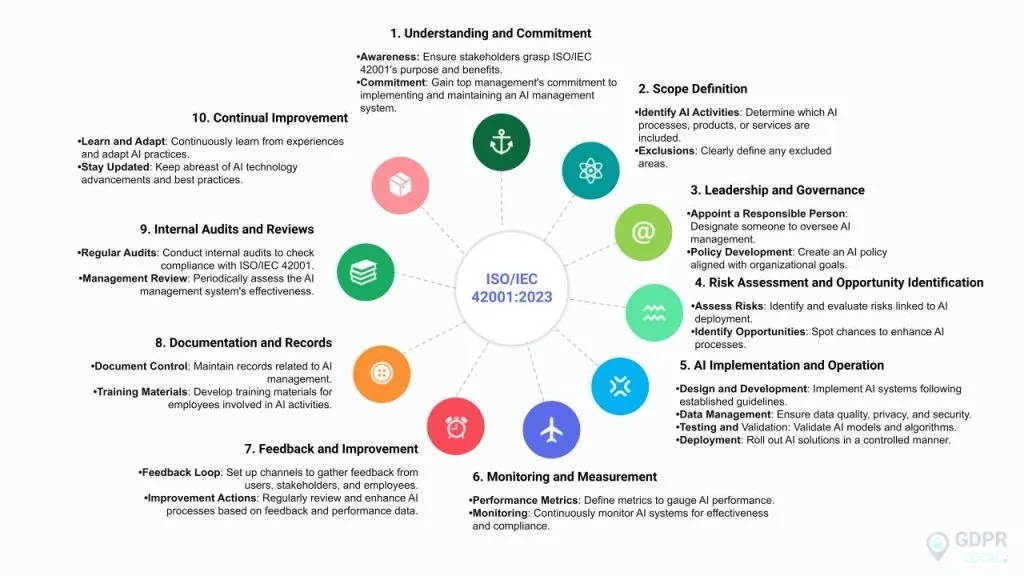
Image Source: Northwest AI Consulting
ISO/IEC 42001 is the first international standard that will give a systematic way to handle key legal risks in artificial intelligence systems. Legal teams must think over structured governance requirements to alleviate potential harms when they develop or deploy AI technologies.
Bias, discrimination, and fairness risks
Organizations using AI systems face algorithmic bias as one of their biggest legal vulnerabilities. This risk shows up when AI creates unfair outcomes for certain groups, which can lead to discrimination claims, regulatory penalties, and damage to reputation. The European Union’s AI Act, now 2 months old, requires organizations to prove they prevent bias systematically in high-risk AI applications.
ISO 42001 deals with bias through several ways. Organizations need to use diverse and representative data sets to reduce bias in algorithms. The standard shows that bias enters AI systems through three main paths:
- Training data bias: historical prejudices embedded in datasets
- Model design bias: structural algorithm choices creating unfair outcomes
- Implementation bias: deployment contexts differing from design environments
Control objective A.2 in Annex A is a vital part of ethical AI and fairness. It makes organizations identify potential algorithmic bias and set up controls to prevent discriminatory outcomes. The standard requires ongoing monitoring and assessment processes that track fairness metrics across demographic groups.
Legal teams need documented proof of bias reduction efforts to defend against discrimination claims or regulatory investigations.
Privacy and data protection obligations
Data governance forms the foundation of legally compliant AI systems in ISO 42001. AI technologies usually process huge amounts of personal information, so the standard creates strict controls to protect data privacy.
The framework merges with existing privacy regulations like GDPR, which creates a stronger connection between AI governance and data protection compliance. Control A.7.4 makes organizations implement data quality checks to ensure accuracy and consistency in training datasets. Control A.7.5 requires full documentation of data’s journey to spot potential privacy vulnerabilities.
AI impact assessments serve as another privacy safeguard in ISO 42001. These work like data protection impact assessments (DPIAs) that many privacy regulations need. Organizations must assess:
- The justification and proportion of an AI system’s data processing
- The system’s potential to compromise data subject rights
- Protection measures needed for affected individuals
ISO 42001 creates ways to prove AI systems follow basic data protection principles—something legal departments need to manage privacy risks.
Accountability and explainability requirements
Many AI systems’ “black box” nature creates unique legal challenges. ISO 42001 tackles these through accountability and explainability requirements. The standard puts emphasis on transparent AI decision-making to build trust and accountability.
Organizations following ISO 42001 must keep complete documentation throughout the AI lifecycle. Model cards, audit logs, decision records, and compliance reports enable traceability. This documentation helps with internal governance and supports communication with regulators.
The standard makes executive accountability for AI impacts crystal clear. Organizations need meaningful human oversight based on risk level, from regular reviews of low-risk applications to constant supervision of high-risk systems.
Legal departments can defend their AI practices better with these requirements. Organizations can quickly address AI failures or ethical concerns through established incident response protocols. The standard’s focus on continuous monitoring helps organizations spot new AI risks and adjust their governance strategies.
ISO 42001’s approach turns AI governance from casual practices into structured, auditable management systems. This gives legal teams documented evidence to show they took reasonable care in developing and deploying AI.
Clause-by-Clause Breakdown for Legal Teams
Legal departments putting in place ISO 42001 must know what each clause requires to avoid compliance issues. The framework requires proper governance controls throughout the AI lifecycle. Each stage has specific legal implications.
Clause 4–6: Context, leadership, and planning
Clause 4 sets up the foundation of an AI Management System (AIMS). Organizations must define its scope and know their internal and external contexts. Legal teams should identify relevant regulations, contractual obligations, and what stakeholders expect from AI systems. They must document both downstream stakeholders (customers, end-users) and upstream parties (developers, suppliers). These expectations shape AI governance frameworks.
Clause 5’s leadership requirements focus on executive accountability and clear governance structures. The core team must show their dedication by creating an AI policy that:
- Lines up with organizational values and other management systems
- Sets clear principles for fairness, transparency, and security
- Blends into business processes and strategies
Clause 5 turns AI governance from an IT issue into something executives must handle. Legal teams ensure top management actively supports AI initiatives.
Clause 6 is the life-blood for legal teams. It requires structured risk management. Organizations must do formal AI risk assessments and review impacts to spot potential problems early. Legal departments need proof that AI systems have been checked for:
- Bias and discrimination risks
- Privacy and security weak points
- Regulatory compliance gaps
- Effects on society and individuals
Legal teams should keep detailed records that show reasonable care in AI governance decisions throughout these first clauses.
Clause 7–10: Support, operation, evaluation, improvement
Clauses 7-10 deal with practical implementation and ongoing monitoring of AI systems. Clause 7 requires organizations to provide enough resources, including staff trained in AI ethics and law. Documentation requirements cover everything from proving competency to communication protocols.
Clause 8 covers operational requirements for AI controls throughout the system lifecycle. Legal teams make sure clear procedures exist for AI development, deployment, and monitoring. They pay special attention to changes that might create new legal risks.
Clause 9 requires performance reviews through regular monitoring, internal audits, and management checks. Legal departments must set measurable metrics to track how AI systems follow ethical and regulatory requirements over time.
Clause 10 focuses on making things better through continuous improvement. Legal teams must find root causes when problems occur and fix them properly instead of quick patches.
Annex A: 38 AI-specific controls for legal compliance
Annex A is the life-blood of ISO 42001’s practical implementation. It has 38 AI-specific controls across nine governance areas. These controls give legal teams specific, auditable requirements that prove they did their due diligence in AI governance.
Key control areas with major legal implications include:
- Data governance controls (A.7) for data quality, origin, and preparation
- Transparency mechanisms (A.8) to document things properly for stakeholders
- Impact assessment protocols (A.5) to review effects on individuals and groups
- Third-party relationship management (A.10) that defines responsibilities across the AI supply chain
Legal departments should create a Statement of Applicability (SoA). This document shows which Annex A controls apply to their AI systems and explains why. The SoA becomes crucial evidence during certification audits and regulatory investigations. It proves they took a methodical approach to AI governance.
Building a Legally Compliant AI Management System
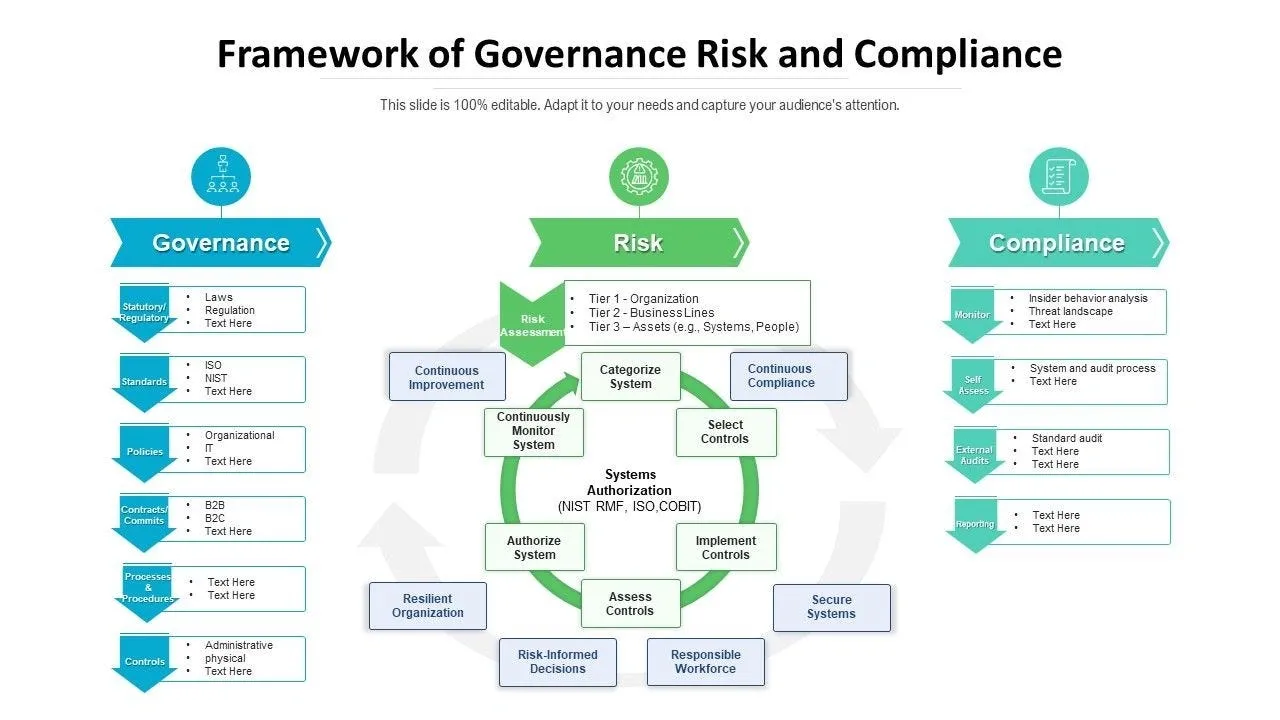
Image Source: Medium
Building a legally compliant AI Management System under ISO 42001 needs systematic implementation throughout your organization. Legal officers should see compliance as an evolving governance framework that grows with AI capabilities and regulatory needs, not just a one-time checklist.
Defining scope and stakeholder roles
The life-blood of an ISO 42001-compliant system starts with scope definition. Clause 4.3 requires organizations to clearly document which sections and AI applications fall within their Artificial Intelligence Management System. Your scope definition should look at internal factors like existing governance structures and external elements such as regulatory requirements and market expectations.
ISO 42001 places five key AI stakeholder roles at the center of your governance framework:
- AI Customer – Organizations that use AI to optimize business processes while ensuring compliance
- AI Provider – Entities that deliver AI solutions balancing breakthroughs with regulatory needs
- AI Producer – Teams that create AI models and address bias and ethical risks
- AI Partner – Collaborators that enable AI integration and governance
- AI Subject – People who need protection from unfair AI-driven decisions
Your organization might play multiple roles simultaneously, each with its own legal obligations. To name just one example, a financial institution could be both an AI customer using third-party fraud detection and an AI provider offering AI-powered investment tools to clients.
After identifying roles, Clause 4.1 requires you to document relationships among stakeholders throughout the AI lifecycle and create clear accountability structures for supporting roles like AI Compliance Officer, AI Risk Manager, and Data Scientist.
Embedding legal review in AI lifecycle
Legal reviews must be strategically placed at critical decision points throughout AI development. The ISO standard requires Artificial Intelligence Impact Assessments (AIIAs) for systems that could significantly affect individuals, groups, or society.
These assessments should produce documented reports that identify potential legal risks and their severity ratings. Legal departments must also establish formal sign-off procedures at key development stages. This approach turns theoretical compliance into real-world practice.
The standard requires legal viewpoints in daily AI operations, beyond the original assessment. Control A.3.3 requires dedicated channels for reporting AI-related concerns – you could modify existing ethical reporting mechanisms for this purpose.
Your operational integration should have clear procedures to:
- Prove AI providers follow regulations and ethical standards
- Monitor AI performance against defined risk thresholds
- Address emerging risks through systematic reviews
Maintaining traceability and audit logs
A complete documentation system supports ISO 42001 compliance, but auditors need more than well-organized folders. You must show implementation evidence through logs of bias testing, oversight actions, and incident response activities.
Control A.6.2.8 requires event logs that capture “who did what, why, when, and under which policy” across all AI development and operation phases. These logs must record important decisions, user actions, anomalies, policy overrides, and retraining events to create a complete chain of custody.
Organizations seeking ISO 42001 certification need strong evidence portfolios including:
- Core AI governance frameworks and policies that address ethics, fairness and explainability
- Lifecycle documentation such as model cards, retraining logs, and evaluation metrics
- Role accountability charts and risk registers
- Data governance frameworks showing lineage and quality controls
CLOs overseeing compliance efforts should remember that documented issues need implementation logs showing what changed, when, and why. The standard’s traceability requirements won’t be met by fixing problems without documenting remediation steps.
ISO 42001 compliance requires legal departments to shift from reactive problem-solving to proactive governance embedded throughout AI operations.
ISO/IEC 42001 Certification: Legal Readiness Checklist
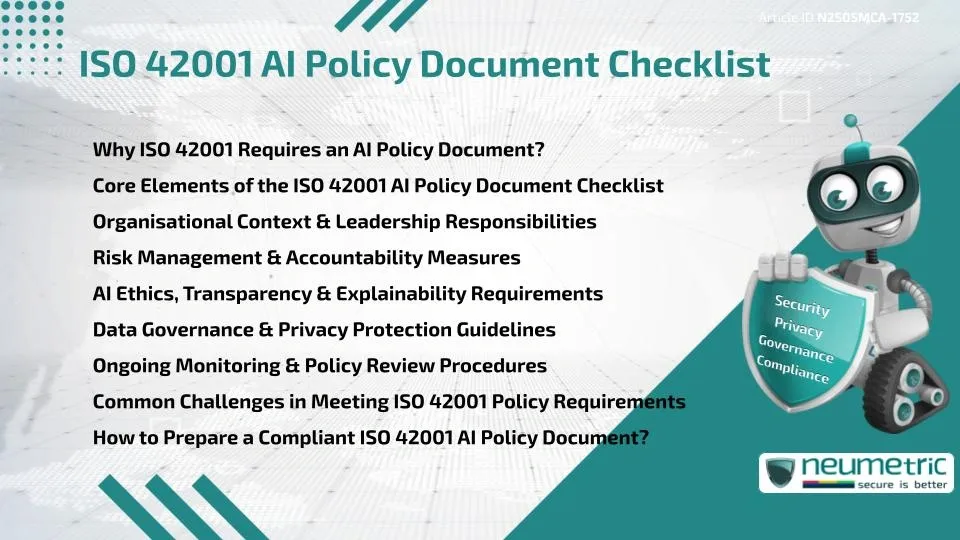
Image Source: Neumetric
Getting ready for ISO/IEC 42001 certification needs careful planning and documentation to show compliance with AI governance requirements. Your success depends on good preparation that covers legal, technical, and operational aspects.
Pre-certification assessment for legal gaps
Organizations should start with a complete gap analysis to review their AI governance practices against ISO 42001 requirements. This review gives you a full picture of where you stand on compliance and shows what needs work.
You can tell an organization is ready for ISO 42001 certification when you see these key signs:
- The core team and stakeholders show strong commitment
- AI management system and governance framework work well
- AI policies and procedures are in daily use
- Risk management and compliance measures are active
- Teams have finished internal audits and fixed any issues
- AI system documentation and evidence is easy to find
These reviews help legal teams spot gaps in compliance and create a step-by-step plan to fix them. “This kind of pre-assessment is a great way to get a snapshot of where your organization currently is when it comes to complying with the ISO/IEC 42001 requirements,” notes one certification body.
Evidence collection: logs, model cards, approvals
Good documentation is the foundation of successful certification. Your organization needs to keep specific records like risk assessment reports, internal audit results, AI system performance logs, training records, and incident reports.
Your evidence portfolio should include:
- Model cards that show AI systems’ features and limits
- Audit trails that record who did what, when, and why
- Decision records that show approval workflows
- Compliance reports that prove you follow policies
This paper trail shows auditors that governance isn’t just theory but real practice. Auditors look at documentation to check if it’s complete, accurate, lines up with ISO 42001 requirements, and shows ongoing improvement.
Legal sign-off and documentation standards
Legal teams must set clear documentation standards that meet both certification needs and regulatory requirements. The Statement of Applicability (SoA) plays a crucial role by connecting each Annex A control to your implementation approach with clear reasons.
Documentation has its challenges. Small organizations might struggle with limited resources. Creating custom templates takes time, and staff need training on digital tools. Book a Readiness Meeting with an accredited certification body to confirm your documentation approach and get ready for the audit.
Your documentation must show real operational proof—not just paperwork—for every AI risk and responsibility in your management system. Auditors want to see measurable, time-bound goals that connect top-level priorities to day-to-day milestones.
Certified organizations go through checkup audits every 12 months during years two and three, so they must keep their documentation current.
Common Legal Challenges and How to Overcome Them
Implementing ISO/IEC 42001 brings several organizational hurdles that go beyond the technical side of AI management. Organizations face multiple obstacles that need strategic solutions while building compliant AI systems.
Team Coordination Challenges
Teams that used to work separately now must work together on complex AI governance issues that few understand completely. This disconnect happens between IT, legal, compliance, HR, product, and marketing teams, each bringing different priorities and knowledge levels to the table.
The solution lies in creating a multi-team AI governance committee with clear roles and duties. This committee should bring together people from all key business areas to ensure complete oversight. Your organization can line up technical, legal, and business units through shared playbooks and governance frameworks that build a common understanding of AI risk management.
Legal Teams’ AI Knowledge Gap
The core team members, even those working in IT and compliance, don’t know enough about AI governance principles. Legal teams don’t deal very well with ISO 42001’s mix of requirements that need expertise in technical AI, risk management, and ethics.
Organizations can close this knowledge gap through ongoing training programs, working with external partners who can spot competency gaps and aid knowledge sharing. Setting up an AI Center of Excellence becomes a knowledge hub that guides teams of all sizes. On top of that, it helps to create practice communities where teams share experiences and learn from each other’s challenges and wins.
Keeping Up with AI Rules
AI development’s global nature means dealing with scattered regulations and different transparency rules across regions. The EU AI Act calls for strict accountability, but other regions might have completely different requirements, making it harder to adopt ISO 42001 uniformly.
Smart organizations aren’t waiting for final regulatory rules before implementing ISO 42001. Taking early action to adopt the standard helps future-proof compliance programs and reduces the risk of getting pricey, rushed changes when new regulations start. This approach shows your organization leads change rather than just reacting to it.
Conclusion
ISO/IEC 42001 serves as a vital framework for legal teams dealing with AI governance as artificial intelligence reshapes business operations. This piece shows how the groundbreaking standard helps manage key legal risks like bias, privacy issues, and accountability challenges through well-laid-out approaches.
The systematic framework of ISO 42001 helps Chief Legal Officers turn theoretical compliance into practical, auditable processes. Legal departments now have the tools to show due diligence in AI governance decisions thanks to the standard’s focus on complete documentation, stakeholder identification, and clear accountability structures.
Smart organizations are already using ISO 42001 instead of waiting for regulatory enforcement to make their AI operations future-ready. This ahead-of-the-curve approach prepares businesses for new regulations like the EU AI Act and builds trust with stakeholders through responsible AI practices that everyone can see.
Organizations wanting to confirm their AI governance maturity should book a Readiness Meeting with certified bodies. These meetings help spot gaps before formal certification audits begin by checking implementation methods and documentation standards.
ISO 42001 implementation has its challenges, especially when you have to coordinate across functions and need special expertise. A well-laid-out governance committee, regular training, and centralized frameworks make these obstacles easier to handle by matching technical abilities with legal needs.
ISO 42001 might be optional, but it grows more important as the first globally recognized way to measure AI management systems. Legal teams that use this standard make their organizations stand out not just for following rules, but as ethical leaders who develop and use AI technologies responsibly.
FAQs
Q1. What is ISO 42001 and why is it important for AI governance? ISO 42001 is the world’s first international standard for AI management systems. It provides a structured framework for organizations to implement responsible AI governance, addressing ethical considerations, transparency, and risk management throughout the AI lifecycle.
Q2. How does ISO 42001 help organizations manage AI-related risks? ISO 42001 requires organizations to conduct comprehensive AI risk assessments and impact evaluations. It provides guidelines for identifying, assessing, and mitigating potential harms associated with AI systems, including bias, privacy concerns, and ethical issues.
Q3. What are the key requirements for ISO 42001 compliance? Key requirements include establishing clear AI governance structures, conducting AI impact assessments, implementing risk management protocols, ensuring transparency in AI decision-making, and maintaining comprehensive documentation throughout the AI lifecycle.
Q4. How does ISO 42001 differ from the EU AI Act? While the EU AI Act focuses on product safety requirements for AI systems, ISO 42001 centers on organizational management systems for AI governance. ISO 42001 provides a broader framework for how organizations develop, deploy, and operate AI systems responsibly.
Q5. What are the benefits of implementing ISO 42001 for legal teams? Implementing ISO 42001 helps legal teams demonstrate due diligence in AI governance, provides structured approaches to managing key legal vulnerabilities, and offers a proactive stance in preparing for emerging AI regulations. It also helps build stakeholder trust through transparent and responsible AI practices.