
Organizations pursuing ISO 42001 and ISO 27001 together, often alongside ISO 9001, usually discover the standards share far more than they expected. ISO 42001 (AI management), ISO 27001 (information security), and ISO 9001 (quality management) are all built on the same backbone. Because ISO 42001 and ISO 27001 in particular share nearly identical management-system requirements, you can certify against all three without building three separate management systems.
Why the Three Standards Align
All three standards follow the Harmonized Structure, sometimes called Annex SL, with their core requirements living in Clauses 4 through 10, the same skeleton used across modern ISO management system standards. In practice, that means every key pillar of the management system, context-setting, leadership, risk, support, operations, measurement, and improvement, sits in the same clause position with the same underlying logic across all three standards. If your organization already holds one of these certifications, the architecture of the others will feel familiar, which is exactly why ISO 42001 and ISO 27001 are so often pursued as a pair.
All three also run on the same Plan-Do-Check-Act rhythm, so the cycle of planning controls, operating them, evaluating them, and improving them is common to the AI, security, and quality systems. That shared cadence is what lets one set of audit and review machinery serve several certifications at once.
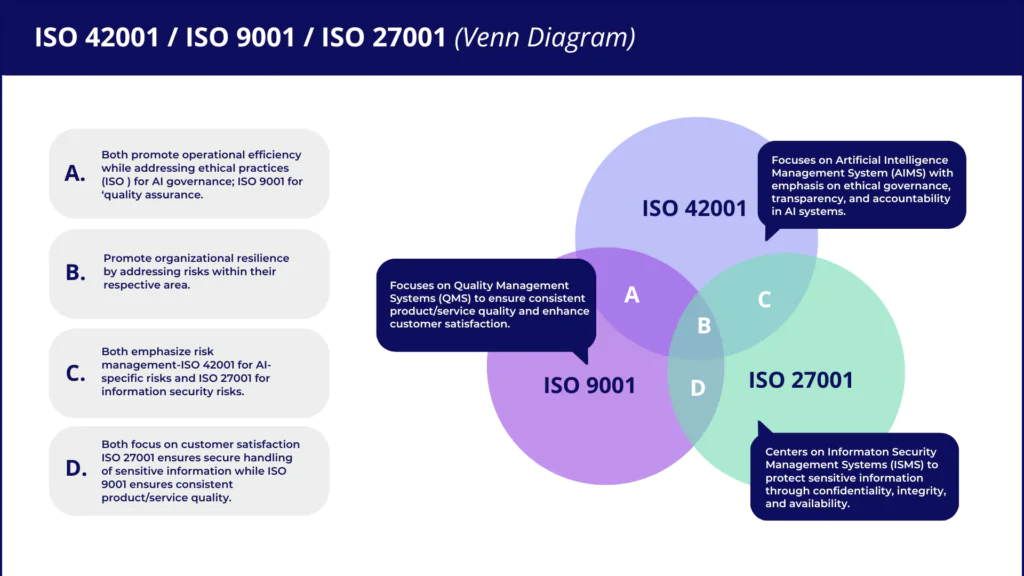
Figure 1: ISO 42001, ISO 9001 and ISO 27001 Venn Diagram
The practical payoff is significant. Leadership commitment, policy, and role assignments defined under Clause 5 can be established once and applied across the AI, security, and quality management systems, and risk policies set under Clause 6 align directly across all three. This is why a single internal audit, one management review cycle, and a shared risk register can serve multiple certifications at once.
Clause-by-Clause Crosswalk
The table below maps the shared Annex SL clauses across the three standards and shows where each one applies the common requirement to its specific domain.
| Annex SL Clause | ISO 9001 (Quality) | ISO 27001 (Information Security) | ISO 42001 (AI Management) |
|---|---|---|---|
| Clause 4: Context | Quality-relevant stakeholders and scope | Information assets, interested parties, ISMS scope | AI stakeholders, regulatory landscape, AIMS scope |
| Clause 5: Leadership | Quality policy and roles | Security policy and roles | AI policy, responsible-AI commitment, roles |
| Clause 6: Planning | Quality objectives, risk and opportunity | Risk assessment and treatment, SoA | AI risk assessment plus AI impact assessment, SoA |
| Clause 7: Support | Resources, competence, documented info | Resources, awareness, documented info | Resources, AI competence, documented info |
| Clause 8: Operation | Product and service delivery controls | Operational security controls | AI system lifecycle: design, development, testing, deployment, monitoring, decommissioning |
| Clause 9: Performance | Monitoring, internal audit, management review | Monitoring, internal audit, management review | Monitoring, internal audit, management review |
| Clause 10: Improvement | Nonconformity and continual improvement | Nonconformity and continual improvement | Nonconformity and continual improvement |
Clauses 4, 5, 7, 9, and 10 are where most of the shared effort lives. The documentation, processes, and evidence you build for one standard largely satisfy the same clause in the others. The real divergence appears in Clauses 6 and 8, where each standard applies the common structure to its own subject matter.
ISO 42001 in Brief
ISO/IEC 42001:2023, published in December 2023, is one of the first international, certifiable standards dedicated to AI system governance. Developed jointly by the International Organization for Standardization (ISO) and the International Electrotechnical Commission (IEC), it provides a structured framework for managing AI technologies responsibly throughout their lifecycle, aligned with ethical principles, regulatory requirements, and organizational goals. The standard sets out ten clauses, with the auditable requirements in Clauses 4 through 10, and four annexes. Its normative Annex A provides 38 reference controls grouped under nine control objectives numbered A.2 through A.10, with implementation guidance for each control in Annex B.
The key components of ISO 42001 focus on the responsible development, deployment, and operation of AI systems, including:
Governance Structure: a framework for an AIMS that integrates with organizational processes so AI practices align with business objectives, strategy, and continuous improvement.
- AI Risk Management: a systematic approach to identifying, assessing, and mitigating risks across the AI lifecycle, including risks such as inaccurate generated output, regulatory exposure, and intellectual property concerns.
- Data Protection and Privacy: data management processes that maintain transparency, privacy, and security across the AI system environment, in line with applicable data protection laws.
- System Reliability and Safety: AI systems must demonstrate a high degree of safety and reliability, particularly in critical domains such as healthcare.
- Transparency and Explainability: AI decisions should be transparent and free of bias, with insight into the factors influencing them.
- Governance Structure: a framework for an AIMS that integrates with organizational processes so AI practices align with business objectives, strategy, and continuous improvement.
ISO 27001 in Brief
ISO/IEC 27001:2022 is a leading standard for information security management. It provides a structured framework for organizations to establish, implement, maintain, and continuously improve their information security practices. The standard defines the governance and technical controls necessary to develop a robust information security program.
Key components of ISO 27001 include:
- Purpose: The standard aims to protect the confidentiality, integrity, and availability (CIA) of information within an organization.
- Management Commitment: top-level support for the information security management system so it aligns with business objectives and strategy.
- Risk-Based Approach: identifying risks to information and treating them through security controls.
- Measurement and Metrics: key performance indicators that evaluate control effectiveness.
- Continuous Improvement: a cycle of planning and acting that refines the program over time.
ISO 9001 in Brief
ISO 9001 is a widely recognized standard for quality management systems. It provides a process-driven framework designed to improve efficiency, meet customer expectations, and enhance overall customer satisfaction.
Key principles of ISO 9001 include customer focus, prioritizing customer needs to deliver value; leadership, establishing a clear vision and direction; a process approach, managing activities as interrelated processes; evidence-based decision-making, using data to guide strategy; and continuous improvement, driving iterative enhancement. ISO 9001 applies across industries and can serve as a foundation for integrating other standards into the organization.
Overlaps and Benefits of Integration
ISO 42001 and ISO 27001
The overlap between ISO 42001 and ISO 27001 is the closest of the three, because their management system frameworks are the most tightly aligned. While ISO 27001 protects the confidentiality, integrity, and availability of information assets, ISO 42001 extends these principles to address AI-specific risks.
These standards overlap in several ways. Both emphasize proactive identification and mitigation of risk, and the same assessment methodology carries across both environments. Both provide a governance structure that supports internal policy and external regulation: ISO 27001 through an ISMS, ISO 42001 through an AIMS that defines the structures, responsibilities, and processes for ethical and effective AI use. Both mandate controls to protect what sits inside the management system, with ISO 42001 extending familiar security concerns into AI-specific areas such as data quality, system validation, and ongoing monitoring. And both promote continuous improvement, requiring ongoing reassessment as threats and technologies evolve.
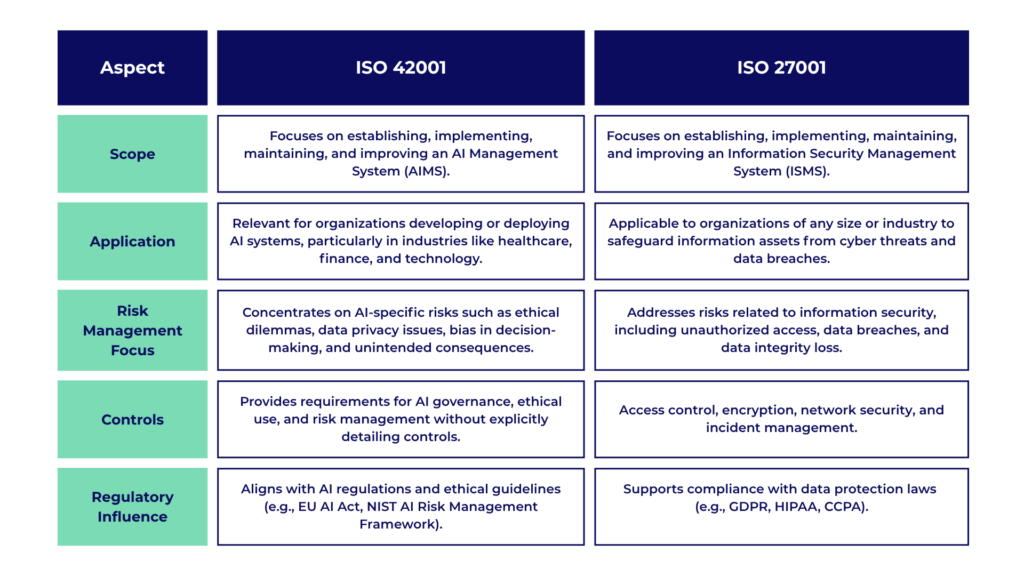
Table 1: ISO 42001 and ISO 27001 Comparison
ISO 42001 and ISO 9001
ISO 42001 shares foundational similarities with ISO 9001 as well, since both are structured around management system frameworks that emphasize risk management and continuous improvement. While ISO 9001 establishes a quality management system for product and service excellence, ISO 42001 extends the same discipline into the AI environment.
Unlike the ISO 42001 and ISO 27001 pairing, which centers on risk, the ISO 9001 relationship centers on process. Both advocate a process-oriented approach. ISO 9001 uses a cycle of planning and implementation to drive improvement in organizational processes, and ISO 42001 applies the same cycle to manage the AI system lifecycle. Risk management is a further point of overlap: ISO 9001 requires identifying and controlling risks to product and service quality, and ISO 42001 applies risk and impact assessment to the AI environment, covering issues such as algorithmic bias and the unintended consequences of AI decisions. Both also emphasize data quality, with ISO 9001 controlling documented information and ISO 42001 extending that concern to the lineage and source of data used in AI models.
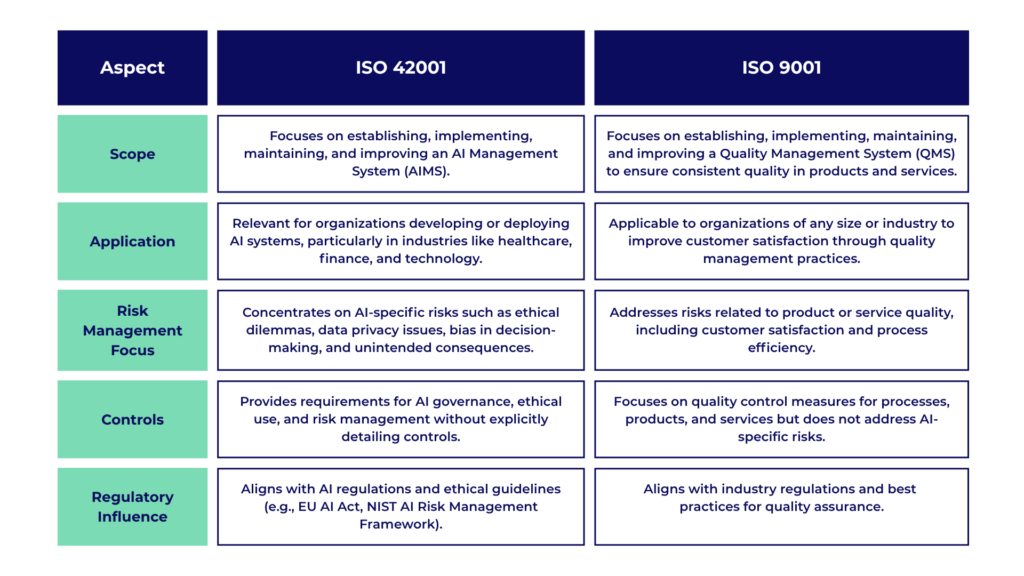
Table 2: ISO 42001 and ISO 9001 Comparison
What Is Unique to Each Standard
The shared structure does not make the standards interchangeable. Each carries domain-specific requirements and its own set of controls.
| Dimension | ISO 9001 | ISO 27001 | ISO 42001 |
|---|---|---|---|
| Focus | Consistent product and service quality | Confidentiality, integrity, availability of information | Responsible development and use of AI systems |
| Controls Annex | No control annex | Annex A: 93 information security controls | Annex A: 42 AI control objectives |
| Signature Requirement | Customer satisfaction and process consistency | Statement of Applicability, risk treatment | AI risk assessment and AI impact assessment |
| Risk Lens | Process and product risk | Threats to information assets | Model bias, data provenance, transparency, decisions that learn and change over time |
ISO 42001’s Annex A maps 42 control objectives ranging from data quality and transparency to human oversight and incident response, while ISO 27001 already addresses data protection, access controls, and incident response, and ISO 42001 extends those concerns into AI-specific territory like model behavior monitoring, bias detection, and decision transparency. ISO 9001 contributes the change-management discipline: AI model updates can flow through the same controlled change management that applies to other quality-affecting changes.
What This Means for Multi-Standard Certification
The ISO 42001 and ISO 27001 relationship is the one most organizations act on first: if you already hold ISO 27001, integrating ISO 42001 is the most natural next step, because the security management system you already operate can share its risk assessment processes, internal audit procedures, and management review meetings with the AI management system. ISO 9001 adds the quality and change-control layer that keeps AI systems consistent over time. Building all three on one Annex SL foundation reduces duplicated documentation, lets you run combined audits, and turns governance into a single coherent program rather than three competing initiatives.
The efficiency is real but it is not automatic. The ISO 42001 and ISO 27001 clauses only collapse into shared effort if the management system is designed that way from the start, with one risk register, one audit calendar, and one management review that covers all three scopes. Organizations that certify each standard as a separate project rebuild the same Clause 4, 5, 7, 9, and 10 machinery three times and capture none of the overlap.
How Can Elevate Help with ISO 42001 Compliance
ISO 42001 extends the established principles of information security and quality management into the AI domain, letting organizations address emerging-technology challenges within a structured, familiar framework. By using the common components of these standards, an organization can build management systems that go beyond regulatory compliance toward reliability, security, and continuous improvement, each aligned with business objectives.
Elevate Consult helps organizations map these overlaps, build an integrated management system, and prepare for combined certification across ISO 42001, ISO 27001, and ISO 9001. To scope an integrated management system against the standards your organization needs, book a call with an Elevate advisor.
Conclusion
ISO 42001 and ISO 27001, together with ISO 9001, are far more integrable than they first appear, because all three inherit the same Annex SL structure and the same Plan-Do-Check-Act rhythm. The shared clauses, context, leadership, support, performance, and improvement, let one risk register, one audit, and one management review serve every scope at once, while the genuine differences concentrate in planning and operation, where each standard applies the common frame to its own subject. The organizations that benefit most are the ones that design for the overlap from day one rather than certifying each standard in isolation.
Key Takeaways
ISO 42001 and ISO 27001, together with ISO 9001, share one management-system backbone, which turns multi-standard certification from three projects into one.
One structure underlies all three. The Harmonized Structure (Annex SL), Clauses 4 through 10, and the Plan-Do-Check-Act cycle are common across the three standards, so their architecture is shared.
The overlap lives in specific clauses. Clauses 4, 5, 7, 9, and 10 carry most of the shared effort; the real divergence is in Clause 6 (planning and risk) and Clause 8 (operation).
ISO 27001 is the natural on-ramp to ISO 42001. An existing ISMS can share its risk assessment, internal audit, and management review with an AIMS, making ISO 42001 the most efficient next certification.
The standards are not interchangeable. ISO 27001 carries 93 Annex A controls, ISO 42001 adds 38 controls under nine control objectives for AI-specific concerns, and ISO 9001 contributes change-management discipline.
The savings require deliberate design. One risk register, one audit calendar, and one management review across all scopes capture the overlap; certifying each standard as a separate project does not.
FAQs
Q1. What is the difference between ISO 42001 and ISO 27001?
ISO 27001 governs an information security management system, protecting the confidentiality, integrity, and availability of information. ISO 42001 governs an AI management system, extending similar risk and governance discipline to AI-specific concerns such as model bias, data provenance, transparency, and decisions that change over time. They share the same Annex SL structure and Plan-Do-Check-Act cycle, so the frameworks feel familiar, but each carries its own controls and signature requirements: a Statement of Applicability and risk treatment for ISO 27001, an AI risk assessment and AI impact assessment for ISO 42001.
Q2. Can ISO 42001 and ISO 27001 be certified together?
Yes, and doing so is efficient. Because both follow the Harmonized Structure across Clauses 4 through 10, an organization can share leadership commitment, risk processes, internal audit, and management review between the two systems. A single risk register, one audit calendar, and one management review can cover both scopes, which is why organizations that already hold ISO 27001 typically find ISO 42001 the most natural next certification to add.
Q3. Does ISO 42001 replace ISO 27001?
No. The two standards address different domains and are complementary rather than substitutes. ISO 27001 secures information assets; ISO 42001 governs the responsible development and use of AI systems. ISO 42001 assumes and builds on strong information security rather than replacing it, which is why the two are commonly implemented together, with ISO 27001 providing the security foundation and ISO 42001 extending governance into AI-specific risks.
Q4. How does ISO 9001 relate to ISO 42001 and ISO 27001?
ISO 9001 shares the same Annex SL backbone as the other two, so its clauses map directly onto theirs. Its distinct contribution is quality and change-management discipline: the controlled change management ISO 9001 applies to quality-affecting changes is exactly what keeps AI models consistent and traceable over time under ISO 42001. Organizations pursuing all three build one integrated management system, using ISO 9001 for process consistency, ISO 27001 for security, and ISO 42001 for AI governance.
Q5. Which standard should you implement first, ISO 27001 or ISO 42001?
For most organizations, ISO 27001 first. It establishes the risk assessment methodology, information security controls, and management-system discipline that ISO 42001 then extends into the AI domain. An organization that already operates an ISMS can reuse most of that machinery when adding an AIMS, making the combined effort substantially smaller than certifying ISO 42001 from a standing start. Organizations that already hold ISO 27001 are therefore in the strongest position to add ISO 42001 efficiently.