
CMMC readiness stands as a vital requirement for organizations aiming to secure and maintain Department of Defense contracts. Our organization’s direct experience with the certification process shows that compliance goes beyond regulatory requirements – it’s now a competitive edge.
Organizations handling Controlled Unclassified Information (CUI) must meet specific security requirements through the Cybersecurity Maturity Model Certification (CMMC) framework, which builds on NIST 800-171 standards. A thorough gap analysis helps identify your organization’s current position relative to these requirements. This crucial step reveals the differences between your existing cybersecurity practices and CMMC framework standards.
Defense Industrial Base (DIB) members need a systematic, programmatic approach to protect sensitive defense information while pursuing CMMC compliance. CMMC Level 2 certification has become crucial to demonstrate compliance with federal cybersecurity standards and retain valuable DoD contracts.
Let us show you our proven 5-step roadmap to CMMC readiness. This approach will help you tackle gaps effectively and direct your path to certification with confidence.
Step 1: Define Your CMMC Scope and Objectives
Your CMMC compliance success starts with a clear scope and objectives. Many organizations rush to put controls in place before they know which systems handle sensitive government information. This first step shapes everything from how much your assessment will cost to how complex implementation becomes. Your certification success depends on getting this right.
Clarifying CUI and FCI Boundaries
Every CMMC readiness effort starts with understanding how Federal Contract Information (FCI) differs from Controlled Unclassified Information (CUI). These differences shape your compliance needs and assessment scope.
FCI is information the government doesn’t want released publicly, which they either provide or generate under a contract. This covers documentation, technical data, and project communications not available to the public. CUI is a special type of FCI that needs specific protection and control measures based on laws, regulations, and government policies.
Here’s a key rule: CUI always counts as FCI, but FCI isn’t always CUI. This matters because CUI needs stronger protection than regular FCI.
A visual data flow diagram can help you set clear boundaries by showing how information moves through your company. This helps you spot:
- Entry points where CUI/FCI comes into your environment
- Systems and assets that work with this information
- Places where sensitive data lives
- How and where information travels and exits
Physical boundaries cover your buildings, offices, and data centers with CUI, while logical boundaries include your networks, systems, and cloud setups. You need good separation between systems that handle CUI and those that don’t to set the right scope.
The CMMC Assessment Scope document lists five asset types for Level 2 compliance:
- CUI Assets – Systems that directly handle CUI
- Security Protection Assets – Systems that keep things secure (firewalls, authentication servers, etc.)
- Contractor Risk-Managed Assets – Systems that could handle CUI but aren’t meant to
- Specialized Assets – Government property, IoT devices, operational technology, or test equipment
- Out-of-Scope Assets – Systems completely cut off from CUI environments
Each type needs different documentation and assessment methods. To cite an instance, CUI assets need assessment against all 110 CMMC controls, but specialized assets need less evaluation.
Determining Applicable CMMC Level
The sensitivity of information in your contracts decides which CMMC level you need. The DoD has clear rules about this.
CMMC 2.0 has three levels:
- Level 1 (Foundational): For organizations that only handle FCI
- Level 2 (Advanced): For those who work with CUI
- Level 3 (Expert): For handling critical CUI or sensitive programs
Most defense contractors need CMMC Level 2 certification if they work with CUI. The assessment type changes based on your CUI category:
- Level 2 Self-Assessment: Works for CUI outside the National Archives’ CUI Registry Defense Organizational Indexing Grouping
- Level 2 Certification by C3PAO: Required for CUI within the Defense Organizational Indexing Grouping
You can check which level you need by looking at your contracts’ DFARS clauses. DFARS 252.204-7012 usually means you need Level 2. Contracts with just FAR 52.204-21 might only need Level 1.
Level 2 certification comes with a note: you must close all Level 2 Plan of Action and Milestones (POA&M) items before starting a Level 3 assessment if you need one later.
Avoiding Over-Scoping and Under-Scoping Pitfalls
Getting your scope wrong can get pricey and cause problems. Over-scoping happens when you include systems that don’t handle CUI in your assessment. This makes compliance more expensive, takes longer, and complicates everything.
Under-scoping means missing key systems that handle CUI, which can make you fail assessments and lose contracts. Both mistakes come from not understanding CUI boundaries and data flows clearly.
Here’s how to avoid these issues:
- Review your contracts to find what CUI you handle
- Talk to your teams about possible shadow IT or hidden workflows
- Check cloud service bills to find all data storage spots
- Keep CUI and non-CUI environments separate
- Document everything, especially data flows and security measures
You can separate in-scope and out-of-scope assets both logically and physically. Logical separation uses VLANs and firewall rules, while physical separation means complete disconnection. Without good separation, your whole network might need certification, which gets complex fast.
Here’s a useful tip: if CUI touches more than 60% of your systems, certifying everything might make more sense than creating a separate area.
Your C3PAO will check during pre-assessment that everything within your boundaries has proper protection and only authorized people can access it. Good documentation of your scoping decisions with data flow diagrams, network diagrams, and asset lists shows you’re ready and prevents scope expansion.
Scoping isn’t just about saving money. You need accurate, defensible boundaries that protect sensitive government information properly while making your CMMC preparation work efficiently.
Step 2: Conduct a CMMC Readiness Assessment
Your next critical step after setting scope boundaries is to do a complete CMMC readiness assessment. This evaluation shows where you stand with CMMC Level 2 requirements and finds gaps you need to fix.
Using a CMMC Readiness Checklist
A well-laid-out CMMC readiness checklist guides you through the assessment process. You can track progress, organize evidence, and make sure you don’t miss any requirements.
Your checklist should have these key parts:
- Complete inventory of all in-scope assets (CUI-handling systems, security protection assets, risk-managed assets, and specialized assets)
- Documentation review checklist (policies, procedures, System Security Plans)
- Technical implementation verification steps
- Personnel training and awareness verification
- Evidence collection guidelines
The checklist should line up with the CMMC Assessment Guide Level 2, which has 320 assessment objectives across 110 security requirements. C3PAOs will use these objectives during official assessments.
Make your checklist match the actual assessment process. The CMMC Assessment Process (CAP) v2.0 shows how C3PAOs conduct certification assessments. Reading this document helps you know what assessors want.
Your checklist should help evaluate both technical setup and policy documents. CCAs (CMMC Certified Assessors) will check evidence, talk to staff, and test to verify practices. Building your checklist this way prepares you for the real assessment.
Mapping Current Controls to NIST 800-171
Success in assessment depends on understanding how CMMC and NIST 800-171 work together. CMMC Level 2 matches the 110 security requirements in NIST SP 800-171 Rev. 2.
One expert says, “The most important takeaway is that you shouldn’t treat NIST 800-171 and CMMC compliance as separate, unrelated initiatives. They are deeply interconnected, and in practical terms, if you comply with NIST 800-171, you have implemented virtually all the security controls needed for CMMC Level 2, since Level 2 is defined as implementing those 110 controls”.
The mapping involves:
- Writing down your current security controls and practices
- Matching these controls to NIST 800-171 requirements
- Finding which requirements you meet fully, partly, or not at all
- Writing detailed statements about each control
Keep your documents up to date. Your System Security Plans (SSPs) and Plans of Action and Milestones (POA&Ms) must show your environment as it exists today, not old versions. Outdated documents often cause assessment failures.
Mapping also shows where CMMC overlaps with other frameworks you might use. This saves work and lets you use what you’ve already done for compliance.
Book a Readiness Call with certified consultants who can help map your controls to NIST 800-171 requirements and find critical gaps that need quick fixes.
Identifying Gaps Across 14 Control Families
After mapping your controls, you’ll likely find gaps in some or all of the 14 control families. These families organize NIST 800-171 and CMMC Level 2 requirements.
The 14 control families are:
- Access Control
- Awareness and Training
- Audit and Accountability
- Configuration Management
- Identification and Authentication
- Incident Response
- Maintenance
- Media Protection
- Personnel Security
- Physical Protection
- Risk Assessment
- Security Assessment
- System and Communications Protection
- System and Information Integrity
Common gaps include outdated System Security Plans (SSPs), missing access control policies, incomplete incident response plans, gaps in multi-factor authentication (MFA), no formal risk assessment processes, weak training programs, and poor network segmentation or audit logging.
Focus first on what experts call “showstopper requirements” – critical controls like multi-factor authentication, vulnerability patching, and incident response capabilities. These high-priority requirements support other controls and can block compliance if not done right.
For each gap you find, write down:
- Which requirement isn’t met
- Current state versus desired state
- Resources you need to fix it
- How long it will take
- Who’s responsible
NIST 800-171 scoring gives different weights to controls. Each of the 110 security controls gets 1, 3 or 5 points, adding up to 110 points for perfect compliance. Knowing these weights helps you focus on fixes that matter most.
Using CMMC Readiness Assessment Services
CMMC requirements are complex, so many organizations get help from specialized assessment services. These services offer expert guidance, proven methods, and fair evaluations of your security setup.
Professional CMMC readiness assessment services usually provide:
- Detailed control mapping against CMMC Level 2 requirements
- Test-case matrices for verification
- Custom remediation roadmaps
- Documentation review and improvement
- Mock assessment simulations
These services verify your scoping decisions, which matters because wrong scoping can cause assessment failures or extra costs. Your C3PAO will check that everything within your boundaries is protected and only available to authorized people.
Choose assessment services that have The Cyber AB certified CMMC consultants. These experts know the assessment process inside out and can get you ready for C3PAO evaluations.
Assessment services can also tell if you qualify for the Plan of Action and Milestones (POA&M) process. With CMMC, you can use POA&Ms to fix remaining gaps if your assessment score hits at least 80% (88/110 practices ‘MET’) after fixing limited practice issues. But POA&Ms won’t work for most three- or five-point controls, so good preparation matters.
A good readiness assessment gets your team ready for assessment interviews. CCAs will check documents and technical controls but also talk to staff to verify understanding. Assessment services run practice interviews to prepare your team.
Remember, this process isn’t just about compliance. A structured assessment finds specific weak points and suggests targeted fixes, helping you use resources wisely to improve your cybersecurity to meet DoD standards.
Step 3: Prioritize Gaps Based on Risk and Impact
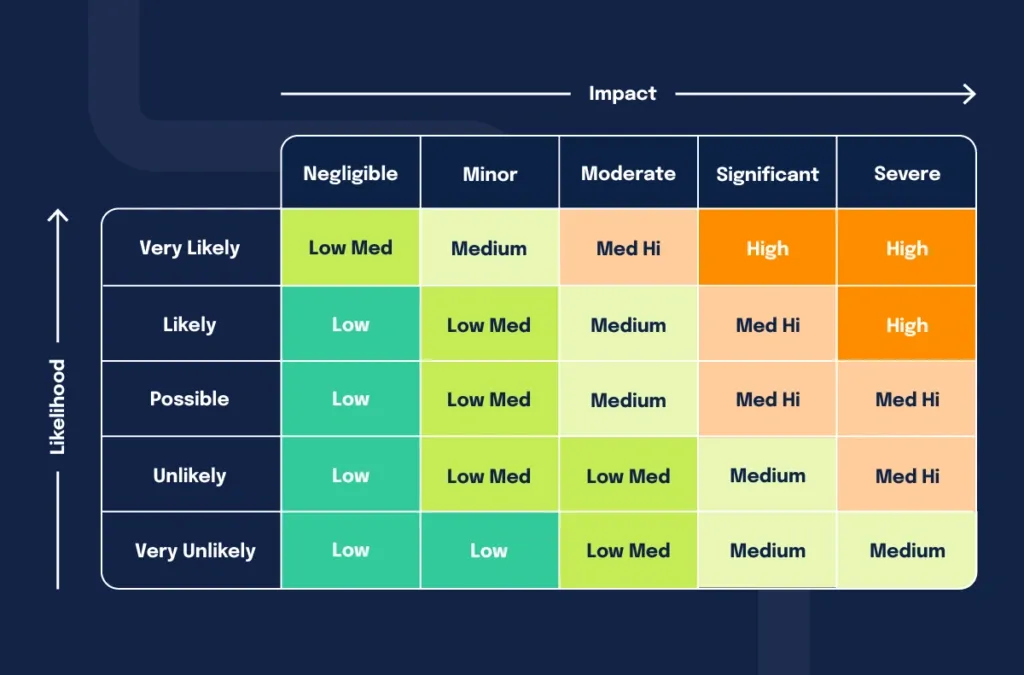
Image Source: Hyperproof
Once you’ve spotted gaps in your environment, the next big step in your CMMC readiness is to rank them by importance. Security gaps don’t all carry the same weight. Some might pose major threats to your security, while others need more work to fix. The quickest way to handle this is to tackle the most dangerous vulnerabilities first, which helps you get the most out of your security efforts and resources.
Categorizing Gaps by Criticality
The best place to start is by sorting gaps based on their effect and likelihood. The CMMC framework assigns different weights to controls—1, 3, or 5 points based on how critical they are to your security. This scoring system gives you a solid foundation to work from.
When ranking gaps, think over these factors:
- Risk level: The potential impact if exploited
- Cost of remediation: Resources required to address the gap
- Implementation complexity: Technical difficulty and time requirements
- Relationship to CUI protection: Direct impact on Controlled Unclassified Information security
Creating a priority matrix helps you see which problems need immediate attention. Here’s an example:
| Gap Identified | Risk Level | Priority (1-5) |
| Lack of Incident Response Plan | High | 1 |
| Weak User Authentication | High | 2 |
| Insufficient Audit Logs | Medium | 3 |
| Missing Configuration Baseline | Medium | 4 |
Your first priority should be the “non-negotiable” requirements that are the foundations of your security program. Multi-factor authentication (MFA), FIPS-validated encryption, incident response capabilities, audit logging, and complete System Security Plans (SSPs) are essential. You can’t put these off with Plans of Action and Milestones (POA&Ms)—they must be ready for assessment.
Arranging Remediation with CMMC Level 2 Requirements
Your priority list must match CMMC Level 2 requirements, which include all 110 security requirements from NIST SP 800-171 Rev. 2. You need a minimum score of 80% (88 out of 110 points) to qualify for conditional certification.
These critical controls can’t be included in POA&Ms:
- AC.L2-3.1.20: External Connections (CUI Data)
- AC.L2-3.1.22: Control Public Information (CUI Data)
- CA.L2-3.12.4: System Security Plan
- PE.L2-3.10.3: Escort Visitors (CUI Data)
- PE.L2-3.10.4: Physical Access Logs (CUI Data)
- PE.L2-3.10.5: Manage Physical Access (CUI Data)
High-impact controls boost your SPRS score while fixing major compliance gaps. Your risk strategy should mix risk assessments with gap severity to fix the most urgent security issues within your 9-12 month timeline.
The best approach tackles three categories in order:
- Critical Requirements: Controls you can’t delay that you need for certification
- Five-point and Three-point Controls: High-value controls that substantially affect your score
- One-point Controls: Lower-impact requirements that might qualify for POA&Ms if you hit the 80% mark
Your priority strategy should focus on making your security stronger while working toward compliance, not just ticking boxes.
Using POA&M Templates for Planning
A Plan of Action and Milestones (POA&M) isn’t just paperwork—it’s your roadmap to fixing problems. A good POA&M template helps you track and fix gaps within 180 days after getting conditional certification.
For CMMC Level 2, POA&Ms let organizations that meet most requirements (at least 80% compliance) get conditional certification while fixing remaining issues. You can only use POA&Ms for specific 1-point controls, not critical requirements.
A solid POA&M template needs these elements:
- Direct Traceability: Linking each gap to specific CMMC practices, controls, and assessment objectives
- Risk-Based Prioritization: Scoring that pushes leadership to fix serious issues first
- Acceptance Criteria: Clear conditions that show when a gap is fixed
- Evidence Location: Where to find proof of implementation
- Timeline and Milestones: Specific completion dates with checkpoints
Your template should also include fields for backup controls and temporary risk measures to show how you’re handling exposure until permanent fixes are ready.
The POA&M process starts with a security assessment that shows where your controls fall short. Focus on five-point and three-point controls first—missing these means no conditional certification.
POA&Ms come with specific rules:
- You need a minimum score of 80% (88/110)
- Only certain 1-point low-impact controls can be missing for temporary conditional status
- Everything must be fixed within 180 days
- If a C3PAO created your POA&M, they must do the final assessment
Your POA&M becomes your guide to closing cybersecurity gaps. It spells out which controls need work, what resources you’ll need, who’s responsible, and when it needs to be done. A well-built POA&M organizes your fixes, makes progress measurable, and lines up with contract dates.
A structured approach to fixing gaps puts you on track for CMMC certification while making the best use of your resources. This risk-based method ensures you tackle the biggest security risks first, protect CUI effectively, and build a strong foundation for your cybersecurity program.
Step 4: Implement Technical and Policy Controls
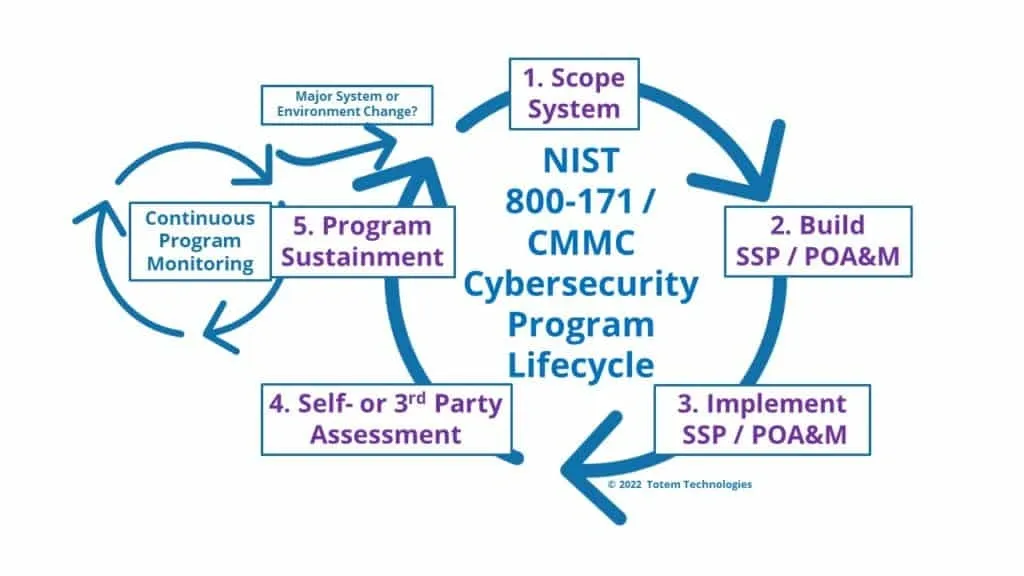
Image Source: Totem Technologies
Your CMMC readiness effort needs strong technical and policy controls after identifying and prioritizing gaps. The remediation plan should focus on security requirements that protect Controlled Unclassified Information (CUI).
Multi-Factor Authentication and Access Control
MFA implementation is mandatory to achieve CMMC Level 2 compliance. The CMMC practice IA.L2-3.5.3 needs MFA for:
- Local and network access to privileged accounts
- Network access to non-privileged accounts
- Nonlocal maintenance sessions via external network connections
You can’t use two passwords to meet MFA requirements. The system needs two different authentication factors: something you know (password), something you have (token), or something you are (biometric). Many organizations only set up MFA for cloud services like Microsoft 365. This approach falls short since local logons to privileged accounts need MFA too.
A proper access control system has:
- Role-based access limits that follow least privilege principles
- Written user provisioning and de-provisioning steps
- Access reviews every quarter
- Quick account deactivation when staff leaves
Shared administrator accounts create accountability issues. These accounts make it hard to track specific users and often lead to compliance failures.
Encryption for CUI at Rest and in Transit
CMMC Level 2 requires FIPS-validated encryption to protect CUI both at rest (SC.L2-3.13.16) and in transit (SC.L2-3.13.8). FIPS-validated cryptographic modules must be used instead of just FIPS-approved algorithms.
AES-256 encryption should protect all CUI storage locations:
- File servers and document management systems
- Databases with controlled technical information
- Email archives containing CUI
- Backup systems and disaster recovery infrastructure
- Endpoint devices including laptops
TLS 1.2 or higher with FIPS-approved cipher suites protects most data transmissions. Old protocol versions with known vulnerabilities should be turned off. Email security needs special attention. Standard email doesn’t encrypt messages end-to-end, so you need secure email solutions with AES-256 encryption.
Cloud services’ key management decides who can access encrypted CUI. You have three options: provider-managed keys (simple but provider keeps access), customer-managed keys (you control lifecycle but provider stores keys), and customer-owned keys (best security as provider never has keys).
Updating System Security Plans (SSP)
The System Security Plan shows how your organization safeguards CUI through people, processes, and technology. A complete SSP needs:
- Network diagrams and data flow maps
- Control implementation statements for all 110 NIST 800-171 requirements
- Staff responsible for each security domain
SSP works as a risk management tool and provides evidence during CMMC assessments. Regular quarterly reviews through a formal change management process keep your SSP accurate and in sync with your environment.
Your organizational structure should detail specific security roles and duties. Each control needs implementation details rather than compliance statements. For example: “Access to CUI systems requires multi-factor authentication using hardware tokens with complex passwords (minimum 12 characters)” works better than “We use multi-factor authentication”.
Training SMEs for the CMMC Assessment Process
Staff preparation plays a vital role in CMMC assessment success. Assessors will talk to your team to verify security practices. Your staff should be ready to:
- Explain security policies, procedures, and technical setups
- Show how they handle and protect CUI
- Give accurate answers without saying too much or creating new compliance gaps
Training Subject Matter Experts (SMEs) for each control family helps ensure knowledgeable responses during assessor interviews. Mock assessment sessions help staff understand typical assessor questions and appropriate response levels.
The team needs to know that assessors use three methods: they look at documentation, talk to staff, and test security controls. Getting your team ready for all these methods will lead to certification success.
Step 5: Validate Readiness with a Pre-Assessment
A pre-assessment to prove your readiness is the last significant step before seeking formal CMMC certification. This process helps find compliance gaps that might surface during the official assessment.
Simulating a CMMC Level 2 Assessment
Mock assessments mirror the official CMMC Level 2 certification process and help organizations spot compliance gaps. Your teams will become familiar with assessment procedures. The simulation lets you identify areas that don’t meet requirements without risking certification failure. You’ll get a preview of your compliance score, build team competence, and spot controls that need work.
C3PAOs use the same methodology in mock assessments by reviewing documentation and testing control implementation. Your team gets hands-on experience with the assessment process in a relaxed environment.
Reviewing Evidence Submission Requirements
Evidence management plays a vital role in the pre-assessment phase. Organizations need to show consistent application of security practices. Each control needs specific artifacts that demonstrate implementation:
- System-generated logs that show control effectiveness
- Documentation that proves consistent operation over time
- Evidence that shows both control existence and operational implementation
Book a Readiness Call with experienced CMMC specialists to help prepare complete evidence packages that satisfy C3PAO requirements.
Correcting Misalignments in SSP and Policies
Organizations often find systemic problems in their System Security Plan during pre-assessment. Documentation gaps, outdated information, and scoping errors are common issues. The mock assessment results will show if your organization’s control practices meet CMMC requirements.
These SSP weaknesses need attention:
- Unclear descriptions of system boundaries
- Incomplete component listings (hardware, software, users, cloud services)
- Missing network flow diagrams showing how CUI travels
Preparing for C3PAO Interviews and Walkthroughs
Staff preparation is essential for successful assessments. C3PAO assessors will interview your personnel to verify security practices awareness and implementation. Get your team ready by:
- Assigning interview roles based on security domain expertise
- Conducting practice sessions with assessment-style questions
- Training staff to demonstrate security controls in action
Note that assessments use three main methods: reviewing documentation, discussions with personnel, and verifying actual control behavior. Preparing for these approaches will position your organization for certification success.
Conclusion
CMMC compliance is more of a continuous process than a final destination for organizations within the Defense Industrial Base. Our strategic approach turns CMMC preparation from an overwhelming challenge into a manageable process. The five-step methodology provides clear direction and addresses critical compliance requirements.
A proper scoping helps focus resources well and prevents mistakes that can get pricey or create risks through insufficient coverage. Complete readiness assessments then identify gaps in all 14 control families. Risk-based prioritization helps remediation efforts target the most critical vulnerabilities first, especially when protecting Controlled Unclassified Information.
Technical and policy implementations are the foundations of our compliance strategy. Multi-factor authentication, proper encryption, and detailed System Security Plans are essential elements for Level 2 certification. Pre-assessment simulations prepare teams well for their interactions with C3PAOs during formal certification.
Note that CMMC compliance provides benefits beyond contract eligibility. This systematic approach builds a stronger security posture, protects sensitive information, and shows your dedication to cybersecurity excellence. Companies that see CMMC as a chance rather than just a requirement gain competitive edges in the defense marketplace.
The certification process starts with understanding your current position and creating an achievable plan. You should assess your current state, identify priority gaps, and build your roadmap to CMMC certification success now.
Key Takeaways
CMMC compliance requires a systematic approach that transforms overwhelming requirements into manageable steps. Here are the essential insights for achieving certification success:
• Define clear CUI boundaries first – Proper scoping prevents costly over-scoping and risky under-scoping that can derail your entire compliance effort.
• Prioritize critical “showstopper” requirements – Focus on non-negotiable controls like multi-factor authentication, FIPS encryption, and incident response that cannot be deferred.
• Implement technical controls systematically – MFA for privileged accounts, FIPS-validated encryption for CUI, and complete System Security Plans form the compliance foundation.
• Validate readiness through mock assessments – Pre-assessment simulations identify gaps and prepare teams for C3PAO interviews before formal certification.
• Treat CMMC as competitive advantage – Organizations viewing compliance as opportunity rather than burden gain significant advantages in the defense marketplace.
The 5-step roadmap provides a proven framework for achieving CMMC Level 2 certification while strengthening your overall cybersecurity posture. Success depends on understanding your current state, prioritizing gaps by risk and impact, and building a realistic implementation timeline that addresses the most critical vulnerabilities first.
FAQs
Q1. What is the first step in preparing for CMMC certification? The first step is to define your CMMC scope and objectives. This involves clarifying CUI and FCI boundaries, determining the applicable CMMC level, and avoiding over-scoping or under-scoping pitfalls. Proper scoping is crucial for focusing resources effectively and preventing costly errors.
Q2. How should organizations prioritize gaps identified during a CMMC readiness assessment? Organizations should prioritize gaps based on risk and impact. This involves categorizing gaps by criticality, aligning remediation efforts with CMMC Level 2 requirements, and using Plan of Action and Milestones (POA&M) templates for planning. Focus on addressing critical “showstopper” requirements first, followed by high-value controls that significantly impact your compliance score.
Q3. What are some key technical controls required for CMMC Level 2 compliance? Key technical controls for CMMC Level 2 compliance include multi-factor authentication (MFA) for privileged accounts and network access, FIPS-validated encryption for CUI at rest and in transit, and comprehensive access control measures. Implementing these controls is essential for protecting Controlled Unclassified Information (CUI) and meeting certification requirements.
Q4. Why is a pre-assessment important before seeking formal CMMC certification? A pre-assessment is crucial because it simulates a CMMC Level 2 assessment, helping organizations identify compliance gaps and familiarize teams with the certification process. It allows for reviewing evidence submission requirements, correcting misalignments in System Security Plans (SSPs) and policies, and preparing staff for C3PAO interviews and walkthroughs without risking certification failure.
Q5. How does CMMC compliance benefit organizations beyond meeting contractual requirements? CMMC compliance offers benefits beyond contract eligibility. It strengthens an organization’s overall security posture, enhances protection of sensitive information, and demonstrates a commitment to cybersecurity excellence. Organizations that view CMMC as an opportunity rather than just a requirement can gain significant competitive advantages in the defense marketplace.