
The implementation of an ISO 27001 checklist can take 3 to 12 months based on your organization’s size and complexity.
Small and medium-sized businesses need about four months to get audit-ready, plus two to three months for the certification audit. Your implementation might never succeed without proper project management that defines tasks, responsibilities and timeframes clearly.
Project managers in companies with up to 200 employees must dedicate about 20% of their time throughout the project, which equals one day per week. But ISO/IEC 27001 remains one of the most important information security standards globally.
We created this complete 12-month blueprint to help you implement your ISO 27001 checklist. Our step-by-step breakdown of the standard will help you establish an Information Security Management System (ISMS) that improves accountability and reduces missed requirements. This piece provides a structured approach to guide you through the ISO 27001 implementation roadmap – from building your team to achieving certification. You’ll meet all requirements along the way.
Your path to ISO 27001 compliance starts here!
Month 1–2: Set Up Your ISO 27001 Project
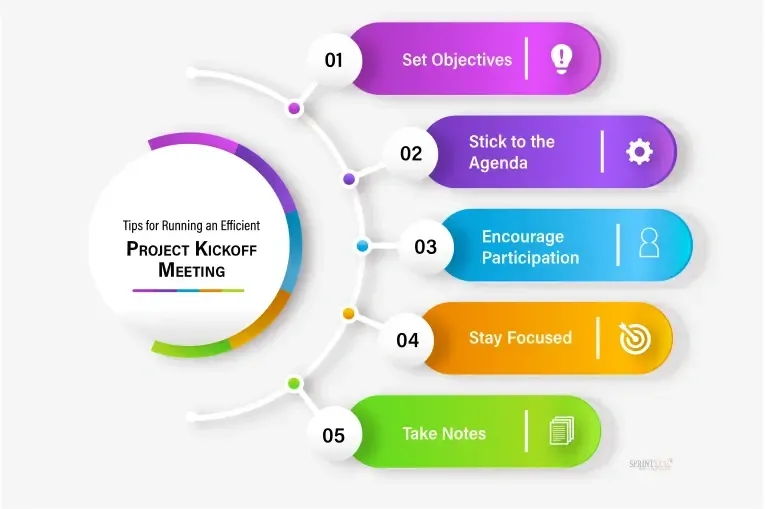
Image Source: Sprintzeal.com
A proper project setup lays the groundwork for successful ISO 27001 implementation. Studies show that organizations with well-laid-out teams have a 23% higher chance of passing their first ISO 27001 audit. Here’s what you need to do in the first two months of your compliance experience.
Form your implementation team
The right team makes all the difference in implementing your ISO 27001 checklist. Start by picking a dedicated project manager or information security manager to lead the initiative. This person will coordinate the project, handle documentation, and keep track of progress.
Your core team should have:
- Project Manager/IS Manager: The primary ISMS implementer who coordinates the project
- IT and System Administration: Critical for implementing technical controls
- C-level Support: The work to be done needs their authority and budget approval
- Department Heads: Stakeholders from departments of all sizes (HR, Engineering, etc.)
- ISO 27001 Expert: You might need external expertise if internal knowledge falls short
- Internal Auditor: A crucial yet often overlooked role for independent evaluation
Companies that clearly define roles see a 20% boost in ISO 27001 compliance. Make sure each team member knows their specific responsibilities and how they contribute to the implementation process.
On top of that, set up an Information Security Group (ISG) with clear guidelines to oversee the implementation. Regular meetings help review progress, tackle challenges, and fine-tune the implementation plan.
Define project scope and objectives
Maybe one of the most crucial early decisions is defining your ISMS scope. As one expert puts it, “Your scope decision isn’t just a compliance checklist item; it’s a high-stakes move that separates leaders who own risk from those who inherit regret”.
Your scope defines which information needs protection – whatever its storage location or access method. A scope that’s too wide wastes time and money, while a narrow one leaves gaps.
A solid scope document needs:
- A clear statement of boundaries
- Context of the organization (internal/external factors)
- Interested parties and their requirements
- Interfaces and dependencies with other systems/organizations
- Information asset inventory
Be explicit about what’s in and out of scope. Think about systems, people, locations, and departments during this process. A visual representation of dependencies and interfaces helps everyone see your ISO 27001 implementation boundaries.
After setting the scope, create SMART (Specific, Measurable, Attainable, Relevant, Time-bound) objectives for your ISMS. These objectives should line up with your business goals and guide your implementation efforts.
Create a high-level roadmap
Success demands treating ISO 27001 implementation as a formal project. Draft a detailed project charter that outlines scope, objectives, deliverables, timelines, and needed resources. Set key milestones to monitor progress throughout the implementation experience.
Most organizations use the PDCA (Plan-Do-Check-Act) cycle with these timeframes:
- Plan (1-3 months): Set objectives, organize information security, implement risk management framework
- Do (3-6 months): Create key policies, implement Annex A controls
- Check (1-2 months): Run internal ISMS audit, monitor and analyze
- Act (1-2 months): Fix issues and non-conformities
A solid communication plan keeps all stakeholders in the loop during implementation. Spot potential project risks early and develop strategies to handle them.
Note that Plan and Do phases need the most resources. Give these crucial foundation-building steps the time and team attention they deserve.
Month 3: Understand ISO 27001 Requirements
The third month is when you move from planning to learning what ISO 27001 really needs. You need to know these requirements well before putting them into practice. Research shows that companies who really understand the standard before implementation are 40% more likely to pass their certification audit on their first try.
Study Clauses 4–10 and Annex A
The ISO 27001 checklist has two main parts: mandatory clauses (4-10) and optional security controls (Annex A). Here’s what the mandatory clauses cover:
- Clause 4 (Context): Define your ISMS scope and understand organizational context
- Clause 5 (Leadership): Establish management commitment and security policies
- Clause 6 (Planning): Conduct risk assessment and create treatment plans
- Clause 7 (Support): Allocate resources, ensure competence, and document information
- Clause 8 (Operation): Implement risk treatment and control operations
- Clause 9 (Performance): Monitor, measure, analyze, and evaluate your ISMS
- Clause 10 (Improvement): Address nonconformities and improve continuously
Each clause has specific requirements you must meet to get certified. To name just one example, see clause 4.1 – it asks you to define your organization’s context, including internal and external factors that affect your information security goals.
You should also get familiar with Annex A. The 2022 version has 93 security controls in four categories: Organizational controls (37 controls), People controls (8 controls), Physical controls (14 controls), and Technological controls (34 controls). You don’t need to use every control – just pick the ones that match your risk assessment.
Identify key compliance obligations
You need to know exactly what documents you’ll need to show compliance. Your ISO 27001 checklist should include proof of:
- A formally defined ISMS scope document
- Information Security Policy signed by leadership
- Risk assessment methodology and results
- Statement of Applicability (SoA) showing which Annex A controls you’ve implemented
- Risk treatment plans that address identified risks
- Competence records proving staff qualifications
- Operational planning and control documentation
These documents show that your organization understands and manages information security risks actively. The Statement of Applicability plays a key role – it shows which controls you’ve implemented, which ones you’ve left out, and why.
Line up with other frameworks like GDPR or SOC 2
ISO 27001 overlaps with other popular frameworks, which can make compliance easier. Understanding these connections helps reduce duplicate work during implementation.
GDPR and ISO 27001 work well together. GDPR focuses on transparency and privacy rights for users, while ISO 27001 helps prevent breaches. ISO 27001’s controls can help meet many GDPR requirements, especially around data protection and security.
ISO 27001 and SOC 2 share several core elements:
- Information Security Management Systems (ISMS)
- Risk assessment methodologies
- Access control mechanisms
- Incident response procedures
- Continuous monitoring requirements
Mapping common controls across these frameworks creates a unified approach to compliance. ISO 27001’s risk assessment process can help meet SOC 2’s risk management requirements.
A single integrated risk management strategy that covers multiple standards will save time and resources. This way, you can use your ISO 27001 implementation as a foundation to meet other compliance needs your organization has.
Month 4–5: Conduct Gap Analysis and Risk Assessment
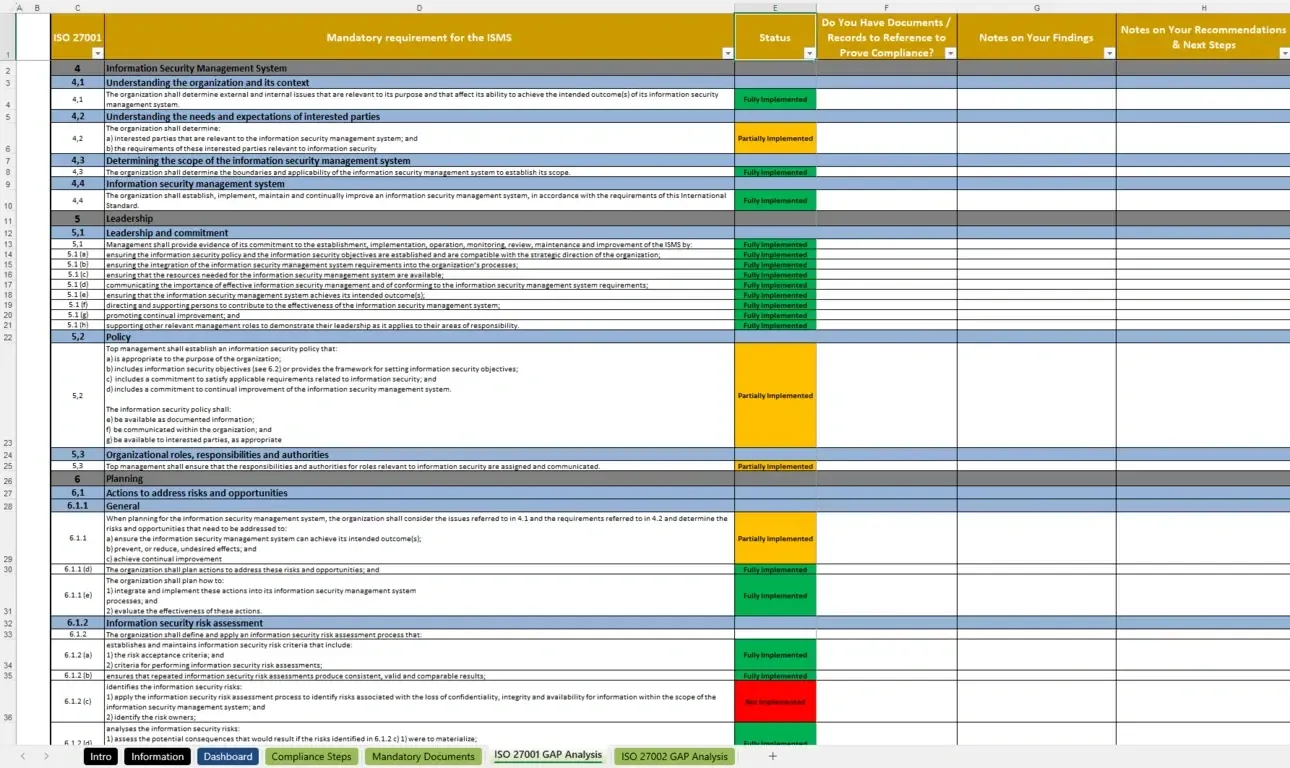
Image Source: Cyberzoni.com
The fourth and fifth months of your ISO 27001 experience move from theory to hands-on assessment. You need to get a full picture and assess risks during this crucial phase. These steps will build your security framework.
Assess current controls and policies
A gap analysis helps you start implementing ISO 27001. It compares your organization’s security practices with the standard’s requirements. You should assess your current controls against ISO 27001 Annex A. The standard contains 93 controls in four domains: Organizational (37), People (8), Physical (14), and Technological (34).
A well-laid-out gap analysis should include:
- Clear scope definition outlining which departments, systems, or processes need assessment
- Documentation review of existing policies and procedures
- Control assessment against Annex A requirements
- Stakeholder interviews to confirm findings
- Findings report with prioritized action items
Studies show that 60% of breaches target known vulnerabilities. Patches existed but weren’t applied, which shows why this assessment matters. Your organization must define and implement a risk assessment process that sets risk acceptance criteria and gives consistent results.
Identify risks and vulnerabilities
The next step identifies information security risks after you assess existing controls. ISO 27001 needs a “systematic, contextual, and defensible” approach to risk assessment. You must identify risks linked to confidentiality, integrity, and availability losses within your ISMS scope.
Here’s how to identify risks:
- Gather IT, Legal, HR, and operational department representatives to find risks in systems, data, suppliers, and people
- List relevant threats (like malicious actors, technical failures) and vulnerabilities (such as unpatched software, weak authentication) for each key asset
- Write specific risk statements instead of vague ones like “risk of hacking”. Use this format: “A [threat] could exploit [vulnerability] in [asset], leading to [impact]”
- Give risks to individuals, not teams—ISO 27001:2022 wants clear accountability
Next, analyze each risk by looking at potential consequences and realistic occurrence likelihood. Use your organization’s criteria to set risk levels. This analysis helps you decide which risks need attention first.
Document findings in a risk register
The risk register becomes your main tool to manage information security risks. It needs to be clear, current, and show a logical path from finding risks to making decisions. A good ISO 27001 risk register should have these key parts:
- Risk Identification: Unique ID, date identified, risk owner, affected assets, structured risk description
- Risk Analysis: Inherent likelihood score, inherent impact score, overall risk score
- Risk Treatment: Existing controls, treatment decision (reduce, accept, transfer, avoid), proposed controls, control owner
- Tracking: Status, review date, notes
Your documentation must stay audit-ready. Old files raise more red flags than trust during certification audits. ISO 27001 requires you to keep documented information about your risk assessment process.
The next phase starts right after you complete your risk register. You’ll define your ISMS scope and Statement of Applicability based on what you found. This creates a smooth flow in your ISO 27001 implementation plan and makes sure all identified risks have proper controls.
Risk management isn’t a one-time task. ISO 27001 needs you to assess risks regularly, at least yearly or when big changes happen.
Month 6: Define ISMS Scope and SoA
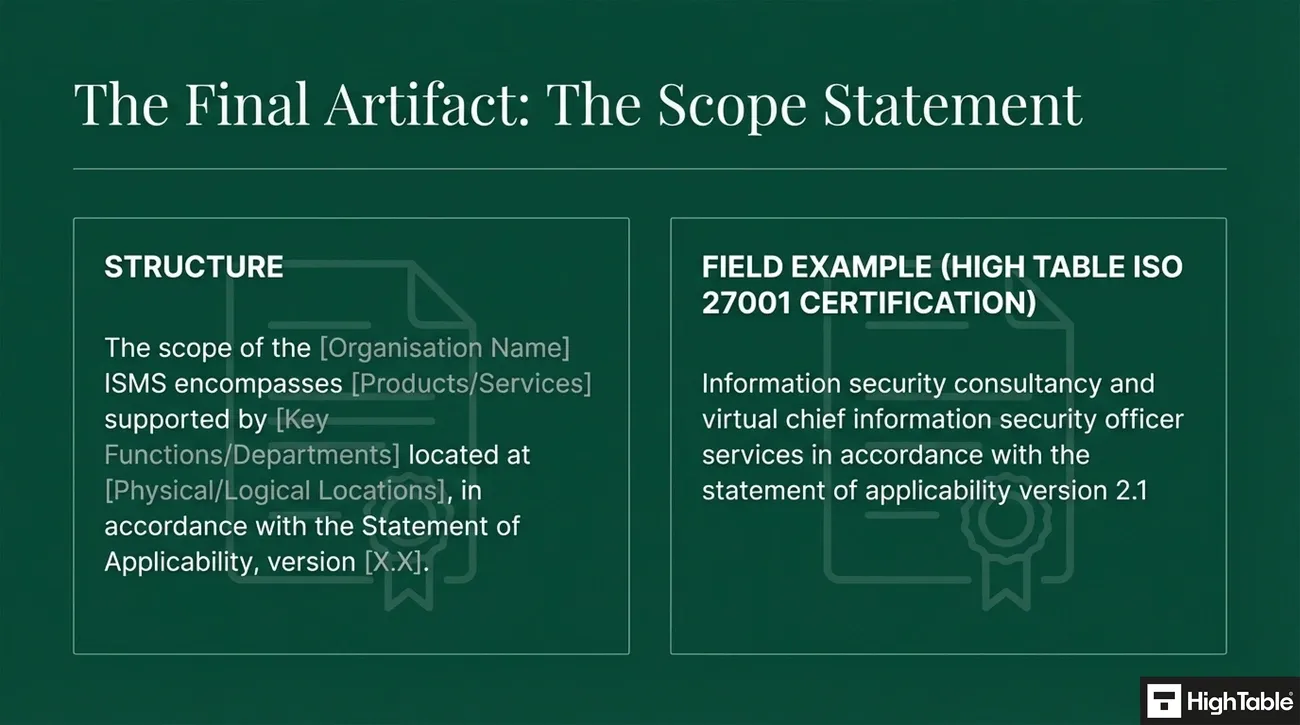
Image Source: High Table
Month 6 marks a crucial point in your ISO 27001 experience—time to define the boundaries of your Information Security Management System (ISMS) and document your security controls. These documents will be the foundations for your certification audit and ongoing security operations.
Determine what’s in and out of scope
Setting the scope of your ISMS is without doubt the most important step to get an ISO 27001 certified system. Your scope document should clearly show the boundaries of what your audit will cover. This will give a solid protection to your most valuable information assets.
As you set the scope, think about:
- Organizational context: What business processes create, access, or process valuable information?
- Physical locations: Which offices, data centers, or remote working arrangements are included?
- Technology assets: What systems, applications, and infrastructure fall within the boundary?
- Information assets: Which databases, documents, and intellectual property require protection?
- People: Which teams and activities directly manage client data?
You should also document what’s clearly out of scope. This helps auditors and prevents confusion about security responsibilities. All the same, be careful about excluding elements—narrow scopes “will be unable to protect your data” and “cannot satisfy the requirements of your clients”.
Smaller organizations often find it simpler to include the entire company in scope. Your scope should focus on what your customers buy from you and need assurance about regarding your security posture.
Want to check if your ISMS scope lines up with certification requirements? Book a Readiness Call with our ISO 27001 experts to check your approach before moving forward.
Draft the Statement of Applicability
The Statement of Applicability (SoA) shapes the scene of your ISO 27001 compliant system. This required document shows which controls from Annex A of the ISO 27001 standard you’ll implement based on your risk assessment results.
A working SoA needs:
- A complete list of all controls from Annex A
- Clear indication of which controls are included or excluded
- Justification for each inclusion or exclusion decision
- Implementation status of included controls
To build your SoA, start with your risk assessment and treatment documentation. Then create a logical, tabular format that maps each Annex A control to your organization’s activities. Many teams use a spreadsheet with columns for the control ID, name, applicability, justification, and implementation status.
Auditors typically review the SoA first during certification. It offers a “summary window” of your security controls and shows how your risk assessment guided your security decisions.
Get management approval
Management’s approval for your scope and SoA isn’t just a formality—it shows leadership’s dedication to your ISMS. Senior management should review and approve these documents to ensure they match organizational objectives and provide enough risk protection.
Show management your scope and SoA by highlighting:
- How the scope matches business objectives and client expectations
- The connection between identified risks and selected controls
- Resource needs for implementing the controls
- Ongoing maintenance requirements
Many powerful customers with high information risk ask to see your scope and SoA before working with you. They need to know your certification covers the parts of your business that will handle their information.
After approval, these documents become the life-blood of your ISMS implementation. They guide your security efforts and prove your organization’s systematic approach to information security.
Note that both the scope and SoA need regular reviews—at least yearly or when big business changes happen. This keeps them relevant as your organization grows and faces new security challenges.
Month 7–8: Create and Implement Documentation
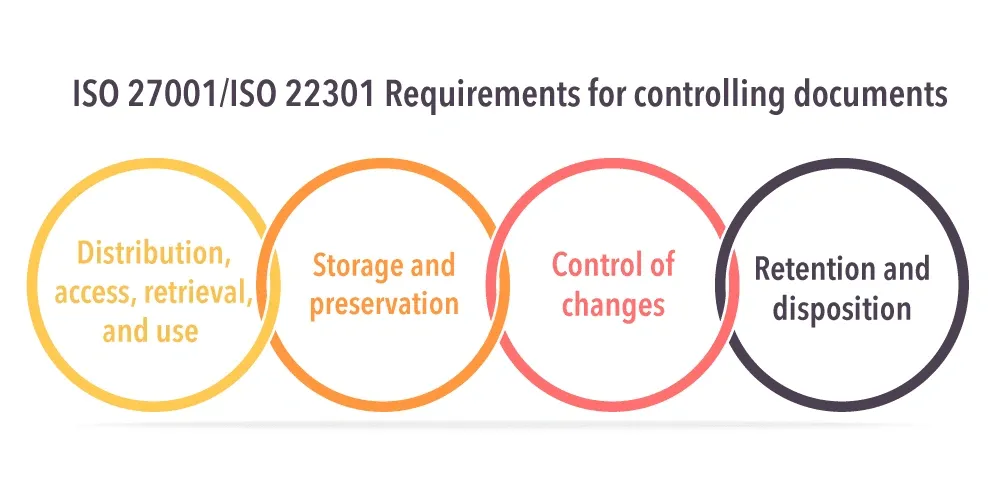
Image Source: Advisera
Documentation is the backbone of ISO 27001 compliance during months 7-8. Your security plans will turn into actionable policies and procedures. Most certification failures happen due to poor or ignored documentation rather than technical issues, so this phase needs your complete focus.
Develop required ISO 27001 policies
Your Information Security Policy (ISP) starts the ISMS documentation process. This high-level document should match your organization’s strategic goals and show leadership’s dedication to information security. Your ISP must:
- Address key stakeholder needs and security concerns
- Show dedication to meeting applicable requirements
- Prove commitment to ongoing ISMS improvement
- Create a structure to set security objectives
Your Statement of Applicability guides the development of supporting policies. These essential foundation policies typically fall into four categories:
- Governance: Information Security Policy, Risk Management Policy, Continual Improvement Policy
- Data Lifecycle: Data Protection Policy, Data Retention Policy, Information Classification and Handling Policy
- Asset Management: Asset Management Policy, Acceptable Use Policy, Clear Desk and Clear Screen Policy
- Human Resources: Information Security Awareness and Training Policy, Remote Working Policy
The next step involves effective communication of these policies. Include them in new hire materials, display key points on noticeboards and intranets, and make them mandatory in contracts for employees and suppliers.
Implement operational procedures
Policies outline what you do, while procedures explain how you do it. Operational procedures give step-by-step guidance to implement your security policies. A well-laid-out four-tier approach works best:
- Policies: Basic security requirements and organizational positions
- Procedures: High-level descriptions of policy implementation
- Work Instructions: Detailed steps for specific tasks
- Records: Proof of following procedures and instructions
Simple and practical procedures work better than complex ones. Auditors now look for proof that your documented procedures match ground practices. Create operational procedures for each major risk from your assessment and detail how controls are implemented.
Your Risk Treatment Plan should outline specific actions for each control implementation. Risk owners and top management must approve this plan before you move forward.
Ensure document control and versioning
Document control is vital for ISO 27001 compliance. ISO 27001:2022’s Clause 7.5.3 requires organizations to manage all documented information. This ensures documents stay available, protected, and easy to find when needed.
A solid document control system needs:
- Clear document owners with specific duties
- Full document lifecycle tracking from creation to archiving
- Role-based permissions to stop unauthorized changes
- Detailed logs of document access, changes, and approvals
- Version control to track current document status
Each document needs these elements:
- Unique ID
- Version number
- Last review date
- Owner details
- Approval status
Managing ISO 27001 documentation can be challenging, especially for larger businesses with thousands of pages. A document management system helps arrange and maintain your ISO 27001 documentation. These systems can send review reminders and keep documentation current and consistent.
Note that documentation evolves constantly. Your ISO 27001 checklist should include regular document reviews, especially after business changes, new risks, or security incidents that suggest policy updates.
Month 9: Train and Educate Your Team

Image Source: Cyber Security
Month 9 of ISO 27001 implementation focuses on your most critical security asset—your people. The most reliable security policies and controls fail without properly trained staff to execute them. This phase will turn your employees from potential vulnerabilities into your frontline defense system.
Launch security awareness training
Security awareness training is the life-blood of ISO 27001 clause 7.2.2, which mandates appropriate education for all employees and relevant contractors. We designed the training program to cover:
- Simple security concepts and the importance of information protection
- Your organization’s information security policies and procedures
- Personal accountability in protecting organizational information
- Common cyber threats like phishing, malware, and social engineering
- Secure work practices including password management
Your ISO 27001-compliant training should involve staff through varied delivery methods. Traditional one-time sessions don’t work well – you should think over implementing recurring micro-challenges that take only 3-4 minutes to complete. Note that training should be role-specific—your system should deliver content appropriate for each employee’s responsibilities.
Provide incident response training
Beyond general awareness, specialized incident response training helps your team act decisively during security events. Your employees need to learn how to recognize, report, and respond to potential incidents without delay.
Incident response training must include:
- Clear communication protocols for reporting incidents quickly and accurately
- Proper documentation procedures for collecting evidence
- Analysis techniques to identify mechanisms
- Understanding of regulatory requirements for breach notifications
You should run tabletop discussions with simulated scenarios that guide participants through your incident response checklist. These exercises reinforce key concepts in a practical context and ensure your team can apply their knowledge during actual incidents.
Document training records
Your training activities need detailed documentation that serves as evidence for ISO 27001 certification. Auditors look specifically for proof of program implementation and learning progress measurement.
Your training records should include:
- Attendance logs for all security training sessions
- Assessment results demonstrating comprehension
- Regular refresher training schedules (at least annual)
- Role-specific training documentation
- Evidence that new employees receive security training before accessing systems
Automation can streamline this process—platforms can track video views, send reminders for incomplete training, and generate attendance reports for audit purposes. This systematic approach satisfies ISO 27001 requirements and encourages a security-conscious culture where employees actively participate in protecting organizational assets.
Month 10–11: Perform Internal Audit and Review
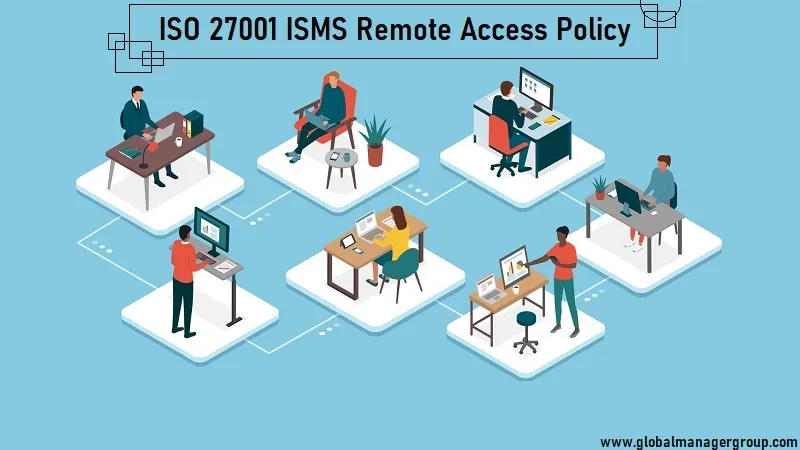
Image Source: Information Security System Certification 27001 – WordPress.com
Your ISO 27001 certification’s success depends on verification during months 10-11. These months will test if your implementation can pass certification. Organizations that do full internal audits are more likely to get certified on their first try, according to studies.
Conduct internal audit using ISO 27001 audit checklist
Internal audits act as practice runs for certification and help spot hidden issues that could hurt your business. ISO 27001 doesn’t tell you exactly how often to do them, but you should run audits at least yearly. You should create a complete checklist based on your policies and procedures before starting the audit.
Your internal audit process should follow these steps:
- Define audit scope and objectives
- Select independent auditors (not those who developed the ISMS)
- Review documentation and collect evidence
- Conduct interviews with control owners
- Document findings, including non-conformities
- Present results to management
Note that auditing Annex A controls takes time—you’ll review 93 controls. You might want to split the work among auditors with different skills. The audit should cover every department in scope because information security is everyone’s responsibility.
Hold a management review meeting
Management review meetings show leadership’s dedication and need a structured agenda. ISO 27001 asks you to review ISMS effectiveness at set times—at least once a year, but monthly reviews work better during implementation.
Your management review must cover:
- Status of actions from previous reviews
- Changes in external/internal issues affecting the ISMS
- Information security performance trends (nonconformities, monitoring results, audit outcomes)
- Feedback from interested parties
- Risk assessment results and treatment plan status
- Opportunities for improvement
The outputs should include decisions about ongoing improvements and needed ISMS changes. Document everything because meeting minutes serve as vital evidence for auditors. Book a Readiness Call with our experts to make sure your management review meets all requirements before certification audit.
Fix non-conformities and update documentation
Start a correction process right after finding non-conformities. Look at why it happens instead of just fixing symptoms. Create a corrective action plan that shows:
- Actions needed to fix the root cause
- People responsible for implementation
- Timeline for completion
Check if your corrective actions work—ISO 27001 asks for proof that fixes are effective. Keep records of each step in your non-conformity process, from finding issues to solving them.
This verification phase gets you ready for the final certification push in month 12. You’ll know your ISMS works and meets requirements.
Month 12: Certification and Continuous Monitoring
Finally, month 12 marks your ISO 27001 certification achievement and starts your steadfast dedication to compliance.
Schedule and complete external audit
The certification audit has two stages. Stage 1 reviews documentation, and Stage 2 verifies implementation. You should address any non-conformities found during internal audits before proceeding. Certification bodies look for evidence that your ISMS meets both ISO 27001 requirements and your security objectives. A successful completion gives you a three-year valid certification. This marks the start of your compliance obligations rather than the end.
Implement continuous monitoring tools
We used continuous monitoring to change ISO 27001 compliance from a periodic checkbox exercise into an ongoing security program. To cite an instance, see these options:
- SIEM systems give immediate security insights
- Automated risk assessment platforms validate controls continuously
- Centralized dashboards show how well security controls work
Organizations have embraced these tools. About 70% plan to increase their risk management technology budget. These tools detect control failures automatically before they become audit findings. This provides constant protection between formal audits.
Plan for surveillance audits and recertification
Your ISO 27001 certificate stays valid for three years but needs regular checks. The process includes:
- Annual surveillance audits during years one and two
- A complete recertification audit in year three
Surveillance audits focus on specific controls, previous non-conformities, and management systems. These audits need less work than the original certification but still require preparation. You should schedule them ahead of time and run internal audits first. Your certification might be revoked if you don’t maintain standards through these regular checks.
Conclusion
ISO 27001 certification just needs steadfast dedication, methodical planning, and consistent execution. This 12-month blueprint offers a well-laid-out approach that breaks down overwhelming tasks into manageable monthly steps. Each phase builds on previous work and creates a detailed Information Security Management System that fits your organization’s specific needs.
Note that certification is just the beginning of your security trip. You need constant alertness through continuous monitoring to maintain ISO 27001 compliance. Regular internal assessments and preparation for surveillance audits are crucial. Organizations that successfully apply this standard don’t just get international recognition – they also boost their security posture, customer trust, and competitive edge.
Your implementation team is the backbone of this entire process. Proper training and encouraging a security-conscious culture in all departments are the foundations of long-term success. Book a Readiness Call with our ISO 27001 experts today to get a full picture of your readiness and create a customized implementation strategy.
The real value of ISO 27001 certification comes when your ISMS grows with your business and adapts to new threats and opportunities. This systematic approach protects your most valuable assets and shows your steadfast dedication to security excellence in today’s risk-conscious business environment.
Key Takeaways
Implementing ISO 27001 certification requires a structured 12-month approach that transforms complex security requirements into manageable monthly milestones, significantly increasing your chances of first-time certification success.
• Form a dedicated implementation team early – Organizations with well-structured teams are 23% more likely to achieve ISO 27001 compliance on their first audit attempt.
• Define clear ISMS scope boundaries – Your scope decision determines what information you’ll protect and directly impacts implementation time, cost, and audit success.
• Conduct thorough gap analysis and risk assessment – Systematically evaluate current controls against ISO 27001’s 93 Annex A requirements to identify vulnerabilities and prioritize security investments.
• Document everything with proper version control – Most certification failures stem from inadequate documentation rather than technical shortcomings, making comprehensive record-keeping essential.
• Invest in comprehensive security training – Transform employees from potential vulnerabilities into your frontline defense through role-specific awareness programs and incident response training.
• Perform internal audits before certification – Organizations conducting thorough internal audits using structured checklists are significantly more likely to pass external certification audits successfully.
The certification marks the beginning of your ongoing security journey, requiring continuous monitoring, annual surveillance audits, and recertification every three years to maintain compliance and protect your organization’s valuable information assets.
FAQs
Q1. How long does it typically take to implement ISO 27001? Implementation time can vary, but it generally takes 3-12 months depending on the organization’s size and complexity. For small to medium-sized businesses, the process often takes around 4-6 months for implementation, with an additional 2-3 months for the certification audit.
Q2. What are the key components of an ISO 27001 checklist? An ISO 27001 checklist typically includes defining the ISMS scope, conducting a risk assessment, creating a Statement of Applicability, developing security policies and procedures, implementing controls, training staff, performing internal audits, and preparing for certification.
Q3. How often should internal audits be conducted for ISO 27001 compliance? While ISO 27001 doesn’t specify an exact frequency, it’s recommended to conduct internal audits at least annually. Some organizations choose to perform more frequent audits, especially during the initial implementation phase, to ensure ongoing compliance and identify areas for improvement.
Q4. What role does employee training play in ISO 27001 implementation? Employee training is crucial for ISO 27001 compliance. It includes general security awareness training for all staff and specialized training for those with specific security responsibilities. Effective training transforms employees from potential vulnerabilities into active participants in protecting organizational assets.
Q5. How long is an ISO 27001 certification valid? An ISO 27001 certificate is valid for three years. However, organizations must undergo annual surveillance audits in years one and two, followed by a complete recertification audit in the third year to maintain their certification status.