
Defense contracts with the DoD can reach six to eight figures. A failed CMMC audit could put these lucrative contracts at risk or make you ineligible for new bids.
Defense Industrial Base businesses must meet 110 NIST SP 800-171 security practices. Getting ready for certification takes time. Most organizations need at least six months to prepare for their CMMC audit. A safer timeframe spans 9-12 months. The financial stakes are high – Level 2 audits can get pricey, ranging from $30,000 to $700,000.
Your compliance experience depends on understanding the CMMC assessment guide and running complete mock audits. The CMMC rule took full effect in August 2025, and official assessments are moving forward. Organizations typically start with a readiness assessment. This gives you a chance to spot gaps before they turn into expensive problems.
This piece will show you the key steps to run effective mock audits using the DoD CMMC assessment guide. We’ll help you prepare with confidence, whether you want Level 1 basic cyber hygiene for federal contract information (FCI) or need the stricter Level 3 for controlled unclassified information (CUI).
Understanding the Role of a Mock Audit
Taking a CMMC certification without testing your readiness is like walking into a final exam without studying. Mock audits are a great way to get practice runs that can make or break your certification success.
Why mock audits matter for CMMC readiness
Mock audits work as dress rehearsals for your official CMMC assessment. These practice runs show organizations exactly where they stand with compliance. You’ll see what happens during the actual assessment and fix any problems while you still have time.
Companies that skip these readiness reviews often run into surprises during official audits. Level 2 audits take several months to complete, and finding major gaps during the official assessment can push back your certification. This delay might affect your contract eligibility.
A full mock assessment gives you several benefits:
- Realistic preview of compliance status: You can see your compliance score just like in an actual CMMC 2.0 assessment by a C3PAO
- Peace of mind: Your leadership team knows they’re backing a CMMC score checked by experts
- Competitive advantage: Outside verification shows your steadfast dedication to cybersecurity to clients and primes
On top of that, mock assessments help train your team. Your staff learns what to expect, which creates a smoother certification process. This prep work matters because Level 2 audit preparation needs at least six months, while Level 3 usually takes a year or more.
How mock audits reduce audit failure risk
Mock audits lower your chances of certification failure through careful preparation. Independent teams check all evidence, practice answering assessor questions, and time how long it takes to pull up evidence. This ensures everything works well during the official evaluation.
Mock audits also help confirm that:
- Control implementations match DoD CMMC assessment guide requirements
- Your team can explain security procedures clearly in interviews
- Documentation has no gaps or inconsistencies
Staff interviews are often overlooked but they’re vital. Your team needs to know how to answer CMMC auditor questions to pass the assessment. Practice interviews give employees a safe space to get comfortable with the process. This builds confidence and improves team performance.
Regular mock audits with CMMC-certified assessors make a big difference. These experts spot weak points, train staff on what’s expected, and check security controls across every part of the assessment.
Finding problems early gives businesses time to fix issues before working with a C3PAO. This proactive step cuts down certification time and protects your contract eligibility. Mock audits turn uncertainty into confidence by showing exactly where your organization stands for the upcoming CMMC assessment.
Breaking Down the CMMC Assessment Guide
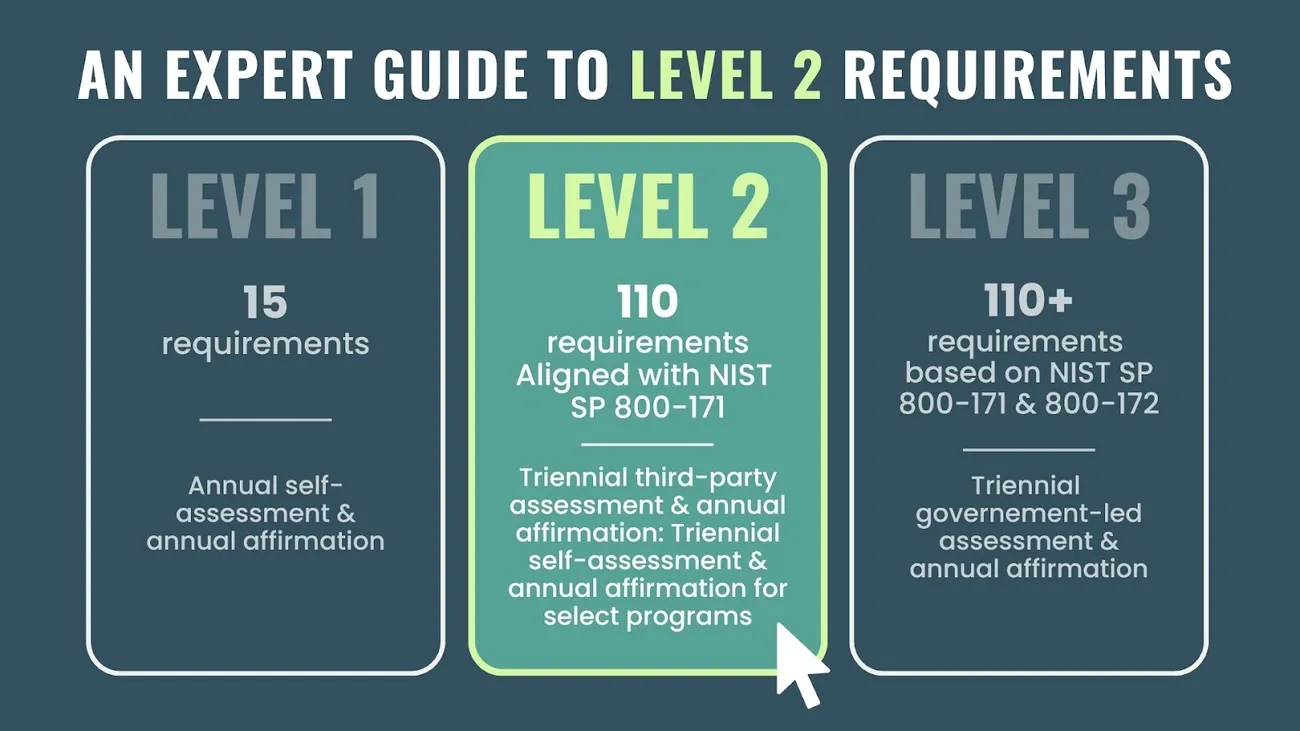
Image Source: ISI Security
The DoD CMMC Assessment Guide is a roadmap that helps organizations get ready for certification and guides assessors during evaluations. A really good understanding of this guide is significant to run mock audits that work and get certification.
Overview of the DoD CMMC Assessment Guide Level 2
The Department of Defense’s CMMC Assessment Guide Level 2 (Version 2.13) offers complete guidance to run self-assessments and certification assessments. This official document shows how to review an organization’s implementation of 110 security practices needed for Level 2 certification.
Organizations need separate certifications at each CMMC level, with different guides available for Level 1 and Level 3 assessments. The guide adds to the main CMMC source material like 32 CFR part 170 and related documents instead of replacing them.
The guide describes two types of assessments for Level 2:
- Self-Assessment: Organizations review their own CMMC level
- Certification Assessment: C3PAOs handle these assessments
32 CFR 170.19 requires a clear assessment scope before starting. This scope covers all assets that need to meet CMMC security requirements.
Assessment methods: Examine, Interview, Test
The guide uses NIST SP 800-171A methodology with three main assessment methods:
- Examine: Assessors review, inspect, observe, study, or analyze assessment objects (specifications, mechanisms, activities). This method makes it easier to understand, get clarity, or find evidence.
- Interview: Teams talk with individuals or groups to learn more, get clarity, or find evidence. The core team needs proper preparation to succeed in these interviews.
- Test: This step puts assessment objects through specific conditions to compare actual and expected behavior.
Assessors use results from all three methods to decide if requirements are met.
How assessors use the guide during audits
CMMC Level 2 assessments follow a well-laid-out methodology. The CMMC Assessment Process (CAP) has four phases:
Phase 1: Conduct pre-assessment preparations Phase 2: Review conformity to security requirements
Phase 3: Complete and report assessment results Phase 4: Issue certificate and close out POA&M
During Phase 2, assessors look at how organizations implement all 110 required CMMC Level 2 practices through evidence checks, staff interviews, and testing. Each practice gets a score of “MET,” “NOT MET,” or “Not Applicable” (NA).
NIST SP 800-171A’s nonstatistical sampling approach uses “FOCUSED” value for depth and coverage. This balanced method helps get a full picture of assets, people, policies, and procedures while keeping things budget-friendly.
Assessment teams and organizations meet daily to confirm findings and review new evidence that might change practice scores. Some practices allow minor issues to be fixed, leading to a “MET” score if corrected within the given time.
Organizations can prepare better for CMMC certification by understanding these assessment methods and building their mock audits around them.
Step-by-Step Mock Audit Process
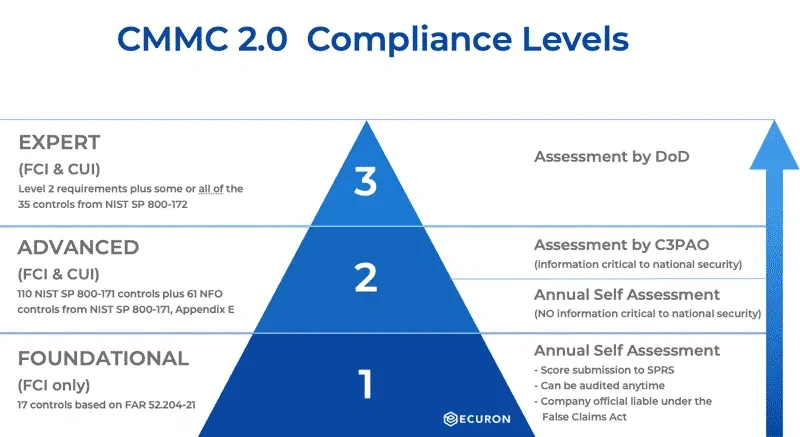
Image Source: ECURON
A methodical approach that follows the official CMMC Assessment Guide will help you run a successful mock audit. These six steps will help you spot gaps before they block your certification path.
1. Define your CMMC scope and boundaries
The first crucial step requires you to specify your CMMC Assessment Scope as stated in 32 CFR § 170.19. This step determines which assets need assessment and its specific details. Level 2 assets must fit into five categories: CUI Assets, Security Protection Assets, Contractor Risk Managed Assets, Specialized Assets, and Out-of-Scope Assets.
Your inventory should document all asset categories with a network diagram to aid scoping discussions. You should also create a visual data flow diagram showing how CUI moves through your organization.
2. Review your System Security Plan (SSP)
The SSP acts as your roadmap to CMMC compliance. This document needs to detail your environment’s scope, including all systems with CUI data, and outline the security controls that protect your IT systems.
Your SSP should detail implementation statements for each NIST SP 800-171 practice that show how you meet requirements. These statements need to cover each assessment objective linked to the practice. Make sure all practices show “implemented” or “not applicable” status before you start your assessment.
3. Collect and organize audit evidence
Evidence plays a vital role in CMMC audits and certification. Good documentation helps prove that your virtual and physical environment matches your SSP in protecting CUI.
A well-organized evidence package will make your assessment run smoothly. Your evidence can include policies, procedures, configuration screenshots, sample tickets of actions taken, and meeting minutes.
4. Simulate assessor interviews
CMMC assessment involves interviews with the core team. Your team should explain security policies, procedures, and technical implementations while showing they know how to handle and protect CUI.
Mock interviews give employees a safe space to get comfortable with the certification process. This preparation matters because knowing how to answer a CMMC auditor’s questions will help you pass your assessment.
5. Confirm technical controls
Each security control in your SSP should work as described and be traceable. This step ensures your environment meets CMMC requirements to protect the CUI you store, process, or transmit.
Technical validation shows that your controls work properly before the official assessment. Book a Readiness Call with CMMC experts who can help you review your controls objectively.
6. Score your compliance using the guide
A CMMC Readiness Assessment uses pass/fail scoring to determine if you’re ready for formal certification. Your mock assessment will give you a scoring simulation that shows strengths, weaknesses, and readiness status: Ready, Conditionally Ready, or Not Ready.
These results will guide your remediation plan for any gaps and help update your CMMC audit checklist.
Common Gaps Found During Mock Audits
Image Source: Sprinto
CMMC certification efforts could fail due to three critical compliance gaps that mock audits repeatedly uncover. You need to spot these common pitfalls to address them early.
Missing or outdated documentation
Organizations most often fail CMMC audits because of poor documentation. Even companies with strong technical controls don’t deal very well with documentation requirements. Assessors often find problems like outdated policies that mention decommissioned systems or former employees. They also spot missing leadership approval signatures and undefined parameters for scan frequencies or logging thresholds. Your System Security Plan (SSP) serves as the foundation of CMMC Level 2 certification. No assessment can move forward without a current, detailed SSP.
Inconsistent implementation of controls
Many audit failures happen because daily operations don’t match written procedures. Security practices that aren’t applied consistently create major vulnerabilities, especially when you have multi-factor authentication (MFA) and shared accounts. Many organizations use MFA only for Microsoft 365 logins but forget about local logins. Similarly, shared administrative accounts make it impossible to track specific users, which creates accountability problems.
Untrained staff responses during interviews
Staff interviews often expose critical weaknesses when team members can’t explain their security process roles. Many organizations don’t realize how much it matters to prepare employees for assessor questions. Staff members need detailed training on Controlled Unclassified Information (CUI) handling procedures. Without it, they can’t show they understand how to access, mark, protect, and destroy sensitive information. A single training session isn’t enough to meet the “continuous” requirement in the Awareness and Training domain.
Using Mock Audit Results to Improve Readiness
Mock audit findings become valuable only when turned into concrete action steps. The time after assessment gives you a crucial window to improve your compliance standing before the official certification.
Creating a remediation plan
Your mock assessment reveals gaps that need a well-laid-out remediation plan that fixes the real problems, not just the symptoms. Rank each finding as high, medium, or low risk based on how it affects compliance and security. Give specific team members ownership of each remediation task with achievable deadlines. The plan needs proper financial, technological, and human resources to work. Team meetings help keep things moving and everyone accountable during fixes.
Updating your CMMC audit checklist
The mock audit gave an explanation to help refine your evidence package, which should include your System Security Plan (SSP) and supporting documentation. Your documents must show your organization’s current cybersecurity posture and strategy accurately. Your policies, training records, system logs, and configuration settings need to be final—C3PAO assessors won’t accept working drafts. These documents prove your compliance and are the foundations of your C3PAO assessment. Book a Readiness Call to let experts review your updated documentation before submission.
Preparing for the official C3PAO assessment
CMMC 2.0 framework has provisions for Plans of Action and Milestones (POA&Ms) if your organization can’t meet every requirement right away. Organizations that score at least 88% during C3PAO assessments can get temporary certification while they fix remaining issues. Note that only certain controls qualify for POA&Ms, and you get 180 days to implement these outstanding items before a follow-up audit. Your certification will be denied if you don’t pass this follow-up assessment within the timeframe.
Conclusion
Your CMMC audit preparation can make or break your chances of keeping valuable DoD contracts. This piece outlines key steps to run effective mock audits using the official CMMC Assessment Guide. Without doubt, these practice runs are your best defense against certification failure.
Mock audits spot gaps in documentation, reveal inconsistent implementation, and show where staff training falls short. These issues can get pricey if they surface during official evaluations. Organizations seeking Level 2 certification need six to twelve months to prepare well.
The DoD CMMC Assessment Guide offers a well-laid-out path to certification readiness and self-assessment. Your organization can spot and fix weaknesses in time by doing this six-step mock audit process. Start by defining scope boundaries clearly. Review your System Security Plan in detail. Put together solid evidence packages. Get your staff ready through practice interviews. Check all technical controls against requirements. Score your compliance using the guide’s method.
These practice runs only matter when you act on what you find. Your fix-it plan should tackle all gaps with clear deadlines and assigned team members. This ahead-of-time planning cuts down the risk of certification delays that could affect your contract eligibility.
CMMC compliance isn’t just another box to check. It shows your organization’s steadfast dedication to protecting sensitive defense information. Regular practice assessments boost your team’s confidence and set you up for success in today’s critical compliance world.
Key Takeaways
Mock audits are essential practice runs that can prevent costly CMMC certification failures and protect lucrative defense contracts worth six to eight figures.
• Conduct thorough mock audits 6-12 months before certification to identify gaps in documentation, control implementation, and staff preparedness before official assessment • Follow the 6-step process: Define scope, review SSP, organize evidence, simulate interviews, validate technical controls, and score compliance using DoD guidelines • Address three common failure points: Missing/outdated documentation, inconsistent security control implementation, and untrained staff unable to explain procedures • Transform findings into action by creating structured remediation plans with specific timelines, responsible parties, and resource allocation to fix identified gaps • Leverage POA&M provisions for organizations scoring 88%+ during C3PAO assessments, allowing 180 days to resolve remaining issues while maintaining temporary certification
Mock audits transform uncertainty into confidence by providing realistic previews of your compliance status and ensuring your team is prepared for the rigorous CMMC assessment process that determines your eligibility for defense contracts.
FAQs
Q1. What is the purpose of conducting a CMMC mock audit? A mock audit serves as a practice run for the official CMMC assessment, helping organizations identify and address compliance gaps before the actual certification process. It provides valuable insights into an organization’s readiness and reduces the risk of audit failure.
Q2. How long should an organization prepare for a CMMC Level 2 audit? Most organizations need at least six months to prepare for a CMMC Level 2 audit, with 9-12 months being a safer timeframe. This allows sufficient time to address any gaps identified during mock audits and ensure comprehensive readiness.
Q3. What are the three primary assessment methods used in CMMC audits? The three primary assessment methods used in CMMC audits are Examine (reviewing documentation and specifications), Interview (discussions with staff), and Test (evaluating the actual behavior of security controls). These methods help assessors determine if requirements have been satisfied.
Q4. What are common gaps found during CMMC mock audits? Common gaps identified during mock audits include missing or outdated documentation, inconsistent implementation of security controls, and untrained staff responses during interviews. Addressing these issues is crucial for successful certification.
Q5. Can an organization still achieve certification if it doesn’t meet all requirements during the assessment? Yes, organizations scoring at least 88% during C3PAO assessments can receive temporary certification through Plans of Action and Milestones (POA&Ms). This allows a 180-day grace period to implement outstanding items before a follow-up audit.