
Recent studies show that only 37% of organizations conduct regular AI risk assessments, even as AI adoption surges in companies of all sizes. This concerning statistic shows why businesses need ISO 42001 to deploy AI responsibly.
ISO 42001 stands as the world’s first global standard dedicated to AI governance. The standard equips organizations with structured methods to build AI systems that deliver both power and safety, while ensuring fairness and audit readiness. Its framework includes 38 controls that help direct the complex world of AI management.
The implementation of ISO 42001 helps speed up your preparation for regulations like the EU AI Act. Organizations can demonstrate proper oversight, risk management, and compliance through its operating model. Many organizations find it challenging to get ISO 42001 certification because they lack a systematic approach.
Let’s explore 7 practical steps to implement an ISO 42001 AI management system with purpose-built governance tools. We’ll help you turn complex ISO AI standards into clear processes. These processes will protect your business and build customer trust as we guide you from AI landscape assessment to continuous improvement.
Step 1: Assess Your AI Landscape
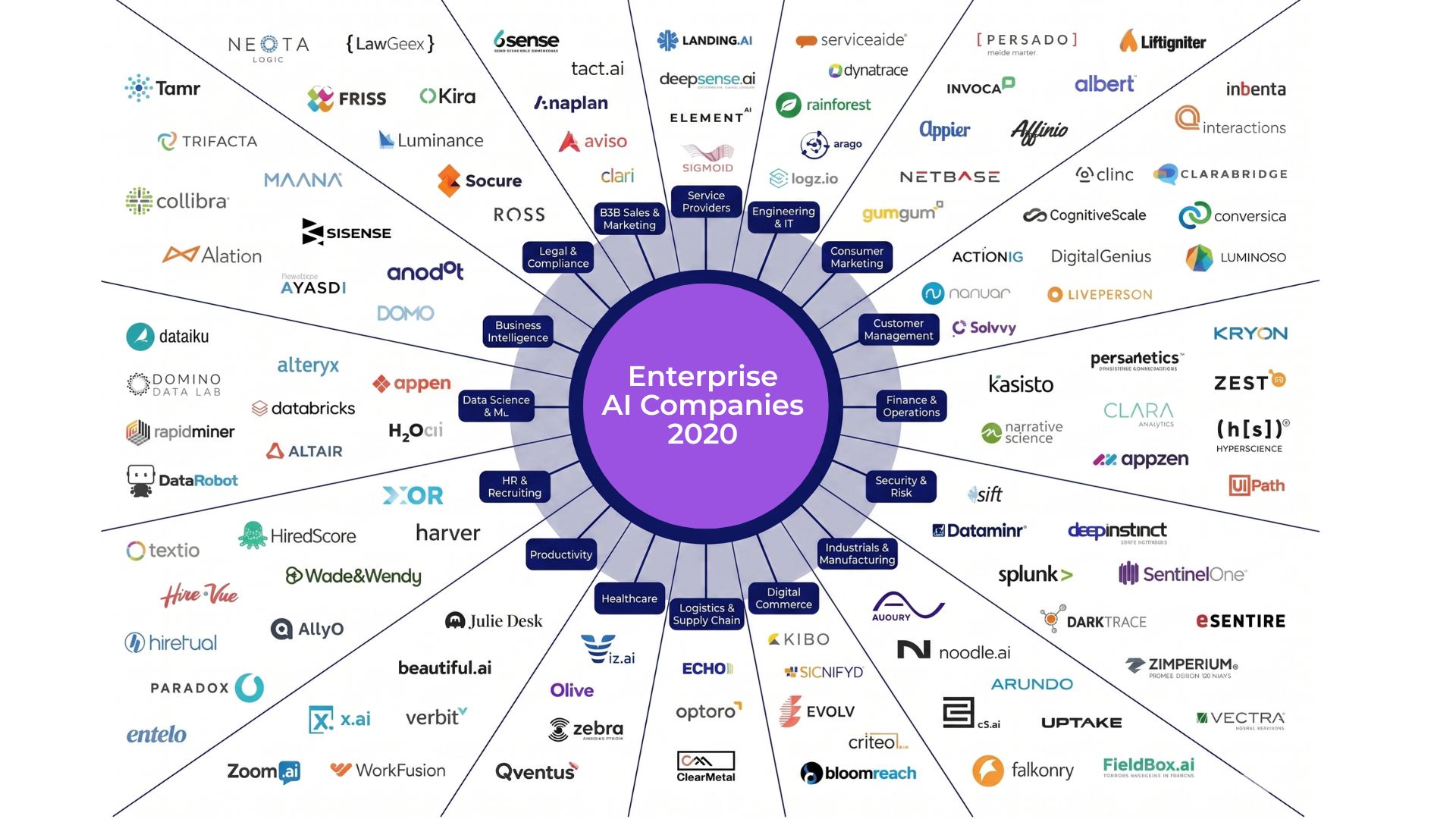
Your ISO 42001 implementation experience starts with a full picture of your artificial intelligence footprint. Teams now want to move from reactive monitoring to proactive approaches. A clear view of your AI landscape is the life-blood of good governance.
Step 1: Assess Your AI Landscape
Create an AI system inventory
The path to ISO 42001 certification starts with building a complete AI inventory—a detailed catalog of every AI system in your organization. This inventory serves as the foundation of your AI Management System (AIMS). It gives you visibility into your entire AI ecosystem.
A good AI inventory should include:
- System names and descriptions
- Departments and teams that use each system
- Data processing activities and information flows
- Assessment frequency and compliance status
- Specific use cases for each AI tool
Each use case for the same AI system needs separate attention because they might carry different risks. To name just one example, a large language model could handle internal translations while also creating content for external audiences—each scenario needs its own governance approach.
Your organization’s size and complexity will determine if a spreadsheet or a specialized AI governance tool works better. Organizations that already maintain Records of Processing Activities (RoPA) under GDPR can make use of this information. Many elements directly help develop the AI inventory.
Classify systems by risk and purpose
After completing your inventory, you need to classify your AI systems based on their risk levels and intended purposes. This classification shows which ISO 42001 controls apply and helps you focus your governance efforts.
The EU AI Act offers a strong framework for risk classification that lines up well with ISO 42001 requirements. It groups systems into:
- Prohibited applications (e.g., social scoring, manipulation of human behavior)
- High-risk systems (critical infrastructure, education, employment, law enforcement)
- Limited-risk applications
- Minimal-risk systems
You should assess each system in your inventory against these criteria. Better classification frameworks doubled the rate of consistent and accurate classifications compared to basic frameworks. This shows why a systematic approach matters.
Teams find it easier to assess a system’s impact level than its autonomy level during classification. Classification accuracy improves by a lot when systems use descriptive levels (like “action,” “decision,” “perception”) instead of simple “high,” “medium,” and “low” labels.
Identify gaps in current controls
The final step after inventory and classification involves finding gaps between your current governance practices and ISO 42001 requirements.
Your gap analysis for ISO 42001 should look at potential weaknesses in several key areas:
- AI risk assessment methodologies
- Impact evaluation processes
- Decision rights and ownership structures
- Documentation practices
- Monitoring and evaluation mechanisms
This assessment reveals AI-specific risks that regular governance might miss. StackAware’s ISO 42001 risk assessment found vulnerabilities to prompt injection, unintended training data retention, and potential biases.
ISO 42001 needs a separate impact assessment that looks at what it all means for external entities, individuals and society. This assessment should look at impacts on legal positions, life opportunities, physical and psychological well-being, human rights, and societal norms.
Many organizations find they need to move from separate AI oversight to integrated governance after a complete gap analysis. Smart requirement mapping speeds up this process. It compares new regulatory compliance requirements with existing controls and spots gaps in your governance framework quickly.
This three-part assessment gives you a clear view of your AI landscape. It sets the stage for building strong governance structures that meet ISO 42001 requirements.
Step 2: Define Governance and Ownership
ISO 42001 implementation requires clear lines of authority and decision-making. AI systems that span multiple departments often create ownership confusion, which weakens governance efforts due to unclear responsibilities.
Step 2: Define Governance and Ownership
Assign control owners and decision rights
A chain of accountability forms the foundation for ISO 42001 certification. Someone must take responsibility at each stage as the AI moves through its ModelOps lifecycle. Your organization needs to define:
- The overseers of each AI system
- The people accountable for system performance issues
- The managers of data security and quality
Specific roles with clear responsibilities work best. Data stewards should handle data quality and protection. Algorithm auditors need to check performance and ethical alignment regularly. Compliance officers must ensure your AI meets regulatory requirements.
Organizations pursuing ISO 42001 certification need leaders who champion compliance efforts. These leaders coordinate among product management, data engineering, infrastructure, legal, and trust and safety teams involved in AI risk management.
Establish an AI governance committee
A cross-functional AI Governance Committee (AIGC) should serve as the cornerstone of your ISO 42001 compliance strategy. This team oversees AI policy development and enforcement, reviews potential risks, and maintains ethical standards.
Your committee should include these key members:
- Technical leadership: CTOs or CIOs with deep AI system knowledge
- Legal experts: People who understand evolving AI regulations and ensure compliance
- Daily operators: Team members who use AI systems regularly
- Human resources: Staff who address workforce implications
- Compliance: Professionals who ensure alignment with existing frameworks
- Management: Executives who secure buy-in and resources
This diverse approach matters because technical, legal, ethical, and operational teams must cooperate to manage AI complexities effectively. Many leading enterprises now have formal AIG committees. CIO, CISO, and legal teams jointly lead these committees to approve high-risk use cases and assign oversight.
Your committee must implement the Plan-Do-Check-Act methodology to manage AI-related risks organization-wide for ISO 42001 compliance. ISO 42001 offers a practical framework for organization-wide AI governance, unlike approaches that look at specific AI applications in isolation.
Set review cadences and escalation paths
Regular monitoring and clear escalation protocols help maintain ISO 42001 compliance long-term. Your governance structure should include regular reviews to measure AI system performance against set metrics.
A structured review cycle with specific timing works best:
- Business Overview Reviews (monthly): Check pipeline coverage, spot slipped deals, and track forecast alignment
- Strategic Execution Reviews (quarterly): Check process adherence and maintain momentum
- System Performance Reviews (ongoing): Watch for drift, bias, and unexpected behaviors
Each review needs an owner responsible for monitoring, drift detection, and problem escalation. This approach addresses trust and control gaps that often appear in AI governance.
Your escalation paths should clearly state who gets alerts, response times, and intervention powers when AI systems behave unexpectedly.
Note that ISO 42001 implementation supports innovation rather than hindering it. It helps organizations tap into AI’s potential while prioritizing safety, security, and ethical considerations. Strong governance and ownership structures create a solid foundation for ISO 42001 certification and regulatory compliance.
Step 3: Map ISO 42001 Controls to Your Systems
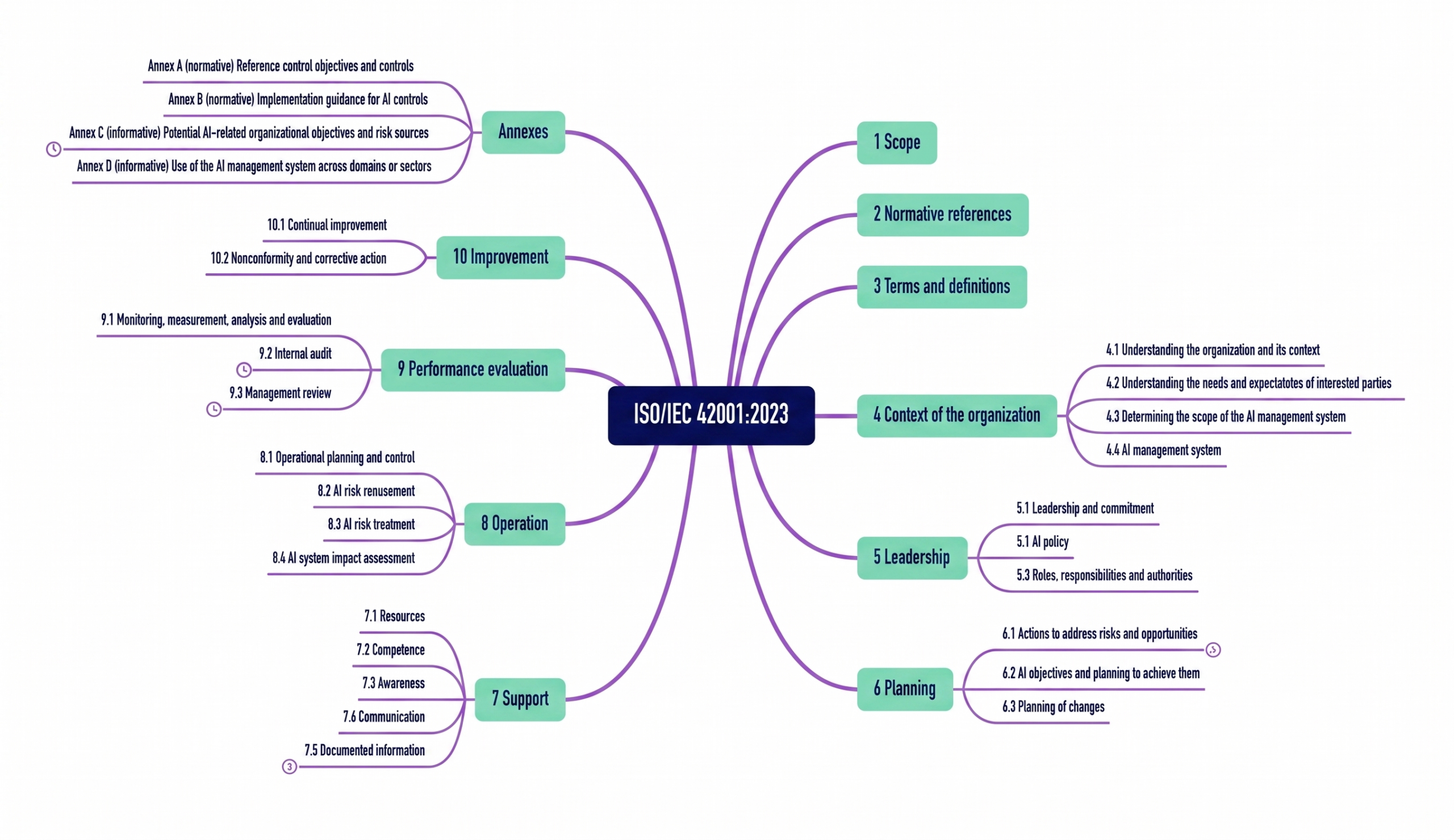
Mapping ISO 42001 controls to your AI systems is a key phase where theory meets practice. You need to match specific controls to your environment after creating your system inventory and setting up governance structures.
Step 3: Map ISO 42001 Controls to Your Systems
Use Annex A to apply relevant controls
Annex A of ISO 42001 is the life-blood of the standard. It provides a well-laid-out catalog of 42 control objectives in 9 topics (A.2–A.10). The extensive list might seem daunting at first, but note that not every control is mandatory. Your organization should pick controls based on your AI risk landscape.
Requirement 6.1.3 of the standard explains this selection process. You must compare your AI risk treatment choices with Annex A controls to make sure you haven’t missed any essential controls. As you map these controls, think about these control areas:
- AI policies and how they line up with existing organizational policies
- Internal organization structures and reporting mechanisms
- Resource documentation and management
- Impact assessment procedures
- Data governance and quality assurance
- Third-party relationship management
- AI system lifecycle oversight
Auditors will check if your organization has picked and implemented Annex A controls that match your AI risk treatment strategy. They verify adopted controls, check if excluded controls have valid reasons, and review any extra controls beyond Annex A.
Use common-control libraries
You don’t need to create your ISO 42001 compliance program from scratch. Many organizations have created crosswalks that map ISO 42001 to other common frameworks. These ready-to-use control libraries speed up implementation.
The Cloud Security Alliance (CSA) has developed a complete mapping between the AI Controls Matrix (AICM) and ISO 42001, along with ISO 27001 and 27002. These mappings show full, partial, or no alignment between frameworks and offer guidance for implementation.
NIST has published a crosswalk that directly maps their AI Risk Management Framework to ISO/IEC 42001. This serves as a “Rosetta Stone” between the two frameworks. These common-control libraries help you:
- Deploy AI/ML systems consistently and securely
- Meet emerging AI regulations more easily
- Improve transparency and interoperability across governance programs
- Run AI risk management with confidence
Give priority to controls based on your risk classification from Step 1 when using these libraries. High-risk AI systems need more controls, while minimal-risk systems might work with fewer.
Avoid duplication across frameworks
Organizations often struggle with too many overlapping AI governance frameworks. Managing multiple compliance requirements becomes harder with fragmented governance approaches.
Don’t treat ISO 42001 as just another checklist. Build one unified approach that uses ISO 42001’s structure while adding elements from your existing frameworks. This helps you meet international standards and tailor risk management to your needs.
Create a central repository for all AI governance items—from policies and process documents to risk assessments and control evidence. Then arrange your documentation to match both ISO 42001 and other relevant frameworks. This meets requirements without creating extra paperwork.
ISO 42001 shares much with ISO 27001 (information security) and ISO 9001 (quality management) if you’re already certified. These standards use the same high-level structure, which makes integration simple. The main difference is that ISO 42001 focuses on AI-specific risks like bias, model drift, and lack of explainability, while ISO 27001 deals with information security risks.
A control rationalization matrix helps avoid duplication by:
- Finding overlapping requirements across frameworks
- Picking a primary control owner for each requirement
- Connecting evidence collection to multiple framework requirements
- Keeping regulatory records for audits
A solid foundation for implementation comes from carefully mapping ISO 42001 controls to your systems and existing frameworks. This ensures full coverage of AI risks without unnecessary overlap.
Step 4: Implement AI Governance Tools
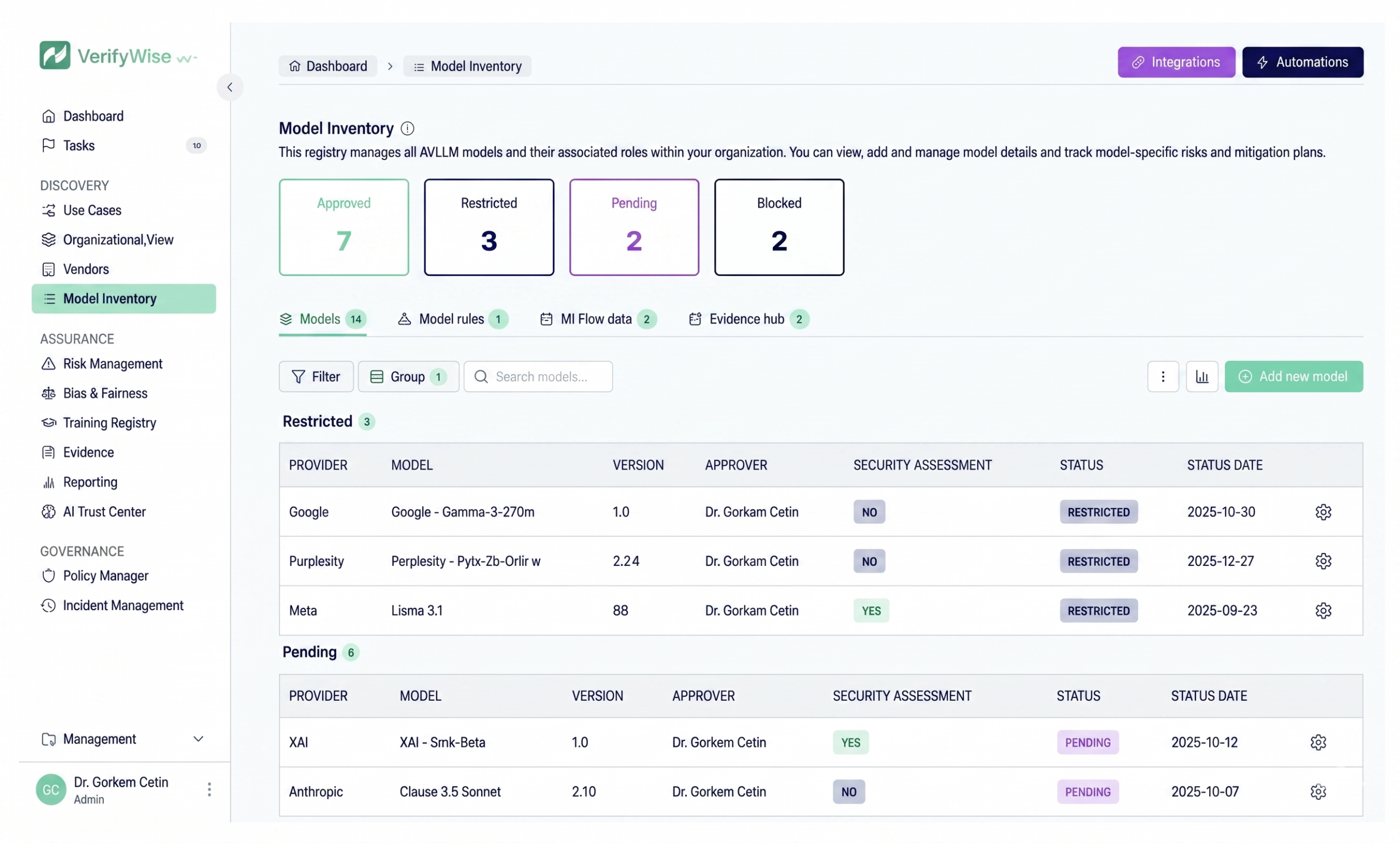
Image Source: verifywise.ai
Strong technological support is essential to operationalize ISO 42001 since manual processes alone cannot scale to meet the standard’s requirements. Your systems need mapped controls first. The next significant step involves implementing specialized AI governance tools to transform written policies into practical workflows.
Step 4: Implement AI Governance Tools
Centralize documentation and evidence
Detailed documentation serves as the foundation of ISO 42001 compliance. It provides primary evidence for certification audits and helps manage AI risks throughout the development lifecycle. A well-documented process not only supports governance but also boosts collaboration by creating a shared knowledge base for all stakeholders.
The right tools should provide:
- Standardized model documentation: Tools like Amazon SageMaker Model Cards offer structured documentation including purpose, performance metrics, and limitations. This helps maintain transparency and auditability across your AI systems.
- Automated evidence collection: These solutions collect documentation directly from source systems where data resides. This approach ensures evidence stays untampered before analysis.
- Centralized storage: A single repository houses all governance artifacts—from policies to risk assessments to control evidence. This eliminates scattered documentation across departments.
- Audit-ready reporting: Dashboards automatically generate key metrics and reports suitable for management boards and auditors.
Organizations often struggle with inconsistent practices and insufficient evidence for certification without proper documentation tools. Notwithstanding that, centralized documentation tools help transform ISO 42001 from theoretical frameworks into daily operations.
Enable human-in-the-loop approvals
Human-in-the-loop (HITL) represents a critical approach within ISO 42001 compliance that requires human oversight and intervention in AI systems. This approach acknowledges that automation brings efficiency, but human judgment remains vital for ethical reasoning and accountability.
ISO 42001 and other regulatory frameworks like the EU AI Act ended up mandating human oversight for high-risk AI systems. The EU AI Act’s Article 14 specifically requires that “High-risk AI systems shall be designed and developed in such a way… that they can be effectively overseen by natural persons”.
Your HITL tools should provide:
- Action-level approvals: These tools route sensitive AI actions to contextual human review instead of using broad preapproved scopes. This ensures appropriate oversight for each critical decision.
- Decision boundaries: Clear parameters define which decisions can be automated versus those that need human escalation or should never be fully delegated to AI.
- Transparent audit trails: Documentation of every approval, denial, and intervention includes timestamps and rationales to create complete traceability for compliance.
Human oversight needs thoughtful design rather than being treated as a checkbox exercise. Humans themselves can make mistakes and sometimes compound technological errors instead of fixing them.
Automate tasking and change control
Scaling ISO 42001 compliance needs automation to reduce manual workload while maintaining governance integrity. Automated workflows help embed policies and collect evidence continuously to ensure consistency, accuracy, and economical solutions.
Essential automation capabilities include:
- Automated task management: Tools enable efficient workflows for roles of all types in the AI lifecycle—from business owners to data scientists to model validators.
- Scheduled evaluations: Governance checks at key development milestones and alerts for data drift or model changes maintain proactive oversight.
- Policy enforcement: Systems automatically enforce governance policies across development and deployment to reduce manual oversight.
- Change control workflows: Automated approvals for system modifications ensure changes match established governance frameworks.
Whatever your organization’s size, automated governance processes reduce administrative burden while ensuring consistency. Automated controls can immediately alert when activities deviate from established parameters for high-risk AI systems, allowing quick intervention.
The technical aspects of implementing these tools seem complex? Book a Readiness Call with ISO 42001 implementation experts who can help select and configure the right governance tools for your environment.
Note that meaningful human involvement must continue even with the best automation tools. The right balance will give your ISO 42001 implementation accountability while enabling breakthroughs at scale.
Step 5: Monitor and Evaluate Performance
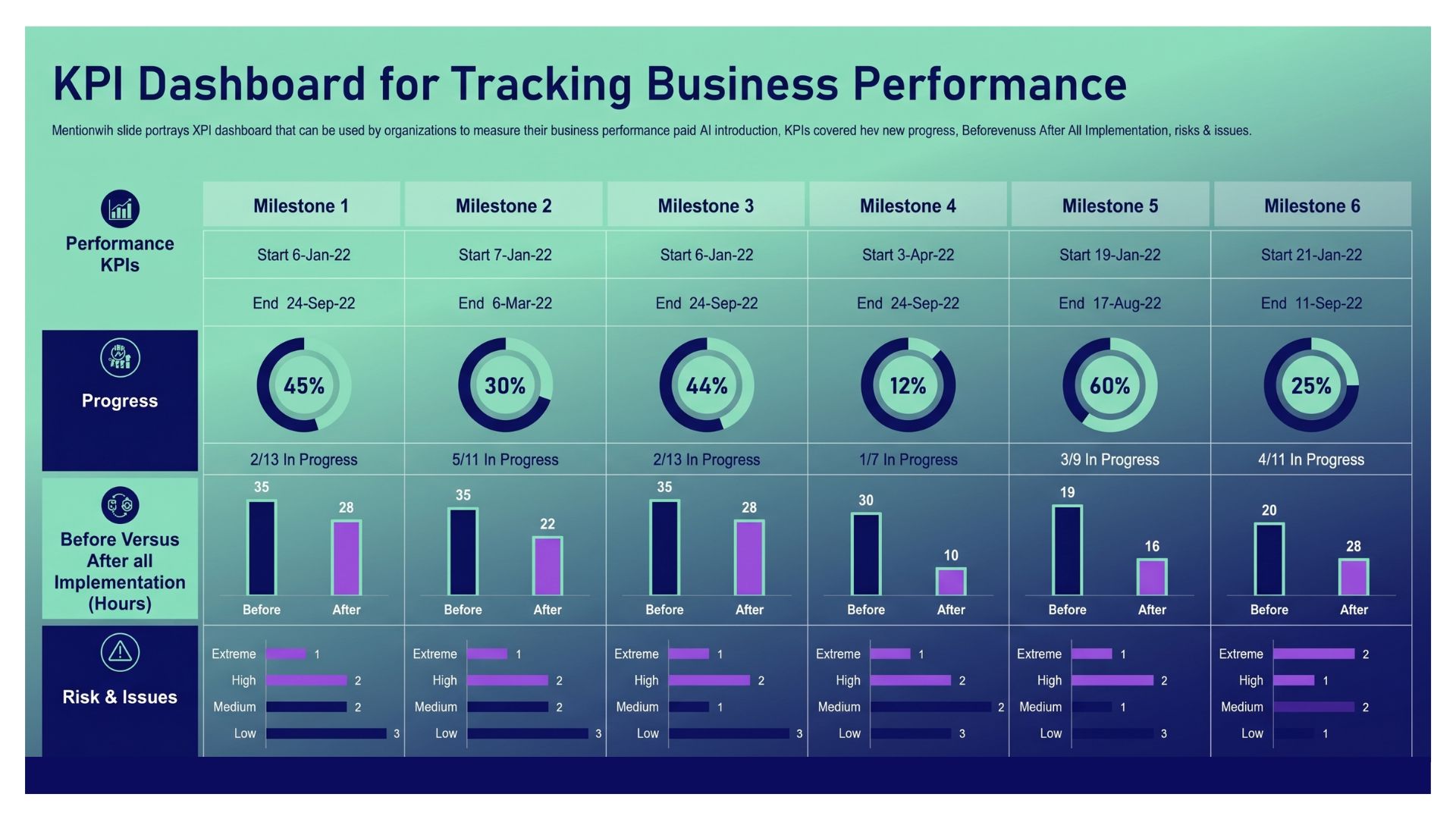
Setting up the right monitoring systems plays a vital role in your ISO 42001 trip. Your AI governance framework needs ongoing performance checks and assessment methods to show your compliance status, no matter how advanced it is.
Step 5: Monitor and Assess Performance
Track KPIs like throughput and rework
Well-defined Key Performance Indicators (KPIs) turn theoretical governance into informed decisions. System metrics help track how your AI systems work to make sure they run well, stay reliable, and grow when needed.
To name just one example, see these essential metrics:
- Request and token throughput: Track how many requests and tokens your system handles over time to spot capacity needs and reduce HTTP 429 errors
- Resource utilization: Keep an eye on GPU/TPU accelerator usage to better allocate resources and manage costs
- Model fairness: Watch demographic parity, equal opportunity, or disparate impact to ensure fair outcomes
- Human behavior metrics: Check if team members know AI risks, spot data bias issues, and take proper responsibility
Organizations risk falling into bias, non-compliance, and waste without clear metrics. These metrics make governance practical and connect strategy to real-life results. We picked KPIs that encourage good practices and line up with governance goals.
Run internal audits and reviewer adherence checks
Internal audits work as vital checkpoints in your ISO 42001 compliance trip. ISO 42001 needs yearly internal audits of your AI Management System (AIMS), including one before your first Stage 1 certification audit.
During these audits, internal auditors check your AIMS against ISO 42001 rules and internal controls by:
- Looking through documentation, processes, and records
- Talking to the core team to ensure everyone follows the same practices
- Checking governance, risk management, and technical safeguards
Internal audit teams have a chance to add value beyond just checking boxes. They can look at governance structures, suggest responsible AI practices, and test how well controls work with their company-wide view. In fact, forward-thinking Chief Audit Executives should create yearly AI audit plans with several audits instead of just one governance review.
The system also needs to watch if reviewers stick to set protocols. This stops cases where experts spot AI errors but don’t act because different metrics measure their work.
Export audit-ready reports
Audit-ready reports make certification easier and show your steadfast dedication to ISO 42001 compliance. These reports should show your governance work and prove it met intended goals.
Your reporting should:
- Keep all documentation in one place during setup
- Create full, secure event logs with clear time stamps
- Build executive dashboards showing status and trends
- Add context that explains what metrics mean for business
Most companies find quarterly reviews work best, with extra checks after big changes like model launches, incident reports, or new regulations. These reviews prove due diligence under various AI rules.
Detailed audit-ready reports help you show how you follow ISO 42001 and other rules, which builds trust with stakeholders. These reports give a clear picture of your compliance status and point out where you can do better.
Step 6: Align with ISO AI Standards and Regulations
Your ISO 42001 implementation should work together with broader regulatory frameworks. This creates a unified way to handle compliance and makes better use of resources while strengthening AI governance. The need to arrange regulations has grown more significant as we approach 2026, since frameworks like the EU AI Act now place strict rules on organizations that develop or use AI systems.
Step 6: Arrange with ISO AI Standards and Regulations
Map ISO 42001 to EU AI Act requirements
The EU AI Act and ISO 42001 share about 40-50% of their high-level requirements. This overlap creates many chances to use your ISO 42001 implementation for wider regulatory compliance. These shared areas include several vital domains:
- Data governance: Both frameworks stress data categorization, bias detection, and clear ownership roles
- Risk management: ISO 42001’s organized approach fits with the EU AI Act’s risk classification system (unacceptable, high, limited, and minimal risk)
- Human oversight: Article 14 of the EU AI Act needs high-risk AI systems to allow ongoing human oversight, which matches ISO 42001’s human-in-the-loop requirements
- Ethical implications: Both frameworks put fairness first, along with bias reduction and prevention of harmful effects
You should compare your existing ISO 42001 controls with EU AI Act requirements to find any gaps in compliance. ISO 42001 provides a framework for risk management, oversight, record-keeping, and post-market monitoring—all vital parts of the EU AI Act.
Attach evidence to each control
ISO 42001 certification needs detailed documentation that proves your AI governance works in practice. Auditors look for evidence that shows your controls are active and working, not just written down.
Your essential documentation should include:
- Statement of Applicability (SoA): A table that shows Control IDs, names, application status (Yes/No), and justification notes—auditors see this as “a critical component of certification”
- AI Impact Assessment reports: Papers that show how you evaluate AI’s effects on people and society
- Risk assessment records: Official documents of identified AI risks and their matching controls
- Competency evidence: Training matrices that compare required versus actual skills for all AI-related roles
- Management review minutes: Records showing how senior management regularly reviews your AI Management System
Note that evidence must stay current, clearly show ownership, have version control, and link to actual operational events. Each document should answer: “Does this trail prove who did what, when, in response to which risk, and is it still valid?”
Ensure traceability and transparency
The EU AI Act makes traceability a key technical requirement. Providers of high-risk AI systems must set up automated, secure logging systems that record significant events throughout the system’s life. This creates a permanent record of operations and decisions.
Here’s how to build effective traceability:
- Establish event logging: Set up automatic recording of timestamps, unique decision IDs, model versions, and processing steps
- Document input/output relationships: Keep records of data inputs and their outputs to show direct connections
- Track human-AI interactions: Record when humans oversee, intervene, or approve actions
- Monitor system states: Save performance metrics and environmental conditions to place decisions in context
Transparency gives full visibility into your AI system’s entire life—from design and training to deployment. This means keeping records of key processes like data sourcing, model development, testing, and validation.
When combined, traceability and transparency turn accountability into real action. Your organization can prove systems worked as planned while letting deployers check their use within the organization. During legal or regulatory reviews, a detailed audit trail becomes your best evidence for defending or showing responsibility.
Step 7: Drive Continuous Improvement
ISO 42001 certification is just the start of your AI governance trip. The standard requires you to keep improving your AI Management System (AIMS) to stay compliant and handle new risks.
Schedule periodic reviews
The ISO 42001 standard requires yearly audits that should cover your controls and policies from the original certification. Your organization should run quarterly assessments that focus on different areas:
- Policy Compliance Audits (quarterly): Check if teams follow acceptable use policies and data handling standards
- Technical Controls Review (quarterly): Test security control effectiveness and fix status
- Risk Classification Validation (semi-annually): Check if use case risk ratings are accurate
- Governance Maturity Assessment (annually): See how well the program works overall
These well-laid-out reviews spot weak points before they turn into compliance problems. Your schedule should add more reviews after big changes like model deployments or new regulations.
Update training and documentation
Staff training is a vital part of getting better. The core team needs yearly training on AI basics, governance policies, and ethical guidelines. This education should include new insights from audits and latest best practices.
Your documentation needs to grow with your AIMS. Keep clear records of:
- Model versions and updates applied
- Policy changes and their reasons
- Decision-making steps and human input
Refine controls based on audit outcomes
Internal audit teams see the whole picture across your company. They can assess how governance structures and controls work. Audit findings help fix root causes of problems instead of just treating symptoms.
Watch key indicators like policy violations, how often incidents happen, and response times. Need help setting up your improvement process? Book a Readiness Call with ISO 42001 experts who can help turn lessons learned into better governance.
Conclusion
ISO 42001 is a strategic investment that turns AI governance from theory into real-life practice. This piece outlines a systematic way to build a complete AI Management System. The system works with international standards and new regulations. Our seven-step framework helps organizations at any point in their AI trip. It works for teams just starting to list their systems and those fine-tuning mature governance practices.
Good ISO 42001 setup does more than just tick compliance boxes. Teams can see their whole AI world clearly. They set up clear accountability and build customer trust through open governance. On top of that, it matches frameworks like the EU AI Act. This lets you meet multiple regulatory needs with one governance approach.
All the same, success needs steady evaluation and growth. Your AI governance must adapt as tech advances and regulatory scenes change. Teams that face complex setup challenges should reach out to experts. Book a Readiness Call with ISO 42001 specialists who can guide your specific needs.
Without doubt, companies will soar in the AI era when they balance innovation with responsible governance. ISO 42001 gives you the framework. Your setup approach decides if it becomes a game-changing tool or just another checkbox. Start your setup today. These seven steps will help you build AI systems that are powerful, trustworthy, ethical, and eco-friendly.
Key Takeaways
ISO 42001 implementation transforms AI governance from theoretical frameworks into practical, operational systems that build trust and ensure regulatory compliance across your organization.
• Start with comprehensive AI inventory: Catalog all AI systems, classify by risk level, and identify governance gaps before implementing controls • Establish clear ownership structures: Create cross-functional AI governance committees with defined decision rights and escalation paths • Leverage existing frameworks: Map ISO 42001 controls to current systems and avoid duplication by integrating with ISO 27001 or other standards • Implement specialized governance tools: Centralize documentation, enable human-in-the-loop approvals, and automate compliance workflows • Monitor performance continuously: Track KPIs, conduct regular internal audits, and generate audit-ready reports for certification • Align with broader regulations: Map ISO 42001 to EU AI Act requirements while ensuring complete traceability and transparency
ISO 42001 certification is not a destination but the foundation for ongoing AI governance excellence. Organizations that balance innovation with responsible oversight will build sustainable competitive advantages in the AI-driven economy.
FAQs
Q1. What is ISO 42001 and why is it important for organizations using AI? ISO 42001 is the world’s first global standard focused on AI governance. It provides structured methods for organizations to build AI systems that are powerful, safe, fair, and audit-ready. Implementing ISO 42001 helps businesses navigate the complex landscape of AI management and accelerates readiness for regulations like the EU AI Act.
Q2. How do you start implementing ISO 42001 in an organization? The first step is to assess your AI landscape by creating a comprehensive inventory of all AI systems, classifying them by risk and purpose, and identifying gaps in current controls. This lays the foundation for developing robust governance structures aligned with ISO 42001 requirements.
Q3. What role does human oversight play in ISO 42001 compliance? Human-in-the-loop (HITL) is critical for ISO 42001 compliance, especially for high-risk AI systems. It requires implementing tools that enable action-level approvals, define clear decision boundaries, and maintain transparent audit trails of human interventions to ensure accountability and ethical reasoning.
Q4. How does ISO 42001 align with other AI regulations like the EU AI Act? ISO 42001 shares significant overlap (about 40-50%) with the EU AI Act in areas like data governance, risk management, and human oversight. Implementing ISO 42001 can help organizations meet many requirements of the EU AI Act and other AI regulations, creating a unified compliance approach.
Q5. Is ISO 42001 certification a one-time process? No, ISO 42001 certification is not a one-time event but the beginning of an ongoing journey. The standard requires continuous improvement through regular audits, periodic reviews, updated training and documentation, and refinement of controls based on audit outcomes. This ensures your AI governance evolves with changing technologies and regulations.