
AI’s growing role in business operations has made ISO 42001 compliance a crucial factor for organizations worldwide. Companies using AI in at least one business function have jumped to 72% from 55% in just one year. This dramatic increase shows why AI governance frameworks have become essential.
Organizations can govern their AI systems responsibly and ethically through ISO 42001’s well-laid-out approach. Your understanding of the difference between simple compliance and full certification matters whether you’re learning about ISO 42001 requirements or tackling compliance challenges. SaaS companies need the right ISO 42001 compliance solutions that can substantially affect their AI governance strategy.
Organizations with ISO 42001-certified processes already in place achieve compliance 40% faster than those starting fresh. The choice between compliance and certification depends on your business needs, resources, and long-term goals.
This piece gets into both paths and helps you determine which approach lines up best with your organization’s AI governance objectives. You’ll learn about certification requirements and compliance audits that will help you make an informed decision about your ISO 42001 path forward.
Understanding ISO 42001: Compliance vs Certification
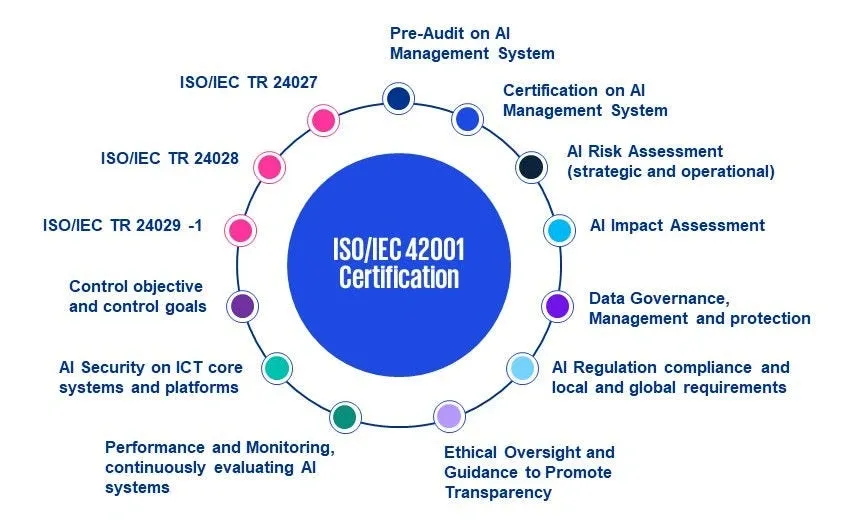
Image Source: KPMG International
ISO 42001 is the world’s first international standard for Artificial Intelligence Management Systems (AIMS). This standard gives organizations a structured way to govern AI responsibly and ethically. Organizations can choose between two paths: they can either work toward compliance or go for full certification.
Definition of ISO 42001 Compliance
Organizations can comply with ISO 42001 through internal self-assessment without getting formal certification. They set up their own policies and procedures that line up with ISO guidelines and review their progress internally. This method helps them build an AI management system that reduces risks in AI development, implementation, and management. The standard isn’t mandatory, but more people recognize it globally as a best practice.
What ISO 42001 Certification Involves
Getting fully certified under ISO 42001 needs a detailed audit from an accredited third-party conformity assessment body (CAB). Organizations must buy and understand the standard first. Then they spot gaps and put the right controls in place. The certification has two audit stages. The first stage looks at documentation and AIMS design. The second stage checks if everything works properly. A successful certification lasts three years with yearly check-ups.
Key Differences in Validation and Oversight
The biggest difference between compliance and certification comes down to how they’re validated:
- Validation Method: Internal teams handle compliance checks, while independent external auditors must certify
- Market Recognition: Compliant organizations can’t say they’re “ISO-certified”, but certified ones get official recognition and better credibility
- Cost Structure: Compliance costs less since it uses internal resources, while certification costs more due to audit fees and certification charges
- Implementation Timeline: Organizations can comply at their own pace, but certification follows strict audit schedules
Both paths help create an effective AI management system. Certification adds independent validation that gives customers extra confidence in AI risk management throughout the AI lifecycle.
When to Choose Compliance Over Certification
Many organizations find it practical to follow ISO 42001 compliance without getting formal certification. This strategy helps them implement responsible AI practices and skip the demanding certification process.
Startups and Early-Stage SaaS Vendors
ISO 42001 compliance gives early-stage companies a well-laid-out yet adaptable foundation. Startups need to move fast with AI features while dealing with security concerns. A compliance-first approach makes more sense since certification costs $4,000 to $250,000 and takes 4-12 months to implement.
Most startups don’t have dedicated compliance teams. Engineering or product leaders handle these extra duties. A compliance-focused approach lets organizations:
- Split responsibilities among existing team members
- Make use of simple frameworks
- Bring in outside experts when needed
Internal Risk Management Without External Audits
Companies can adapt ISO 42001 practices to match their specific needs. This flexibility helps maintain reliable AI governance. Self-assessment and internal risk management replace the mandatory external audits required for certification.
This method works best when organizations already use related systems like data governance, security, privacy, and enterprise risk management.
Meeting Legal Requirements Without Formal Recognition
ISO 42001 isn’t legally mandatory in the U.S. or worldwide, but it shapes new AI laws globally. Organizations using AI tools or operating internationally see this standard as a best practice.
Market forces drive adoption more than regulators do. Cautious clients, corporate buyers, and insurance companies want proof of AI governance. Many accept compliance without demanding certification.
When Certification Becomes Essential
Simple compliance has its benefits, but full ISO 42001 certification becomes essential in certain situations.
Enterprise Clients and Global Market Access
International organizations, particularly in Europe, now expect their strategic collaborations to have ISO 42001 certification as proof of trustworthy AI governance. Industry giants like Microsoft and Google have already gotten certified, making it a requirement for serious contenders in the AI space. Organizations aiming for global market expansion must recognize how certification speeds up enterprise deals and creates competitive advantages in regulated markets.
ISO 42001 Certification Requirements for AI Governance
ISO 42001 certification requires organizations to establish a complete Artificial Intelligence Management System (AIMS) that covers governance structures, risk management protocols, and compliance mechanisms. Organizations need to document their AI governance policies, stakeholder risk assessments, and model logs. The standard also requires validation and verification methods to ensure AI systems represent users from various backgrounds.
Building Trust Through Third-Party Validation
Third-party certification validates independently that an organization’s AI systems meet the highest governance standards. This external verification shows your dedication to responsible AI practices, which matters more as 38% of organizations worry about regulatory compliance.
ISO 42001 Compliance Solutions for SaaS Companies
SaaS providers can strengthen their controls over quality, security, and transparency through ISO 42001 certification. Book a Readiness Call to learn how certification can speed up your AI development by creating a more stable environment and reduce development costs through complete frameworks and guidelines.
Benefits and Challenges of Each Path
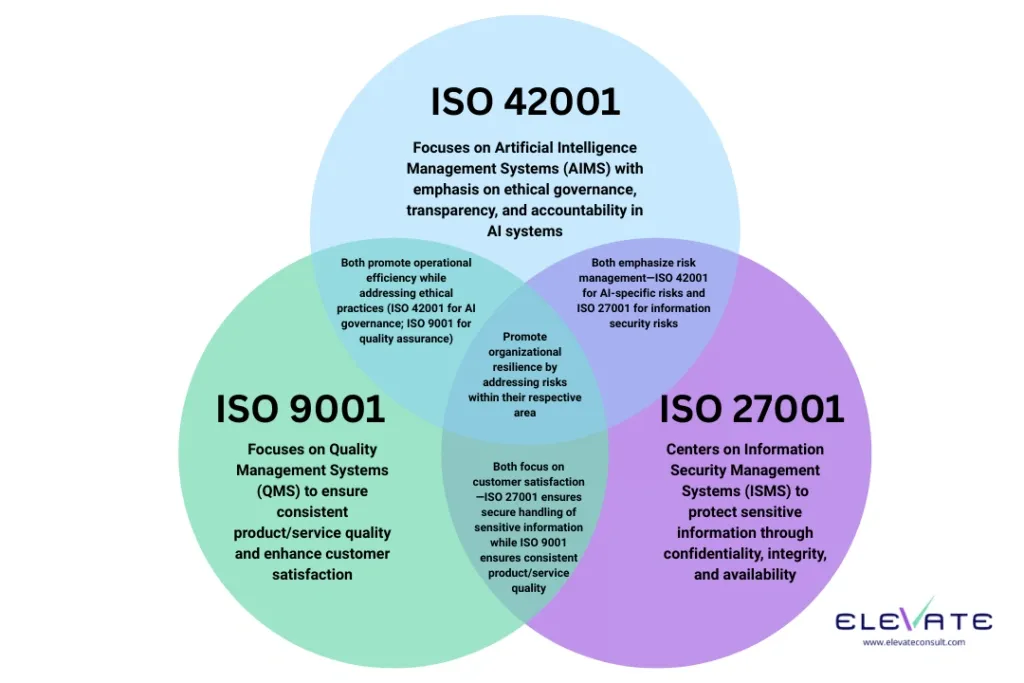
Image Source: Elevate Consult
Organizations face unique challenges and advantages when they implement ISO 42001. Let’s get into both sides of the story.
ISO 42001 Compliance Challenges for Small Teams
Small teams struggle to find enough time and expertise to implement ISO 42001. Startups usually don’t have dedicated compliance staff. The responsibility falls on busy engineering or product leaders. On top of that, it’s hard to interpret the broad requirements. Many organizations can’t figure out how much implementation is “enough”. The biggest problem remains finding the right balance between state-of-the-art AI and ethical and legal obligations.
Cost and Time Investment in Certification
ISO 42001 certification costs vary between $4,000 and $250,000 based on organization size and AI complexity. The trip to certification takes 4-12 months. Organizations familiar with other ISO standards can complete it faster. Annual surveillance audits cost $3,000-$10,000. This means companies need to set aside resources year after year.
Strategic Benefits of Certification for Long-Term Growth
Certification offers strong strategic advantages. It helps companies stand out as leaders in responsible technology adoption. Independent validation of AI safety and governance builds stakeholder trust. Companies become ready for regulatory readiness and reduce compliance risks. They can also save money on cyber insurance.
Combining Compliance and Certification for Maximum Effect
Companies can blend ISO 42001 with existing frameworks like ISO 27001 to get the best results. This creates one board-level framework that covers AI and information security. Companies with ISO 27001 certification can achieve ISO 42001 compliance 30-40% faster than others. Book a Readiness Call to learn how this integrated approach cuts operational costs and removes duplicate controls across multiple standards.
Comparison Table
| Aspect | ISO 42001 Compliance | ISO 42001 Certification |
| Validation Method | Internal self-assessment and audits | Independent third-party external audits |
| Cost Structure | Lower costs, internal resources only | $4,000-$250,000 plus annual surveillance audits ($3,000-$10,000) |
| Implementation Timeline | Flexible, self-paced implementation | 4-12 months with structured audit schedules |
| Market Recognition | Cannot claim “ISO-certified” status | Official recognition with stronger credibility |
| External Audits | Not required | Mandatory two-stage audit process |
| Ideal For | Startups, early-stage companies, small teams | Enterprise organizations, global market players |
| Resource Requirements | Can be managed with existing team members | Requires dedicated compliance personnel |
| Key Benefits | – Flexible implementation – Lower resource commitment – Easier internal risk management |
– Better market credibility – Global market access – Independent validation – Stronger stakeholder confidence |
| Validation Period | No formal period | Valid for three years with annual surveillance |
Conclusion
Your organization’s size, resources, and goals will help determine if ISO 42001 compliance or certification works better. Startups and smaller teams might want to start with compliance as a practical step toward responsible AI governance. It needs less investment than certification. Larger organizations and companies looking to access global markets will benefit more from certification. This third-party validation builds trust with enterprise clients and stakeholders.
Your existing frameworks play a key role in this choice. Companies that already use ISO 27001 or similar standards can achieve ISO 42001 compliance 40% faster. This creates a more efficient governance structure. Small teams face compliance challenges and certification needs substantial resources. Both options help strengthen AI governance and risk management capabilities.
AI governance grows more crucial each day. Companies in every industry adopt AI at a rapid pace. Structured frameworks like ISO 42001 are a great way to get proof of responsible AI practices. Schedule a Readiness Call to evaluate your current AI governance maturity. This helps figure out if compliance or certification arranges better with your business goals.
ISO 42001 goes beyond a simple checklist. It provides a complete framework to manage AI risks, build trust, and position your company for eco-friendly growth in an AI-driven future. Taking steps toward responsible AI governance today through compliance or certification will give you competitive advantages tomorrow.
Key Takeaways
Understanding the distinction between ISO 42001 compliance and certification is crucial for making the right AI governance decision for your organization’s specific needs and resources.
• Compliance suits startups and small teams – Self-assessment approach costs less and offers flexible implementation without external audits • Certification opens enterprise markets – Third-party validation provides credibility needed for global clients and competitive advantage • Cost varies dramatically by path – Compliance uses internal resources only while certification ranges $4,000-$250,000 plus ongoing audits • Existing ISO frameworks accelerate adoption – Organizations with ISO 27001 can achieve ISO 42001 compliance 40% faster than starting fresh • Both paths strengthen AI governance – Whether compliance or certification, implementing ISO 42001 demonstrates responsible AI practices and risk management
The decision ultimately depends on your market position, client requirements, and growth strategy. Startups can begin with compliance and upgrade to certification as they scale, while enterprise-focused organizations may need certification from the start to meet client expectations and regulatory readiness.
FAQs
Q1. What is the main difference between ISO 42001 compliance and certification? The key difference lies in validation. Compliance involves internal self-assessment, while certification requires independent third-party audits. Certification provides official recognition and stronger credibility in the market.
Q2. How long does it typically take to achieve ISO 42001 certification? The certification process usually takes between 4 to 12 months, depending on the organization’s size and AI complexity. Organizations already familiar with other ISO standards may complete the process more quickly.
Q3. Is ISO 42001 certification mandatory for all organizations using AI? No, ISO 42001 is not legally required. However, it’s increasingly expected by risk-averse clients, corporate buyers, and insurers as evidence of responsible AI governance, especially for organizations operating internationally.
Q4. What are the cost implications of ISO 42001 certification? Certification costs can range from $4,000 to $250,000, depending on the organization’s size and AI complexity. Additionally, there are ongoing costs for annual surveillance audits, typically between $3,000 to $10,000.
Q5. Can small startups benefit from ISO 42001 without full certification? Yes, startups and small teams can benefit from ISO 42001 compliance without pursuing full certification. This approach allows them to implement responsible AI practices and establish a structured foundation for AI governance while avoiding the rigorous and costly certification process.