
AI adoption has grown substantially, and ISO IEC 42001 plays an increasingly vital role as 72% of businesses now use AI in at least one business function, up from 55% just last year. This rapid growth brings substantial risks. Documented AI safety incidents rose from 149 in 2023 to 233 in 2024, marking a 56.4% year-on-year increase. The AI Incident Database tracks over 1,200 real-life incidents with many more likely unreported.
ISO 42001 AI management system standard is a vital framework that helps organizations navigate this complex digital world. Organizations can demonstrate accountability through this standard that aligns with emerging regulations like the EU AI Act, which became effective August 1, 2024. Companies that get ISO 42001 certification achieve compliance 40% faster compared to those starting without it.
Our complete guide explores the scope of the ISO IEC 42001 AI management system standard by breaking down its structure, requirements, and practical implementation steps. ISO certifications worldwide increased by 20% in 2024 compared to the previous year. Understanding this standard matters for any organization developing, deploying, or using AI technologies. This piece will give you everything you need to know about implementing an effective AI Management System (AIMS) under the ISO IEC 42001 framework.
Understanding ISO/IEC 42001:2023 and Its Role in AI Governance
The world’s first international standard for artificial intelligence management, ISO/IEC 42001, became a game-changer in AI governance in 2023. This new framework came out in December 2023 and gives organizations a well-laid-out way to manage their AI systems from start to finish.
Definition of ISO/IEC 42001 AI Management System Standard
ISO/IEC 42001:2023 is a complete framework that helps organizations set up, use, maintain and improve their Artificial Intelligence Management System (AIMS). An AIMS combines different organizational parts to create policies, goals, and processes that lead to responsible AI development, delivery, and use. Organizations of all sizes can use this standard if they develop, provide, or use AI-based products or services. This includes private companies, non-profits, and government agencies.
This standard is different from other tech standards because it tackles unique AI challenges like ethical issues, transparency needs, bias reduction, and continuous learning abilities. You’ll find 10 detailed sections along with four key annexes:
- Annex A: Reference control objectives and controls
- Annex B: Implementation guidance for AI controls
- Annex C: Potential AI-related objectives and risk sources
- Annex D: Use of the AI management system in different sectors
Why ISO/IEC 42001 Matters for AI Platforms
AI platforms get several key benefits from ISO/IEC 42001. The standard supports smooth integration of AI into existing organizational structures and helps companies see AI deployment as a strategic move that matches their business goals. It also provides a structured approach to handle both risks and opportunities in AI, striking a balance between state-of-the-art ideas and responsible governance.
Organizations that use ISO/IEC 42001 see these benefits:
- Better quality, security, traceability, and reliability in AI applications
- More efficient AI risk assessments
- Stronger stakeholder trust in AI systems
- Lower development costs
- Better compliance with regulations, especially with new rules like the EU AI Act
The standard creates a systematic, repeatable process for AI compliance that fits with the EU AI Act’s ongoing governance requirements. Companies can now actively manage AI risks instead of just reacting to enforcement.
How ISO/IEC 42001 Is Different from ISO/IEC 27001 and SOC 2
ISO/IEC 42001 and ISO/IEC 27001 come from the same international groups and share similar structures, but they serve different purposes. ISO/IEC 27001 focuses on Information Security Management Systems (ISMS) and protects data confidentiality, integrity, and availability through access control and network protection.
ISO/IEC 42001, however, targets AI Management Systems and emphasizes responsible, transparent, and explainable AI operations. It adds AI-specific requirements that ISO/IEC 27001 doesn’t have:
- Transparency and explainability documentation
- Special data governance and quality standards
- Model development and validation procedures
- Human oversight mechanisms
- AI ecosystem governance
Companies that already have ISO/IEC 27001 certification can implement ISO/IEC 42001 up to 40% faster because of their similar structures. Using both standards creates a complete governance framework that handles both information security and AI-specific challenges.
SOC 2 mainly looks at security, availability, processing integrity, confidentiality, and privacy controls for service organizations. ISO/IEC 42001 takes a broader view of AI governance throughout its lifecycle and puts special focus on ethical considerations and explainability that traditional security frameworks don’t address.
Breaking Down the AIMS Scope in ISO/IEC 42001
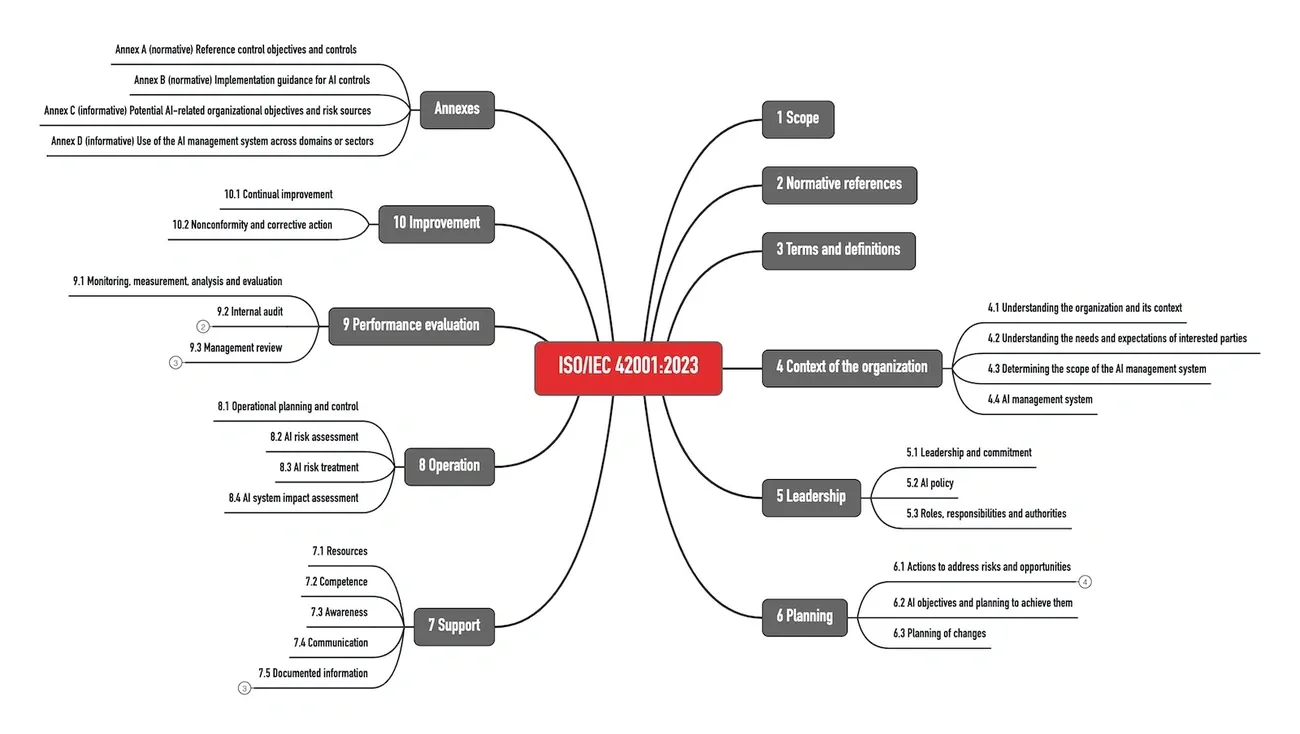
Image Source: Johner Institute
The life-blood of successful ISO/IEC 42001 implementation lies in defining an Artificial Intelligence Management System (AIMS) scope. Organizations must determine how they will govern their AI systems. This decision shapes every part of compliance and risk management that follows.
AI Roles: Provider, Developer, and User
Organizations need to identify their AI roles when establishing their AIMS scope under ISO/IEC 42001. The standard recognizes three main categories:
- AI Providers: Organizations that supply AI-based products or services. These include platform providers who let users build AI solutions and vendors who combine AI into their offerings
- AI Producers/Developers: Teams that design, develop, test, and deploy AI systems. They create the models, datasets, and algorithms
- AI Users/Customers: Organizations that employ AI systems others have developed to make decisions or run operations
Many organizations play multiple roles. To name just one example, a company might develop AI internally while using third-party AI components. ISO 42001 asks organizations to document each role because they carry specific duties within the AI governance framework. Producers must ensure their AI systems work well and behave correctly. Providers take charge of system performance, ethics, and compliance.
AI System Boundaries and Lifecycle Coverage
Organizations must specify which AI systems their AIMS governs. ISO/IEC 42001 requires them to map out system boundaries across the entire lifecycle. ISO/IEC 22989:2022, which ISO 42001 references, breaks this lifecycle into stages: inception, design and development, verification and validation, deployment, operation and monitoring, re-evaluation, and retirement.
Each stage needs specific governance controls. Teams should review ethics and test for bias during development. They must monitor performance when systems go live. This integrated approach helps organizations manage AI risks from start to finish.
Stakeholder Identification and Organizational Context
Organizations should analyze internal and external factors that affect their AI governance before finalizing their AIMS scope. Clause 4.1 of ISO 42001 asks them to identify issues that impact their AIMS goals. These range from regulations and market forces to public expectations and the organization’s capabilities.
Identifying “interested parties” with stakes in the AI systems is crucial. Stakeholders often include customers, employees, regulators, business partners, and suppliers. Organizations must document what each group expects from AI development and use.
A detailed approach to these three AIMS scope aspects will create strong foundations. This helps organizations meet ISO/IEC 42001 requirements and promote responsible AI governance in their work.
Clause-by-Clause Breakdown of ISO/IEC 42001 Structure
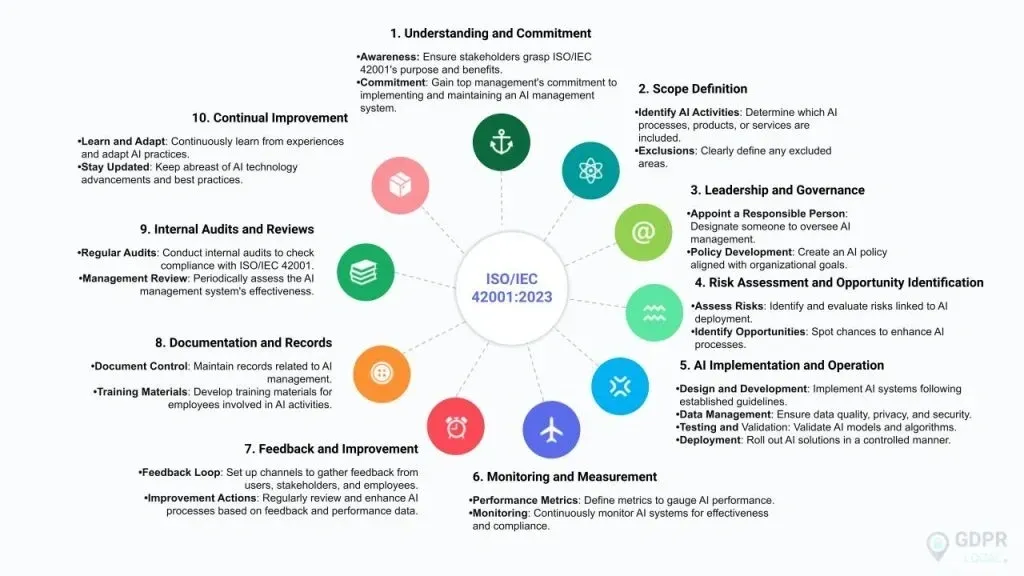
Image Source: Elevate Consult
ISO/IEC 42001 uses a well-laid-out approach with ten connected clauses. These clauses create a detailed framework to govern AI. You need to understand what each clause requires. This will help you set up an AI Management System (AIMS) that works.
Clause 4: Context of the Organization
Clause 4 lays the groundwork for AIMS. Organizations must look at their external and internal environment. They need to identify who their AI systems will affect and combine their expectations. The clause asks for a clear AIMS scope that lists AI systems, functions, and processes. A well-defined scope helps during audits and regulatory responses. Organizations should also map relevant laws. They need to look at both downstream and upstream stakeholders when they think over fairness, human rights, and environmental effects.
Clause 5: Leadership and Accountability
The life-blood of good AI governance under Clause 5 is how involved top management becomes. Leaders must show their steadfast dedication by creating an AI policy that matches their strategic direction. Business processes must include AI management requirements. Leaders should allocate resources, talk about responsible AI practices, and push for ongoing improvements. The core team needs clear roles and responsibilities to retain control over system performance.
Clause 6: Planning and Risk Assessment
Clause 6 sits at the heart of AI governance with its systematic risk management planning. Organizations must set risk criteria that separate acceptable risks from unacceptable ones. They need to assess risks, put treatment options in place, and evaluate how AI systems affect people. The standard asks organizations to look at what it all means for individuals, groups, and society. They must also set AI goals they can measure and create plans to reach them.
Clause 7: Support and Documentation
Clause 7 shows how getting enough resources helps AIMS succeed. Organizations need sufficient resources and trained staff. Everyone should know about the AI policy. Teams must document procedures and control versions. Clear communication channels help report AI concerns. Legal, compliance, and technical teams should learn from each other.
Clause 8: Operational Controls for AI Lifecycle
Clause 8 requires controls throughout the AI lifecycle to meet AIMS requirements. Organizations must handle processes for design, development, buying, deployment, operation, monitoring, changes, and retiring AI systems. A lifecycle approach with specific checkpoints ensures controls work properly.
Clause 9–10: Performance Evaluation and Improvement
These last clauses complete the Plan-Do-Check-Act cycle. Clause 9 needs regular monitoring, measurement, analysis, and evaluation of AI systems. This happens through ongoing checks, detailed internal audits, and management reviews. Clause 10 focuses on getting better by finding opportunities, noting problems, fixing issues, and adapting AIMS for current and future needs.
Annexes A–D: Controls and Sector-Specific Guidance
ISO/IEC 42001 has four crucial annexes that are the foundations of implementing AI management systems. These annexes help organizations set up their AI Management Systems effectively.
Annex A: 38 Controls for AI Risk and Governance
Annex A stands as the operational heart of ISO/IEC 42001. It provides 38 specific controls spread across nine domains. These controls cover the complete AI lifecycle and set concrete requirements for responsible AI governance. The nine control domains are:
- AI Policies (A.2): Lines up with your organization’s policies
- Internal Organization (A.3): Sets roles and reporting structures
- Resources for AI Systems (A.4): Lists system components and resources
- Assessing Impacts (A.5): Looks at how AI affects people and society
- AI System Lifecycle (A.6): Guides you from requirements to maintenance
- Data for AI Systems (A.7): Handles quality, preparation, and transformation
- Information for Interested Parties (A.8): Makes communication transparent
- Use of AI Systems (A.9): Creates deployment policies
- Third-Party Relationships (A.10): Handles external partnerships
Organizations can use these controls to implement AI governance, spot algorithmic bias, stay privacy-compliant, and set up reliable auditing procedures.
Annex B: Implementation Guidance for Controls
Annex B works as your complete guide to implementing the controls from Annex A. You’ll find detailed explanations about applying controls throughout different AI lifecycle stages. The annex offers practical advice about integrating processes, enforcing policies, and checking if controls work. It helps organizations turn ISO/IEC 42001 requirements into real actions.
Annex C: Risk Sources and Organizational Goals
Annex C shows potential AI-related goals and risk sources for your organization. Your AI strategies can better match business goals like better decision-making or staying compliant with regulations. The annex points out risks such as biased outcomes, data breaches, or damage to reputation. Organizations need this annex to promote trustworthiness in AI systems by tackling issues related to accountability, expertise, and data quality.
Annex D: Sector-Specific Adaptations
Annex D shows how ISO/IEC 42001 works in a variety of industries and sectors. Healthcare, finance, manufacturing, and other fields can implement this standard while addressing their unique challenges. The annex promotes combining the AI management system with existing sector-specific standards like ISO 22000 for food safety or ISO 13485 for medical devices. This way, AI governance stays relevant to each sector while maintaining consistency across different operations.
How ISO/IEC 42001 Aligns with Global Regulations
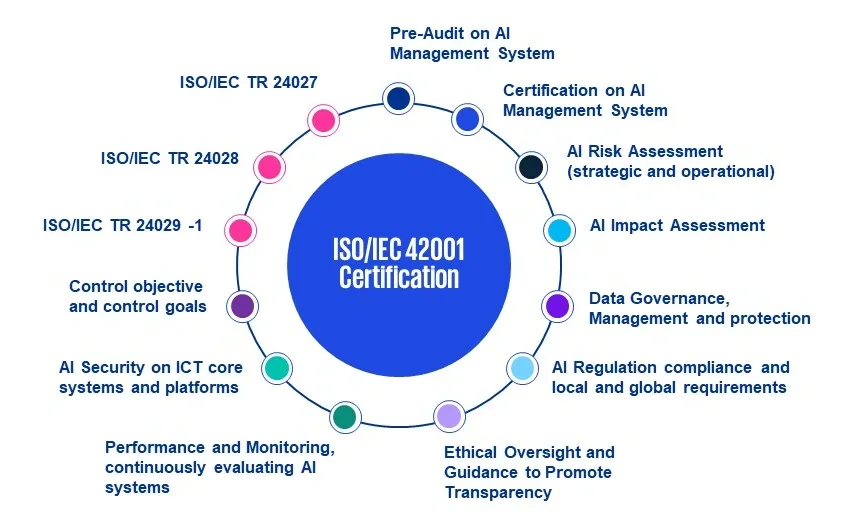
Image Source: KPMG International
ISO/IEC 42001 acts as a bridge between organizational AI practices and compliance requirements as regulatory landscapes change worldwide. This standard creates practical ways to meet new global AI regulations.
EU AI Act Article 15 Compliance Mapping
ISO/IEC 42001 supports Article 15 of the EU AI Act through specific control mappings. Article 15 requires high-risk AI systems to be “accurate, robust, and secure” throughout their lifecycle. The standard’s mapped controls (including A.7.4, A.6.2.4, A.8.29, A.6.2.6, 10.2) build an evidence structure that meets these requirements. The standard breaks accuracy into measurable, cross-functional controls built for regulatory review. Companies using these controls keep versioned logs that track accuracy changes and fixes—exactly what regulators want to see.
GDPR, DORA, and NIS2 Alignment with ISO 42001
ISO 42001 goes together with broader digital governance frameworks. Clause 8.4’s Data Protection Impact Assessment (DPIA) and AI System Impact Assessment (AISIA) support GDPR’s core principles of purpose limitation, data minimization, and explainability. DORA’s requirements for financial services about ICT risk, testing, incident management, and third-party oversight match ISO 42001 Clauses 4–9 directly. Companies under NIS2 will see their security requirements for risk management, reporting, and secure development line up with Clauses 5–10.
Audit-Ready Documentation and Reporting Practices
ISO 42001 promotes audit readiness through organized documentation that meets regulatory standards. Companies should keep audit-grade evidence including chain-of-custody logs, versioned model changes, and detailed incident management records. This approach, paired with proper access management that matches permissions to job responsibilities, creates clear paths to compliance. Teams that implement ISO 42001 properly can handle audit notifications efficiently instead of dealing with crisis situations during reviews.
Conclusion
AI technologies are reshaping business operations worldwide, and ISO/IEC 42001 serves as the foundation for responsible implementation and governance. This state-of-the-art standard helps organizations manage AI risks throughout its lifecycle while tapping into new opportunities. Its well-laid-out clauses and complete annexes guide organizations to establish policies, define roles, assess effects, and implement controls that tackle AI systems’ unique challenges.
Organizations using ISO/IEC 42001 gain advantages beyond just compliance. They build transparent, repeatable processes that earn stakeholder trust. Their audit-ready documentation speeds up regulatory responses. The robust risk assessment methods protect against harm while encouraging responsible innovation.
The standard’s connection with new regulations like the EU AI Act, GDPR, and DORA is valuable as the regulatory world changes. Companies with an AIMS create a foundation that adapts to new requirements instead of just reacting to each regulation. This forward-thinking approach turns compliance from a burden into a business advantage.
Setting up ISO/IEC 42001 needs dedicated resources and leadership support, but the benefits are worth the investment. Organizations ready to start their AI governance should Book a Readiness Call with experienced consultants to assess their capabilities and create a custom implementation plan.
Without doubt, AI governance will become crucial as algorithmic systems take on bigger roles in critical business functions. Companies that set up structured management systems now will be ready for tomorrow’s challenges. The question isn’t whether to implement an AIMS, but when and how well it will fit with existing operations. ISO/IEC 42001 provides the answer—a complete framework that balances innovation with responsibility while building trustworthy artificial intelligence.
Key Takeaways
ISO/IEC 42001 provides organizations with a structured framework to govern AI systems responsibly while maintaining competitive advantage in an increasingly regulated landscape.
• Define your AI role clearly: Organizations must identify whether they’re AI providers, developers, or users to establish proper governance boundaries and responsibilities.
• Implement lifecycle controls: The standard requires systematic management from AI conception to retirement through 38 specific controls across nine domains.
• Align with global regulations proactively: ISO/IEC 42001 maps directly to EU AI Act Article 15, GDPR, and other emerging regulations, enabling 40% faster compliance.
• Establish audit-ready documentation: Maintain versioned logs, impact assessments, and incident records to transform regulatory reviews from crisis management to routine processes.
• Leverage leadership commitment: Top management must demonstrate active involvement by establishing AI policies, allocating resources, and defining clear accountability structures.
Organizations implementing ISO/IEC 42001 create a foundation for trustworthy AI that adapts to evolving regulations while fostering innovation. The standard transforms compliance from reactive burden into proactive competitive advantage, positioning companies advantageously for tomorrow’s AI governance challenges.
FAQs
Q1. What is ISO/IEC 42001 and why is it important for AI governance? ISO/IEC 42001 is the world’s first internationally recognized standard for artificial intelligence management systems. It provides a comprehensive framework for organizations to govern AI systems throughout their entire lifecycle, from conception to retirement. This standard is crucial as it helps organizations demonstrate accountability, align with emerging regulations like the EU AI Act, and manage AI-related risks effectively.
Q2. How does ISO/IEC 42001 differ from other standards like ISO/IEC 27001 and SOC 2? While ISO/IEC 27001 focuses on information security management and SOC 2 addresses security controls for service organizations, ISO/IEC 42001 specifically targets AI management systems. It introduces AI-specific requirements such as transparency and explainability documentation, specialized data governance standards, and model development procedures that are not present in other standards.
Q3. What are the key components of the AI Management System (AIMS) scope in ISO/IEC 42001? The AIMS scope in ISO/IEC 42001 includes identifying AI roles (provider, developer, or user), defining AI system boundaries throughout the lifecycle, and identifying relevant stakeholders and organizational context. This comprehensive approach ensures that AI risks are managed systematically from conception through decommissioning.
Q4. How does ISO/IEC 42001 support compliance with global AI regulations? ISO/IEC 42001 aligns closely with global AI regulations such as the EU AI Act, GDPR, DORA, and NIS2. It provides specific control mappings that support compliance requirements, particularly for high-risk AI systems. The standard’s structured approach to documentation and reporting practices also helps organizations maintain audit-ready evidence for regulatory scrutiny.
Q5. What benefits can organizations gain from implementing ISO/IEC 42001? Organizations implementing ISO/IEC 42001 can expect several benefits, including enhanced quality and reliability of AI applications, improved efficiency in AI risk assessments, greater stakeholder confidence, lower development costs, and better regulatory compliance. Additionally, companies that obtain ISO 42001 certification can achieve compliance with emerging regulations up to 40% faster compared to those starting without it.