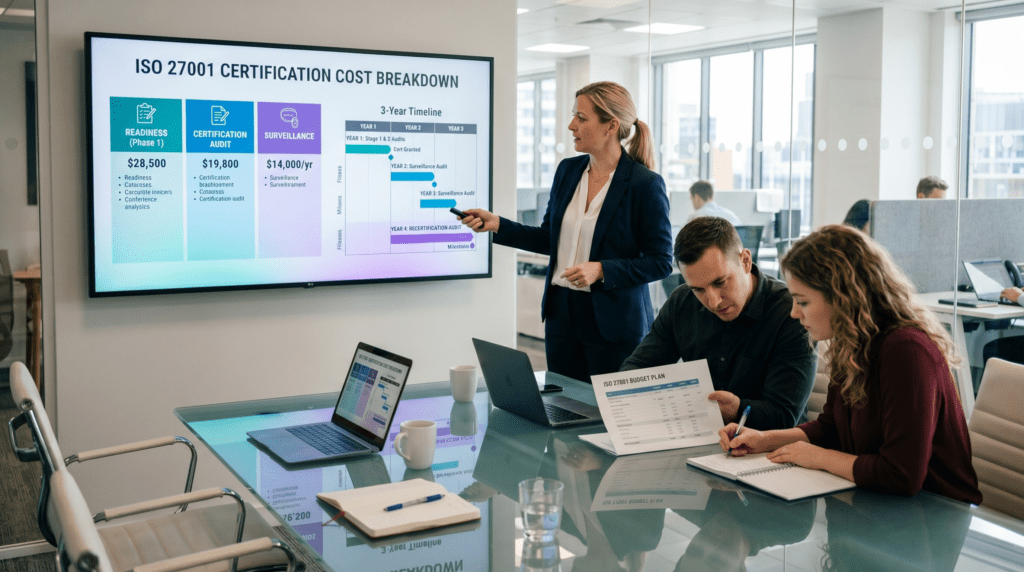
One of the first questions any company asks before pursuing the standard is what ISO 27001 certification cost actually looks like, and the honest answer is that it depends on a handful of clear factors. The total is not a single invoice; it is a combination of certification body fees, the cost of getting ready, and the ongoing expense of maintaining the certificate over its three-year cycle. Understanding how those pieces fit together helps a company budget accurately and avoid the common mistake of planning only for the audit and being surprised by everything around it. This guide breaks down what drives ISO 27001 certification cost, what a small company can realistically expect, and the ongoing costs to plan for, so you can approach ISO 27001 with a clear picture.
What Goes Into ISO 27001 Certification Cost
The total cost has several components, and conflating them is what makes pricing feel confusing. Separating them makes the picture much clearer.
The Certification Body Audit
The certificate itself is issued by an accredited certification body, not by a consultant. That audit happens in two stages, a documentation review followed by the main assessment, and the fee is usually the most predictable line item because it is driven largely by the size of the organization and the scope. This is a separate cost from any help a company gets preparing for it.
Getting Ready
The larger and more variable cost is usually readiness: building or maturing the information security management system, closing control gaps, and preparing evidence. A company can do this internally, hire a consultant, or use a managed model, and the choice has a big effect on both cost and timeline. Where a company starts matters too, since an organization with mature controls needs far less remediation than one beginning from scratch. Many teams find that getting risk treatment right early prevents expensive rework later.
Internal Time and Tooling
The cost that is easiest to underestimate is internal effort. Staff time to implement controls, run an internal audit, and hold management reviews is real, and many organizations also invest in GRC tooling to manage documentation and evidence. These are not optional extras; they are part of the true cost of certification.
What a Small Company Can Expect
For a small company, ISO 27001 certification cost is driven most by scope and current maturity rather than by headcount alone. The certification body audit tends to be the most contained and predictable part, while readiness and internal effort are where the numbers move. The single most effective way to keep cost down is to scope tightly, certifying the part of the business that matters to customers rather than the entire organization, and to arrive at the audit well prepared so there are few findings to remediate. A small team that prepares well and scopes carefully will spend meaningfully less than one that over-scopes and treats the audit as the moment to start fixing things. Pairing readiness with a virtual CISO or a managed compliance model can give a small company the expertise it lacks internally without the cost of a full-time hire. Book a Readiness Call with Elevate’s ISO 27001 specialists for a cost estimate scoped to your business.
The Ongoing Cost After You Certify
ISO 27001 certification is valid for three years, but the cost does not stop at the certificate. Maintaining it is part of the standard, and planning for it prevents an unwelcome surprise in year two.
During the three-year cycle, the certification body conducts surveillance audits, typically at the end of the first and second years, followed by a recertification audit before the certificate expires. Between audits, the organization must keep the management system running through internal audits, management reviews, risk reassessment, and continual improvement. Companies that have just certified and want help sustaining this often use ongoing compliance support so the program stays healthy and each surveillance audit is smoother than the last. Budgeting for maintenance from the start treats certification as the ongoing commitment it actually is.
Conclusion
ISO 27001 certification cost is best understood as three things: the certification body audit, the cost of getting ready, and the ongoing expense of maintaining the certificate. For a small company, scope and maturity drive the total far more than headcount, and tight scoping with strong preparation is the most reliable way to control it. Plan for surveillance and recertification from day one so maintenance is a budgeted commitment rather than a surprise. Book a Readiness Call with Elevate for a cost estimate scoped to your business and a clear path to certification.
Key Takeaways
ISO 27001 certification cost is a combination of audit fees, readiness, and ongoing maintenance, and scope plus maturity drive the total more than company size.
- The total has three parts – Certification body audit fees, the cost of getting ready, and ongoing maintenance over the three-year cycle, and conflating them is what makes pricing confusing.
- Readiness is the variable cost – The certification body audit is fairly predictable, while building the management system and closing gaps varies most based on where a company starts.
- Internal time and tooling are real costs – Staff effort for controls, internal audits, and management reviews, plus any GRC tooling, are part of the true cost and are easy to underestimate.
- Tight scope keeps small-company cost down – Certifying the part of the business that matters to customers and arriving well prepared reduces both audit and remediation cost.
- Maintenance is ongoing – Surveillance audits in years one and two and recertification before expiry, plus running the management system between audits, should be budgeted from the start.
The companies that control ISO 27001 cost best are the ones that scope deliberately, prepare thoroughly, and plan for maintenance before they ever sit the first audit.
FAQs
Q1. What drives ISO 27001 certification cost? The main drivers are the size and scope of the organization, its current security maturity, and how much readiness work is needed. The total combines the certification body audit fee, the cost of getting ready, internal staff time and tooling, and ongoing maintenance over the three-year certification cycle.
Q2. How can a small company reduce ISO 27001 cost? The most effective levers are scoping tightly, certifying only the part of the business that matters to customers, and arriving at the audit well prepared so there are few findings to remediate. Using a virtual CISO or managed compliance model can provide expertise without the cost of a full-time hire.
Q3. Does a consultant issue the ISO 27001 certificate? No. The certificate is issued by an accredited certification body after a two-stage audit. A consultant helps a company prepare, close control gaps, and organize evidence, but the certification decision rests with the certification body.
Q4. What are the ongoing costs after ISO 27001 certification? The certificate is valid for three years, during which the certification body conducts surveillance audits, usually at the end of the first and second years, followed by recertification. Between audits, the company must run internal audits, management reviews, and risk reassessment to keep the management system effective.
Q5. How long does ISO 27001 certification take? Timing depends on scope and current maturity. A company with mature controls and a tight scope can move quickly, while one building its management system from scratch needs longer for implementation and to accumulate the evidence an auditor expects before the Stage 2 audit.