
Generative AI now reaches almost every part of business operations, and the organizations building or deploying it need a resilient AI governance framework more than ever. AI governance frameworks give organizations a structured set of principles and practices for developing and operating artificial intelligence responsibly while staying compliant. They exist to reduce risk, sustain compliance, and protect sensitive data, and they form the backbone of any serious AI governance and risk management program.
The stakes are concrete. Under the EU AI Act, violations involving prohibited practices can draw fines of up to 35 million euros or 7 percent of global annual turnover. In the privacy domain, the HIPAA Journal reports that data-handling failures have led to federal settlements reaching roughly 16 million dollars. A sound governance structure protects an organization both financially and ethically.
This overview examines the principles that shape AI governance frameworks, profiles the five major models including the EU AI Act and the NIST AI Risk Management Framework, and offers practical guidance for choosing the approach that fits a given organization. As enterprises move from piloting AI to running it in production, governance has shifted from a nice-to-have into a board-level concern. Elevate’s view of the trends and controls shaping AI governance sets out why.
Understanding AI Governance Frameworks
AI governance frameworks are structured systems of principles and practices that help organizations develop and deploy artificial intelligence responsibly. They create boundaries that keep AI systems working ethically, securely, and within the law across the full lifecycle, from design and development through deployment and operation.
These frameworks set out policies and practices that reduce risks such as biased outputs, non-compliance, security threats, and privacy breaches. They also establish the means to monitor and evaluate AI systems against ethical norms and legal requirements. The strongest frameworks share a common core:
- Human oversight: keeping AI systems under meaningful human control.
- Transparency: making AI systems understandable to users and regulators.
- Accountability: defining clear responsibility for AI outcomes.
- Safety: building secure, reliable systems that are resilient to failure.
- Fairness: developing AI that reduces bias and supports equitable treatment.
Each framework weights these differently based on its focus. UNESCO’s Recommendation on the Ethics of Artificial Intelligence emphasizes environmental sustainability and gender equality, while the EU AI Act takes a tiered, risk-based approach.
How AI governance differs from data governance
AI governance and data governance are closely connected but serve different purposes. Data governance focuses on managing data quality, integrity, security, and privacy. AI governance extends further, covering model design, algorithms, decision-making processes, and the ethical implications of AI systems. Put simply, data governance ensures quality inputs, while AI governance keeps outputs accountable. The main differences:
- Scope: AI governance addresses ethical compliance, algorithmic fairness, model transparency, and accountability, the risks unique to AI.
- Risk management: AI risks shift more often and demand more complex handling, especially for issues like bias.
- System architecture: AI governance requires practices beyond data management and weighs both benefits and risks.
The role of AI governance in enterprise risk management
AI governance strengthens enterprise risk management by identifying, assessing, and reducing AI-related problems before they escalate. As machine learning drives more consequential decisions, organizations need reliable structures to prevent misuse and adverse impact. Companies without clear governance face compliance gaps, reputational damage, and system failures. Mapping those exposures is the starting point, and Elevate’s perspective on the top AI risks facing businesses today sets out the categories most worth tracking. Effective governance helps an organization:
- Establish clear principles for responsible AI use.
- Make AI systems transparent, explainable, and fair.
- Build shared understanding of AI goals and oversight duties.
- Formalize practices for AI security and compliance.
Core Principles of Responsible AI Frameworks
“Most AI regulations will need businesses to act on four major concerns as they adopt and integrate the technology: inclusiveness, transparency, factual integrity, and continuous evaluation.” — Colin Priest, Chief Evangelist at FeatureByte
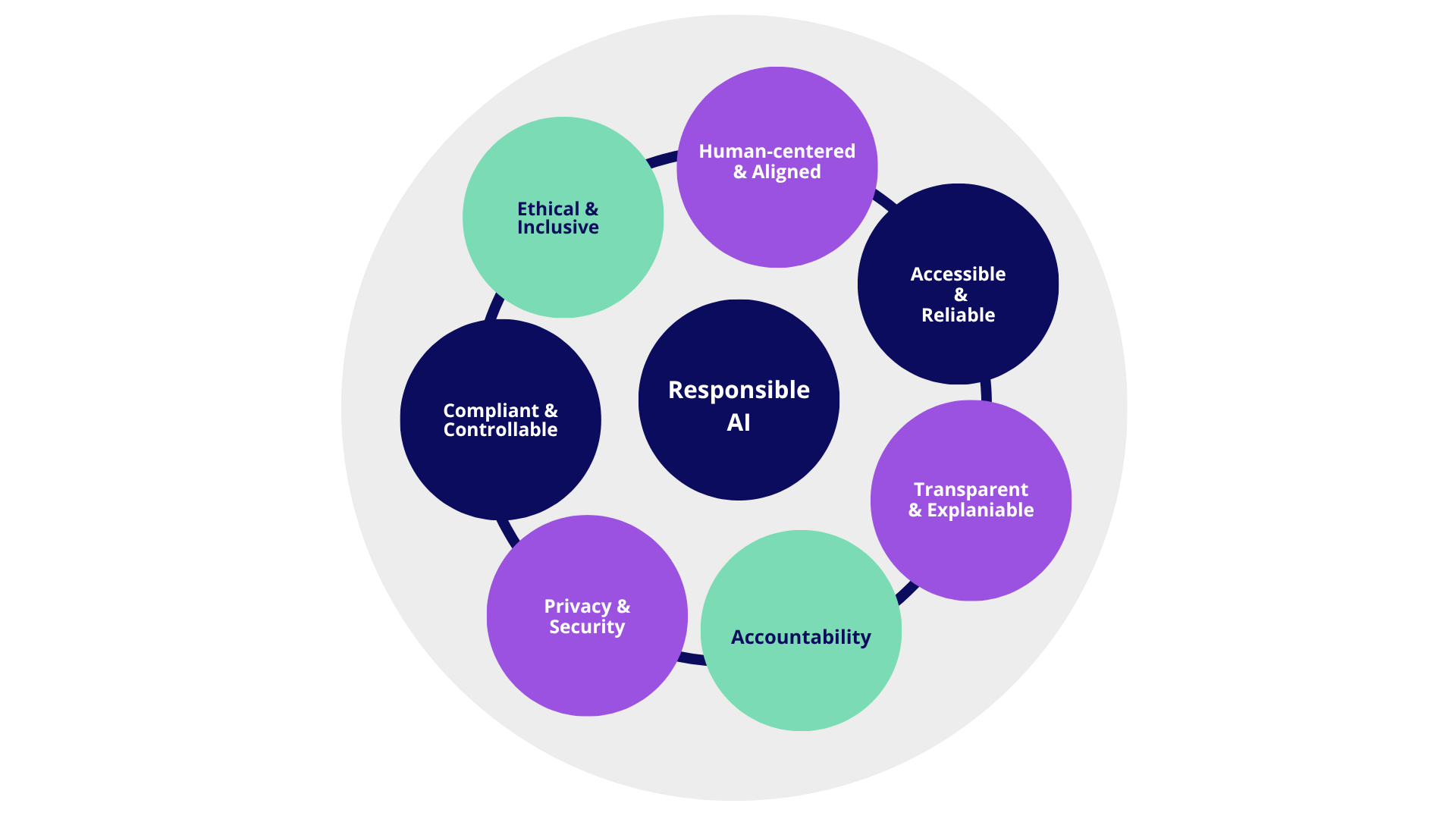
A handful of principles anchor responsible AI. They help organizations build systems that stay accountable, transparent, fair, and secure throughout their life.
Human oversight and accountability
Human oversight keeps automated systems under human control. The EU AI Act requires high-risk AI systems to operate under human supervision in order to minimize risks to health, safety, and fundamental rights. People in oversight roles need to understand what a system can and cannot do, watch for anomalous behavior, avoid over-relying on AI outputs, interpret results correctly, and stop or adjust operations when needed. Clear accountability becomes critical when AI causes harm, because these systems are complex and hard to interpret. Organizations build trust by making accountability an explicit part of governance.
Transparency and explainability
The “black box” problem makes it difficult to explain how complex AI systems reach their outputs. Transparent AI lets stakeholders see the model’s underlying logic, the data used to train it, and the methods used to validate it. Explainability turns opaque systems into ones stakeholders can understand, which matters most in healthcare, finance, and criminal justice, where a wrong decision can harm people. The EU AI Act reflects this by requiring that people be told when they are interacting with an AI system.
Fairness, bias mitigation, and data ethics
Fairness concerns how systems treat different people and groups. Models often perform poorly for underrepresented groups, which can amplify social bias. Teams pursue fairness through pre-processing methods (adjusting training data before building models), in-processing methods (correcting algorithms during training), and post-processing methods (correcting biased results after training).
Fairness metrics can also conflict. The COMPAS recidivism-scoring case, documented in ProPublica’s investigation into algorithmic risk assessment, illustrates a mathematical reality: when base rates differ between groups, a model cannot satisfy both predictive parity and equalized odds at once. Teams have to choose which fairness criterion matters most for their context, and document why.
Security, privacy, and compliance alignment
AI systems process large volumes of sensitive data, so security and privacy are central to any responsible framework. Sound governance should assess privacy risks during development, collect only lawful data that meets people’s expectations, give people control over their data through consent, apply security best practices, and add extra protection for sensitive domains like healthcare and finance. The intersection of AI and security runs deep, and Elevate’s analysis of AI in cybersecurity covers the benefits, risks, and mitigations in more detail.
Overview of the Five Major AI Governance Frameworks
Several major instruments now exist to manage the growing complexity of AI systems. They differ in legal force and purpose, but together they define the governance landscape. One point of precision before the profiles: these are not all “frameworks” in the same sense. One is a binding regulation, one is a voluntary risk framework, one is a certifiable standard, and two are sets of intergovernmental principles.
EU AI Act: risk-based classification
The EU AI Act is the world’s first comprehensive legal framework for AI. It sorts systems into four risk levels, unacceptable, high, limited, and minimal, each with its own obligations. Since February 2025 the Act has prohibited a defined set of practices considered to pose unacceptable risk, including social scoring, emotion recognition in the workplace, and biometric categorization that infers sensitive traits. Obligations for general-purpose AI models took effect in August 2025. High-risk systems face the strictest requirements: risk assessment, quality datasets, detailed record-keeping, and human supervision. For a fuller breakdown, see Elevate’s guide to the EU AI Act’s key dates and who needs to comply.
Provisional, verify before relying on it. The high-risk timeline is in flux. Under the Digital Omnibus on AI, a package of amendments the European Parliament approved on 16 June 2026, high-risk obligations would be deferred: standalone Annex III systems (biometrics, critical infrastructure, education, employment, migration) to 2 December 2027, and AI embedded in regulated products under Annex I (such as medical devices, machinery, lifts, and toys) to 2 August 2028. As of mid-June 2026 this is not yet law. It takes legal effect only once the Council formally adopts it and it is published in the EU Official Journal. If that does not happen before 2 August 2026, the original 2 August 2026 high-risk deadline applies as written. Most Article 50 transparency obligations still apply from 2 August 2026 regardless.
To help providers and deployers meet those Article 50 transparency obligations, the European Commission published a voluntary Code of Practice on marking and labelling AI-generated content on 10 June 2026. It covers machine-readable marking, watermarking, deepfake and AI-text labelling, a common set of EU labelling icons, and free detection tools. Signing supports compliance but does not by itself establish it.
NIST AI Risk Management Framework: Govern, Map, Measure, Manage
The NIST AI Risk Management Framework (AI RMF) launched in January 2023 as a voluntary framework for handling AI-related risk. Its four core functions are Govern (building a risk-aware culture), Map (placing AI systems in context), Measure (evaluating risk through quantitative and qualitative methods), and Manage (prioritizing the most important risks). Organizations of any size can adapt it, and the AI RMF Playbook offers practical steps for each function. NIST is updating the framework in line with current US AI policy. Elevate’s primer on the NIST AI RMF and how to implement it goes deeper.
ISO/IEC 42001: AI management system certification
Published in December 2023, ISO/IEC 42001 is the first AI management system standard that organizations can be certified against. It sets requirements for establishing, running, maintaining, and improving an AI management system, using a Plan-Do-Check-Act cycle to manage AI risk over time. Its distinguishing feature is certification: a third-party audit produces evidence of responsible AI practice that organizations can show customers and regulators. Because it overlaps with adjacent standards, many organizations run it alongside their existing management systems, as Elevate explains in how ISO 42001 overlaps with ISO 27001 and ISO 9001.
OECD AI Principles: global ethical alignment
The OECD AI Principles, first adopted in 2019 and updated in May 2024, were the first intergovernmental standard on AI and shaped many later instruments, including the EU AI Act’s definitions and lifecycle concepts. One clarification worth making: the adherents are governments, not companies. They include OECD member countries, several non-member states, and the European Union, currently around 47 in total. The principles promote innovation while keeping AI trustworthy and grounded in human rights and democratic values.
UNESCO Recommendation on the Ethics of AI: human rights and sustainability
UNESCO’s Recommendation on the Ethics of Artificial Intelligence was the first global standard for AI ethics, agreed by all 193 member states in 2021. It goes beyond high-level principles to give guidance across eleven policy areas, including prohibitions on using AI for social scoring and mass surveillance. Environmental responsibility, gender equality through the Women4Ethical AI initiative, and inclusive governance are central priorities, supported by UNESCO training and policy guidance.
The Five Frameworks Side by Side
The table compares the five across the dimensions that matter most when choosing one: instrument type, whether it is mandatory or voluntary, whether you can be certified against it, its geographic reach, and who it best fits.
| Criteria | EU AI Act | NIST AI RMF | ISO/IEC 42001 | OECD AI Principles | UNESCO AI Ethics |
|---|---|---|---|---|---|
| Type | Binding regulation | Voluntary risk framework | Management system standard | Intergovernmental principles | Intergovernmental ethics standard |
| Mandatory or voluntary | Mandatory for AI touching the EU market | Voluntary | Voluntary | Voluntary | Voluntary |
| Certifiable | No | No | Yes (third-party) | No | No |
| Geographic reach | EU, with extraterritorial effect | US, used globally | International | International (~47 adherents) | Global (193 member states) |
| Best for | Organizations placing AI on the EU market | Flexible, structured risk management without certification | Certifiable proof of responsible AI practice | Aligning to globally accepted ethical baselines | Public-sector and mission-driven bodies prioritizing rights and sustainability |
A few practical takeaways. Only the EU AI Act carries legal force, and only for AI systems touching the EU market, though its reach extends to providers outside the EU. ISO/IEC 42001 is the single instrument here that offers formal certification, which is why organizations that must demonstrate compliance to customers or auditors often pair it with one of the others. NIST AI RMF and the EU AI Act work well together: the RMF provides the operational structure to meet many of the obligations the Act requires. OECD and UNESCO function less as implementation playbooks and more as the ethical foundation the others build on.
Not sure which combination fits your risk profile and regulatory exposure?
How to Choose the Right AI Governance Model
Choosing an AI governance framework requires a clear-eyed look at your organization’s needs, risk tolerance, and regulatory environment. The right model addresses your specific challenges without creating unnecessary red tape.
Assess your risk profile and regulatory exposure
Start by assessing AI risks against your existing tolerance across operations, reputation, legal, and privacy. Risk appetite ranges widely, from heavily regulated firms that minimize exposure to organizations rolling out AI aggressively. Whether your systems are built in-house or bought from vendors matters too, because each path brings different governance challenges.
Map governance needs to framework strengths
Match your needs to what each instrument does best. The NIST AI RMF gives you a flexible way to assess risk, while ISO 42001 provides certifiable practices for building governance systems. A disciplined approach brings four advantages: repeatable evaluation steps, audit readiness through documented risk registers, cross-team alignment via shared taxonomies, and regulatory mapping that simplifies compliance.
Industry-specific considerations
Healthcare organizations must weigh risks to patient safety, privacy, and clinical workflows. Financial institutions need governance that handles the added complexity generative AI introduces into modeling, fraud detection, and customer-facing decisions. Heavily regulated sectors usually keep risk tolerance low because compliance rules are strict, and guidance from public-private partnerships can offer tailored approaches.
Balance flexibility against formal certification
You will need to weigh flexible voluntary frameworks against certified validation. Whichever you choose, documenting governance decisions matters, because that record is your proof for regulators and stakeholders. Governance is not a one-time exercise; it needs ongoing attention as systems evolve, with fresh assessments after major changes or shifts in external conditions. For organizations folding this into broader planning, Elevate’s guide to integrating AI governance into corporate strategy is a useful next step.
Implementing AI Governance Across the Lifecycle
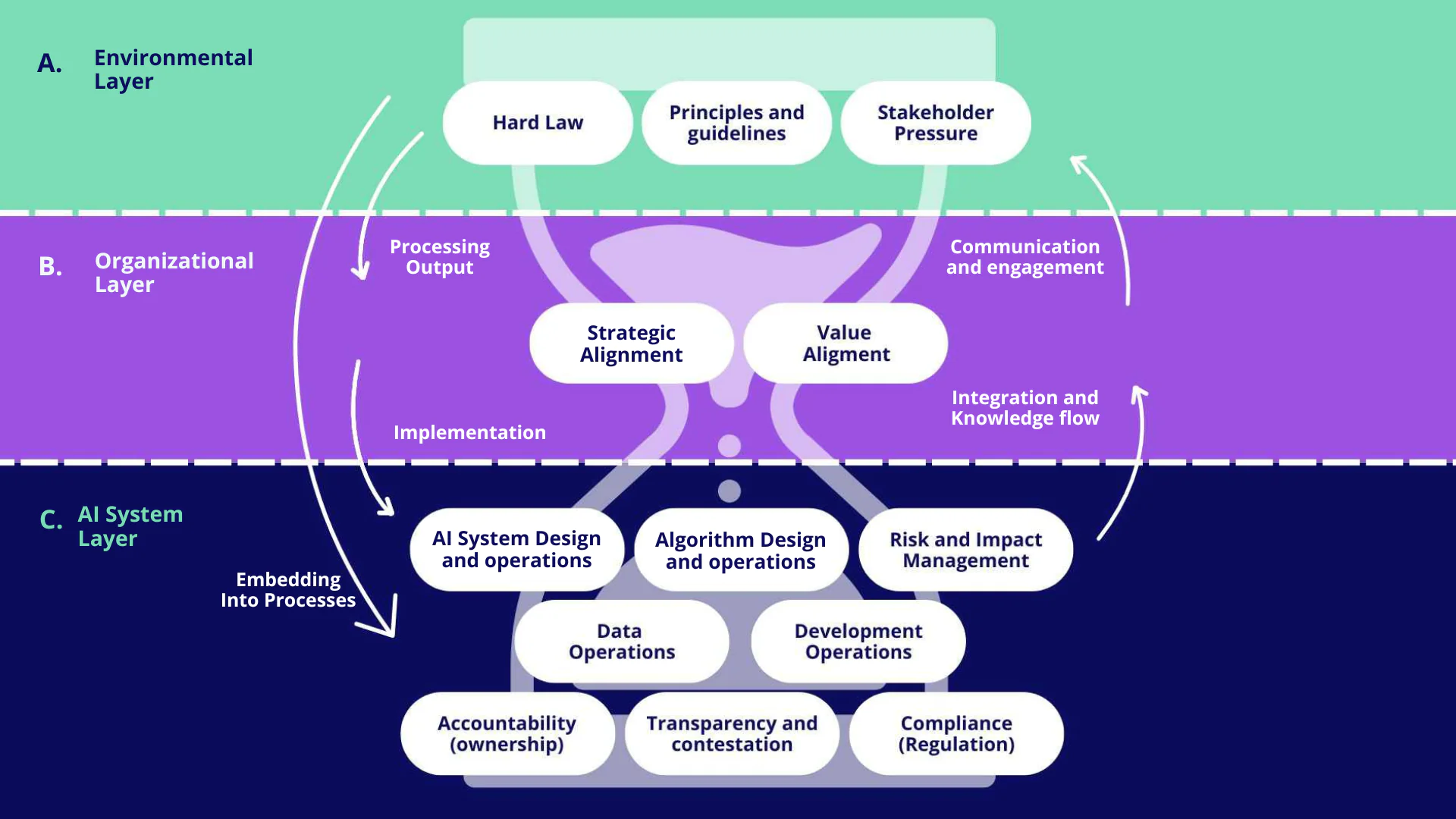
AI governance needs attention throughout the lifecycle, not as a compliance checkbox bolted on at the end. Each phase calls for its own controls.
Design: traceability and ethical alignment
Governance begins at design with documentation of data sources, model features, and use cases. Building explainability in from the start keeps systems auditable from day one. Define ethical rules for acceptable development practices, and bring in varied expertise, including ethicists and legal teams, so data collection and processing follow standards that work cleanly with the models.
Deployment: secure environments and audit logging
Deployment calls for security controls built for AI: detailed AI asset inventories, communication channels secured with managed identities, and platform-specific protections. Audit logging is central. Store logs in tamper-resistant storage with strict access controls so there is a durable record of events to prove actions and support investigation.
Monitoring: drift detection and feedback loops
After deployment, watch models closely for performance change. Model drift, where performance shifts over time, calls for systematic detection using statistical methods such as the Kolmogorov-Smirnov test or Wasserstein distance to compare training data against new inputs. User feedback adds another monitoring layer; set up a system to triage and prioritize it by severity and potential impact.
Ongoing risk management and explainability
Run risk assessments regularly at both the organization and system levels. Techniques such as reinforcement learning from human feedback let teams encode human values while maintaining alignment, and explainability tooling helps show how features influence predictions. Working with subject-matter experts to produce model cards and data sheets for each system keeps transparency and accountability intact across the lifecycle.
Conclusion
AI continues to spread through every part of business, and strong governance frameworks are the guardrails that make responsible innovation possible. Five major models shape the landscape: the EU AI Act, the NIST AI Risk Management Framework, ISO/IEC 42001, the OECD AI Principles, and the UNESCO Recommendation on the Ethics of AI. They differ in implementation, but they converge on the same core: human oversight, transparency, fairness, and security.
The right choice depends on your circumstances, your risk profile, your regulatory exposure, and your industry. Some organizations benefit from ISO 42001’s certification pathway; others find the NIST AI RMF more flexible. Whatever the mix, governance must span the full lifecycle, from ethical design and traceability through secure deployment, continuous monitoring, and ongoing risk management. Systems without consistent governance tend to fall short of both ethical and regulatory expectations. Above all, governance is a continuous discipline, not a destination, and the organizations that treat it that way are the ones that build durable trust in AI.
Choosing and Implementing the Right Framework
The five frameworks each serve a different purpose, and most organizations end up combining them rather than picking just one. The right starting point depends on your regulatory exposure, your industry, and whether you need certification you can show to customers and auditors. Elevate Consult helps organizations assess their risk profile, map obligations to the right combination of frameworks, and build a governance program that holds up to scrutiny.
Find out which model fits your organization and what implementation will take.
Key Takeaways
Choosing the right AI governance framework is central to balancing innovation with responsible deployment as AI becomes integral to operations.
- Five major models offer different approaches: the EU AI Act provides risk-based legal compliance, NIST offers flexible voluntary risk management, ISO 42001 enables certification, and OECD and UNESCO supply the ethical baseline.
- Match framework strengths to your needs by first assessing risk profile, regulatory exposure, and industry before deciding between voluntary flexibility and formal certification.
- Implement governance across the full lifecycle: ethical design and traceability, secure deployment with audit logging, monitoring for model drift, and ongoing risk management.
- Core principles stay constant across every framework: human oversight, transparency, fairness, and security.
- Governance is an ongoing discipline; as technology and regulation evolve, the approach must adapt while maintaining stakeholder trust and compliance.
The organizations that establish robust governance now will be better positioned for sustainable, competitive innovation.
Frequently Asked Questions
What are the key components of an AI governance framework?
Most AI governance frameworks center on human oversight, transparency, accountability, fairness, and security. Together these components help organizations develop and deploy AI responsibly while managing risk and meeting regulatory requirements.
How does AI governance differ from data governance?
Data governance manages data quality, integrity, and security. AI governance extends beyond the data to the design, algorithms, decision-making, and ethical implications of AI systems, addressing AI-specific challenges such as algorithmic fairness and model explainability.
Which AI governance framework is most suitable for my organization?
It depends on your needs, risk profile, and regulatory environment, including industry requirements, the flexibility you want, and whether formal certification matters. The EU AI Act is mandatory for AI on the EU market, the NIST AI RMF offers a flexible voluntary structure, and ISO/IEC 42001 is the one model you can certify against, so many organizations combine them.
How can organizations implement AI governance across the lifecycle?
Apply controls at every stage: traceability and ethical alignment during design, secure environments and audit logging at deployment, drift detection and feedback loops during monitoring, and ongoing risk management with explainability tooling throughout the system’s life.
Why is AI governance important for businesses?
It reduces risk, supports regulatory compliance, and builds stakeholder trust. Good governance helps organizations balance innovation with responsible use, avoiding costly legal and reputational damage while creating a foundation for durable competitive advantage.