
ISO 42001 controls stand as the world’s first international standard created specifically for Artificial Intelligence Management Systems (AIMS). The International Organization for Standardization (ISO) and the International Electrotechnical Commission (IEC) published this pioneering framework in December 2023 to help organizations manage AI responsibly.
ISO/IEC 42001:2023 has 38 strategic controls spread across 9 key governance areas. These guidelines help organizations build AI systems that are safe, fair, and ready for audits. The controls address everything from governance and risk management to transparency and ethical use throughout the AI lifecycle. SaaS providers can now follow a clear roadmap to tackle the unique challenges of AI deployment.
Compliance with ISO 42001 goes beyond simple checkboxes. Your AI-enabled SaaS must show commitment to transparency, accountability, and society’s wellbeing. These factors matter more than ever to regulators and enterprise clients alike. The growing momentum of the EU AI Act and other global governance initiatives makes ISO 42001 a must-have for organizations looking ahead.
This piece will walk you through the key ISO 42001 Annex A controls that matter most for SaaS features. You’ll find practical implementation guidance and learn how these standards can boost your AI governance while preparing for upcoming regulations.
Overview of ISO 42001 Annex A Controls for SaaS
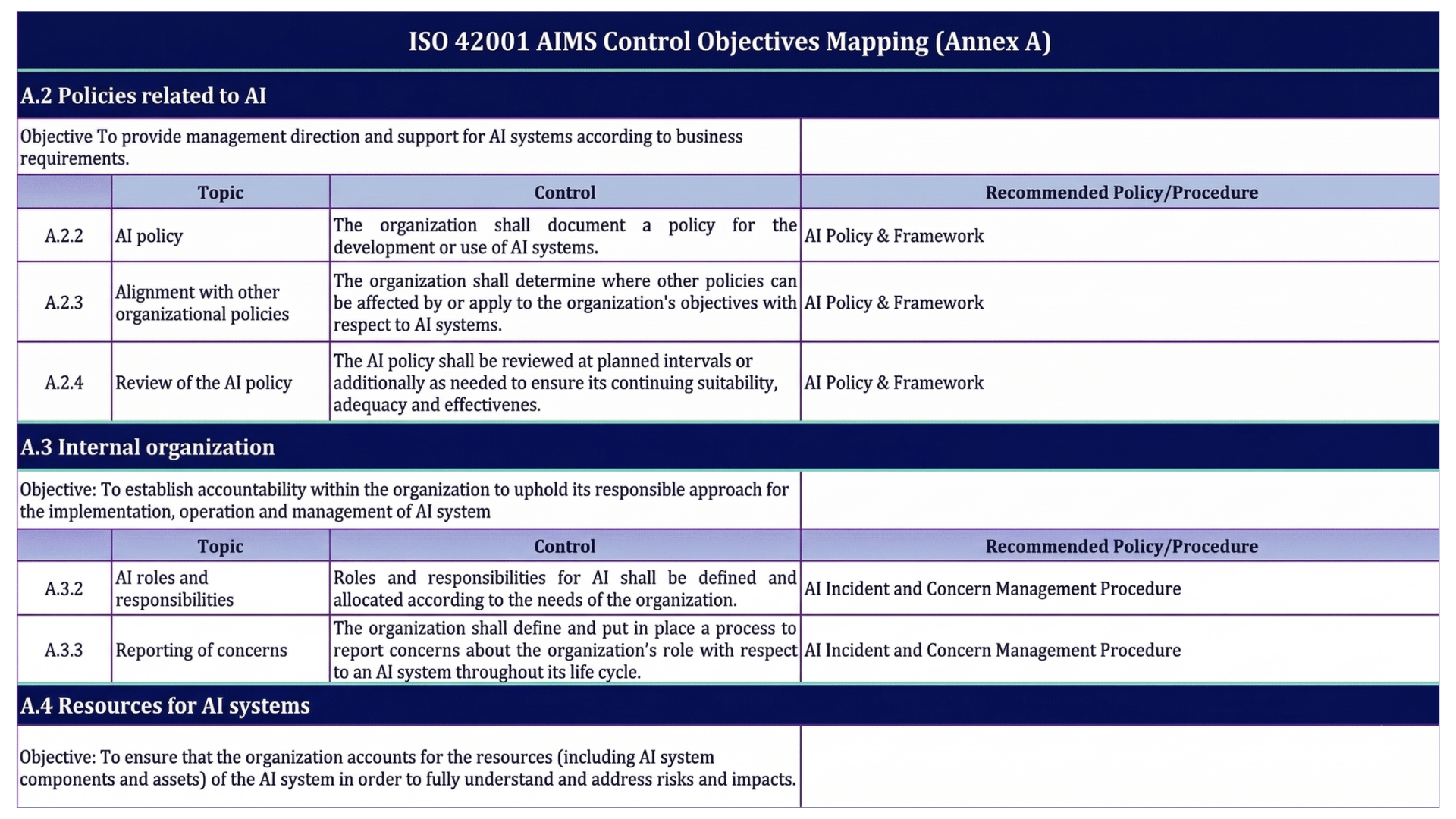
Image Source: GRC Documents
“ISO 42001 controls are a set of guidelines and requirements for designing and managing AI systems that follow ethical practices and ensure compliance.” — Sprinto Compliance Team, ISO 42001 Controls and AI Governance Experts
Annex A is the life-blood of ISO 42001. It gives organizations a structured way to handle AI governance. This framework provides detailed guidelines to manage artificial intelligence systems throughout their lifecycle. SaaS providers who add AI capabilities to their platforms will find these guidelines especially significant.
Structure of ISO 42001 Annex A: 9 Domains, 38 Controls
Annex A has nine different governance domains with 38 specialized controls. These domains cover every aspect of responsible AI from policy development to deployment and monitoring:
- A.2 – Policies Related to AI: Sets the management direction for AI systems that fits business needs through written AI policies. It makes sure these policies work with existing organizational frameworks and get regular reviews.
- A.3 – Internal Organization: Sets up clear accountability structures for responsible AI. It defines specific roles and creates procedures to report AI-related concerns.
- A.4 – Resources for AI Systems: Makes sure all critical AI system components are well-documented and managed. This includes everything from data resources to computing infrastructure and team skills.
- A.5 – Assessing Impacts of AI Systems: Looks at how AI systems affect individuals, communities, and society. It also documents ways to reduce risks.
- A.6 – AI System Life Cycle: Has nine detailed controls that cover the entire development process. These range from setting goals and design requirements to testing, deployment planning, and monitoring operations.
- A.7 – Data for AI Systems: Tackles data’s key role in AI performance. It includes controls for data sources, quality checks, and proper preparation methods.
- A.8 – Information for Interested Parties: Creates transparency through documentation, reporting channels, incident updates, and stakeholder communications.
- A.9 – Use of AI Systems: Shows how to use AI responsibly by setting proper usage limits and adding safeguards against misuse.
- A.10 – Third-Party and Customer Relationships: Manages relationships with partners, suppliers, and customers. It makes sure everyone knows their responsibilities and shares risks appropriately.
These domains work together as connected parts. They create an all-encompassing governance system that handles both technical and organizational aspects of AI management.
Why Annex A Matters for SaaS AI Governance
SaaS providers will find Annex A especially valuable because it tackles the unique challenges of cloud-based AI delivery. These controls give a systematic approach to AI governance that combines smoothly with existing standards like ISO 27001 (information security) and ISO 9001 (quality management).
Market trends show that 2025 will likely match or exceed the growing need for ISO 42001 compliance seen in 2024. Three main factors drive this growth:
- New AI regulations affecting global markets
- Enterprise procurement requirements (such as Microsoft SSPA program v10 AI updates)
- Growing customer expectations for responsible AI practices
The framework helps SaaS providers avoid common AI governance problems like:
- Missing clear ownership of AI risks
- Poor documentation of system parts and dependencies
- Limited evaluation of AI’s impact on users and communities
- Blurred lines between vendor and customer responsibilities for AI outputs
Annex A controls give SaaS companies practical guidance for each AI lifecycle stage. These controls do more than just help with compliance. They help build AI systems that people can trust, verify, and audit.
SaaS providers who use these controls gain more than just regulatory compliance. They build stakeholder trust, manage risks better, stand out from competitors, and prove their AI practices are ethical. These benefits matter more each day as AI becomes central to the SaaS marketplace.
AI Policy and Internal Organization Controls
SaaS organizations need clear policies and structures to make AI governance work. ISO 42001 controls in domains A.2 and A.3 give specific requirements. These help manage artificial intelligence systems throughout their lifecycle.
A.2.1: Establishing an AI Policy for SaaS
ISO 42001 requires SaaS organizations to create and document a detailed AI policy. This policy is the life-blood of your AI governance framework. It sets boundaries and expectations for developing, deploying, and managing AI systems.
Your AI policy for SaaS environments should include these key elements:
- Requirements for assessing AI system effects
- Guidelines for system development and deployment
- Ways to line up with other company policies
- Steps to report AI system concerns
The policy should blend with your business strategy and values instead of standing alone. This helps AI governance match your business goals and risk management. You need regular policy reviews to stay current with new AI technologies and regulations.
SaaS companies must focus their AI policy on transparency, accountability, fairness, security, and privacy. These basic principles help you manage resources better and make smarter decisions across your organization.
A.3.1: Defining Roles and Reporting Structures
Control A.3.1 of ISO 42001 stresses the need to define AI-related roles clearly in your SaaS organization. This ensures qualified people oversee every part of AI system management – from development to deployment.
Setting up an AI governance committee is vital. This committee should have members from IT, legal, compliance, and ethics departments. They make sure all AI projects match your company’s values and follow regulations.
A RACI matrix makes accountability stronger. It shows who handles specific tasks, who owns outcomes, who needs input, and who stays informed. This clarity reduces confusion in AI projects.
Your SaaS organization needs these key roles:
- Chief AI Risk Officer or similar leader
- Data Protection Officer watching AI
- AI Project Managers for features
- Team members with specific AI duties
A.3.2: Handling AI-Related Concerns Internally
Control A.3.2 of ISO 42001 requires clear ways to report AI system issues. These channels should be available to employees, contractors, customers, partners, and the public.
Your SaaS organization should create detailed steps to spot, document, and fix problems found through assessments. These steps must include actions that prevent issues from happening again.
Good reporting systems need:
- Simple paths to raise AI concerns
- Rules for documenting issues
- Timelines for responses and solutions
- Protection for people who report problems
Keeping detailed incident logs is essential. These should show what happened, what you did about it, and how it ended. This record helps you meet compliance rules and improve your AI governance.
These controls give SaaS organizations a strong base for responsible AI governance. You can innovate while reducing risks from bias, privacy issues, and security threats that often affect cloud-based AI services.
Managing Resources and Data for SaaS AI Systems
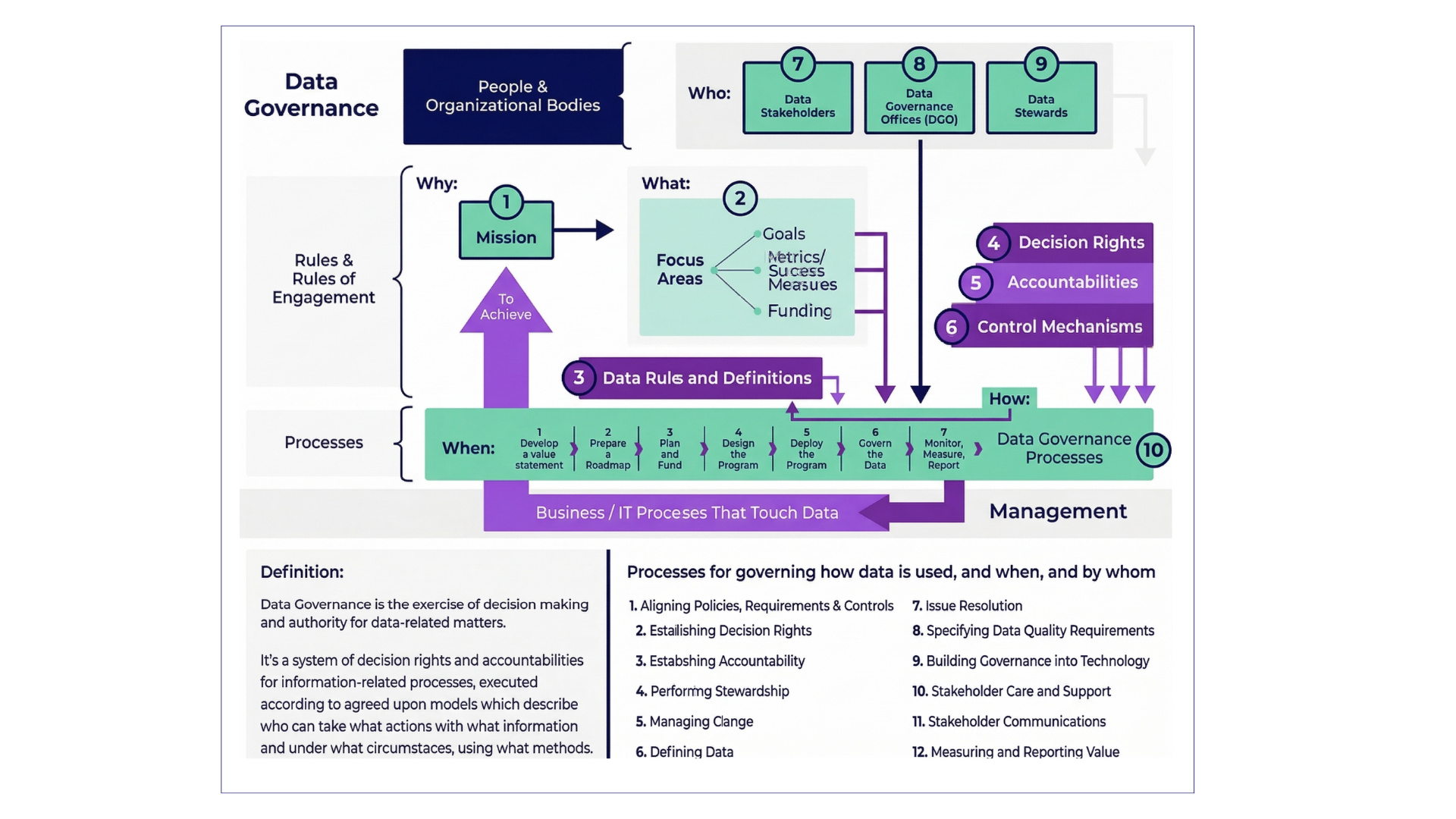
Image Source: Profisee
“By ensuring a thorough understanding of all resources involved in AI systems, organizations can preemptively address vulnerabilities and enhance system resilience.” — ISMS.online Risk Management Team, ISO 42001 Risk Management and Compliance Specialists
Resource management lies at the heart of ISO 42001 compliance for SaaS providers implementing AI features. The A.4 controls set requirements to document, track, and manage both technical and human resources involved in AI systems throughout their lifecycle.
A.4.2: Documenting AI System Components
Documentation is the foundation of AI governance in SaaS environments. ISO 42001 control A.4.2 requires organizations to keep detailed records of all AI system components during development stages. These records do more than meet compliance requirements – they create historical context needed for auditing, validation, and troubleshooting.
We documented five critical resource categories:
- AI system components and their relationships
- Data resources used for training and operation
- Tooling resources used in development
- System and computing resources supporting operations
- Human resources involved throughout the lifecycle
SaaS providers can trace AI-related decisions and spot issues before they reach customers with this documentation. Teams can understand system dependencies better, identify inefficiencies, and respond to incidents faster when they maintain thorough component records.
A.4.3: Managing Data Provenance and Quality
Data provenance has become the most critical aspect of AI governance for SaaS platforms. This historical record details data origin and transformations. ISO control A.4.3 requires organizations to track complete information about all data resources used in AI systems.
Good data provenance management tracks data origin, modification records, categories, usage patterns, quality metrics, retention policies, and bias identification methods. SaaS providers can trace data lineage from collection through transformation to AI output with this documentation.
Data provenance brings specific benefits to SaaS AI implementations:
- Data integrity protection through verifiable custody chains
- Regulatory compliance support across jurisdictions
- Security enhancement by flagging unauthorized changes
- Result reproducibility for validation
Dynamic SaaS environments make data provenance challenging. Organizations must still create systematic collection processes from databases, APIs, IoT devices, and third parties to maintain quality.
A.4.5: Ensuring Team Competency in AI Governance
Human factors play an equally vital role in ISO 42001 compliance. Control A.4.5 (with A.4.6) requires documentation of team members’ roles, responsibilities, competencies, and training records in AI systems.
SaaS providers must identify needed AI governance skills and ensure their teams’ expertise before implementation. AI governance teams stay current with evolving regulations and best practices through continuous training.
Organizations should give specific individuals or teams clear ownership of AI governance decisions and regulatory requirements. AI Project Managers often work with Data Protection Officers or CISOs to define business cases, identify risks, and run stakeholder engagement processes.
Documentation of human resources proves accountability for AI system outcomes. This transparency in development processes helps promote diversity and prevents bias in applications.
SaaS organizations build trustworthy AI features by implementing these resource management controls effectively. They establish the visibility, traceability, and competency needed for responsible AI development.
Assessing AI System Impacts in SaaS Use Cases
SaaS providers need to understand how AI systems affect users and society to implement AI governance that works. ISO 42001’s A.5 controls give providers a well-laid-out way to review these effects throughout the AI’s lifecycle.
A.5.1: Getting the Full Picture of SaaS Features’ Impact
AI impact assessments help SaaS organizations spot how their AI features affect stakeholders and weigh both benefits and risks. ISO 42001 requires these assessments to be part of existing risk management frameworks rather than standalone activities.
The assessment includes these key stages:
- Define scope and context – The AI system’s purpose, functionality, and development stage need clear description while identifying affected stakeholders
- Establish timing and triggers – The right time to conduct assessments during the AI lifecycle (design, development, deployment, post-deployment) needs planning, along with events that call for reassessment
- Allocate responsibilities – The core team with technical, legal, and compliance expertise must have clear ownership
- Integration with existing processes – AI impact assessments should connect with broader risk management frameworks to maintain consistency and avoid overlap
These assessments, as part of your governance program, keep AI systems reliable, ethical, and compliant—building trust among SaaS customers.
A.5.4: Looking at Society-Wide and Individual Effects
ISO 42001 control A.5.4 asks providers to look at effects on individual users and society. SaaS providers must review several critical aspects of individual effects:
- Fairness/bias – The model’s ability to produce fair outcomes for different user groups
- Transparency – Ways to share information about the AI system with stakeholders
- Explainability – Users should understand how the system creates results
- Safety – Risks to human life, property, or environment
- Financial consequences – Economic effects on various stakeholders
- Accessibility – The system’s use by people with different abilities
Society-wide effects need providers to look at environmental sustainability, economic factors, government regulations, and cultural values. This includes the AI system’s effect on jobs, public opinion, and community participation.
Yes, it is true that ISO 42001 acknowledges AI systems can create uniform or varied outcomes based on how they’re implemented.
A.5.5: Writing Down Risk Management Plans
The final part needs clear documentation of ways to handle identified risks. This should include:
- Benefits and risks based on accountability and privacy
- Technical safeguards against vulnerabilities
- Ways to watch the system continuously
- Regular review schedules
SaaS providers should take proactive steps like regular bias testing, building diverse teams, and using differential privacy techniques. These methods can reduce security problems while making the system work better.
A resilient documentation system serves many purposes—it tracks changes, supports compliance, and helps improve AI governance. Poor documentation might lead to AI features that cause unintended harm or break regulations.
The core team should treat AI risks like security vulnerabilities by recording issues, learning from mistakes, and making everyone responsible for spotting problems.
AI Lifecycle and Usage Controls in SaaS Products

Image Source: Space-O AI
The life-blood of AI governance for SaaS environments lies in reliable lifecycle and usage controls. ISO 42001 guides organizations through specific controls. These controls cover everything from the original model validation to production monitoring and acceptable use frameworks.
A.6.2.4: Validating AI Models Before Deployment
ISO 42001 control A.6.2.4 sets clear requirements to verify AI systems before they reach production. The control makes a vital distinction between two types of assessment:
- Verification – Confirming the system is built correctly according to technical specifications
- Validation – Proving the system works right in ground scenarios
SaaS providers need multiple testing approaches to validate their systems:
- Automated and manual testing methods
- Unit, integration, and end-to-end assessments
- Bias identification and adversarial challenges
- Independent review processes
Your AI features need documented evidence to show they work in a variety of scenarios. Every requirement, test, and outcome must be tracked with clear traceability. Studies show that 7 out of 10 AI projects face delays because teams skip proper verification and validation documentation.
A.6.2.6: Monitoring AI Behavior in Production
ISO 42001 needs you to watch AI system performance and behavior after deployment. You need ways to spot technical issues and new behaviors that testing might have missed.
Model drift should be your first focus. It happens when performance changes due to evolving data patterns or user interactions. SaaS providers must track accuracy, watch for bias, and catch unexpected outputs.
Live AI monitoring needs:
- Performance tracking against baseline expectations
- Detection of unusual behavior patterns
- Continuous feedback loops for improvement
- Clear paths to report concerning behaviors
A.9.2: Defining Acceptable Use of AI in SaaS
ISO 42001 control A.9.2 sets boundaries for AI system usage in your SaaS offering. You need complete policies that define proper AI applications and prevent misuse.
A good acceptable use policy lists:
- Approved AI use cases and prohibited applications
- Data handling guidelines for AI interactions
- Security protocols against unauthorized access
- User responsibilities and compliance requirements
Regular reviews help these policies stay current. Organizations that adopt AI faster should assess their policies twice a year. This helps them line up with new risks, regulations, and opportunities.
Third-Party and Customer Relationship Controls
Managing third-party relationships creates unique challenges for SaaS providers who implement AI features. ISO 42001 Annex A.10 controls provide a well-laid-out way to govern these complex relationships.
A.10.1: Assessing AI Vendors and APIs
A full picture of third-party AI providers is crucial. Companies should add AI-specific questions to their risk assessments and scrutinize data validity, segregation capabilities, and access controls. Standard vendor assessments don’t have enough detail to assess AI usage properly, which means you need better due diligence processes. A proper assessment needs verification of certifications like ISO 42001, ISO 27001, and SOC 2 Type II.
A.10.2: Contractual Responsibilities for AI Outputs
Contracts must spell out data ownership and usage rights clearly. Studies show 92% of AI vendors claim broad data rights compared to 63% for traditional SaaS. This makes it vital to explicitly prohibit using customer data for model training. Your contracts should state who owns AI-generated outputs and include indemnification clauses for errors along with performance metrics for AI systems.
A.10.3: Monitoring Third-Party AI Compliance
Regular monitoring will give a clear picture of how third parties stick to your AI governance standards. You need regular assessments, performance tracking, and checks for ISO 42001 control compliance. Research shows only 17% of AI contracts have documentation compliance warranties versus 42% in typical SaaS agreements. This gap shows why resilient monitoring matters so much.
Want to arrange your third-party relationships with ISO 42001 requirements? Book a Readiness Call to assess your current vendor management approach.
Conclusion
ISO 42001 serves as a key framework that helps SaaS organizations handle AI governance. This piece shows how these controls give structured guidance for AI implementation – from making policies to managing third parties. Organizations that adopt this standard don’t just meet regulations. They build stakeholder trust and stand out from competitors.
The framework consists of nine domains and 38 controls. Together they create a complete system that covers both technical and organizational aspects of responsible AI deployment. These controls ensure proper documentation, accountability, impact assessment, and risk management through the AI lifecycle. The right implementation helps SaaS providers avoid common issues like unclear accountability and poor documentation.
Data governance plays a crucial role here. The controls make sure data is tracked properly and quality is managed well. This creates a base for ethical AI and protects users and organizations from possible harm. Impact assessments are a great way to get clarity on how AI systems affect people and society. This allows teams to tackle risks before they become problems.
Note that ISO 42001 compliance is a continuous trip, not a one-time achievement. You just need regular policy reviews, constant system monitoring, and better ways to manage third parties. Clear roles and responsibilities become key to green AI governance.
SaaS providers face unique challenges with AI features, especially when it comes to being transparent and accountable to clients. The framework gives great guidance for these specific cases. It helps organizations build trust while handling complex deployment models.
ISO 42001 controls do more than just check boxes for compliance – they build a foundation for state-of-the-art solutions. SaaS organizations looking to improve their AI governance should Book a Readiness Call. This helps assess current systems and find ways to get better. When implemented right, these controls help build AI systems that are powerful, trustworthy, and ethical. They line up with both business goals and what society values.
Key Takeaways
ISO 42001 provides the world’s first international standard for AI Management Systems, offering SaaS providers a structured framework to implement responsible AI governance across 9 domains and 38 controls.
• Establish comprehensive AI policies and clear organizational roles to create accountability structures with defined responsibilities for AI governance, risk management, and incident reporting.
• Document all AI system components and maintain data provenance to ensure traceability, support auditing requirements, and enable effective troubleshooting throughout the AI lifecycle.
• Conduct thorough impact assessments before deployment to evaluate how AI features affect users and society, addressing fairness, transparency, safety, and potential biases.
• Implement continuous monitoring and validation processes to detect model drift, performance issues, and emergent behaviors in production environments.
• Define clear contractual responsibilities with third-party AI vendors including data ownership rights, usage restrictions, and compliance monitoring to manage shared AI governance risks.
For SaaS organizations, ISO 42001 compliance goes beyond regulatory requirements—it builds stakeholder trust, enhances competitive positioning, and establishes the foundation for ethical AI innovation that aligns with both business objectives and societal values.
FAQs
Q1. How many controls does ISO 42001 include? ISO 42001 comprises 38 controls grouped into 9 key governance areas, providing a comprehensive framework for managing AI systems responsibly.
Q2. What are the main objectives of ISO 42001 controls? The primary objectives of ISO 42001 controls are to ensure ethical AI usage, implement comprehensive risk management, and promote innovation within a structured ethical framework for AI systems.
Q3. How does ISO 42001 differ from other ISO standards like ISO 27001? While ISO 27001 focuses on information security, ISO 42001 is specifically designed to manage risks related to AI systems, addressing ethical concerns, transparency, and governance of AI models.
Q4. What key areas do ISO 42001 controls cover for SaaS providers? ISO 42001 controls cover crucial areas for SaaS providers including AI policy establishment, internal organization, resource management, impact assessments, lifecycle controls, and third-party relationship management.
Q5. How often should organizations review their ISO 42001 compliance? Organizations should conduct regular reviews of their ISO 42001 compliance, with bi-annual assessments recommended, especially for those rapidly adopting AI technologies. This ensures alignment with emerging risks, regulations, and opportunities.