
ISO 42001 marks a turning point for businesses that use artificial intelligence technologies. The International Organization for Standardization unveiled this pioneering framework in December 2023. This framework stands as the world’s first certifiable management system standard created just for AI. Companies now have clear guidelines to develop and deploy AI responsibly.
ISO/IEC 42001:2023 sets a detailed standard for AI governance. The certification demands strict lifecycle controls for security, fairness, transparency, and accountability. Companies can no longer rely just on vendor promises. They need independent validation to prove their AI systems meet strict international standards. The certification process requires compliance with 38 distinct controls. These controls fall into 9 control objectives and cover everything from risk assessments to data management practices.
The “Trust by Design” approach in ISO 42001 uses early prevention methods. Trust, security, privacy, ethics, and transparency become part of AI projects from day one. Companies in various sectors benefit from this approach. Healthcare organizations use ISO 42001 certification to make AI decisions clear. The certification helps reduce bias in clinical algorithms and meets HIPAA and FDA requirements.
This piece will show you why ISO 42001 certification offers business value beyond just following rules. You’ll learn how it speeds up market access and what steps your organization needs to take to build a governance framework that meets these new requirements.
Trust by Design: The Foundation of ISO 42001 AI Systems
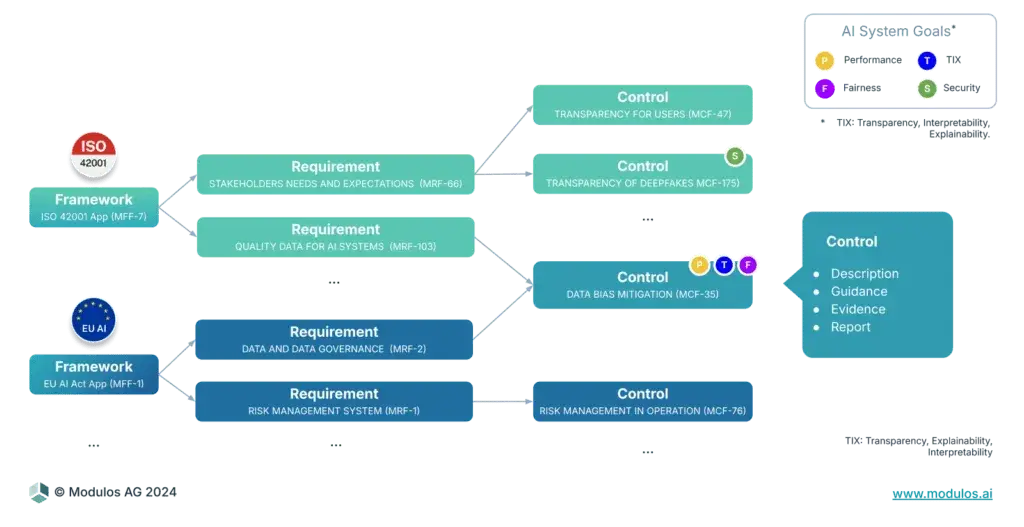
Image Source: Modulos AI
Trust is the life-blood of AI adoption and implementation. Studies show that trust directly affects whether customers will use AI-powered products and services. People simply won’t participate with AI outputs if they lack confidence in them. ISO 42001 builds its governance framework on this fundamental principle.
Why Trust Must Be Embedded Early
Organizations need to embed trust from the earliest stages of AI development – a lesson learned the hard way. One factual account states, “The root cause wasn’t a bad model. It wasn’t missing features. It was governance—everything we hadn’t done early enough”. Organizations that treat AI governance as a final compliance checkbox often realize the damage has already occurred.
Companies face poor data quality issues because they try fixing problems after data spreads throughout their systems. Data management experts say this reactive approach uses up 20-40% of IT budgets. ISO 42001 takes a different path by requiring a proactive stance that builds trust into AI systems during the original design phases.
Building trust early through ISO 42001 offers several benefits:
- Bias detection before it enters production workflows
- Privacy standards that shape data collection from day one
- Model explainability as a core component rather than an afterthought
- Guardrails that grow with code development
Shift-Left Governance for AI Development
ISO 42001’s effectiveness stems from the “shift-left” approach. This method moves governance activities earlier in the development timeline. Organizations embed controls, policies, and oversight when data is created instead of adding them later. This transforms governance from enforcement into design.
ISO/IEC 42001:2023 requires risk assessments during model selection and security reviews while defining data labeling. Organizations must treat compliance as an ongoing process rather than a final audit. Data receives the same treatment as code, with contracts, validations, and compliance built into workflows.
Organizations see significant benefits from shift-left governance in ISO 42001 implementation. They spend less on fixes, complete audits faster, and keep engineering speed while improving safety protocols. The shift-left approach also prevents expensive recalls and helps maintain market presence without disruptions.
Trust as a Feature, Not a Compliance Add-On
ISO 42001 stands out by treating trust as an inherent feature rather than just meeting regulations. Research shows that trust in AI needs five key attributes designed from the start:
- Transparency: Users should know when they interact with AI, get proper notifications, and control interaction levels
- Explainability: Organizations must explain AI systems clearly and ensure they can describe training methods and decision criteria
- Bias mitigation: Teams must identify and address inherent biases throughout the design chain
- Resilience: AI components and algorithms should resist unauthorized access, corruption, and attacks
- Performance monitoring: AI outcomes should meet stakeholder expectations with consistent precision
ISO 42001 puts these attributes into action through its Artificial Intelligence Management System (AIMS). Organizations must document AI policies that guide all AI activities. The standard also requires detailed impact assessments that consider fairness, accountability, trustworthiness, transparency, security, privacy, safety, and financial consequences.
ISO 42001 certification proves that trust goes beyond compliance – it becomes a vital tool for business success and maximizing AI value across organizations.
How Trust by Design Operationalizes ISO/IEC 42001
“ISO 42001 goes beyond the level of advisory principles. As with its illustrious antecedent, ISO 9000, it forms an auditable and certifiable standard.” — World Certification Organization, International certification standards authority and thought leadership organization
ISO/IEC 42001 works best when you connect governance principles with real-world actions. The Trust by Design approach bridges this gap. It turns standard requirements into workable solutions through well-laid-out methods that build AI governance right into development workflows.
Making Governance Work with Technical Tasks
ISO 42001’s Plan-Do-Check-Act framework connects governance choices to technical workflows. Companies can define AI policies and check risks during planning. They put controls in place while developing, check if they work through monitoring, and adapt based on results. This creates an ongoing governance cycle that lines up with development sprints instead of being just another compliance task.
ISO/IEC 42001 works best when governance checkpoints become part of existing processes. One company found that governance works best “when it’s built into daily delivery flows.” They added automated bias tests and security checks to their CI/CD pipelines, running them alongside code checks. This keeps governance from slowing things down while making sure everything stays compliant.
Companies should use stepped trust models because different AI projects have different oversight needs. Rating AI applications as high, medium, or low risk helps assign governance resources wisely. This prevents unnecessary roadblocks for simpler projects.
Teams Working Together for AI Oversight
Studies show that companies with teams from different departments handling AI governance launch AI projects 40% faster. They also have 60% fewer compliance issues after launch compared to companies that keep departments separate. So, ISO/IEC 42001 works better with diverse teams that bring technical, legal, ethical, and business knowledge.
Banks and tech companies have had success with AI governance committees that include people from various departments. These teams make possible:
- Reviews that fit into development work
- Risk categories everyone understands
- Clear paths to follow when problems cross department lines
- Shared records through model cards and AI registries
ISO 42001 needs input from compliance teams, AI developers, and risk managers when making decisions. This mix of expertise helps spot potential issues and balance different needs.
Building Proof from Day One
Trust by Design naturally creates the documentation needed for ISO/IEC 42001 certification. Companies generate evidence as they work instead of making it a separate task.
Important documents include standard model cards showing purpose and limits, bias detection reports, data source tracking, and rules for generative AI. These give the transparency and tracking needed for ISO 42001 certification while helping manage AI systems.
Companies should keep complete records of their system’s life cycle. This includes specifications, validations, deployment plans, and event logs that make sense to different readers, including regulators. These records should help guide actions rather than just tick compliance boxes. They become a living history of governance decisions that grows with AI systems.
Strategic Business Value of ISO 42001 Certification
“Certification distinguishes organizations in a crowded market, highlighting their commitment to ethical AI practices.” — ISMS.online, ISO standards and market differentiation expert
ISO 42001 certification offers major strategic advantages beyond basic compliance for organizations that use AI systems. The world’s first AI management system standard provides a well-laid-out framework to govern AI and deliver real business benefits.
Accelerated Market Entry and Procurement Advantage
ISO/IEC 42001 certification gives organizations a verified way to show responsible AI governance in the digital world. Early adopters gain a competitive edge. Organizations with certification stand out in markets where many companies don’t deal very well with AI governance basics. This difference matters especially when you have procurement scenarios – 71% of executives say lack of trust remains the biggest barrier to AI adoption.
Smart organizations see ISO 42001 certification as their path to faster market access. The standard has become a procurement requirement, as shown by Microsoft’s SSPA program v10 AI updates. These updates now require certification for vendors who handle high-risk AI use cases. Technology providers, healthcare organizations, and financial institutions find this certification speeds up vendor evaluations and opens new opportunities closed to others.
Demonstrating Ethical AI to Customers and Regulators
The certification proves an organization’s ethical AI practices and helps them:
- Build transparent, trustworthy, and ethical AI systems
- Meet compliance obligations for emerging regulations
- Improve risk management and accountability
- Increase customer and stakeholder confidence
- Line up AI governance with strategic business goals
Organizations with ISO 42001 certification stay ahead of evolving global regulations. To cite an instance, see the EU AI Act – the world’s first detailed AI law that came into force. These certified organizations already have the governance foundations to meet such requirements, avoiding expensive last-minute changes.
Reducing AI-Related Legal and Reputational Risks
Reputational risk tops the list of AI concerns among S&P 500 companies, with 38% of firms reporting it in 2025. Organizations that implement ISO 42001 tackle potential issues before they become PR challenges or legal problems.
The standard’s systematic approach helps organizations identify and alleviate AI-related risks effectively. Companies with certified management systems show their steadfast dedication to safe, reliable, and ethical AI development in their daily operations.
Organizations can automate up to 80% of manual governance tasks by integrating ISO 42001 controls. This puts ethical AI oversight at their operation’s core. Such an approach protects brand value and builds trust while supporting long-term digital growth.
Building a Scalable AI Governance Framework
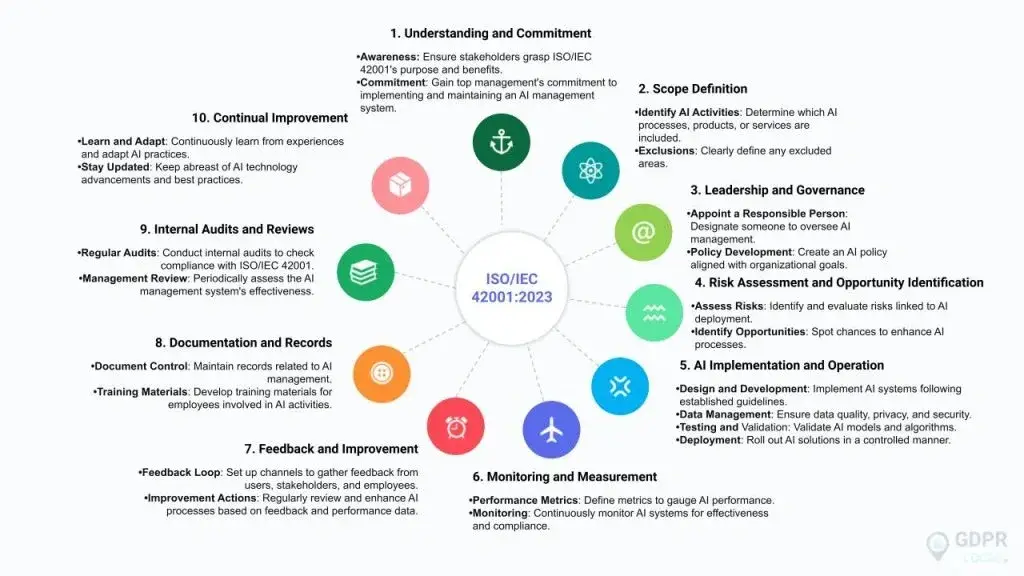
Image Source: Northwest AI Consulting
Organizations need to turn ISO 42001 requirements into working structures when they develop practical AI governance systems. A successful framework needs both policy controls and technical guardrails that work together. This ensures responsible AI use throughout its lifecycle.
Establishing AIMS with Lifecycle Controls
The Artificial Intelligence Management System (AIMS) supports ISO/IEC 42001:2023 compliance. Organizations should create AI policies and objectives that don’t deal very well with data privacy, security protocols, and ethical guidelines. AIMS uses the Plan-Do-Check-Act method where companies spot AI risks and put mitigation strategies in place. They review how well these strategies work and adjust them as needed. This back-and-forth approach helps companies keep up with trends in potential AI threats while meeting changing regulations.
Integrating Risk Registers, Model Cards, and Logs
Documentation is the foundation of auditable AI governance. A good framework should include:
- Model Cards – Standardized documentation that shows model purpose, performance metrics, and limitations. These cards help create transparency and accountability
- Risk Registers – Well-laid-out assessments of technical, ethical and legal risks with matching control measures
- Audit Logs – Complete records that track model decisions, changes, and user interactions to help meet regulatory requirements
These documentation tools create a clear trail of AI governance decisions that grows as AI systems evolve.
Continuous Monitoring and Feedback Loops
Regular monitoring plays a vital role in maintaining ISO 42001 compliance. Human feedback loops are a great way to get data about problems like inaccuracies, biases, or unexpected behaviors. In fact, these feedback systems let organizations gather, analyze, and respond to information about AI system performance in a systematic way.
We tracked metrics like request rates, error percentages, latency, and cost indicators. Companies should set up automated alerts to catch anomalies or potential issues quickly. This approach helps identify emerging problems before they turn into compliance violations or business disruptions.
Readiness Indicators for ISO 42001 Certification
Getting ready for ISO 42001 certification needs a systematic approach that looks at specific organizational markers. Your organization should assess three critical areas before pursuing certification.
Leadership Commitment and Policy Alignment
Effective AI governance’s life-blood comes from top management involvement. Leaders need to show active commitment by creating detailed AI policies that match the organization’s strategic direction. A certification-ready organization documents roles and responsibilities clearly for AI governance. It also assigns specific people to maintain system performance.
Your leadership readiness assessment should:
- Check if top management provided enough resources (technological, human, financial) to support the AI management system
- Look for AI policy documents with executive signatures and dates, ready when needed
- Make sure AI governance goals fit into wider business objectives
Operational AI Risk Management in Place
Organizations ready for certification use structured risk assessment processes throughout the AI lifecycle. They have procedures to find, assess, and handle both technical and ethical risks. Your organization must complete detailed AI impact assessments (AIIAs) for high-risk use cases before certification.
A mature risk register shows operational risk management readiness. It should list risk owners, current threat information, clear methods, and specific control measures. These elements prove your governance framework works actively rather than just existing on paper.
Internal Audit Completion and Evidence Availability
External certification requires internal audits first. These assessments should verify that your AI management system meets both ISO 42001 requirements and your organization’s goals. Book your Readiness Meeting to see how you measure up against certification requirements.
Available evidence shows certification readiness. Organizations usually need 75-100 audit artifacts based on AI system complexity. This documentation needs audit logs that show what was checked, who took part, what gaps exist, and how to fix them. Organizations that fix problems found during internal audits before external certification substantially increase their chances of success.
Conclusion
ISO 42001 marks a crucial milestone for organizations dealing with artificial intelligence. This piece explores how this groundbreaking standard turns AI governance from a mere compliance task into a valuable business asset. Without doubt, the Trust by Design approach within ISO 42001 brings a fundamental transformation. Trust becomes an inherent feature rather than just another regulatory requirement when governance activities start earlier in development cycles.
Organizations welcome ISO 42001 certification and gain competitive edges in the market. They show their commitment to ethical AI practices with proof, speed up market entry, lower legal and reputation risks, and stay ahead of global regulations. This certification proves that AI systems meet strict international standards for security, fairness, transparency, and accountability.
Creating an adaptable AI governance framework needs a detailed Artificial Intelligence Management System with lifecycle controls. It also needs proper documentation and constant monitoring. Companies should get a full picture of their readiness through leadership commitment, risk management processes, and internal audits before they seek certification.
The journey to ISO 42001 certification might look daunting, but its strategic value makes the investment worthwhile. Starting early helps companies avoid getting pricey fixes and enter markets faster. We recommend you Book your Readiness Meeting to assess where you stand against certification requirements and create your implementation roadmap.
AI technologies reshape industries every day. ISO 42001 certification will soon become a basic requirement rather than just a competitive edge. Smart organizations know this standard goes beyond compliance. It provides a well-laid-out framework for responsible AI governance that builds trust, reduces risk, and realizes the full potential of artificial intelligence in business operations.
Key Takeaways
ISO 42001 certification transforms AI governance from compliance burden into strategic business advantage, delivering measurable value through enhanced trust, market access, and risk mitigation.
• Trust by Design prevents costly fixes: Embedding governance early in AI development reduces remediation costs by 20-40% and prevents expensive post-deployment compliance issues.
• Certification accelerates market entry: ISO 42001 provides procurement advantages as 71% of executives cite trust barriers, making certification increasingly mandatory for vendor selection.
• Cross-functional governance delivers results: Organizations with diverse AI oversight teams achieve 40% faster deployment timelines and 60% fewer compliance issues than siloed approaches.
• Documentation creates audit-ready evidence: Integrating model cards, risk registers, and monitoring logs into daily workflows produces certification artifacts without additional compliance overhead.
• Leadership commitment drives success: Top management involvement with documented AI policies, allocated resources, and strategic alignment serves as the foundation for effective certification readiness.
The shift from reactive compliance to proactive governance positions organizations ahead of evolving regulations like the EU AI Act, while building the trust foundation necessary for sustainable AI adoption across industries.
FAQs
Q1. What is ISO 42001 and why is it important for businesses? ISO 42001 is the world’s first certifiable management system standard for artificial intelligence. It’s important because it provides a framework for responsible AI development and deployment, helping businesses build trust, mitigate risks, and gain a competitive advantage in the AI marketplace.
Q2. How does the “Trust by Design” approach benefit organizations implementing ISO 42001? The Trust by Design approach embeds governance early in the AI development process. This proactive stance helps organizations detect and address issues like bias and privacy concerns from the start, reducing costly fixes later and creating more trustworthy AI systems.
Q3. What are some key business advantages of obtaining ISO 42001 certification? ISO 42001 certification can accelerate market entry, provide a procurement advantage, demonstrate ethical AI practices to customers and regulators, and reduce AI-related legal and reputational risks. It also positions organizations ahead of evolving global AI regulations.
Q4. What are the main components of a scalable AI governance framework under ISO 42001? A scalable AI governance framework typically includes an Artificial Intelligence Management System (AIMS) with lifecycle controls, integrated risk registers and model cards, comprehensive audit logs, and continuous monitoring mechanisms with feedback loops.
Q5. How can an organization assess its readiness for ISO 42001 certification? Organizations can assess their readiness by evaluating three key areas: leadership commitment and policy alignment, operational AI risk management processes, and completion of internal audits with available evidence. It’s also recommended to conduct a readiness meeting with certification experts to evaluate current state against requirements.