
AI governance matters more than ever as technology advances faster in organizations worldwide. Knowledge workers have embraced AI tools, with over 70% using them weekly. Yet only 30% of organizations have formal AI policies. Legal teams must address this governance gap that creates major legal and compliance risks.
AI governance needs specialized frameworks and documentation approaches, unlike traditional IT governance. Legal professionals will find our complete toolkit helpful when establishing proper oversight. Our resources line up with recognized standards like NIST AI RMF 1.0 and ISO/IEC 42001:2023. This alignment ensures your framework meets international best practices. The EU AI Act creates specific obligations that need attention to risk classification, transparency, human oversight, and documentation.
Your team can implement effective AI governance without enterprise-scale resources or dedicated ethics boards, and with good reason too. In this piece, we’ll share practical templates, tools and workflows that help legal teams build strong AI governance principles. The documentation kit covers everything from intake procedures to ongoing supervision. This helps you establish a legally defensible approach to AI governance while managing risks appropriately.
Establishing a Legal-Grade AI Governance Framework
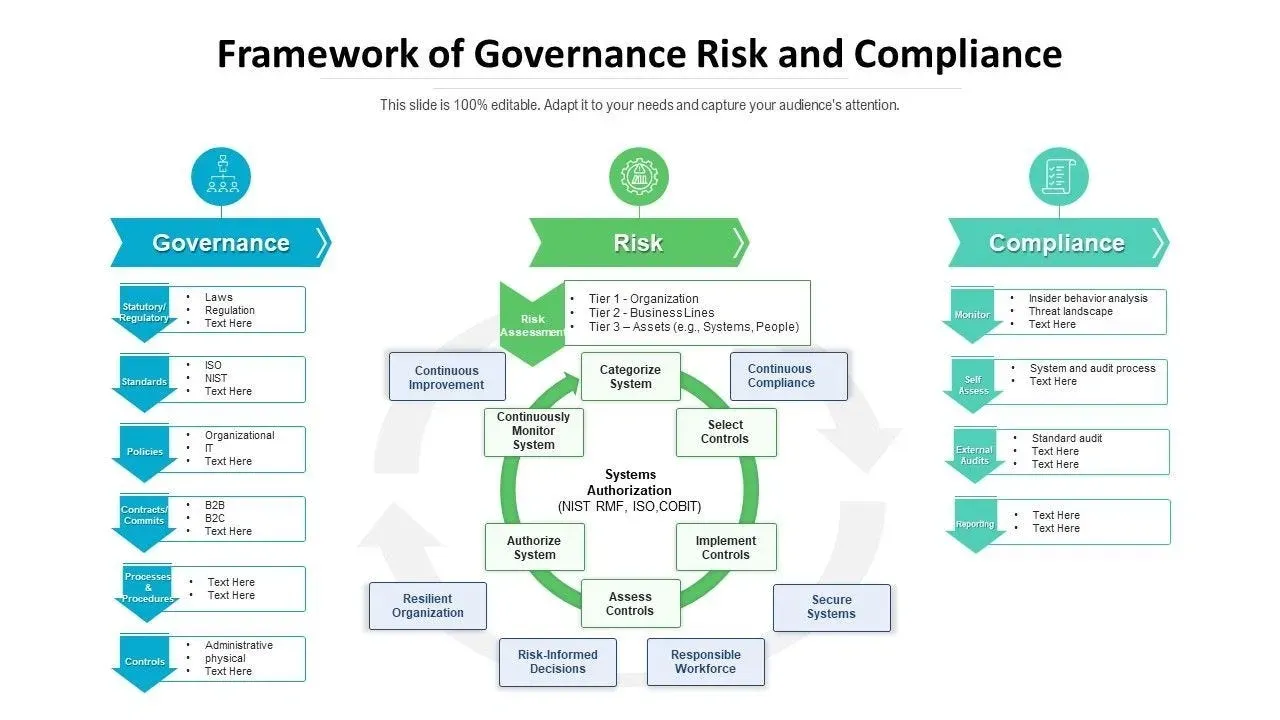
Image Source: Elevate Consult
Legal teams need well-laid-out frameworks to govern AI systems in their organizations. Two frameworks provide complementary approaches that build a solid foundation for legal oversight of AI technologies.
Aligning with ISO 42001 and NIST AI RMF
ISO 42001 and NIST AI RMF serve as the life-blood for establishing legally defensible AI governance. ISO 42001 delivers a complete AI Management System (AIMS) with clear accountability structures and continuous improvement cycles. This framework provides top-down governance that grows with organizational AI programs.
NIST AI RMF takes a practical, bottom-up approach through four core functions: govern, map, measure, and manage. Companies using both frameworks gain efficient global compliance and better readiness for new regulations. Research shows this integration makes governance simpler, improves operational resilience, and connects high-level oversight with practical AI deployment.
Defining AI governance responsibilities for legal teams
Legal departments handle several key roles in AI governance. They ensure compliance with new AI-specific regulations and standards like the EU AI Act, Colorado AI Act, and NIST AI RMF. Legal teams must also develop complete policies that cover:
- Data governance and privacy protection
- Intellectual property strategy and risk management
- AI vendor assessment and contract management
- Risk controls and human oversight protocols
Legal teams protect intellectual property by filing patents for AI innovations, copyrighting AI-generated works, and establishing clear ownership rights. They also negotiate and manage licensing agreements for third-party data, algorithms, and software used in AI systems.
Mapping AI governance principles to legal risk domains
Legal AI governance needs core principles mapped to specific risk domains. Five core principles shape AI use: fairness, transparency, accountability, privacy, and human oversight. Each principle tackles specific legal risks:
Fairness addresses discrimination and bias risks. Legal teams review datasets and test algorithms for discriminatory outcomes to alleviate potential liability.
Transparency relates to disclosure and explainability requirements. Teams should maintain documentation of model logic and decision-making criteria to support legal defensibility.
Accountability creates ownership for model outputs and ethical oversight, establishing clear lines of responsibility that legal teams can defend.
Privacy protects personal data through encryption, pseudonymization, and access controls – critical areas for regulatory compliance.
Human oversight lets humans override automated decisions, a requirement increasingly mandated by regulations like the EU AI Act.
The MIT AI Risk Repository shows security and system limitations (26%), socioeconomic risks (19%), and discrimination risks (15%) represent the most common risk domains. Legal teams should focus their governance resources on these areas accordingly.
A governance framework that blends these standards and principles helps legal departments become strategic advisors who shape their organization’s approach to AI, rather than just compliance guardians.
Core Documentation Kit Components for Legal Teams
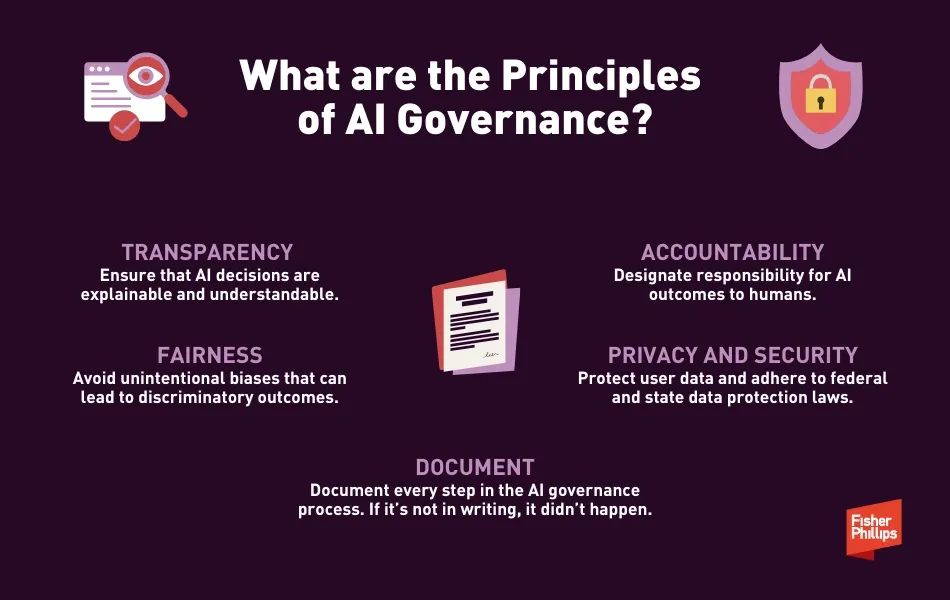
Image Source: Fisher Phillips
Legal teams need complete documentation to adapt AI governance to their organization’s needs. These core documents are the foundations of a defensible AI program that reduces risks while enabling state-of-the-art solutions.
AI Governance and Use Policy Template
The AI Governance Policy Template is the life-blood of any working AI governance program. This foundation document sets clear, enforceable guardrails around AI use across the organization. A working AI policy template should define roles and responsibilities, governance oversight mechanisms, and escalation procedures for AI-related concerns.
Legal teams must address professional responsibility considerations in the policy. A well-laid-out template sets expectations for attorneys’ knowledge of AI tools and verification requirements for AI-generated outputs. Your policy should have these key sections:
- Purpose statement defining the overall goal and compliance commitments
- Competence requirements for legal professionals using AI tools
- Permitted and prohibited AI use cases with verification protocols
- Confidentiality and data security safeguards
- Compliance with jurisdictional regulations
- Monitoring and continuous improvement processes
AI Risk Assessment Checklist for Legal Review
Legal teams should use a structured approach to review AI systems before deployment. A complete AI risk assessment checklist helps spot potential legal vulnerabilities across multiple dimensions, from data privacy to output reliability.
Legal reviewers should check these aspects:
- Algorithm bias and discrimination potential
- Data privacy compliance across jurisdictions
- Output verification processes and human oversight
- Intellectual property risks
- Documentation adequacy for regulatory compliance
Risk levels determine assessment depth—customer service AI systems need deeper scrutiny than internal document summarization tools. The checklist should also include periodic reassessment since AI systems change faster than traditional software.
AI Vendor Assessment Questionnaire
Third-party AI vendors bring significant risks that legal teams must review carefully. In fact, IBM’s 2025 Cost of a Data Breach Report found that 13% of organizations reported breaches with AI models or applications, and 97% of these organizations lacked proper AI access controls.
Your vendor questionnaire should go beyond basic due diligence to address AI-specific concerns. Vendors must explain how they handle:
- Training data provenance and rights
- Model behavior documentation and limitations
- Explainability tools and audit support
- API security and access controls
- Jurisdiction-specific compliance capabilities
- Service level agreements and fail-safe mechanisms
Ask for specific evidence like model cards, security certifications (SOC 2 Type II, ISO 27001), and documented fallback controls. This questionnaire makes your evaluation process formal and requires potential partners to provide written answers about their data handling, model governance, and security protocols.
AI System Inventory Template for Legal Oversight
Legal teams can track all organizational AI systems with a complete AI inventory. This documentation helps with regulatory readiness and shows AI use transparency to internal and external stakeholders.
Your inventory template should record:
- Simple description of AI system function
- Data sources and training methodologies
- Risk classification and compliance requirements
- Human oversight mechanisms
- Verification and testing protocols
- Deployment date and review schedule
The DHS AI Use Case Inventory shows a model approach with detailed technical information and a simplified overview of each AI use case. This inventory helps legal teams spot high-risk AI applications that need enhanced governance controls and documentation.
These four core documentation components create a complete governance framework that tackles AI’s unique challenges while you retain control and defensibility.
Workflow Templates for Intake, Review, and Approval
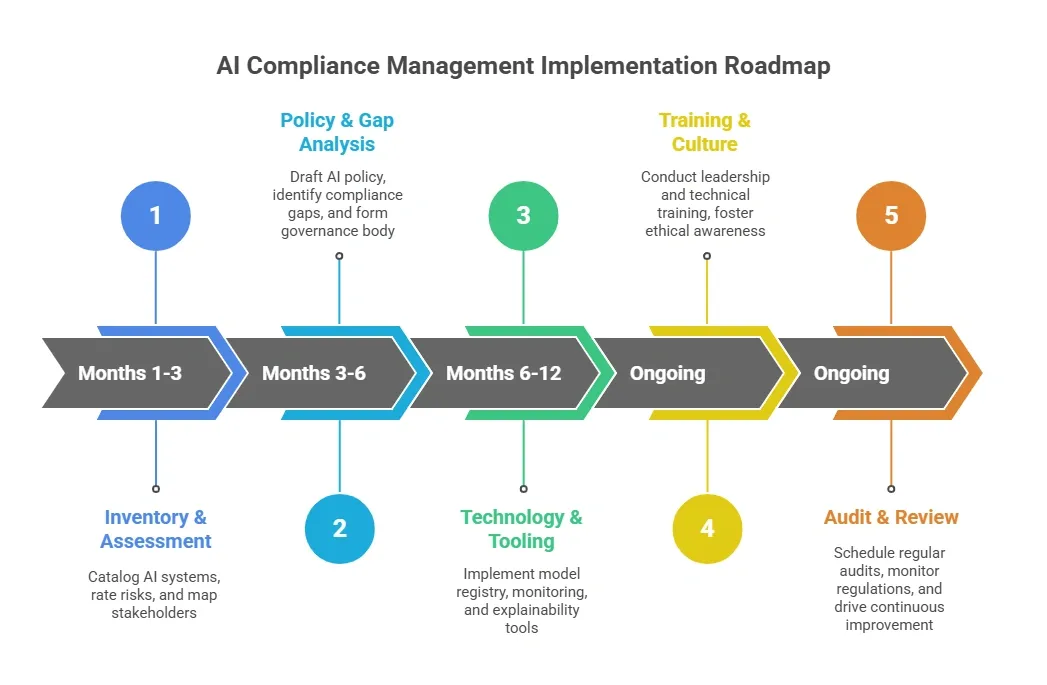
Image Source: Medium
AI governance needs well-laid-out processes that establish how legal teams review, document, and approve AI systems. These templates make the governance process simpler while meeting evolving regulations.
AI Use Case Request Form and Legal Sign-off
The AI use case request form acts as the starting point for new AI initiatives and captures key information before development starts. A good request form ensures teams document all details, supporting materials, and compliance needs upfront. Teams should include the system name, current state (draft, development, deployed), version number, model category, and a description of how it works and will be used. The form must also list ownership details like the provider organization, business unit, and responsible manager.
Smart forms with branching logic reduce back-and-forth between requesters and legal teams substantially. These intake systems sort and route legal requests automatically based on content analysis, urgency levels, and preset business rules. Legal teams can manage their workload better when they get complete details first and route requests based on risk level.
Annex IV Documentation for EU AI Act Compliance
High-risk AI systems under EU AI Act jurisdiction must have Annex IV technical documentation. This documentation needs a general system description with purpose and provider details, system development elements, monitoring information, performance metrics, risk management approach, and the EU declaration of conformity.
Teams must explain how the AI system works with hardware or software components, describe development resources, and outline testing procedures. Annex IV documentation proves that an AI system follows the Act’s rules and allows regulators to assess compliance.
DPIA Workflow Integration with AI Intake
Teams should combine Data Protection Impact Assessments (DPIAs) directly with the AI intake process when systems handle personal data. DPIAs help teams analyze, spot, and reduce data protection risks systematically. The workflow must describe processing activities, check necessity and proportionality, identify and fix risks, and set up consultation procedures.
Combining DPIA workflows with AI intake saves time since both need similar information. Legal teams can spot high-risk processing activities that need extra governance controls early. This ensures data protection compliance from the start of AI development.
Training, Attestation, and Policy Acknowledgement
Image Source: Template.net
Training and human involvement are the foundations of any successful AI governance initiative. Legal departments must uphold strict standards for compliance and risk management. The human element, from education to official sign-off, builds accountability that technical controls alone can’t deliver.
Role-based AI training curriculum for legal stakeholders
Legal roles need specific AI education tailored to their responsibilities. Role-based training programs meet the unique needs of different stakeholders in legal operations. General Counsel and Chief Legal Officers need strategic governance training that focuses on risk frameworks and cross-functional effects. Frontline attorneys need hands-on guidance about acceptable tool usage and verification requirements.
A well-laid-out curriculum should cover basic technology knowledge about AI operations, current regulatory frameworks, and hands-on exercises. Faculty members guide participants through actual AI tools. Legal professionals should end up knowing how to spot AI risks, assess vendors, and put governance controls in place with confidence.
AI User Acknowledgement Form for compliance tracking
Official sign-offs create proof that employees understand their AI system responsibilities. A detailed AI User Acknowledgement Form should confirm that staff have:
- Read and understood the organization’s AI use policies
- Received proper training on approved tools
- Understood what it all means when using AI
- Agreed to follow compliance requirements
These forms prove that specific information reached the right people. They become crucial during regulatory compliance checks, workplace disputes, or legal proceedings that need proof of proper AI usage.
Legal team enablement through policy briefings
The core team needs regular policy briefings to stay current as AI technologies and regulations change. Policy refreshers should cover new tools, regulatory changes, and lessons from past incidents.
These briefings should include scenarios that match different practice areas. Litigation attorneys need different AI guidance than transactional lawyers. Red team exercises that simulate real-life attacks work best. Linking training to Continuing Legal Education credits motivates attorneys. Good enablement turns legal teams from governance enforcers into strategic collaborators who can direct AI challenges with confidence.
Monitoring, Auditing, and Evidence Vault Setup

Image Source: IntuitionLabs
A reliable monitoring and auditing system serves as the foundation of legally defensible AI governance programs. These systems provide vital evidence that organizations need during regulatory reviews or legal proceedings.
Logging and audit trail requirements for legal defensibility
Defensible logging creates an undisputable record of how AI systems behave. The logs need cryptographic signatures or hashing to prove they are genuine and haven’t been altered. Good logs should include system-synchronized timestamps, clear identification of who did what, and meaningful descriptions of events. The system must record before and after states along with reasons for any changes.
Documentation of AI workflows needs to cover everything from initial design to actual operations. This comprehensive record acts as your “last defense against legal and reputational collapse”.
Incident response playbook for AI-related legal risks
A well-designed incident playbook handles AI-specific risks through:
- Forensic procedures to investigate data and prompts
- Clear communication protocols and criteria for notifying regulators
- Steps to take corrective action after incidents
The playbook must cover model failures, bias incidents, data breaches and vendor outages. Teams that practice these procedures through “red team” exercises ended up with better organizational preparedness.
Evidence Vault for storing governance artifacts
Evidence vaults work as secure, append-only storage for governance records. These databases generate unique fingerprints for stored evidence, which lets users quickly verify if records remain unchanged. CI/CD pipelines automate evidence collection by capturing datasets, experiment runs, validation reports and approvals.
High-quality evidence vaults can cut compliance costs by up to 95% through automation. They generate ready-to-export documentation that auditors and regulators need.
Conclusion
Legal teams must establish proper AI governance. This documentation kit offers complete resources that match recognized frameworks like ISO 42001 and NIST AI RMF. Legal professionals will get everything they need to set up resilient oversight and balance state-of-the-art solutions with risk management.
Organizations that use this governance framework get many benefits. They create legally defensible documentation that meets new regulatory needs like the EU AI Act. The well-laid-out processes for intake, review, and approval make governance easier and give a full picture of risks at each step.
Key documentation parts work as one system. These include governance policy templates, risk assessment checklists, vendor questionnaires, and system inventories. Of course, these tools help legal teams spot high-risk applications that need extra controls while they keep watch over lower-risk systems.
Legal professionals can become strategic partners instead of just compliance enforcers through role-based training. Policy briefings and formal acknowledgments keep everyone aware of changes in technology and regulations.
Strong monitoring and auditing systems give vital proof during regulatory reviews. The evidence vault creates unchangeable, verifiable records that cut compliance costs through automation.
This integrated approach to AI governance lets legal teams do their job without slowing progress. So organizations can use new AI technologies while keeping proper risk controls, following regulations, and meeting ethical standards. These governance tools become more valuable as AI changes how businesses work worldwide. Legal departments that want responsible technology adoption will find these tools essential.
Key Takeaways
Legal teams need structured AI governance frameworks to manage emerging risks while enabling innovation. This comprehensive documentation kit provides practical tools for establishing legally defensible oversight.
• Align AI governance with ISO 42001 and NIST AI RMF standards to create internationally recognized, legally defensible frameworks • Implement core documentation including governance policies, risk assessment checklists, vendor questionnaires, and system inventories • Establish structured workflows for AI intake, review, and approval that integrate EU AI Act compliance and DPIA requirements • Deploy role-based training programs with formal acknowledgment procedures to ensure staff understand AI responsibilities and compliance requirements • Create robust monitoring systems with immutable audit trails and evidence vaults to reduce compliance costs by up to 95%
Effective AI governance transforms legal teams from compliance enforcers into strategic partners who can confidently navigate AI challenges while maintaining appropriate risk controls and regulatory compliance.
FAQs
Q1. What are the key components of an AI governance framework for legal teams? The key components include an AI Governance Policy, Risk Assessment Checklist, Vendor Assessment Questionnaire, and AI System Inventory. These tools help legal teams establish oversight, evaluate risks, assess vendors, and track AI systems across the organization.
Q2. How can legal teams ensure compliance with emerging AI regulations? Legal teams can ensure compliance by aligning their governance frameworks with standards like ISO 42001 and NIST AI RMF, implementing structured workflows for AI intake and review, and maintaining comprehensive documentation of AI systems and their risk assessments.
Q3. What role does training play in AI governance for legal departments? Training is crucial for effective AI governance. It includes role-based curricula for different legal stakeholders, formal acknowledgment procedures, and ongoing policy briefings. This ensures that legal professionals understand AI risks, compliance requirements, and their responsibilities when using AI tools.
Q4. How can organizations create legally defensible audit trails for AI systems? Organizations can create legally defensible audit trails by implementing robust logging systems that capture immutable, tamper-evident records of AI system behavior. These logs should include timestamps, identified actors, and business-relevant descriptions of actions and changes.
Q5. What is an AI evidence vault and why is it important? An AI evidence vault is a secure, immutable repository for storing governance artifacts related to AI systems. It’s important because it provides verifiable records for audits and regulatory compliance, potentially reducing compliance costs by up to 95% through automation of documentation processes.