

Moving from NIST 800-53 compliance to a FedRAMP certification is a fundamental undertaking, not a paperwork exercise. Under the new FedRAMP Consolidated Rules (CR26) and the broader FedRAMP 20x modernization, the program has retired the Joint Authorization Board (JAB), replaced prescribed impact-level baselines with a Class-based structure, and is shifting from Word and Excel templates toward machine-readable artifacts in OSCAL and JSON.
For CISOs at Cloud Service Providers (CSPs), this means the map from NIST 800-53 to a FedRAMP certification looks different than it did even a year ago. NIST SP 800-53 Revision 5 still provides the underlying control catalog. FedRAMP still tailors, tightens, and extends those controls for cloud environments. The 3PAO still runs the independent assessment. What has changed is the governance model, the shift from FedRAMP authorization to certification, and the format your evidence must take.
This piece walks through what still holds from the NIST 800-53 foundation, where FedRAMP diverges under CR26, and the practical steps to move an existing NIST implementation into a FedRAMP-ready posture without wasting effort on obsolete structures.
Understanding the Foundations: NIST 800-53 and FedRAMP After CR26
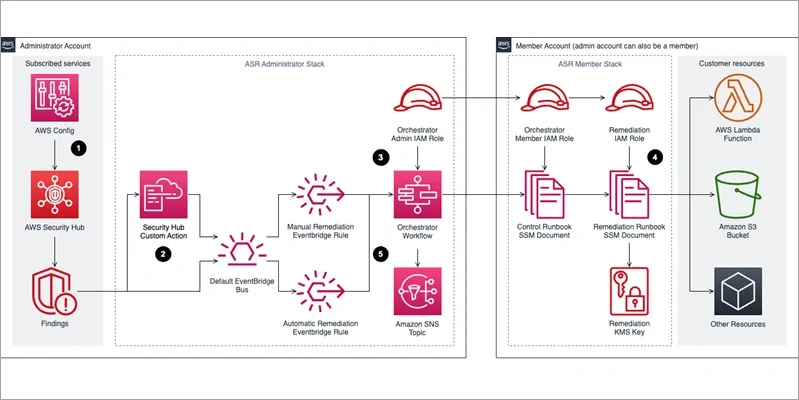
Image Source: AWS
Two frameworks form the backbone of federal information security and work together to protect sensitive government data. CISOs need to understand how each is structured today, not how it looked before the FedRAMP Authorization Act triggered the current modernization cycle.
NIST 800-53 Control Families Overview
NIST Special Publication 800-53 offers a detailed catalog of security and privacy controls. Revision 5, released in September 2020, restructured the catalog around outcomes, blended information security with privacy controls, and now spans twenty (20) control families covering all federal information systems. The current revision covers roughly 1,189 controls when counting base controls and enhancements.
The twenty control families are:
| Family | Name | Focus |
| AC | Access Control | Who can access systems and what they can do |
| AT | Awareness and Training | Security education across the workforce |
| AU | Audit and Accountability | Log generation, review, and protection |
| CA | Assessment, Authorization, and Monitoring | Ongoing assessment and monitoring of controls |
| CM | Configuration Management | Baseline configuration and change control |
| CP | Contingency Planning | Continuity of operations and recovery |
| IA | Identification and Authentication | Verifying user and device identity |
| IR | Incident Response | Detecting, containing, and reporting incidents |
| MA | Maintenance | Controlled system maintenance activities |
| MP | Media Protection | Handling and disposal of storage media |
| PE | Physical and Environmental Protection | Facility and environmental safeguards |
| PL | Planning | Security planning and rules of behavior |
| PM | Program Management | Enterprise-wide security governance |
| PS | Personnel Security | Personnel screening and access management |
| PT | PII Processing and Transparency | Privacy notice and consent controls |
| RA | Risk Assessment | Identifying and evaluating security risk |
| SA | System and Services Acquisition | Security in the procurement lifecycle |
| SC | System and Communications Protection | Network, boundary, and cryptographic controls |
| SI | System and Information Integrity | Flaw remediation and malicious code protection |
| SR | Supply Chain Risk Management | Third-party and supply chain risk |
NIST developed this catalog to support FISMA implementation and to give federal agencies a common vocabulary for security requirements. FedRAMP inherits that vocabulary directly, then adapts it for cloud.
The FedRAMP Certification Framework Under CR26
FedRAMP was created in 2011 to standardize security assessment and monitoring for cloud services used by federal agencies. The FedRAMP Authorization Act, signed into law in December 2022, codified FedRAMP into statute and triggered a multi-year modernization. The Consolidated Rules (CR26) and the FedRAMP 20x initiative are the operational outcomes of that codification.
Under CR26, several structural elements from the older FedRAMP model no longer apply. The Joint Authorization Board (JAB), which previously granted P-ATOs on behalf of DoD, DHS, and GSA, has been retired. Governance now runs through the FedRAMP Board and the Program Management Office (PMO) under GSA. Cloud services now pursue a FedRAMP certification rather than the older “authorization” terminology, and prescribed impact-level baselines (Low, Moderate, High, LI-SaaS) have been replaced by a Class structure.
The core purpose is unchanged: give federal agencies confidence that a cloud service meets a consistent security bar. The mechanism for reaching that confidence has been rebuilt.
How FedRAMP Builds on NIST 800-53 in the Class Structure
FedRAMP still uses NIST SP 800-53 as its control catalog. What changes at the FedRAMP layer is the selection, parameterization, and additional guidance applied to each control for cloud environments. NIST 800-53 was written to be technology-neutral. FedRAMP takes those controls and adapts them for multi-tenancy, data sovereignty, elastic infrastructure, and continuous monitoring at cloud scale.
Under CR26’s Class structure, each Class draws a set of NIST 800-53 controls appropriate to the data sensitivity involved, then layers FedRAMP-specific parameters and cloud-specific guidance on top. Higher Classes carry more controls and stricter parameter values than lower ones. The mechanism is conceptually similar to the retired Low/Moderate/High tiers, but the underlying selection logic has been rebuilt to align with the FedRAMP Authorization Act and CR26.
Understanding this relationship is the first practical step for any CSP mapping an existing NIST 800-53 implementation to a FedRAMP certification.
FedRAMP vs NIST 800-53: Key Differences for Cloud Security
FedRAMP and NIST 800-53 share the same control catalog but diverge in how those controls are selected, parameterized, assessed, and monitored. Under CR26, some of the older rigidity has softened, but the core differences that make FedRAMP more demanding than a straight NIST 800-53 implementation still hold.
Control Parameter Approach: Prescription With CR26 Flexibility
NIST 800-53 leaves many control parameter values (timeout durations, encryption key lengths, session behaviors) for the implementing organization to set based on risk. FedRAMP has historically prescribed specific parameter values for cloud services to keep security posture consistent across CSPs.
CR26 preserves the principle of prescribed parameters where consistency matters most, but introduces additional flexibility for CSPs to justify tailored parameter values based on their system’s context, control implementation approach, and risk model. In practice, CSPs should still plan to meet FedRAMP’s prescribed parameter values as the default and use the CR26 flexibility only where they can document a defensible tailoring rationale.
Assessment Requirements: Self-Assessment vs 3PAO
The largest practical gap between a NIST 800-53 implementation and a FedRAMP certification remains the assessment model. NIST 800-53 permits an organization to assess its own controls. FedRAMP requires an accredited Third-Party Assessment Organization (3PAO) to conduct the independent assessment.
The 3PAO responsibility set includes independent verification of security control implementation, penetration testing and vulnerability scanning per FedRAMP methodology, verification of control documentation accuracy against observed reality, chain-of-custody evidence handling, and direct observation or verified evidence review for testing activities. This independent verification is what gives federal agencies confidence they cannot get from a CSP’s self-attestation alone.
Documentation: From Word Templates to OSCAL and JSON
FedRAMP has historically demanded extensive documentation using specific Word and Excel templates, including a System Security Plan (SSP) that often exceeds 300 pages. Under FedRAMP 20x, the program is shifting away from human-readable templates toward machine-readable formats: the Open Security Controls Assessment Language (OSCAL) for control documentation and JSON for related artifacts.
For CSPs, this means the content required has not shrunk (the same control implementation detail, boundary definitions, data flows, and inheritance statements are still expected), but the format is changing. Machine-readable submissions allow automated validation, faster reviewer processing, and continuous updates without full re-submission cycles. Existing packages will need to be migrated to OSCAL over time, and new CSPs entering the program under CR26 should plan for OSCAL-native documentation rather than legacy Word templates.
Continuous Monitoring Obligations
FedRAMP treats compliance as an operational state rather than a point-in-time attestation. Monthly continuous monitoring deliverables under CR26 continue to include vulnerability scanning across all inventory components within the certification boundary, regular POA&M updates reflecting new findings and remediation progress, annual independent reassessment by a 3PAO, incident reporting to affected federal customers on strict timelines, and documentation of significant system changes before implementation.
The specific reporting cadence and format continue to evolve as FedRAMP 20x reshapes the underlying documentation model, but the operational obligation to keep security posture current has not changed.
Mapping FedRAMP Controls to NIST 800-53 Under the Class Structure
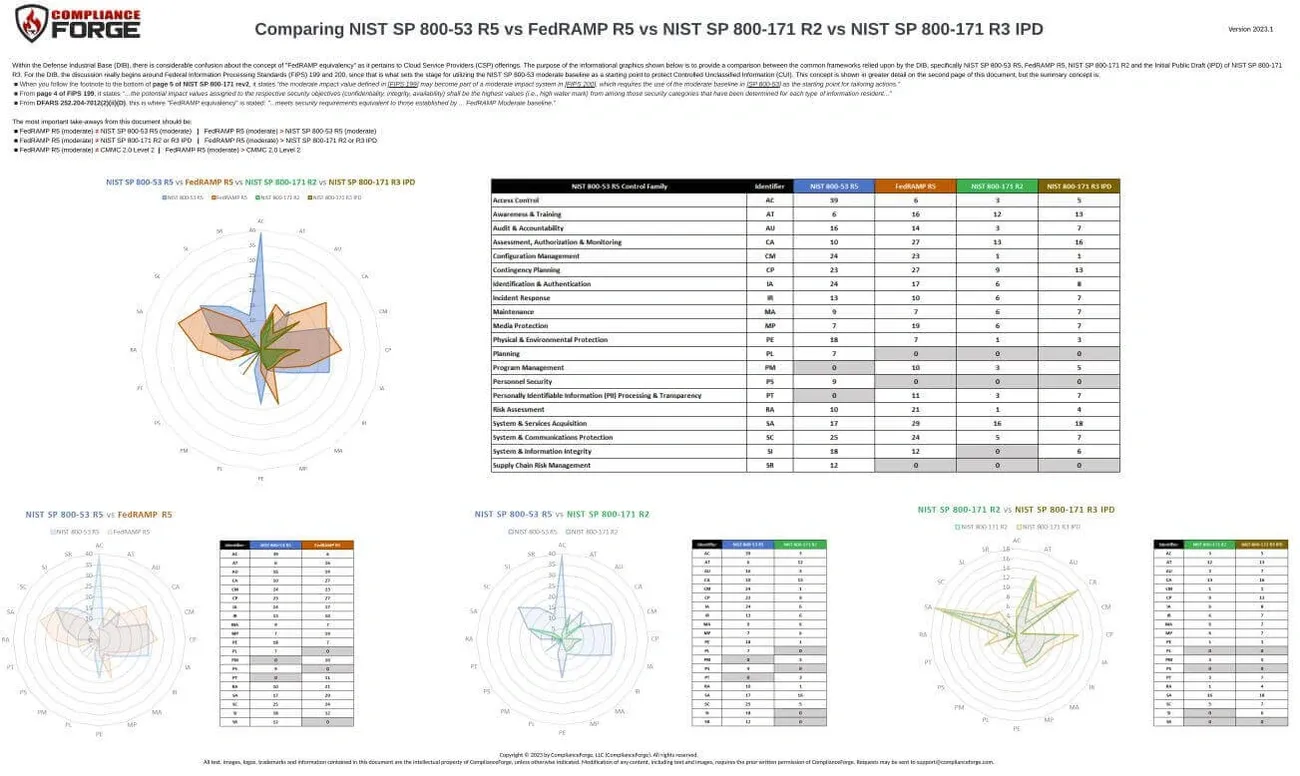
Image Source: ComplianceForge
A well-structured control mapping is essential to a FedRAMP certification. CSPs already implementing NIST 800-53 need to understand where their controls satisfy FedRAMP expectations directly, where they need to adjust parameter values to meet FedRAMP’s prescribed defaults, and where FedRAMP adds cloud-specific requirements NIST does not cover.
FedRAMP Class Alignment With NIST 800-53
Under CR26, FedRAMP groups cloud services into Classes based on the sensitivity of the data the service processes and the risk profile of the service itself. Each Class draws a defined set of NIST 800-53 controls, adapted for cloud contexts through FedRAMP-specific parameter values and guidance overlays.
Higher Classes build on lower ones. A service certified at a higher Class carries all the controls of lower Classes plus additional requirements to address higher-risk data and system profiles. The exact structure and naming of the Classes is defined in the current CR26 rulebook, and CSPs should refer to the FedRAMP program guidance for the current Class definitions and control selections.
Control Implementation Documentation
Regardless of format (legacy templates or OSCAL), a FedRAMP certification requires each in-scope control to be documented in enough detail for a 3PAO to test it. That documentation must show which NIST 800-53 control the implementation satisfies, how the control is implemented in the specific cloud environment, which role or team is responsible for maintaining the control, and whether the control is fully implemented, partially implemented, planned, or handled through an alternative implementation.
FedRAMP has historically used Control Implementation Summary (CIS) templates for this purpose. Under FedRAMP 20x, the same content is being restructured into OSCAL representations.
System Security Plan and NIST Control References
The System Security Plan (SSP) remains the security blueprint for a Cloud Service Offering (CSO). It ties the technical architecture, certification boundary, data flows, and inheritance statements back to the specific NIST 800-53 controls that apply to the service.
FedRAMP guidance historically distinguished between control statements that begin with “The information system…” (technical implementations) and those that begin with “The organization…” (procedural implementations). That distinction still matters for how CSPs document controls, even as the SSP itself migrates from Word templates to OSCAL.
FedRAMP Overlays Beyond NIST 800-53
FedRAMP adds cloud-specific overlays to the NIST 800-53 control catalog to address multi-tenancy, data location, elasticity, and provider-consumer inheritance patterns that NIST’s baseline does not fully cover. These overlays include additional guidance, tighter parameter values, and in some cases entirely FedRAMP-specific requirements not present in NIST.
CSPs identifying FedRAMP-specific overlays should look for “Additional FedRAMP Requirements and Guidance” sections in the current CR26 control selections. Mapping these overlays against existing NIST 800-53 implementations is where most of the gap-analysis work happens.
Documentation and Assessment Requirements for FedRAMP

Image Source: Telos Corporation
Detailed documentation remains the foundation of the FedRAMP assessment process. It is the evidence a 3PAO tests against and the artifact a federal customer relies on to understand what has been certified.
System Security Plan Structure Under OSCAL
The SSP describes the Cloud Service Offering’s architecture, boundaries, and control implementations. A well-built SSP shows how federal data enters, moves through, and exits the system, and how each control protects it at each stage.
Whether submitted as a legacy Word template or as an OSCAL representation, the SSP must include basic system details (FIPS 199 categorization or its CR26 successor terminology, plus service type), architecture and boundary descriptions, data flows and external connections, detailed control implementation statements, and supporting appendices covering incident response, configuration management, and related procedural documents. The migration to OSCAL under FedRAMP 20x changes the format but not the substance of what a complete SSP must convey.
Plan of Action and Milestones (POA&M)
The POA&M tracks known weaknesses, planned remediation, and progress against remediation timelines. Historically maintained as an Excel workbook with “Open” and “Closed” worksheets, the POA&M is also being restructured into machine-readable form under FedRAMP 20x.
FedRAMP still applies remediation timelines based on risk severity: Critical and High risks within 30 days of discovery, Moderate risks within 90 days, and Low risks within 180 days. Every finding from the Security Assessment Report and every vulnerability from continuous monitoring feeds into the POA&M until it is remediated and closed.
Privacy Threshold Analysis and PIA
The Privacy Threshold Analysis (PTA) is a screening artifact that determines whether a system collects personally identifiable information (PII). Systems that do collect PII must complete a Privacy Impact Assessment (PIA) documenting what PII is collected, why, how it is used, and how it is protected. These privacy artifacts are part of the certification package for any service that handles federal PII.
Role of the 3PAO Under CR26
Third-Party Assessment Organizations perform the independent evaluation that turns a CSP’s documented implementation into a FedRAMP-recognized certification. Accreditation, independence, and technical qualifications for 3PAO personnel remain rigorous under CR26. Selecting an experienced 3PAO with relevant federal domain experience is one of the highest-leverage decisions a CSP makes on the path to certification.
A 3PAO engagement typically produces a Security Assessment Plan (SAP) outlining the test methodology, a Security Assessment Report (SAR) documenting findings, a Security Assessment Test Case Workbook, a Penetration Test Report, and the underlying vulnerability scan data and supporting evidence.
An experienced advisor can compress the readiness cycle significantly. Book a Readiness Call to see where an existing NIST 800-53 implementation already meets FedRAMP expectations and where the gap analysis needs to focus.
Bridging the Gap: Moving From NIST 800-53 to a FedRAMP Certification
CSPs with mature NIST 800-53 implementations have a head start on FedRAMP. The gap is not the control catalog. It is the parameterization, the assessment model, the documentation format, and the operational cadence FedRAMP demands.
Reviewing FedRAMP-Specific Control Parameters
The first step is a controlled comparison between the parameter values in your existing NIST 800-53 implementation and the values FedRAMP prescribes at your target Class. Under CR26 you may have flexibility to tailor some values with justification, but the default is to meet FedRAMP’s prescribed parameters. Any tailoring should be documented before assessment, not discovered by the 3PAO.
Gap Analysis Between Existing NIST Controls and FedRAMP Requirements
A complete gap analysis maps every current control implementation to the corresponding NIST 800-53 Rev 5 control, compares each implementation against FedRAMP’s parameter values and additional guidance, categorizes each gap as documentation, process, or engineering work, and prioritizes gaps by their impact on the certification timeline. The output is a defensible plan that shows exactly what needs to change, in what order, and who owns each item.
Preparing for FedRAMP Certification Readiness
The certification package under CR26 still requires substantive documentation, whether delivered as legacy templates or as OSCAL representations. The core artifacts include the System Security Plan (SSP), control implementation documentation, Plan of Action and Milestones (POA&M), Privacy Threshold Analysis and PIA where applicable, Information System Contingency Plan (ISCP), Configuration Management Plan, and Incident Response Plan.
Engaging an experienced advisor for a readiness review before formal assessment surfaces gaps early, when they are still inexpensive to close.
Choosing Your Certification Path Under CR26
The pre-CR26 model distinguished between JAB authorization (P-ATO) and agency-sponsored authorization. Under CR26, the JAB has been retired and CSPs no longer require an agency sponsor to enter the program. The current path runs through the FedRAMP Board and PMO with 3PAO assessment as the independent verification step. CSPs should confirm the exact intake and certification pathway on the current FedRAMP program guidance, as the operational specifics continue to evolve as CR26 is fully implemented. Elevate’s FedRAMP Rev 5 authorization and transition strategy walks CSPs through the current intake pathway and Rev 5 alignment step by step.
Maintaining FedRAMP Compliance Post-Certification
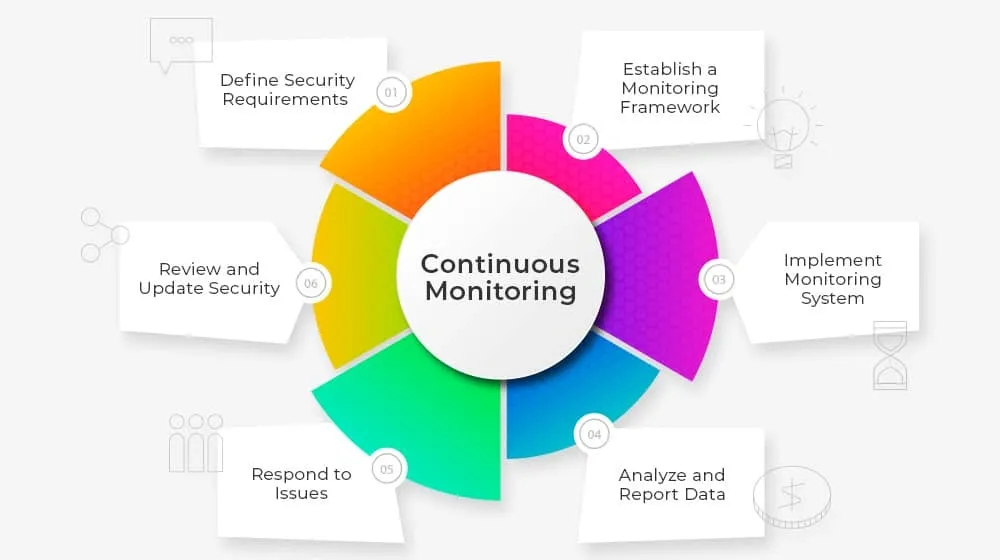
Image Source: Ignyte Assurance Platform
A FedRAMP certification is not a milestone; it is an operating posture. CSPs must maintain continuous compliance obligations that extend well beyond the initial certification date. Continuous monitoring gives Authorizing Officials and federal customers a current view of the system’s security posture through regular updates.
Monthly Vulnerability Scanning and Reporting
CSPs must scan 100% of inventory components within the system boundary every month, including operating systems, web applications, and databases. Higher-sensitivity systems require authenticated scans. Every vulnerability the scan surfaces becomes a POA&M item tracked until remediation, subject to the 30/90/180-day timelines by severity.
Annual 3PAO Reassessment
Security control CA-2 continues to require an annual independent assessment. An accredited 3PAO conducts the reassessment using the same rigor as the initial certification. The reassessment produces an updated SAP, SAR, and POA&M, and confirms to the FedRAMP Board and federal customers that the CSP has maintained its security posture over the past year.
Updating Incident Response and Risk Management Plans
Written Incident Response Plans require annual updates. CSPs must report suspected or confirmed incidents to affected agency customers on a tight timeline, historically within one hour of discovery for the initial notification. The plan documents the incident response structure, reportable incident categories, and named responsibilities. For CSPs building or refreshing this document, how to build an incident response plan covers the required structure and reportable categories. The SSP and its appendices also require annual review to reflect system changes and updated procedures.
Training and Upskilling Security Teams
Staff must complete annual security awareness training, with tailored role-based training for privileged users. Training records are themselves an audit artifact. Assessment teams and 3PAO personnel are also subject to their own qualification and training requirements under FedRAMP.
Conclusion
FedRAMP still builds on NIST 800-53. Under the Consolidated Rules (CR26) and the broader FedRAMP 20x modernization, the underlying control catalog and the practice of independent 3PAO assessment remain in place. What has changed is the governance model (the JAB is gone), the terminology (Classes replace impact-level baselines, certification replaces authorization), and the format (OSCAL and JSON replace legacy Word and Excel templates).
For CISOs at CSPs already implementing NIST 800-53, the practical path forward is unchanged in shape: gap analysis, remediation, documentation, and 3PAO assessment, followed by continuous monitoring. The specifics inside each step have been rewritten. CSPs still working from pre-CR26 materials are running on obsolete assumptions and should update their planning against the current FedRAMP program guidance before spending significant effort on documentation. Elevate’s FedRAMP consulting and authorization services support CSPs across the readiness, assessment, and continuous monitoring lifecycle.
Book a Readiness Call to confirm your existing NIST 800-53 implementation aligns with the current FedRAMP requirements before you commit to a certification path.
Key Takeaways
The FedRAMP-to-NIST 800-53 relationship has been rebuilt under CR26 while preserving the same underlying control catalog and 3PAO assessment model.
- FedRAMP still uses NIST 800-53 as its control catalog. The 20 control families and the base controls are inherited directly; FedRAMP parameters and overlays sit on top.
- The JAB and prescribed impact-level baselines are gone. Under CR26, governance runs through the FedRAMP Board and PMO, and services are structured by Classes rather than Low, Moderate, and High baselines.
- Documentation is migrating from Word and Excel templates to OSCAL and JSON. The content required has not changed, but the format is shifting to machine-readable submissions under FedRAMP 20x.
- Independent 3PAO assessment remains mandatory. CSPs cannot self-assess into a FedRAMP certification, regardless of how mature the NIST 800-53 implementation is.
- Continuous monitoring is an operational obligation, not a checkbox. Monthly scans, annual 3PAO reassessment, and incident reporting to federal customers are permanent commitments after certification.
FAQs
Q1. What are the key differences between FedRAMP and NIST 800-53?
FedRAMP uses NIST 800-53 as its underlying control catalog but adds cloud-specific parameter values, additional overlays, mandatory 3PAO assessment, and continuous monitoring obligations. Under CR26, FedRAMP has retired the older impact-level baselines in favor of a Class structure, replaced “authorization” with “certification,” and is migrating documentation from Word and Excel templates to OSCAL and JSON.
Q2. How is the FedRAMP program governed now that the JAB is gone?
The FedRAMP Authorization Act codified FedRAMP into statute, and under CR26 the Joint Authorization Board has been retired. Governance now runs through the FedRAMP Board and the Program Management Office (PMO) under GSA. CSPs no longer need an agency sponsor to enter the program, though sponsoring agency relationships continue to matter for adoption after certification.
Q3. What is the role of a Third-Party Assessment Organization (3PAO) in FedRAMP?
A 3PAO conducts the independent evaluation that turns a documented control implementation into a FedRAMP-recognized certification. 3PAOs perform initial assessments, produce the Security Assessment Plan and Security Assessment Report, and conduct the annual reassessment required by security control CA-2. Accreditation, independence, and personnel qualifications for 3PAOs remain rigorous under CR26.
Q4. What are the continuous monitoring requirements after achieving FedRAMP certification?
CSPs must scan 100% of inventory components monthly, maintain the POA&M with remediation on a 30/90/180-day cadence by severity, undergo annual 3PAO reassessment, and report suspected or confirmed incidents to affected agency customers on a tight timeline. These obligations are ongoing for the full lifecycle of the certification.
Q5. How should an organization prepare to move from NIST 800-53 to a FedRAMP certification?
Start with a gap analysis that maps every current NIST 800-53 control implementation to the corresponding FedRAMP requirement at the target Class. Compare parameter values, identify documentation and process gaps, and prioritize remediation based on certification timeline impact. Plan for OSCAL-based documentation from the start rather than building on legacy Word templates. Engage an experienced 3PAO advisor early to validate readiness before formal assessment begins.