
The ISO 42001 AI standard arrived just when we needed it most. Latest data shows 72% of organizations used AI technologies regularly in May 2024—almost twice as many compared to ten months ago. The rapid AI adoption has created its share of problems, with 44% of organizations already experiencing collateral damage from AI use, including data privacy issues, biases, and inaccuracies.
December 2023 saw the release of ISO/IEC 42001:2023 framework, marking it as the first international standard to promote responsible AI. Our experience shows how this AI management system standard creates a systematic approach to AI governance throughout the AI lifecycle. The standard gives organizations a well-laid-out method to blend ethical, legal, and technical aspects into AI development and deployment. Organizations using multi-cloud environments need careful scoping and planning to implement an AI Management System (AIMS) based on ISO 42001.
This piece will show you how to scope your AIMS for multi-cloud environments effectively. You’ll learn everything from the basic requirements of the ISO 42001 AI management system standard to mapping AI lifecycle stages across cloud platforms and preparing your scope documentation for audits. A strong governance framework that manages AI risks, ensures compliance with regulations, and keeps your AI systems transparent and fair will be yours when you follow these steps.
Understanding ISO 42001 AI Management System Standard
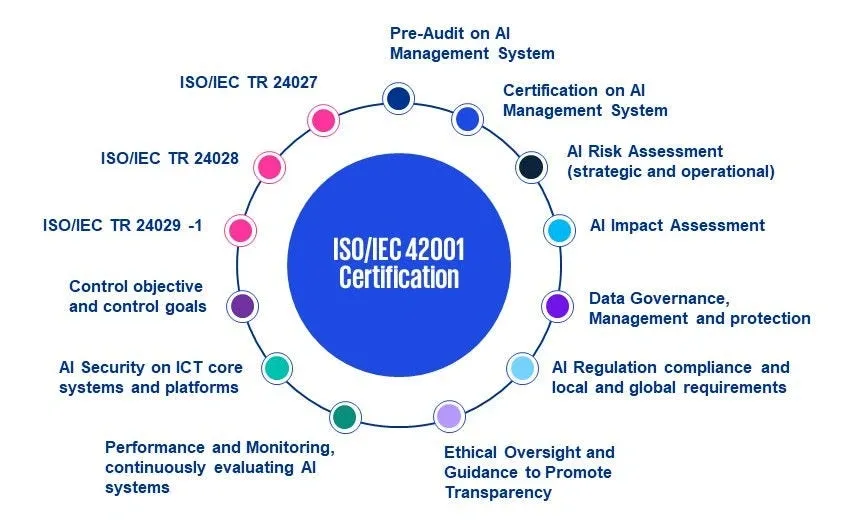
Image Source: KPMG International
Understanding ISO 42001 AI Management System Standard
ISO/IEC 42001:2023, released in December 2023, marks a major milestone as the world’s first international standard created for Artificial Intelligence Management Systems. This framework gives organizations a clear way to handle the challenges of using AI technologies responsibly.
Definition of AIMS under ISO 42001
ISO 42001 defines an AI Management System (AIMS) as “a set of interrelated or interacting elements of an organization intended to establish policies and objectives, and processes to achieve those objectives, in relation to the responsible development, provision, or use of AI systems”. AIMS gives organizations a detailed governance structure to manage their AI applications throughout their lifecycle – from creation to shutdown.
The framework covers these key components:
- Governance structures and leadership accountability
- Risk assessment and management methodologies
- Compliance protocols and regulatory arrangement
- Training programs for personnel involved in AI projects
- Continuous monitoring and improvement mechanisms
This structured approach will give you AI technologies that are ethical, transparent, and follow both internal standards and external regulations.
Scope and objectives of ISO 42001 for AI governance
The main goal of ISO 42001 is to create a framework that manages artificial intelligence technologies within organizations. The standard goes beyond technical aspects and focuses on AI governance throughout the entire lifecycle.
Organizations must document and track management through all AI lifecycle stages: purpose definition, design, deployment, monitoring, and decommissioning. The standard also requires technical documentation of explainability records, model accuracy logs, bias mitigation files, and fairness proofs – crucial elements for trustworthy AI.
The standard works at both strategic and operational levels. Strategic aspects help organizations create AI policies that match their business goals. Operational guidance helps identify and address AI-specific risks like biases, security vulnerabilities, and data privacy issues.
Organizations must assess their impact regularly. They need to evaluate potential harm to individuals, groups, and society, and keep clear records of mitigation or revision efforts. This approach lets organizations balance breakthroughs with responsible governance.
How ISO 42001 aligns with ISO 27001 and ISO 27701
ISO 42001 combines smoothly with existing management system standards, especially ISO 27001 (Information Security Management) and ISO 27701 (Privacy Information Management). They share the “Annex SL” structure – a standard framework used in all ISO management system standards.
This shared structure creates real benefits for integration. The standards have similar clauses for context, leadership, planning, support, operation, performance evaluation, and continual improvement. Organizations can maintain:
- Unified policy management
- Synchronized review and reporting cycles
- Single document and evidence libraries
- Aligned internal audits and improvement tracking
ISO 27001 focuses on information security, and ISO 27701 adds privacy controls. ISO 42001 applies these management principles to AI governance, emphasizing transparency, accountability, and ethical use. These standards work together to protect sensitive data, ensure privacy, and govern AI responsibly.
Organizations that already have ISO 27001 certification can naturally extend their information security management system (ISMS) to include the AI management system (AIMS). This integration helps especially in multi-cloud environments where consistent governance across platforms is crucial for responsible AI deployment.
Clause 4.1–4.4: Defining AIMS Scope in Multi-Cloud Environments

Image Source: Devoteam
ISO 42001’s Clause 4 lays the groundwork for a reliable AI Management System (AIMS) in multi-cloud environments. This vital section shows how organizations should set up their AI governance framework scope, context, and interactions in distributed cloud infrastructures.
Clause 4.1: Internal and external context in multi-cloud
Organizations need to assess factors that affect their AI governance on multiple cloud platforms. The internal context has the organization’s AI strategy, objectives, risk appetite, AI data sources, development frameworks, and deployment environments on different clouds. The external context looks at regulations, what customers expect, and how third-party dependencies work with different providers.
To name just one example, see how healthcare organizations building AI systems need to balance strict privacy rules and medical AI ethics (external factors) with their goal of better patient outcomes. Organizations also need to know their place in the AI ecosystem—whether they’re an AI provider, producer, user, or partner—since each role brings its own set of duties.
Multi-cloud environments make this analysis more complex because of:
- Security models and compliance frameworks that vary between cloud providers
- AI service capabilities and limits on each platform
- Data sovereignty rules that change by region
- Cloud vendors’ different approaches to AI ethics
ISO 42001 specifically asks organizations to check if climate change matters to their AI systems. This becomes crucial for agriculture, energy, or transportation sectors where environmental impact plays a key role.
Clause 4.2: Identifying interested parties across cloud providers
Your AI systems’ interested parties are individuals or groups they affect, those with legal or ethical stakes, and people who can shape your AI projects. The stakeholder landscape in multi-cloud environments grows to include:
- Regulators from many jurisdictions
- Cloud service providers and their subprocessors
- API providers and third-party AI services
- Partner organizations in federated learning systems
- Internal teams who manage different cloud environments
Mapping stakeholders’ needs means looking at legal requirements (like GDPR compliance), ethical expectations (bias mitigation), operational requirements (system transparency), and strategic objectives (business goal alignment). Organizations must document all relevant requirements for their AIMS.
Clause 4.3: Determining scope boundaries for AIMS
A scope statement shows which organizational parts fall under the AIMS. Companies might limit ISO 42001’s scope to specific departments, teams, applications, or AI features instead of applying it company-wide. This targeted approach helps manage implementation better in complex multi-cloud setups.
You should think about:
- AI applications that need governance on cloud platforms
- AI lifecycle stages you’ll cover (from development to retirement)
- How cloud environments connect with each other
- Geographic and regulatory limits for AI deployment
The scope needs clear documentation to avoid confusion. It should build on the context analysis (Clause 4.1) and stakeholder requirements (Clause 4.2). Clear scope definitions ensure proper controls, while vague ones create compliance gaps and audit problems.
Clause 4.4: Mapping AIMS interactions with existing ISMS and PMS
Organizations must set up, implement, maintain, and improve their AIMS continuously under Clause 4.4. This means identifying needed processes, making sure they work well together, and documenting the system fully.
AIMS in multi-cloud environments should work smoothly with existing management systems like Information Security Management Systems (ISMS, ISO 27001) and Privacy Management Systems (PMS, ISO 27701). This integration creates a unified governance approach through:
- Policy frameworks that share AI-specific additions
- Risk assessment methods that stay consistent
- Documentation and evidence storage in one place
- Monitoring of compliance and audits that work together
Organizations should track how these systems depend on each other. They need to find where controls overlap and where AI needs extra measures. This approach helps maintain consistency between cloud providers while tackling AI’s unique governance challenges.
AI Lifecycle Management Across Multi-Cloud Platforms
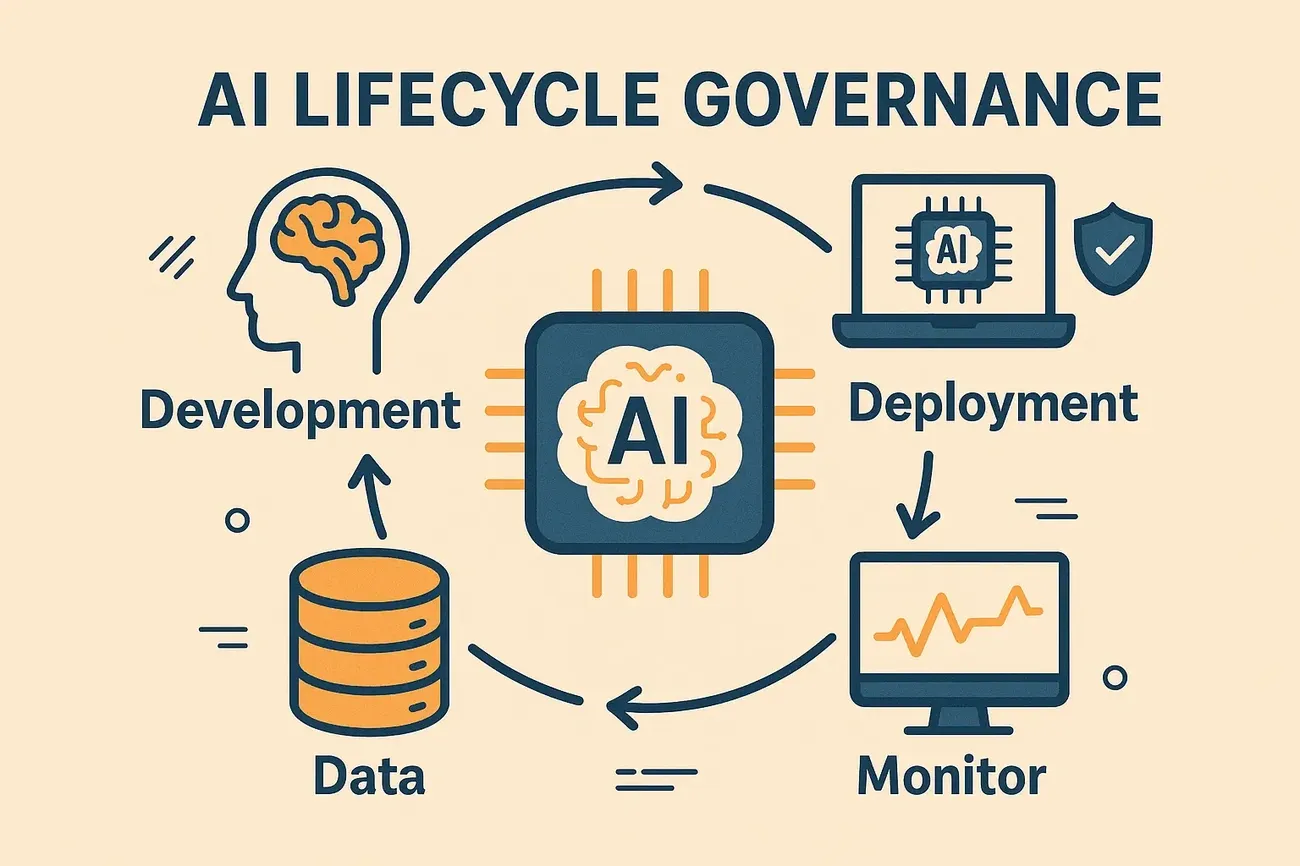
Image Source: Tech Jacks Solutions
AI Lifecycle Management Across Multi-Cloud Platforms
Managing AI systems throughout their lifecycle creates unique challenges, especially when you have multiple cloud environments. A standardized approach based on international standards provides the structure needed to implement ISO 42001 AI Management Systems (AIMS) successfully in these complex settings.
AI lifecycle stages based on ISO/IEC 22989
ISO/IEC 22989:2022 establishes a complete vocabulary and conceptual framework for artificial intelligence that are the foundations of the AI lifecycle. This standard outlines a continuous progression that has design, data preparation, training, evaluation, deployment, monitoring, and eventual retirement of AI systems. ISO 42001 requires specific governance controls at each stage.
The lifecycle starts by defining the AI system’s purpose, followed by design and development phases. Data preparation comes next – a critical stage with collection, processing, and validation of training datasets. The training phase builds and validates the original model before a full evaluation takes place. The system needs ongoing monitoring once operational and retirement happens at the end of its useful life.
ISO/IEC 22989 expands on quality attributes that must be managed throughout this lifecycle:
- Reliability: Ensuring performance consistency across lifecycle phases
- Transparency: Making AI capabilities and limitations visible
- Explainability: Supporting understanding of system outputs
- Fairness: Implementing bias mitigation approaches
- Traceability: Maintaining records of artifacts and evidence
These attributes are the foundations for ISO 42001 compliance in a variety of cloud environments.
Mapping AI lifecycle to cloud-native services
The effective mapping of AI lifecycle stages to appropriate cloud services becomes vital in multi-cloud operations. Each major cloud provider offers specialized tools that support different phases of the AI lifecycle.
Cloud-native services provide critical infrastructure for AI development and operation by offering:
- Development and Training Tools: Including AutoAI capabilities, no-code interfaces, and support for open-source libraries
- Deployment Infrastructure: Scaling deployed models to meet performance requirements across environments
- Monitoring Capabilities: Providing ongoing oversight of model performance
- Data Virtualization: Enabling efficient access to data sources across hybrid cloud environments
Kubernetes has become the standard orchestration platform for AI workloads in multi-cloud settings. Its core capabilities—dynamic resource allocation, auto-scaling, and container orchestration—work perfectly with the volatile resource demands of AI systems. Organizations achieve efficient GPU orchestration by using Kubernetes, which ensures optimal allocation of expensive computing resources across clouds.
Tools like MLflow (for model lifecycle management), TensorFlow Extended (for end-to-end ML pipelines), and Kubeflow (for orchestrating ML workloads on Kubernetes) have proven to work for implementing MLOps across multi-cloud environments. These platforms create consistency across otherwise disparate cloud environments.
Ensuring consistency in model deployment and monitoring
A structured MLOps approach helps maintain consistency in AI operations across multiple clouds. Industry research shows that problems are systemic – up to 85% of AI projects fail due to operational issues rather than algorithmic ones. A reliable MLOps practice addresses this challenge by creating standardized processes across environments.
Multi-cloud AI management needs:
- Immediate performance monitoring: Tracking key metrics including accuracy, precision, recall, and resource utilization across platforms
- Automated retraining pipelines: Detecting model performance degradation and initiating retraining without manual intervention
- Version control for models and data: Ensuring reproducibility and auditability whatever the cloud platform
- Drift detection: Identifying model degradation due to changes in data patterns
Organizations implementing ISO 42001 in multi-cloud environments must establish clear governance over these processes. This means creating consistent policies for data management, model validation, and operational monitoring that apply uniformly across cloud platforms.
A reliable data strategy creates the foundation for successful AI implementation in multi-cloud environments. This strategy should address integration challenges, governance requirements for compliance, and adherence to data sovereignty laws. Organizations will struggle to maintain consistent AI operations across cloud platforms without this foundation.
Successful AI lifecycle management in multi-cloud settings ended up needing tight integration between DataOps and MLOps practices. This integration ensures data quality and model performance stay consistent whatever platform runs the workloads, creating the foundation for ISO 42001 compliance across the entire AI ecosystem.
Identifying and Classifying AI Assets for AIMS Scope
Image Source: Fortune Business Insights
A detailed inventory of AI assets is the life-blood of an effective AI Management System under ISO 42001. You cannot govern what you cannot see in your cloud environments.
AI model inventory across cloud providers
An AI model inventory serves as a centralized catalog that tracks every AI model your organization develops, deploys, or employs. The catalog captures vital details about each model – its purpose, ownership, training data sources, risk classification, and compliance status. Organizations with multi-cloud setups need this inventory to span all cloud platforms while they retain control over classification and governance.
A complete model inventory must document:
- Model metadata (name, version, purpose, owner)
- Development status and deployment environment
- Input and training data sources with classification
- Risk level and regulatory requirements
- Monitoring status and last review date
Organizations that lack accurate inventories often miss AI risks. This oversight can lead to serious legal, ethical, and operational issues. Your inventory needs to answer a basic question: “What AI do we have and how do we use it?” This visibility becomes even more vital in multiple cloud environments where shadow AI—models deployed outside official processes—can spread unchecked.
Governance, risk, and compliance teams usually maintain this inventory. Model owners and developers should update it regularly. Smart organizations use automated discovery tools to scan cloud environments. These tools help find AI assets and eliminate blind spots by uncovering all AI applications and their training datasets.
Data pipelines and training datasets in hybrid environments
Hybrid cloud environments make data pipeline management challenging because sensitive data often moves across boundaries. ISO 42001 compliance requires careful tracking of these movements throughout the AI lifecycle.
Dataset classification requires organizations to review:
- Data sensitivity levels (PII, PHI, financial data, trade secrets)
- Retention policies and privacy controls
- Training data lineage across environments
- Input/output data flows between systems
ISO 42001 implementation requires a clear understanding of data classifications processed by each AI model. Models inherit the highest data classification level from their training data. A model that processes sensitive customer information needs the same level of protection as the data itself.
Organizations using multiple clouds should set up tiered governance. Different risk levels need different documentation requirements. This approach gives appropriate controls without burdening lower-risk systems with excessive paperwork.
Third-party AI APIs and federated learning systems
External AI services make AIMS implementation more complex. Organizations must check potential risks, including data leakage when they send sensitive information to providers like OpenAI or Anthropic. ISO 42001 requires clear documentation of these external dependencies within your AIMS scope.
Federated learning provides a privacy-focused option for multi-cloud AI implementation. This method lets organizations train shared AI models using data from decentralized edge devices or servers without sharing local data samples. Data stays local while only model updates move between systems.
The federated learning process works like this:
- A central server distributes the initial model
- Each participant trains the model on local data
- Model updates aggregate securely
- The improved global model gets redistributed
Healthcare and finance sectors find this technique valuable because data sharing faces strict privacy rules. To cite an instance, hospitals and research networks can train diagnostic models while patient data remains in secure environments.
Organizations using federated learning systems in their AIMS scope must document data boundaries, model ownership, and aggregation methods clearly for ISO 42001 compliance. They need explicit governance interfaces that show how these systems work with internal processes to manage risk throughout the AI lifecycle.
AI Risk Management and Threat Modeling in Multi-Cloud
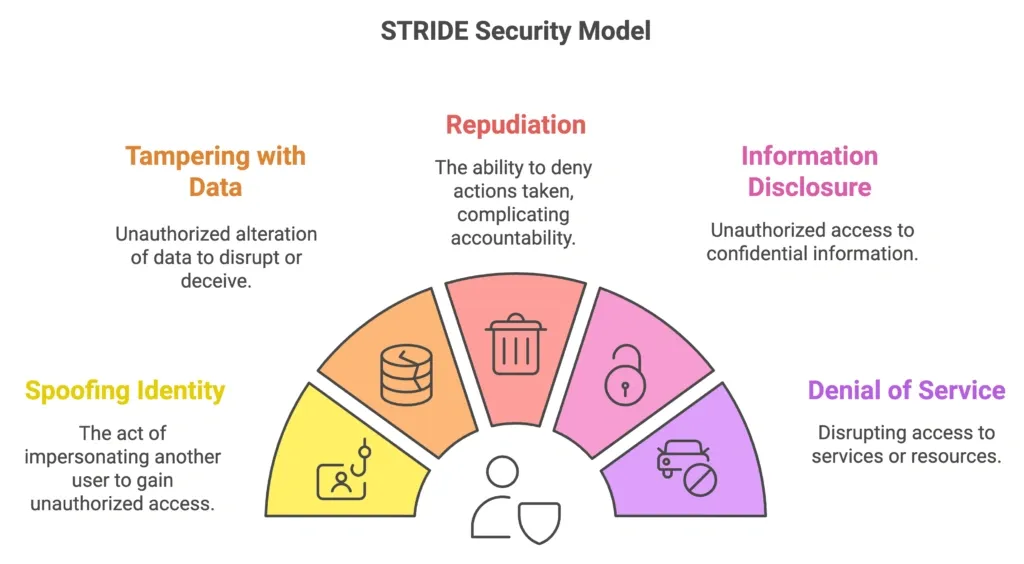
Image Source: Practical DevSecOps
A strong risk management strategy serves as the foundation for successful ISO 42001 implementation. This becomes crucial in multi-cloud environments where AI systems operate in a variety of infrastructures. Your AI systems need protection through effective threat modeling techniques that spot vulnerabilities early.
ISO 42001 Clause 6.1.2: AI risk identification
Clause 6.1.2 of ISO 42001 requires organizations to “define and establish an AI risk assessment process” that evaluates “potential risks to the organization, individuals, and societies.” The results must be consistent and valid to spot risks that could affect your AI objectives.
Your organization should evaluate these risk sources from ISO 23894 when working with multi-cloud environments:
- Lack of transparency and explainability
- Complexity of environment
- System hardware issues
- System life cycle issues
- Technology readiness
- Level of automation
Risk assessment takes two main forms:
Qualitative assessment describes impact and likelihood with terms like “critical,” “high,” or “moderate.” Here’s an example: “Model collapse would result in critical disruption to business operations.”
Quantitative assessment uses numbers to express risk. The Factor Analysis of Information Risk (FAIR) methodology leads the field here, along with AI-specific tools like the Artificial Intelligence Risk Scoring System (AIRSS).
Using STRIDE and OWASP for AI threat modeling
Threat modeling looks at systems from an attacker’s point of view rather than a defender’s stance. STRIDE provides a well-laid-out approach for AI systems in multi-cloud environments by grouping threats into:
- Spoofing: Fake identities using AI systems
- Tampering: Malicious prompt injections altering model behavior
- Repudiation: Users denying prompt activity with no logging
- Information disclosure: Sensitive data accidentally reproduced by models
- Denial of service: Bad actors overloading AI endpoints
- Elevation of privilege: Users bypassing content filters
Each category connects to specific security attributes: authentication, integrity, non-repudiation, confidentiality, availability, and authorization respectively.
OWASP Top 10 for Large Language Models (LLMs) gives threat-focused guidance for generative AI. MITRE ATLAS helps with adversarial threat modeling and LINDDUN addresses privacy threats.
Mapping risks to lifecycle stages and cloud services
ISO 42001 lines up STRIDE threat categories with specific lifecycle stages to secure multi-cloud AI:
- Inception: Deals with spoofing threats and fake identity inputs (Annex A.8.1)
- Design/Development: Tackles tampering vulnerabilities (Annex A.9.1)
- Verification: Handles repudiation risks like lack of decision logs (Annex A.7.1)
- Deployment: Controls information disclosure vulnerabilities (Annex A.5.1)
- Operation: Protects against denial-of-service attacks (Annex A.10.3)
- Re-evaluation: Addresses privilege escalation risks (Annex A.8.6)
Your multi-cloud environment needs cloud-native governance features to alleviate these threats throughout the lifecycle. These features include identity management for spoofing threats, guardrails for prompt injection, logging for repudiation, encryption for information disclosure, rate limiting for denial of service, and strict access control for privilege escalation.
Governance Interfaces and Third-Party Dependencies
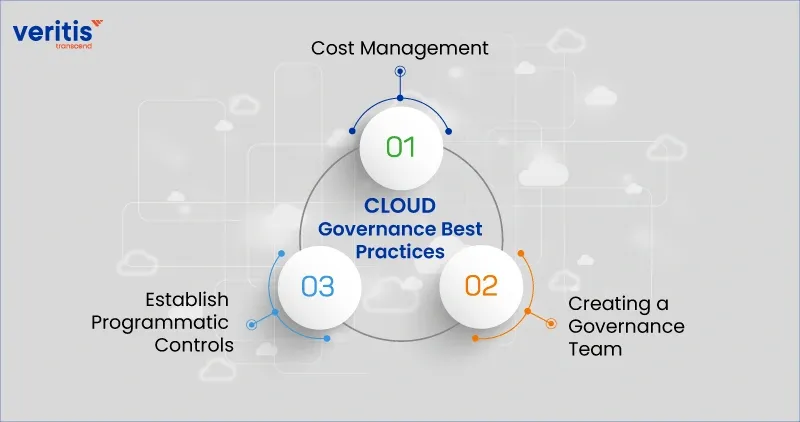
Image Source: Veritis
Organizations need clear interfaces between teams, cloud providers, and external partners to manage AI systems effectively. ISO 42001 requires these connections to maintain accountability throughout the AI lifecycle.
Internal interfaces: DevOps, security, compliance
Several key roles must work together to implement ISO 42001. The core team shares governance responsibilities:
- Chief AI Officer or Chief Technology Officer: Sets technical governance practices and oversees model development
- Chief Information Security Officer: Protects training data and models from adversarial threats
- Chief Data Officer: Maintains data accuracy, ethics, and regulatory compliance
- Legal and compliance teams: Stay current with evolving AI regulations
Many companies create AI governance committees. These bring leaders from technology, security, data, and compliance teams together. The committees take an integrated approach to manage complex AI systems across cloud environments.
DevSecOps teams configure and enforce guardrails around AI workloads in the cloud when implementing ISO 42001. They provide constant visibility into AI-related risks and ensure compliance requirements from development through deployment.
External interfaces: Cloud AI vendors and APIs
Security management becomes complex in cloud environments because systems and data sources vary widely. Companies can improve security by combining security data from multiple clouds. This helps with up-to-the-minute data analysis and response. Tools that combine security alerts and automate analysis across cloud providers make this possible.
APIs are the foundations of modern AI applications. They serve three main functions:
- They provide real-time data access for AI models
- They deliver computing infrastructure
- They enable system integration and interoperability
APIs create significant security risks despite their importance. Insecure APIs cause over 60% of all data breaches. API-related AI vulnerabilities have increased by 1205% compared to previous years.
Managing federated AI and SaaS-based AI tools
Client-side function invocation lets agents work with customer-managed APIs while keeping sensitive tasks within the client’s environment. The backend handles reasoning and decision-making, but function execution happens in the client’s environment.
This separation addresses security and compliance boundaries while orchestration remains smooth. Clients control API calls, identity usage, and constraint enforcement without exposing resources to external agents.
SaaS-based AI tools require governance policies at every access point—dashboards, notebooks, and APIs. A reliable system for lineage tracking, access controls, and audit logs must work across environments. This reduces manual work and audit risk.
Documenting AIMS Scope for ISO 42001 Audit Readiness
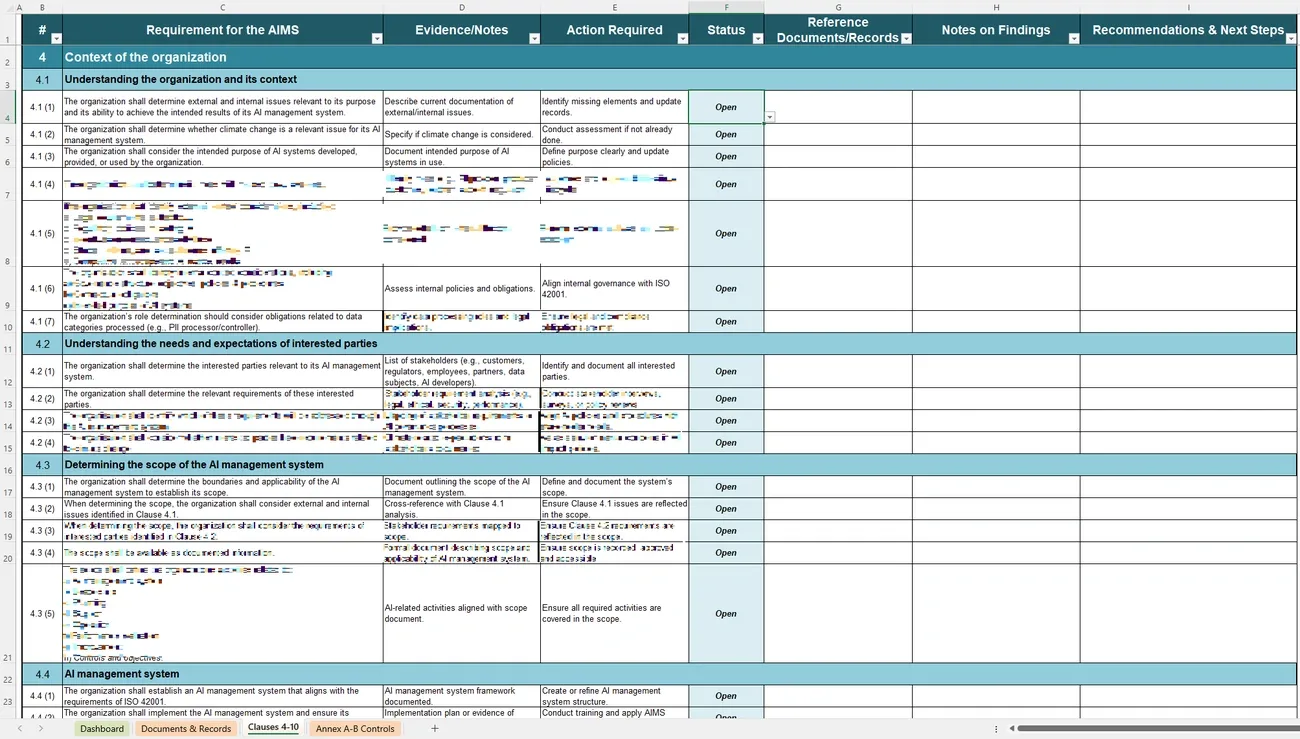
Image Source: Cyberzoni.com
Documenting AIMS Scope for ISO 42001 Audit Readiness
Documentation is the life-blood of successful ISO 42001 audits. A well-laid-out documentation system proves compliance and protects your organization during certification assessments.
Scope statement structure and required elements
Your ISO 42001 AIMS scope statement needs clear boundaries and inclusions. We focused on these essential documentation components:
- Intended purpose of each AI system
- External and internal contexts that influence your AI operations
- Legal requirements including any prohibited AI uses
- Contractual obligations with clients and vendors
The scope statement should identify all in-scope and out-of-scope business functions, products, and AI roles in your program. This clarity helps auditors and prevents hidden compliance gaps.
AI regulatory mapping and stakeholder roles
Your documentation should map AI governance roles and responsibilities for all stakeholders. This mapping covers:
- AI Providers/Producers: Developers, designers, operators, testers
- AI Customers & Users: End-users and their expectations
- AI Partners: System integrators and data providers
- AI Subjects: Data subjects and affected individuals
A RACI (Responsible, Accountable, Consulted, Informed) matrix shows ownership and accountability for all AIMS processes across teams. The regulatory mapping connects each scope boundary to current regulatory context and contractual obligations.
Version-controlled documentation practices
Your AIMS documentation needs rigorous version control to stay audit-ready. Start with:
- Centralized document repositories with controlled access
- Distinct version IDs that differentiate documents from older versions
- Change logs tracking who made changes, at what time, and why
Regular reviews keep your system clean and organized, making your documentation audit-ready. Book a Readiness Assessment to verify that your documentation meets ISO 42001 requirements before formal audit.
Note that successful ISO 42001 certification depends on clarity, traceability, and completeness rather than document volume. Keep your documentation well-laid-out and available to show compliance efficiently during audits.
Common Pitfalls in Scoping AIMS for Multi-Cloud
Poor scoping choices can derail even the most promising ISO 42001 implementation efforts. Organizations need to understand these mistakes to build better AI governance frameworks that work in different cloud environments.
Overlooking third-party AI dependencies
Third-party AI tools create major blind spots in governance frameworks. Research shows that only 6% of organizations watch how vendors use AI in their services completely. A mere 8% would call their internal AI governance models mature. These hidden dependencies pose big risks because vendor models often lack proper security testing and share infrastructure with other clients.
The biggest problem lies in AI vendor contracts. Most lack specific rules that stop vendors from using client data to train their models. Your data might leak or violate regulations without you knowing until something goes wrong.
Excluding high-risk AI systems from scope
Companies often misclassify their AI systems. They might accidentally leave out high-risk applications or include too many low-impact ones. The AI Act splits high-risk systems into two groups: those built into already-regulated products and those listed for specific use cases.
Many teams fail to properly check systems based on how independently they make decisions and how they affect people’s rights. Each system needs careful evaluation to prove it truly deserves exemption from high-risk classification.
Failing to line up scope with business objectives
When AI governance doesn’t match business goals, you end up with empty compliance exercises instead of useful frameworks. Managers often lose track of core principles as daily tasks take over.
Your company should analyze its business goals for both now and later. Then identify key skills needed for critical roles. Finally, check your talent pool to find skill gaps that need work. This approach will help you invest in AI governance that matches your strategy rather than just ticking technical boxes.
Conclusion
ISO 42001 provides a complete framework for responsible AI governance in multi-cloud environments. This piece explores everything in setting up an AI Management System that works. We looked at basic standard requirements and mapped AI lifecycle stages in a variety of cloud platforms. The text also shows how proper asset identification, risk management, and governance interfaces build the foundation for compliant AI operations.
Companies should know that successful AIMS implementation needs clear scope definition based on business goals. They must document AI dependencies well and maintain consistent governance across cloud environments. Of course, multi-cloud operations bring complexity, but they also create chances to standardize approaches that boost accountability and transparency.
ISO 42001’s real strength comes from its systematic way of managing AI risks. It ensures ethical, secure deployment across your technology landscape. Setting up these controls might seem tough at first, but leaving AI risks unmanaged is way beyond the reach and influence of acceptable risks to your reputation and compliance. Book a Readiness Call to spot gaps in your current governance framework and create a targeted implementation plan before you start your certification trip.
Note that good AI governance needs more than just documentation—it demands a steadfast dedication to responsible practices. Companies with strong governance frameworks will lead as AI adoption grows across industries. They will gain advantages through trustworthy implementation. Think over ISO 42001 as a strategic investment in eco-friendly, ethical AI that lines up with long-term business goals while protecting stakeholder interests. A well-laid-out governance framework starts your organization’s path to responsible AI—one that ISO 42001 helps clarify.
Key Takeaways
Implementing ISO 42001 AI Management Systems (AIMS) in multi-cloud environments requires strategic scoping, comprehensive documentation, and systematic risk management to ensure responsible AI governance across distributed infrastructures.
• Define clear AIMS scope boundaries across cloud platforms by mapping internal/external contexts, stakeholder requirements, and AI system interactions with existing security frameworks
• Maintain comprehensive AI asset inventories including models, data pipelines, and third-party dependencies to ensure complete visibility and governance across all cloud environments
• Implement structured risk assessment processes using STRIDE threat modeling and OWASP frameworks to identify AI-specific vulnerabilities throughout the entire lifecycle
• Establish robust governance interfaces between DevOps, security, and compliance teams while carefully managing external dependencies and federated AI systems
• Document everything for audit readiness with version-controlled scope statements, regulatory mappings, and stakeholder role definitions that demonstrate clear accountability
• Avoid common pitfalls by including all third-party AI dependencies in scope, properly classifying high-risk systems, and aligning governance frameworks with actual business objectives
The success of ISO 42001 implementation depends on treating AI governance as a strategic business investment rather than merely a compliance exercise. Organizations that establish comprehensive AIMS frameworks gain competitive advantages through trustworthy AI deployment while protecting against regulatory, ethical, and operational risks inherent in multi-cloud AI operations.
FAQs
Q1. What is ISO 42001 and why is it important for AI governance? ISO 42001 is the first international standard for AI Management Systems (AIMS). It provides a structured approach for organizations to implement responsible AI governance across the entire AI lifecycle, helping to manage risks, ensure regulatory compliance, and maintain transparency in AI systems.
Q2. How does ISO 42001 apply to multi-cloud environments? ISO 42001 requires organizations to define clear scope boundaries, maintain comprehensive AI asset inventories, and implement risk assessment processes across all cloud platforms. This ensures consistent governance and compliance for AI systems deployed in diverse cloud environments.
Q3. What are some key components of an effective AI Management System under ISO 42001? Key components include a well-defined scope statement, AI asset inventory, risk assessment processes, governance interfaces between teams, and thorough documentation. These elements help organizations maintain accountability and demonstrate compliance during audits.
Q4. How can organizations prepare for an ISO 42001 audit? To prepare for an ISO 42001 audit, organizations should maintain comprehensive, version-controlled documentation of their AIMS scope, including regulatory mappings and stakeholder roles. They should also conduct regular internal assessments to identify and address any compliance gaps.
Q5. What are common pitfalls to avoid when implementing ISO 42001 in multi-cloud environments? Common pitfalls include overlooking third-party AI dependencies, excluding high-risk AI systems from the scope, and failing to align the governance framework with business objectives. Organizations should carefully assess all AI systems and ensure their AIMS aligns with overall strategic goals.