
The numbers are striking – 78% of companies now use generative AI, but 91% of machine learning models drift within several years after deployment. Organizations implementing artificial intelligence systems need a solid risk assessment plan.
The rapid AI adoption comes with serious challenges. AI-tool usage has led to data leaks in 68% of organizations, yet only 23% have proper security policies. Business leaders see the potential – over 60% believe AI will boost customer relationships and productivity. A well-planned risk assessment methodology becomes vital for long-term AI success. The stakes are high – companies that don’t document risk assessments under regulations like the EU AI Act risk fines up to 7% of global turnover.
Let me walk you through detailed AI risk assessment frameworks and step-by-step methods that work. You’ll learn how organizations handle risk ownership throughout the AI lifecycle and blend third-party risk assessments into their governance. This piece will help you spot, prioritize and alleviate security, bias, and compliance risks in your AI systems before they create problems or regulatory issues.
Understanding AI Risk Assessment and Its Scope
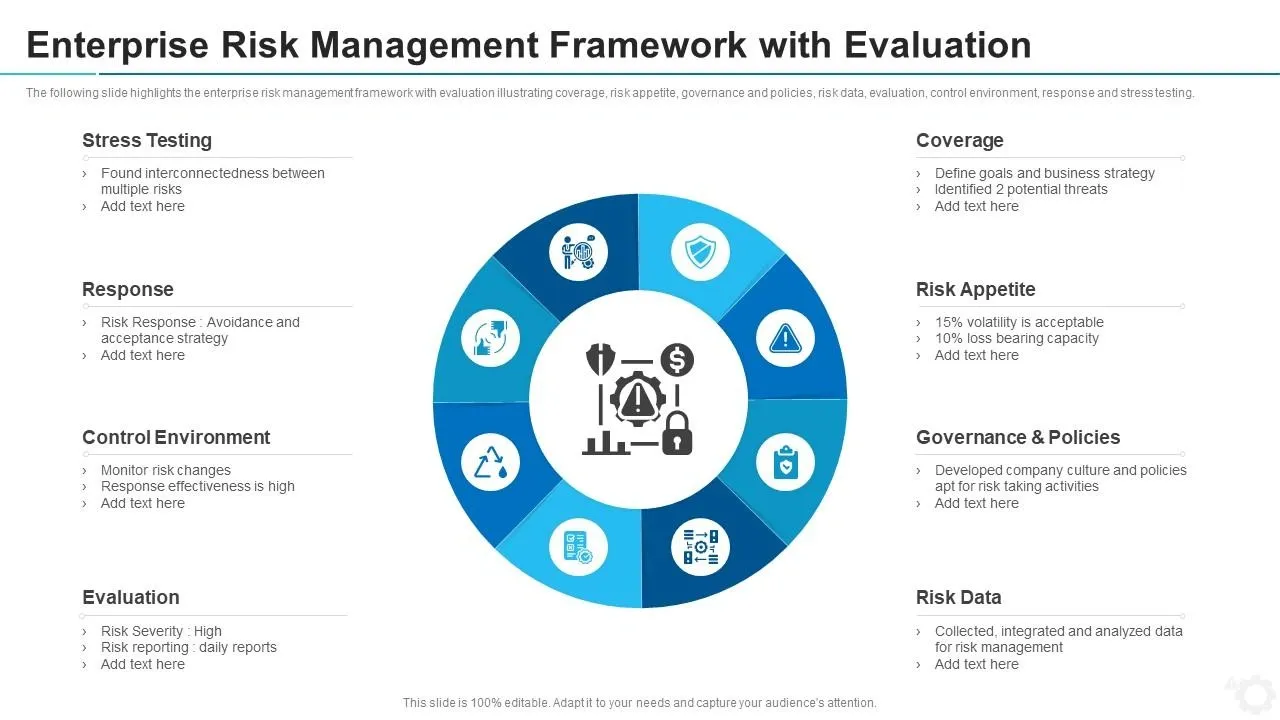
Image Source: SlideTeam
“By far, the greatest danger of Artificial Intelligence is that people conclude too early that they understand it.” — Eliezer Yudkowsky, AI Safety Researcher, Machine Intelligence Research Institute
Organizations that use AI need to know what makes these systems risky. A well-laid-out risk assessment helps teams spot and fix potential problems before they cause damage.
Definition and Purpose of AI Risk Assessment
AI risk assessment helps teams spot, review, and alleviate potential risks in artificial intelligence technologies. The concept boils down to a simple formula: risk = (likelihood of an AI model error or exploit) x (its potential effect). This helps teams calculate both how likely problems are and how bad things could get if they happen.
The National Institute of Standards and Technology (NIST) adds more detail to this idea. They describe AI risk as “the composite measure of an event’s probability of occurring and the magnitude or degree of the corresponding event. The impacts, or consequences, of AI systems can be positive, negative, or both and can result in opportunities or threats”.
AI risk assessment does more than just find problems. It serves three key functions:
- Preventing harm to users and stakeholders by minimizing the likelihood of model errors
- Ensuring compliance with evolving regulatory requirements
- Enhancing trust by showing steadfast dedication to responsible AI use
Risk management that works also helps teams discover the full potential of AI systems. Teams that tackle and document risks early create AI systems people can trust, balancing breakthroughs with responsibility.
Difference Between AI Risk Assessment and AI Governance
AI risk assessment and AI governance play different roles in an organization’s AI strategy. AI governance creates the big-picture frameworks, rules, and standards that guide AI research, development, and use. It writes the rulebook for responsible AI use with detailed policies and structures.
AI risk assessment acts as the hands-on defense within the broader governance plan. Think of governance as your steering wheel and risk management as your brake pedal—it keeps your business safe when surprises pop up.
Risk assessment zeros in on finding and fixing issues like:
- Data bias leading to unfair outcomes
- Model performance degradation
- Security vulnerabilities
- Privacy breaches
- Transparency issues
These pieces work together through collaborative effort. AI governance builds the foundation that makes risk management work through clear accountability, defined policies, ethical AI use guidelines, regulatory alignment, and continuous monitoring. Missing either piece leaves organizations open to regulatory fines and reputation damage.
When to Use an AI Risk Assessment Template
Teams should check AI risks at several points in a system’s lifecycle. The first review should happen before buying or building anything. Regular checks should continue as long as the system runs.
How often you check depends on several things:
- The system’s risk level to the organization and individuals
- How the organization employs the system
- Changes in technology and regulatory environments
Risk-averse organizations might check more often to stay safe. Teams should also review risks when big changes happen—like using the system differently or adding new data sources.
A standard risk assessment template gives teams four key benefits: consistent reviews they can repeat, audit-ready risk documentation, better teamwork between security and data science groups, and easier compliance across different regions. Simple checklists and random security reviews don’t deal very well with AI systems because of their unique challenges—hard-to-explain decisions, changing models, and new ways things can go wrong.
A structured assessment framework helps organizations move from putting out fires to following a process they can measure, audit, and use for regulations. This systematic approach helps teams get the most from AI while keeping risks in check.
Types of AI Risks and Their Real-World Impact
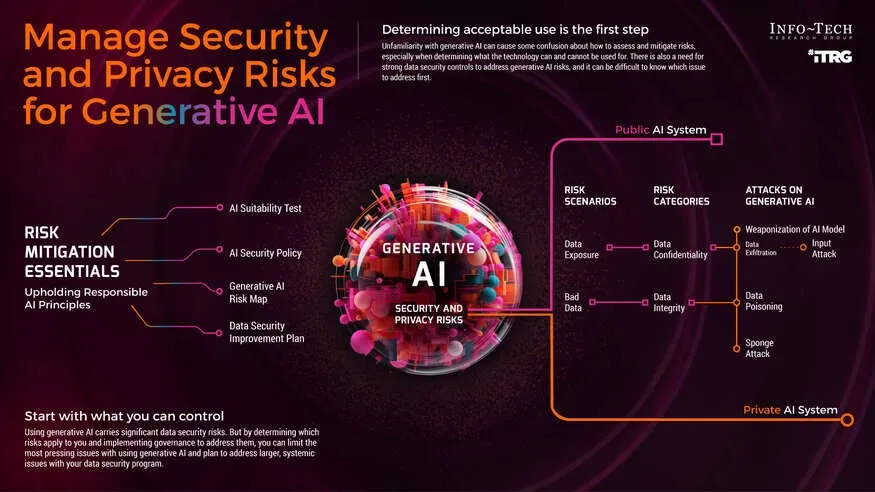
Image Source: Info-Tech
AI implementation comes with risks that affect users, organizations, and society. A well-laid-out risk assessment helps spot problems before they cause damage.
Data Privacy and Security Risks
AI systems handle massive amounts of personal data, which creates major privacy issues. Yes, it is challenging to control these risks. This challenge itself becomes risky as advanced models like GPT-4o evolve faster. AI data privacy risks come from data collection problems and security gaps.
Organizations gather sensitive information without clear permission. Training data contains terabytes of personal details from social media, healthcare records, and financial information. This creates two risks—collecting data without people’s knowledge and using it beyond what was originally allowed.
AI systems face unique security problems. Cybercriminals use AI to launch sophisticated attacks. They create automated phishing campaigns with convincing malicious content. The biggest problem is that only 24% of generative AI projects have proper security. This exposes data and models to breaches that cost $4.88 million on average.
On top of that, new attack methods have emerged:
- Machine learning poisoning (contaminating training data with misleading information)
- Evasion techniques (malware that changes behavior to avoid detection)
- Autonomous attack bots (operating continuously without human intervention)
Model Bias and Explainability Challenges
AI models reflect and increase existing social biases. These systems learn biases from training data and create skewed results that hurt marginalized communities. Here are some examples:
- Healthcare diagnostic systems work less accurately for historically underserved populations
- Applicant tracking systems discriminate based on gender
- Predictive policing tools target systemically marginalized communities more often
A pulse oximeter showed higher blood oxygen levels in patients with darker skin. This led to insufficient treatment of hypoxia. Facial recognition systems make more mistakes with darker-skinned people, especially darker-skinned females.
The “black box” problem creates another challenge—experts cannot easily understand many ML systems’ models. This lack of clarity causes legal, ethical, and operational issues because models cannot undergo verification before deployment. Explainability remains a critical challenge as AI systems make more life-changing decisions.
Regulatory Compliance Risks in AI Systems
Rules about AI risks are changing faster. The EU’s AI Act takes an all-encompassing approach. It groups AI systems by risk level and sets corresponding requirements.
High-risk AI applications in critical infrastructure, education, employment, and law enforcement must meet strict requirements:
- Good risk assessment systems
- High-quality datasets that minimize discrimination
- Detailed documentation
- Human oversight measures
Breaking these rules leads to harsh penalties. Organizations that don’t document risk assessments could pay fines up to 7% of their global turnover. The responsibility extends beyond developers to organizations using AI technologies.
Generative AI Risk Assessment Scenarios
Generative AI creates unique risk scenarios that need special assessment. Organizations should identify different user roles, assess intended purposes, and build resilient access controls.
GenAI risks include:
- AI hallucinations (inaccurate yet plausible outputs causing harm)
- Prompt injection attacks (inputs designed to make models behave unexpectedly)
- Data poisoning (tampering with training data to produce undesirable outcomes)
- Content manipulation (directly manipulating input data to compromise models)
Business processes using generative AI face serious problems from unsafe or biased outputs. To cite an instance, see how AI-generated robocalls copied President Biden’s voice to discourage American voters from voting. Deepfake technology lets people create fake content that damages reputations or enables extortion.
These varied risks require organizations to build specific risk scenarios. They should combine data, user, and purpose elements—then measure them based on likelihood and potential effects.
AI Risk Assessment Frameworks and Standards
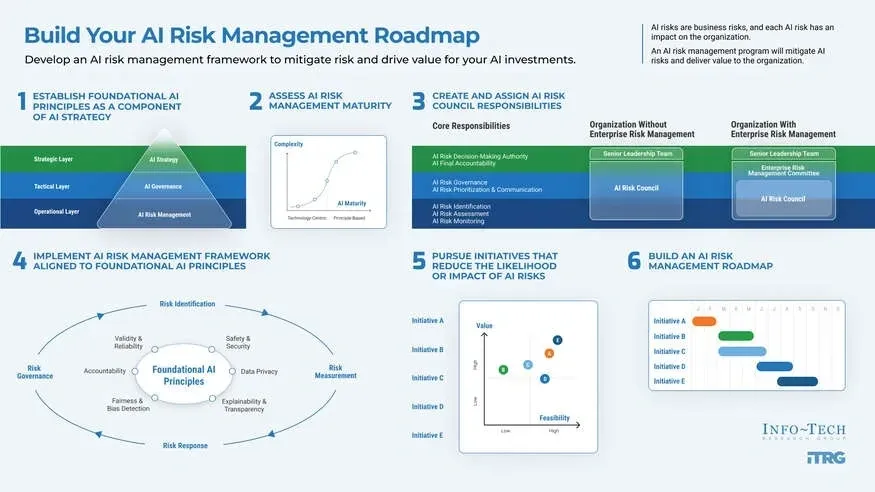
Image Source: Elevate Consult
Organizations can use several reliable frameworks to deal with AI risks in different contexts and regions. These frameworks give standard ways to spot, measure, and reduce possible harm from AI systems.
NIST AI Risk Management Framework (AI RMF)
The National Institute of Standards and Technology (NIST) launched its AI Risk Management Framework in January 2023. The framework came after an 18-month development process where they worked with more than 240 organizations. This optional framework helps make AI systems more trustworthy through detailed risk management.
The NIST AI RMF has four connected functions at its heart:
- Govern: Creating organizational values, policies, processes, and procedures that build trust in AI systems
- Map: Finding and documenting AI system context and possible risks
- Measure: Looking at risks using numbers and descriptions to set priorities
- Manage: Using resources to tackle and track identified risks through prevention efforts
These parts work together throughout an AI system’s life, not as separate steps. The framework takes an integrated view that sees AI risks going beyond technical issues into social, legal, and ethical areas.
NIST AI RMF defines seven traits of trustworthy AI: valid and reliable, safe, secure and resilient, accountable and transparent, explainable and interpretable, privacy-enhanced, and fair with harmful biases managed. Companies can adjust the framework based on their needs, industry rules, and AI uses.
ISO/IEC 23894 Lifecycle Risk Controls
ISO/IEC 23894:2023 shows how to handle risks throughout the AI lifecycle. Released in February 2023, this standard builds on proven risk management principles from ISO 31000:2018 instead of creating new methods.
The standard has four main parts for effective AI risk management:
- Finding risks in data, algorithms, operations, and ethics
- Checking risks through numbers and descriptions
- Handling risks by changing, avoiding, sharing, or keeping them
- Watching and reviewing as AI systems change over time
ISO/IEC 23894 looks at risk across the entire AI lifecycle—from planning through retirement. This complete view helps companies spot and fix risks before they become real problems.
This standard is different because it focuses on fitting into existing risk management processes. It aims to blend AI risk controls into current governance structures instead of creating separate processes.
EU AI Act Risk Classification and Controls
The EU AI Act creates a detailed regulatory system by putting AI systems into four risk levels, each with its own rules and deadlines.
Unacceptable risk systems are banned because they threaten safety, livelihoods, and rights. The Act stops eight specific practices including harmful manipulation, exploitation of vulnerabilities, social scoring, and some biometric identification uses. These bans started in February 2025.
High-risk systems must meet strict rules before market entry:
- Good risk assessment and prevention systems
- Quality datasets that minimize discrimination
- Clear documentation and result tracking
- Proper human oversight
- Strong cybersecurity protection
This group includes AI used in critical infrastructure, education, employment, essential services, law enforcement, migration, and justice administration. Companies must comply by August 2026 and August 2027.
Limited risk systems need to be transparent so people know when they’re dealing with AI. This covers chatbots, deepfakes, and AI-generated content about public interest topics. These rules start in August 2026.
Minimal risk systems have no restrictions as they pose little threat. This includes AI in video games and spam filters.
These frameworks each bring something unique to AI risk assessment. NIST offers voluntary guidance, ISO focuses on lifecycle management, and the EU Act sets regulatory requirements with clear deadlines.
AI Risk Assessment Methodology and Tools
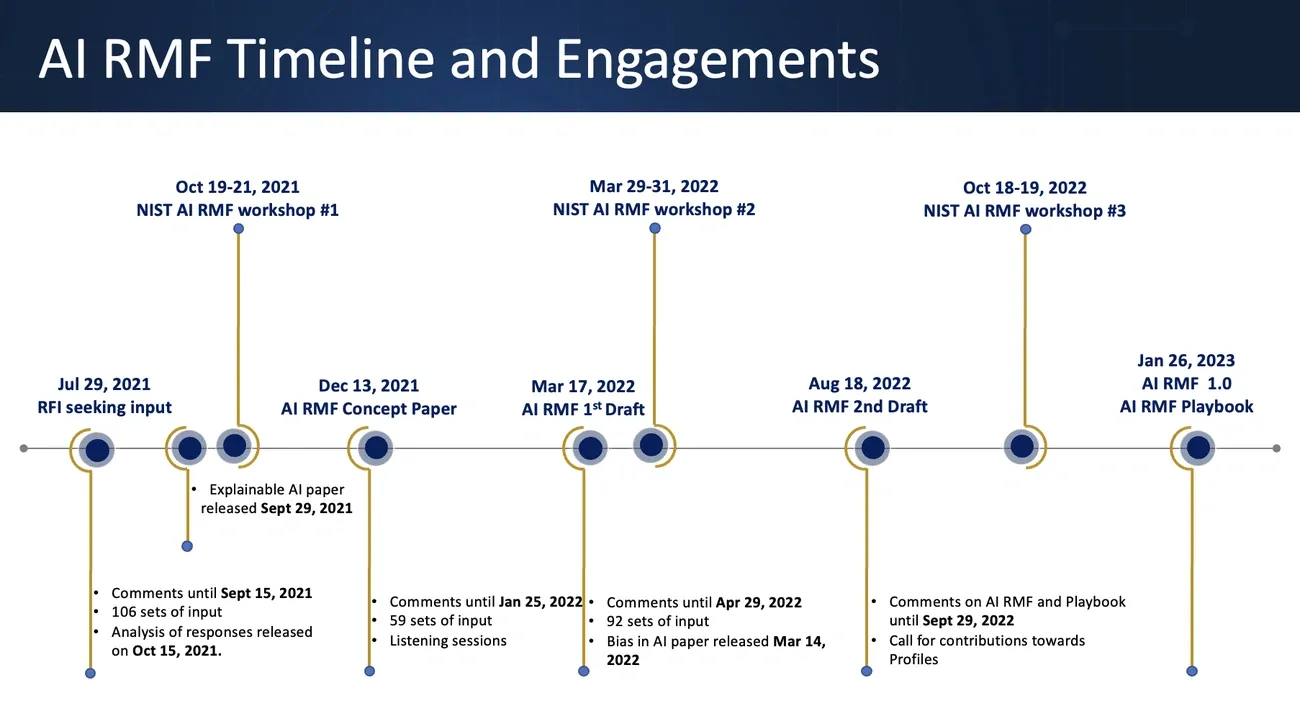
Image Source: National Institute of Standards and Technology
AI risk assessments need well-laid-out methods and the right tools to spot, measure, and alleviate potential harm. These assessments differ from regular IT checks because they must deal with unique challenges like model drift, data biases, and explainability problems.
Step-by-Step AI Risk Assessment Checklist
A detailed AI risk assessment works best when it follows frameworks like NIST’s “Map-Measure-Manage” cycle. Start by listing all your AI systems, including those that might be hiding in shadow IT setups. The next step involves mapping stakeholders and areas of effect. You’ll need to document everyone’s role in a RACI matrix to show how they work with the systems being reviewed.
Your third step should be a systematic threat catalog. Get teams together in focused workshops to review security, privacy, and operational risks. Then analyze how likely these risks are and their effects by plotting each threat on a risk matrix. This should use both qualitative insights and hard numbers. Next, review your risk tolerance and treatment choices by checking each risk against what your organization finds acceptable. Set up ongoing checks using Key Risk Indicators that tell you when it’s time to look things over again.
It’s worth mentioning that teams should really study NIST AI RMF documentation to learn everything about core principles before they start. This turns risk management from occasional checks into an ongoing practice that keeps up with new regulations.
Qualitative vs Quantitative Risk Scoring Methods
Risk assessment methods come in two main types that work together. Teams use qualitative assessments with number ratings (1-5) or colors (green, yellow, red) to rank risks based on how likely they are and their impact. These quick assessments help newer organizations learn about possible effects on their teams and service levels. The biggest problem is they depend too much on who’s doing the assessment.
Quantitative assessments give you hard facts and numbers you can repeat, usually in dollar amounts. They work out actual values like Annualized Loss Expectancy (ALE = Single Loss Expectancy × Annualized Rate of Occurrence). These take longer but give you useful results to help decide where to focus your risk prevention efforts.
Most organizations get the best results by using both approaches. They start with qualitative checks to spot issues quickly, then use number-based analysis for their biggest risks.
Using AI Risk Assessment Tools for Automation
Smart risk assessment tools optimize key processes substantially. They handle risk identification, control scoring, and monitoring automatically. This helps teams learn about risks without doing all the work by hand. The best platforms can automate workflows, process real-time data, quantify risks using FAIR models, create reports, and predict trends.
Tools like Radar AI Risk show how this works by building governance into every part of the AI lifecycle instead of adding it later. These systems match AI applications to specific regulations, create audit documents instantly, and let you watch everything through custom dashboards. AI speeds up the assessment process, but you still need human experts to check that everything makes sense for your organization.
Assigning Risk Ownership and Governance Structures
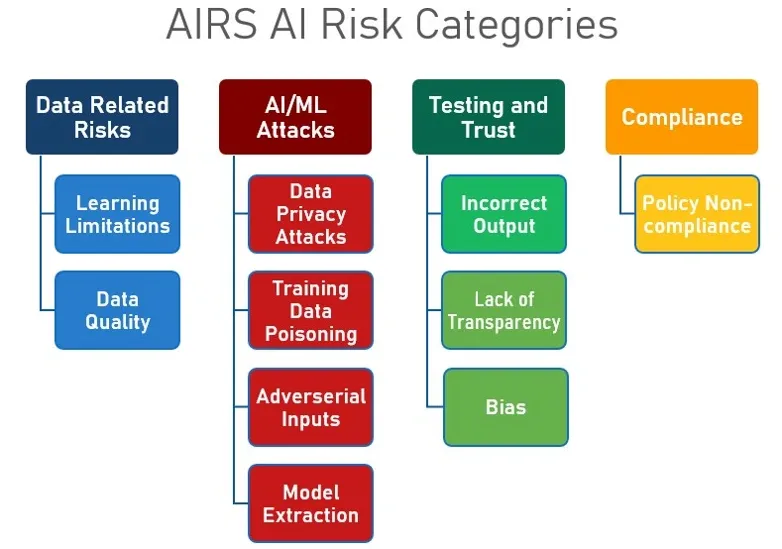
Image Source: Wharton Human-AI Research – University of Pennsylvania
Organizations need clear ownership of risk management responsibilities to make AI implementation work. A KPMG survey reveals divided opinions on AI risk ownership, with 24% of organizations giving the main responsibility to either the CEO or CISO.
Defining Risk Owners Across AI Lifecycle
AI governance needs specific roles with clear responsibilities. The core team typically includes:
- Ethics Review Board – This board assesses high-risk AI projects against company’s ethical principles
- Center of Excellence (CoE) – The center creates and shares best practices while staying connected with industry
- Data Science Teams – These teams control AI system inventory and versions
- ML Operations – The ops team provides data analysis and maintains training datasets
These teams must collaborate throughout the AI lifecycle from design to deployment and monitoring.
Integrating AI Risk into Enterprise GRC Programs
Risk experts warn against creating separate frameworks to manage AI risk. Organizations should expand their current enterprise risk, compliance, and audit programs. This helps address AI challenges like model drift, algorithmic bias, and explainability gaps.
The integration creates consistency across risk areas and eliminates duplicate processes. Dr. Ariane Chapelle puts it simply: “Try very hard to have the same framework for all your risks”.
Third-Party AI Risk Ownership and SLAs
Traditional vendor management doesn’t deal very well with the unique challenges of third-party AI usage. Companies must update their vendor contracts. These updates should require vendors to disclose when they use AI in service delivery and establish clear data usage policies.
Service Level Agreements (SLAs) must specify requirements for AI model testing transparency, result explanation, and intellectual property rights. Companies should improve their third-party risk-tiering frameworks based on AI use cases. This helps prioritize due diligence based on AI type and data sensitivity.
Remediation Planning and Continuous Risk Monitoring
“We really need a system that continuously analyzes behavior, automatically applies adaptive risk scoring and enforcement and protects data throughout its entire life cycle – from discovery and classification to lineage and governance, all the way through to detection and remediation.” — Palavalli, Data Security Expert at Forcepoint
The next significant phase starts after identifying AI risks. Teams need trustworthy AI systems throughout their lifecycle. This happens through proactive planning and resilient monitoring.
Remediation Strategies for High-Risk AI Models
Organizations must apply targeted mitigation strategies after risk prioritization. Teams should think over both incident likelihood and alternative solution costs. Successful remediation needs standard practices and consistent model documentation as its foundation. Development teams will reduce risks by following approved processes.
Organizations need internal and external audit procedures. External evaluations help show compliance with regulations and standards. Teams working with high-risk AI applications should focus on guardrails and rollback mechanisms. These allow quick responses when models show problematic behaviors.
Monitoring AI Risk Drift Over Time
Model drift is an expected operational risk as AI performance degrades with changing conditions. Early detection needs resilient monitoring systems to track up-to-the-minute metrics.
Statistical divergence measures can spot distribution changes between live inputs and training baselines before visible accuracy drops. Teams can step in quickly with this early warning system to prevent small issues from growing. Quality assessment continues as organizations compare predictions with ground truth labels.
Feedback Loops for Risk Reassessment
Impact assessments must give useful recommendations. Researchers can audit systems and test policies under controlled conditions through field experiments. These need public consent and careful oversight.
Monitoring results should feed controlled retraining pipelines. Models stay more stable with incremental updates rather than periodic bulk retraining. The whole process needs transparency. Teams should log model’s inputs, outputs, and features to boost traceability and support future improvements.
Conclusion
AI risk assessment plays a vital role in today’s tech-driven business world. Organizations using AI systems face complex challenges in security, ethics, and compliance. The numbers paint a clear picture – 68% of organizations have experienced data leaks from AI tools, while only 23% have formal security policies. These statistics show why structured risk assessment matters now more than ever.
Organizations must tackle AI risks on multiple fronts, from data privacy and security threats to bias and regulatory compliance. A well-laid-out framework like NIST’s AI Risk Management Framework, ISO/IEC 23894, or EU AI Act requirements helps identify and reduce these risks.
The risk management process transforms from reactive firefighting into a proactive, continuous system through our step-by-step method. Organizations should set up ongoing monitoring systems that track model drift and performance issues early. This approach needs clear ownership throughout the AI lifecycle. Ethics boards, data science teams, and operations staff must have specific roles and responsibilities.
Organizations can adapt their existing governance frameworks to handle AI-specific challenges without creating duplicate processes. Special attention should go to third-party AI through better vendor management and detailed service agreements that set clear transparency requirements.
The path to successful AI implementation requires a balance between state-of-the-art technology and responsible risk management. While this task might seem daunting at first, organizations that tackle AI risks systematically gain an edge through more trustworthy, compliant systems. Book a Readiness Call to evaluate your organization’s capabilities and create a custom implementation plan.
AI’s future depends on more than just technical progress. We need to anticipate, measure, and reduce potential harm. Well-managed AI risks become opportunities to build resilient systems that create value while protecting stakeholders throughout their lifecycle.
Key Takeaways
AI risk assessment has evolved from optional best practice to business-critical necessity, with organizations facing significant regulatory and operational consequences for inadequate risk management.
• Implement structured frameworks early: Use NIST AI RMF or ISO/IEC 23894 standards to systematically identify, measure, and manage AI risks across your entire system lifecycle.
• Assign clear risk ownership: Designate specific roles like Ethics Review Boards and ML Operations teams to ensure accountability throughout the AI development and deployment process.
• Monitor continuously for model drift: Establish real-time monitoring systems that detect performance degradation and bias shifts before they cause operational or compliance issues.
• Integrate AI risks into existing governance: Extend current enterprise risk management programs rather than creating separate frameworks to avoid redundancy and ensure consistency.
• Plan proactive remediation strategies: Develop rollback mechanisms and guardrails for high-risk AI models, enabling quick responses when systems exhibit problematic behaviors.
Organizations that fail to document AI risk assessments face regulatory fines up to 7% of global turnover under frameworks like the EU AI Act. However, those implementing comprehensive risk management gain competitive advantages through more trustworthy, compliant AI systems that balance innovation with responsibility.
FAQs
Q1. What are the key steps in conducting an AI risk assessment? An effective AI risk assessment typically involves identifying AI systems, mapping stakeholders, cataloging potential threats, analyzing risk likelihood and impact, evaluating risk tolerance, and implementing ongoing monitoring through Key Risk Indicators.
Q2. How do organizations assign ownership for AI risk management? Organizations often distribute AI risk ownership across multiple roles, including an Ethics Review Board, Center of Excellence, Data Science Teams, and ML Operations. Clear responsibilities should be defined for each role throughout the AI lifecycle.
Q3. What are the main categories of AI risks that organizations need to address? The primary categories of AI risks include data privacy and security vulnerabilities, model bias and explainability challenges, regulatory compliance issues, and risks specific to generative AI such as hallucinations and prompt injection attacks.
Q4. How can companies integrate AI risk management into existing governance structures? Rather than creating separate frameworks, organizations should extend their current enterprise risk, compliance, and audit programs to address AI-specific challenges. This ensures consistency across risk domains while avoiding redundant processes.
Q5. What strategies are effective for monitoring and mitigating AI risks over time? Effective strategies include implementing robust monitoring systems to track model drift, establishing feedback loops for risk reassessment, conducting regular audits, and developing proactive remediation plans with guardrails and rollback mechanisms for high-risk AI models.