
Companies that welcome AI tend to perform better than their competitors without an AI strategy in 2024. The benefits are clear, yet setting up a working AI governance framework creates major financial hurdles for many organizations.
AI initiatives yield an average return of 3.5X, and 5% of companies see returns up to 8X. The costs of custom AI development vary widely from $20,000 to over $500,000. Projects often run over budget, with 60% of AI initiatives costing 30-50% more than planned. Building your own governance solution needs millions of dollars and dedicated teams working for long periods. Money tells just part of the story – internal development takes up valuable time and management attention that could serve core business goals better.
This piece breaks down everything about budgeting and timing for your AI governance framework rollout. You’ll learn about the changing digital world of AI governance and pick the right framework template. We’ll detail the infrastructure costs, show realistic timelines, and guide you through maintaining your governance program. Trust matters more than ever – 71% of CEOs say it affects their organization’s success by a lot. That’s why proper AI governance has become essential today.
What’s Different About AI Governance Rollouts in 2026
The AI governance landscape has changed dramatically since the early 2020s. AI governance frameworks have evolved from theory to crucial operational components in 2026, and they look quite different from their original versions.
What’s Different About AI Governance Rollouts in 2026
Shift from model building to orchestration layers
AI governance in 2026 puts orchestration first, rather than focusing on individual model governance. Companies started by managing specific models, but now they must handle complex AI systems where multiple models work together. This means governance frameworks must oversee entire AI orchestration layers.
Teams must monitor more than just model outputs – they need to track how models interact, how data flows, and what decision paths look like. Modern enterprise AI governance frameworks now have specific controls to watch how models work together in larger systems. This marks a fundamental change from managing single AI components to overseeing complete AI ecosystems.
On top of that, it’s clear that governance must go beyond technical aspects. The quickest way to handle orchestration involves matching AI systems with business goals and tracking their evolution over time.
Rise of agentic AI and its governance implications
Agentic AI systems, which can make decisions and act with minimal human oversight, present one of 2026’s biggest governance challenges. These systems don’t work well with traditional frameworks and need specialized approaches.
Agentic AI governance is complex for several reasons:
- Decision autonomy: These systems make sequential decisions that we can’t easily predict or explain
- Goal-directed behavior: Agentic systems chase objectives almost independently
- Learning and adaptation: They keep evolving, sometimes in ways developers never predicted
Agentic AI brings new risks about unauthorized actions, decision drift, and goal misalignment. Then, model AI governance frameworks must have specific controls to watch agent behavior, set boundaries for autonomous decisions, and create emergency override options.
Companies rolling out AI governance frameworks must set clear rules about when humans need to step in. They also need detailed testing environments to check agentic systems before launch.
Increased regulatory pressure and audit readiness
Regulatory requirements are a big deal as they mean organizations can no longer develop AI governance frameworks without considering regulations. Major jurisdictions now have binding AI regulations with heavy penalties for those who don’t comply.
The EU AI Act became fully active in 2025. It groups AI systems by risk and sets strict governance rules for high-risk applications. The US has created specific regulations through agencies like the FDA, FTC, and NIST, which makes compliance more complex.
Being ready for audits has become crucial to AI governance framework implementation. Companies must keep detailed documentation, run regular internal audits, and prepare for regulatory inspections. This includes clear responsibility chains, documented decisions, and proof of compliance.
AI governance frameworks typically have regulatory compliance modules that link controls to specific requirements. Organizations can easily show compliance during audits and avoid managing multiple governance structures.
The focus on audit readiness has standardized AI governance documentation. The NIST AI governance framework and ISO 42001 lead the way, giving companies proven templates that meet regulatory requirements across different jurisdictions.
Choosing the Right AI Governance Framework Template
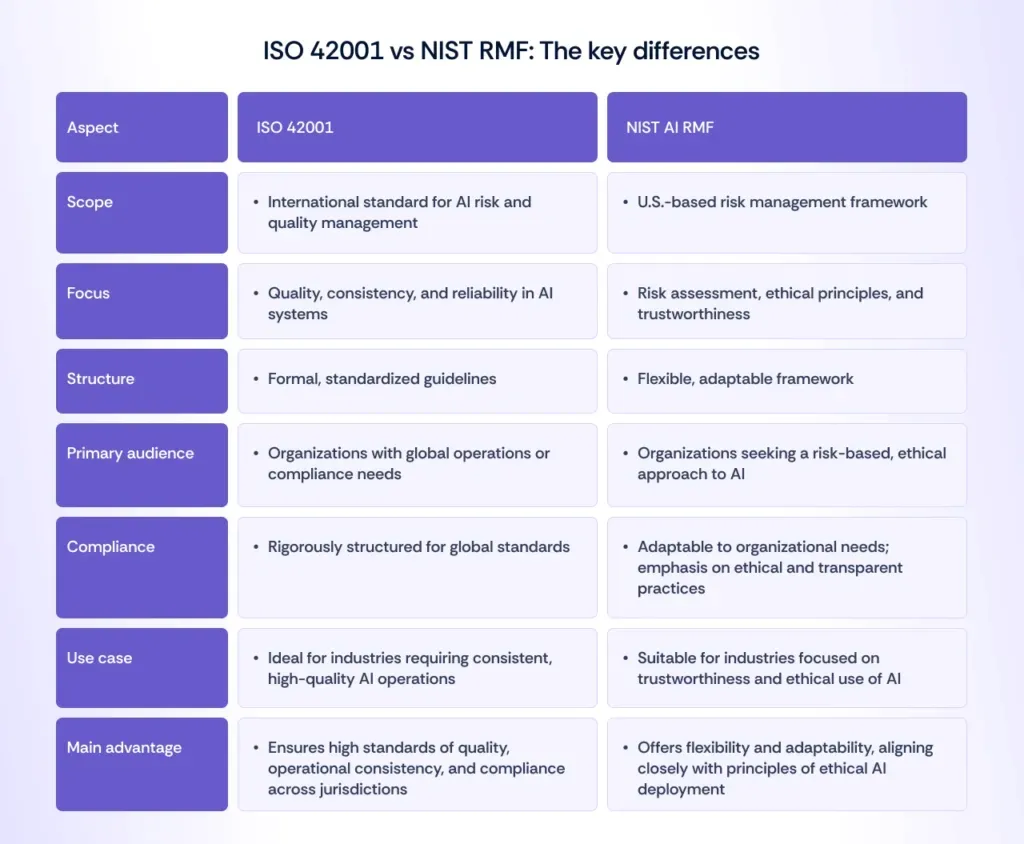
Image Source: Scrut.io
The year 2026 will see organizations choose AI governance frameworks as their building blocks. Several time-tested options exist, and companies must assess which template lines up with their needs and regulatory environment.
Comparing ISO 42001 vs NIST AI RMF
Two major frameworks have become reference standards in the AI world: ISO/IEC 42001 and the NIST AI Risk Management Framework (NIST AI RMF). These frameworks show key differences that shape implementation choices.
ISO/IEC 42001 comes from the International Organization for Standardization. It guides AI management systems and aims to ensure ethical, reliable, and clear AI technology development. The U.S. National Institute of Standards and Technology created NIST AI RMF. This framework takes a structured path to handle risks in AI systems throughout their lifecycle.
These frameworks differ in structure:
- ISO 42001: Built around 10 clauses and 4 annexes with 38 specific controls. These cover policies, organizational structure, resources, and AI system lifecycle.
- NIST AI RMF: Works through four core functions – Govern (setting policies and accountability), Map (finding context), Measure (analyzing risks), and Manage (putting mitigation strategies to work).
ISO 42001 stands out as a certifiable standard that needs external audits valid for three years and yearly checks. NIST AI RMF takes a different route with self-attestation and no formal certification, though companies can bring in third-party validators.
Customizing a model AI governance framework for your org
Your organization’s specific industry needs, context, and risk profile should guide framework customization. Start by getting a full picture of your AI systems and how they affect stakeholders, operations, and compliance needs.
Several factors should guide your choice. ISO 42001 works better for global operations and compliance, especially in strict industries like healthcare, finance, and automotive. NIST AI RMF might suit you better if you work mainly in U.S. markets or want more room for breakthroughs.
Your AI adoption stage matters too. Companies with mature AI systems often do better with ISO 42001’s solid structure. Those just starting find NIST AI RMF’s lighter approach easier to handle.
Resources play a big part in these decisions. ISO 42001 needs more time, money, and skilled staff compared to NIST AI RMF, which works with fewer resources.
Balancing flexibility with standardization
A good AI governance framework needs both strict controls and room to move. Clear but adaptable policies help achieve this balance. They set firm rules while letting teams choose how to follow them.
To cite an instance, keep strict rules (like regulatory compliance) separate from flexible details (like technology choices). This prevents bottlenecks without risking security. Teams can stay compliant while still pushing boundaries.
Automation helps reduce governance friction. Teams can use CI/CD tools to add validation checks in development pipelines. This enforces rules without slowing progress. Pre-commit hooks that scan code for unauthorized data sources can automate compliance without manual checks.
On top of that, it helps to build feedback loops and shared ownership. Cross-functional teams can help update standards based on ground use cases. Teams can try new ideas safely in sandbox environments with synthetic data, which cuts risks while supporting innovation.
Many organizations end up mixing both frameworks. This blend uses ISO 42001’s standardization and quality checks with NIST AI RMF’s flexibility and ethical focus to meet various operational and regulatory needs. Some companies start with NIST AI RMF for quick adoption and switch to ISO 42001 as their AI systems grow.
Budgeting for Governance Infrastructure and Tools
Image Source: Appinventiv
Setting up an effective AI governance framework needs major investment in specialized infrastructure and tools. Organizations must budget properly for these components as their AI initiatives grow bigger.
Cost of AI observability platforms and model registries
The cost of AI observability changes by a lot based on how big your deployment is and what your organization needs. Gartner research shows 36% of clients spend over $1 million each year on observability, while 4% put in more than $10 million. These costs have grown by an amazing 40% year after year in the last five years.
Most organizations put 15-25% of their infrastructure budget into observability tools. This money goes toward monitoring systems, finding anomalies, and tracking how AI systems perform. Analysts say you should aim for 10% if you have good discipline and support from executives.
Model registry costs are easier to plan for. Cloud providers often include registry services at little to no extra cost. To cite an instance, Vertex AI Model Registry doesn’t charge you just to store models – you only pay when you deploy models to endpoints or run batch predictions.
Embedding governance into MLOps pipelines
You need strategic investment and operational changes to add governance controls to your MLOps workflows. The financial impact goes beyond buying tools – better governance can actually help cut costs.
MLOps systems often lead to runaway expenses without proper cost control, especially in cloud environments that can scale up quickly. Companies now add FinOps principles to their MLOps pipelines. This helps create financial responsibility and improves how engineering and finance teams work together.
Smart ways to save money include setting up policies that automatically remove or archive old experiment results. This cuts storage costs while keeping important data for retraining and audits. Teams can also use custom tags for jobs or users to track GPU usage and manage internal budgets better.
Enterprise governance tools are worth the investment. They help prevent quality issues that cost companies about $12.9 million yearly. System downtime can cost $125,000 per hour. Therefore, money spent on governance infrastructure often pays off by reducing risks.
Data lineage and AI data governance framework tooling
Data lineage infrastructure forms the core of any complete AI governance framework. These tools track data movement from start to finish and record changes along the way.
Good data lineage tools should track changes at the column level and show exactly how fields change through complex transformations. Look for tools that work with open standards like OpenLineage to avoid getting locked into one vendor.
The best data lineage tools work well with bigger governance systems and let you manage tags and enforce policies. Platforms like DataHub give you strong access control through platform and metadata policies. Apache Atlas offers flexible metadata management that tracks data lineage.
Data lineage does more than just help with compliance. These tools help teams fix problems faster, make data governance stronger, and work with more confidence by showing clear paths through AI systems. Yes, it is true that organizations with strong AI and data governance perform 21-49% better than others. This improvement jumps to 54% when they also build a better data culture.
Timeline and Milestones for Full Rollout
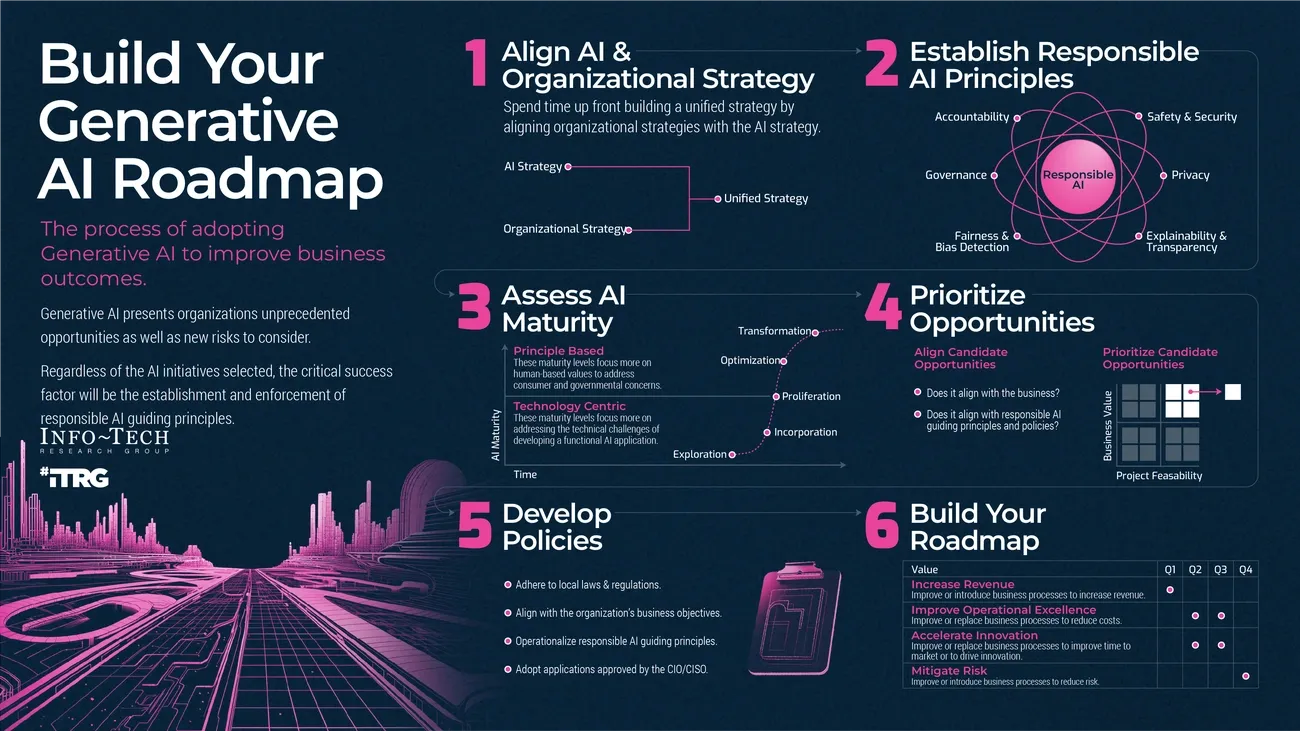
Image Source: Info-Tech
Organizations need a clear timeline with specific milestones to implement AI governance successfully. A well-laid-out enterprise AI governance framework needs careful progression through multiple phases. Each phase comes with its own goals and deliverables.
Readiness assessment and gap analysis (1–2 months)
The first step to effective AI governance starts with a detailed readiness assessment. This vital first step usually takes 4-8 weeks based on how big and complex your organization is. Companies must review their AI landscape and spot readiness gaps before they invest resources.
A standard assessment looks at:
- Current AI systems and deployment plans
- Industry-specific regulatory requirements
- Organizational governance expertise and resources
- Human expertise and decision-making capacity
Teams analyze gaps between current capabilities and requirements after collecting data. This creates a priority-based gap report that forms the foundations of your governance roadmap. This phase helps identify risks that need immediate attention versus items that need ongoing monitoring.
Studies show that by 2026, companies will abandon more than 30% of GenAI projects due to poor data quality and weak risk controls. This makes the assessment phase vital to long-term success. Your organization should look at five pillars: Strategy, Data, Infrastructure, Governance, and People. Wondering if your organization is ready for this assessment? Book a Readiness Call with experts who can guide you through the process.
Framework implementation and training (2–4 months)
The implementation phase typically takes 2-4 months after assessment. This phase follows a structured approach with key stages:
Weeks 5-8 focus on building the framework. Teams create governance policies, monitoring procedures, incident response protocols, and training programs. Your organization needs a cross-functional AI governance committee with members from Information Security, Legal, Technology, Data Privacy, and business units.
Weeks 9-12 involve testing the framework in a limited scope before full rollout. Teams set up monitoring procedures, conduct training programs, and check how well human oversight works.
Organizations seeking ISO 42001 certification should match their timeline with specific milestones. The AI Act requires providers of general-purpose AI models to meet governance rules by August 2, 2025. Organizations have until August 2, 2027, to make frontier models placed on the market before August 2025 compliant.
Monitoring, feedback, and iteration (ongoing)
The last phase sets up continuous monitoring systems to track governance metrics and effectiveness. AI governance needs constant visibility into AI activity as systems change, regulations evolve, and new threats emerge.
Good monitoring starts with centralizing AI access through a controlled layer. This layer blends with identity systems, manages permissions, and records all activity. Every AI interaction needs logging and storage based on compliance rules – from inputs and outputs to users and timestamps.
Data loss prevention tools help track information sent to AI services. These tools block sensitive content, enforce usage policies, and alert teams to violations without depending only on staff judgment. Regular reviews help as AI technologies and business environments keep changing.
The EU AI Act requires providers and deployers to make high-risk AI systems used by public authorities fully compliant by August 2, 2030. Organizations should set up governance metrics and regular audits to stay compliant as regulations mature.
A successful AI governance framework needs careful progression through these phases. Timelines might change based on organizational complexity and current governance maturity. Giving enough time to each phase helps ensure successful adoption and lasting AI governance.
Certification and Audit Preparation Costs
Getting ready for AI governance certification needs careful money management and technical preparation. Organizations need a clear path through the complex certification process. A good budget plan depends on knowing the costs and timelines.
ISO 42001 certification readiness planning
Organizations should get a full picture of their readiness before going for ISO 42001 certification. This helps spot gaps and set priorities for fixes. The assessment takes 4-8 weeks based on how complex the organization is. Teams need to set clear goals, pick which AI systems to certify, and look at all use cases from model creation to outside integrations.
Teams must match their controls with ISO 42001 rules. They need to check how well they handle AI ethics and risk management. A detailed plan helps fix any gaps found. The process moves faster when you book a Readiness Call with experts who know the requirements inside out.
Internal vs third-party audit cost comparison
Organizations can choose between checking things themselves or getting outside help. Internal checks take 1-2 weeks per cycle. This uses up analyst time and might miss important issues. The cheaper option often runs into problems. Teams struggle with 40-100+ items per framework and evidence scattered across many systems.
Third-party audits offer better ways to check AI system’s fairness, transparency, and reliability. Outside auditors look at key numbers like accuracy, precision, recall, and fairness to find possible bias. These audits cost more upfront but give better compliance reports. The reports show gaps, risks, and exact steps to fix problems.
Documentation and evidence collection timelines
Getting evidence ready takes the most time in audit prep. ISO 27001 and similar frameworks need proof from many tools, systems, and processes. Old manual collection took 1-2 weeks per audit. New AI-powered methods cut this down to 1-2 hours and give better quality data.
Good documentation needs detailed records of datasets, models, algorithms, and decisions. Teams should track everything through the AI system’s life. This makes audits easier to handle. Clear records of development, training data, testing results, and system checks help certification succeed.
The certification schedule must fit with legal deadlines. Current rules say organizations need yearly check-ups after first getting certified. A complete new certification happens every three years.
Sustaining and Scaling AI Governance Post-Rollout
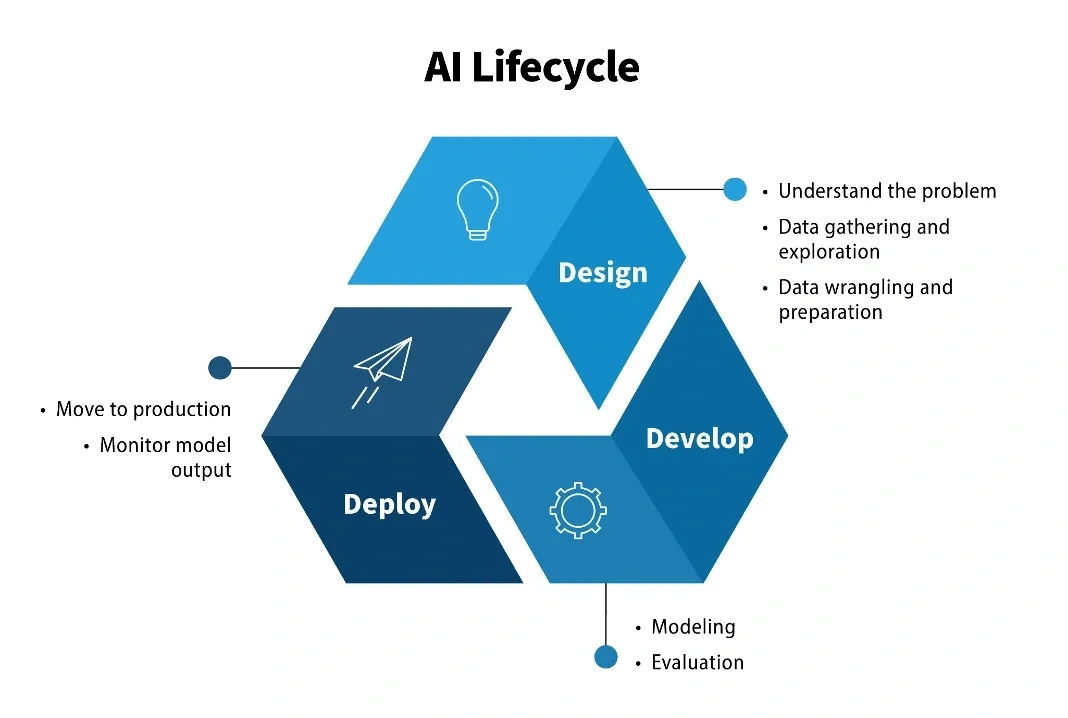
Image Source: IT Modernization Centers of Excellence – GSA
AI governance frameworks need constant attention even after the original deployment. A successful governance system grows from a control function into an enterprise capability that gets stronger over time.
Annual retraining and policy updates
Successful AI governance needs policy updates twice a year to keep up with tech advances and regulatory changes. Companies should set regular schedules. Quarterly governance reviews and continuous monitoring dashboards create structure and accountability. Small improvements made regularly work better than big occasional overhauls, especially as AI capabilities grow.
Governance metrics and performance tracking
Specific metrics in multiple areas help measure how well governance works. Key performance indicators should track bias and fairness scores, explainability rates, regulatory compliance, and AI system registration percentages. Companies must monitor policy violations, approval times, and post-deployment problems to gage governance effectiveness. System resilience becomes clear through incident detection time, resolution speed, and how often issues repeat.
Knowledge transfer and internal capability building
Building internal expertise is essential for lasting governance. Companies using scattered methods often waste money. Six separate training programs cost $180K, while centralized training with reusable tools costs just $45K. Knowledge management systems should record expertise methodically to stop teams from repeating failed experiments. GenAI tools have made knowledge transfer more efficient. These tools make company insights more available while protecting vital human expertise along with AI automation.
Conclusion
A complete AI governance framework represents one of the most important investments organizations need to make as they guide through the complex AI world of 2026. This piece shows how AI governance has changed from simple model management to sophisticated orchestration systems. These systems can handle agentic AI and meet stricter regulatory requirements. Your choice between ISO 42001 and NIST AI RMF frameworks should match your organization’s needs, risk profile, and operational context. Hybrid approaches often lead to the best results.
Smart financial planning for governance infrastructure drives success. Companies that invest in observability platforms, model registries, MLOps integration, and data lineage tools perform better than competitors by 21-49%. Organizations that follow well-laid-out implementation timelines do better too. They move through readiness assessment, framework implementation, and continuous monitoring with fewer disruptions and compliance issues.
Organizations unsure about their readiness should Book a Readiness Call with governance experts. These experts provide custom guidance through the assessment process. This proactive approach helps spot gaps before they get pricey.
Strong AI governance needs steadfast dedication beyond the original implementation. Regular policy updates, performance tracking with meaningful metrics, and internal capability building help your framework grow with AI technology and regulatory requirements. The upfront investment might seem big, but the long-term benefits are worth it. Better risk management, regulatory compliance, customer trust, and operational efficiency are nowhere near the costs.
AI capabilities keep advancing, and reliable governance frameworks will without doubt set apart industry leaders from those struggling with compliance and risk management. Your organization’s approach to AI governance today will shape your market position and reputation over the next several years.
Key Takeaways
Implementing an AI governance framework in 2026 requires strategic planning, significant investment, and ongoing commitment to succeed in an increasingly regulated environment.
• AI governance has evolved beyond individual models to orchestration systems – Focus on managing complex AI ecosystems and agentic systems rather than single model governance • Choose frameworks based on your regulatory needs – ISO 42001 offers global certification for regulated industries, while NIST AI RMF provides flexibility for innovation-focused organizations • Budget 15-25% of infrastructure costs for observability and governance tools – Organizations with mature governance frameworks outperform peers by 21-49% through improved risk management • Follow a structured 6-8 month implementation timeline – Start with readiness assessment (1-2 months), framework implementation (2-4 months), then continuous monitoring • Plan for ongoing costs beyond initial rollout – Annual policy updates, performance tracking, and internal capability building are essential for sustainable governance
The financial investment may seem substantial initially, but proper AI governance delivers measurable returns through reduced compliance risks, improved operational efficiency, and enhanced customer trust in an era where 71% of CEOs view trust as critical to organizational success.
FAQs
Q1. What is a typical timeline for implementing an AI governance framework? A full AI governance framework implementation typically takes 6-8 months. This includes 1-2 months for readiness assessment and gap analysis, 2-4 months for framework implementation and training, followed by ongoing monitoring and iteration.
Q2. How much should organizations budget for AI governance tools and infrastructure? Most organizations allocate approximately 15-25% of their infrastructure budget to AI governance tools, including observability platforms, model registries, and data lineage solutions. This investment often delivers substantial returns through improved risk management and operational efficiency.
Q3. What are the key differences between ISO 42001 and NIST AI RMF? ISO 42001 is a certifiable standard with external audits, suitable for highly regulated industries and global compliance. NIST AI RMF offers a more flexible, self-attestation approach, often preferred by organizations prioritizing innovation or focusing on U.S. markets.
Q4. How often should AI governance policies be updated? AI governance policies should be refreshed bi-annually to adapt to technological advancements and regulatory changes. Organizations should establish quarterly governance reviews alongside continuous monitoring to ensure policies remain current and effective.
Q5. What metrics should be tracked to measure AI governance effectiveness? Key metrics for AI governance include bias and fairness scores, explainability rates, regulatory compliance adherence, AI system registration percentages, policy violations, approval cycle times, and post-deployment issues. Incident detection time, resolution speed, and recurrence rates are also important indicators of governance effectiveness.